Your bedroom walls are the largest decorating surface you own — and in a small room, they’re practically the only one. Floor space is precious, so the smart move is to put your style, your storage, and your personality on the walls. Done right, wall decor makes a small bedroom feel bigger, not busier. Done wrong, it looks like a collage exploded.
Every idea below respects two constraints: small rooms and small budgets. Most cost under $50, several cost nothing, and all of them are renter-friendly or close to it. The goal isn’t to cover every inch — it’s to make the inches you cover count.
1. Build a Small, Deliberate Gallery Wall
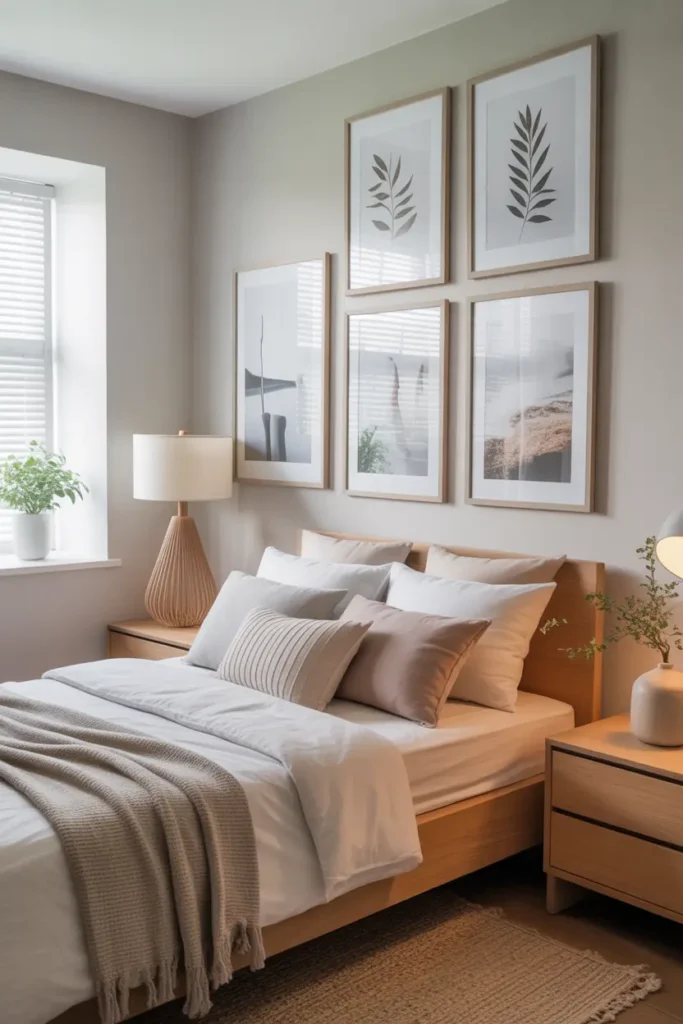
A gallery wall in a small bedroom should be edited, not expansive: three to five frames, arranged with intention, above the bed or desk. The mistake is treating it like a photo dump — twenty random frames on a small wall reads as clutter. Five well-chosen pieces with consistent spacing reads as a gallery.
The budget version is genuinely good: print art at home or at a library (many libraries print large format for a few dollars), use thrifted frames spray-painted one color for cohesion, and lay the arrangement on the floor first. Trace the layout on kraft paper, tape the paper to the wall, and nail through it — zero measuring anxiety, zero extra holes. Keep 2–3 inches between frames; consistent gaps are what make it look professional.
2. Fake a Headboard Wall With Peel-and-Stick Wallpaper
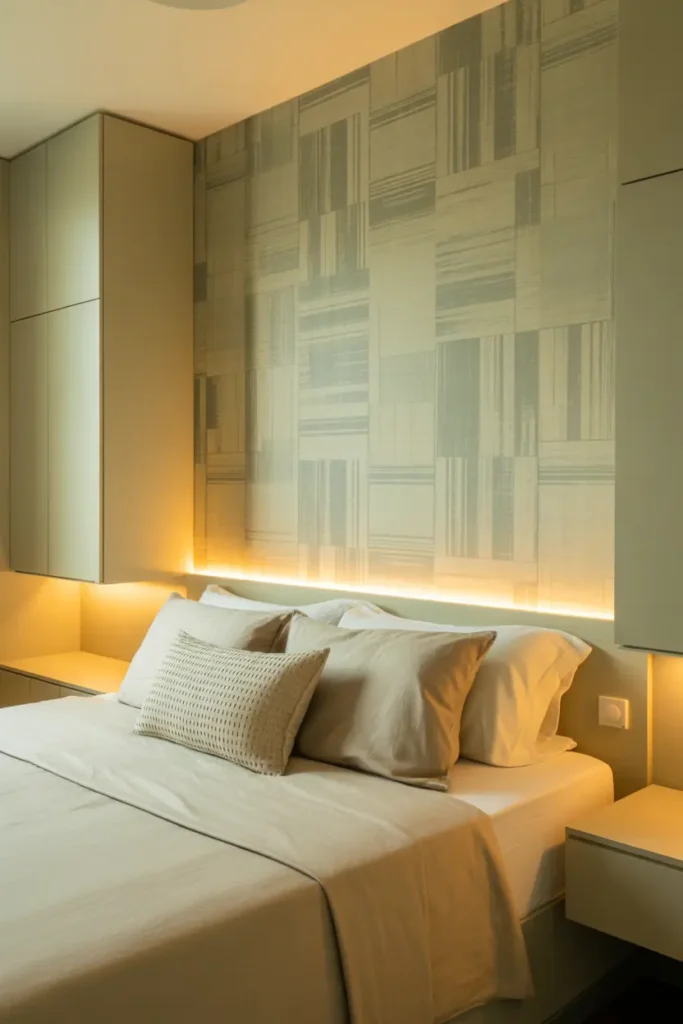
Peel-and-stick wallpaper is the renter’s superpower: a full statement wall for $40–$80, zero damage, removable in an afternoon. Behind the bed is the sweet spot — it creates a focal point that reads as a headboard wall even if your actual headboard is basic. The room instantly looks designed rather than default.
Choose wisely for small rooms: subtle textures (linen, grasscloth-look), soft geometrics, or tone-on-tone patterns. Loud large-scale prints can overwhelm a 10×12 room. And the application tip that matters: start from the top, use a felt squeegee, and work in 12-inch sections — peel-and-stick is repositionable, so there’s no reason to panic about bubbles. If a panel goes wrong, peel it off and redo it.
3. Add Floating Shelves for Storage That Decorates
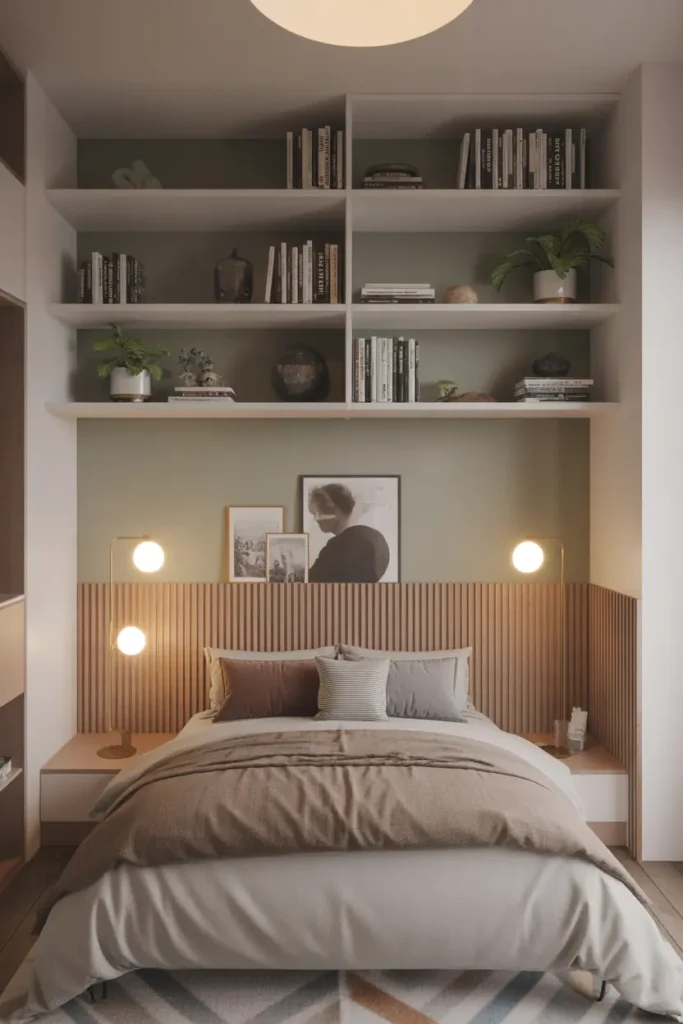
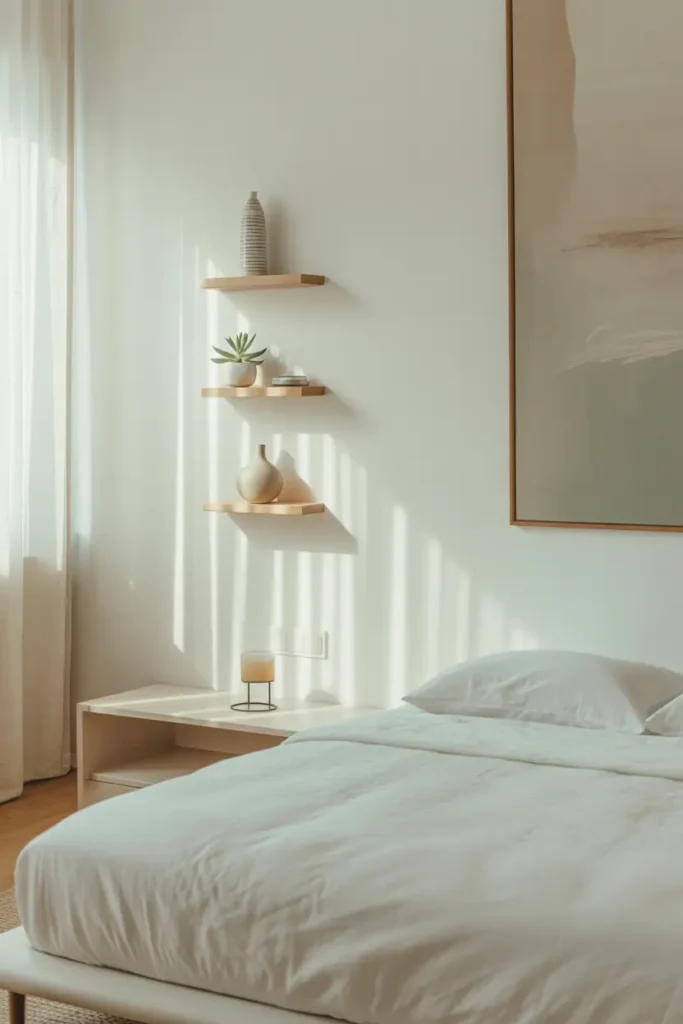
Floating shelves are the hardest-working wall decor in a small bedroom: they hold books, plants, and pretty things while taking zero floor space. One or two shelves above a desk or beside the bed replace a nightstand’s worth of surface and look infinitely better than a cluttered dresser top.
Install them properly — into studs, or with toggle bolts in drywall (a shelf that rips out of the wall is not decor, it’s a disaster). Style with the 70% rule: leave breathing room, group in odd numbers, mix heights. A stack of books, a small plant, a candle, one framed photo: that’s a complete shelf. Anything more is a storage unit, not decor.
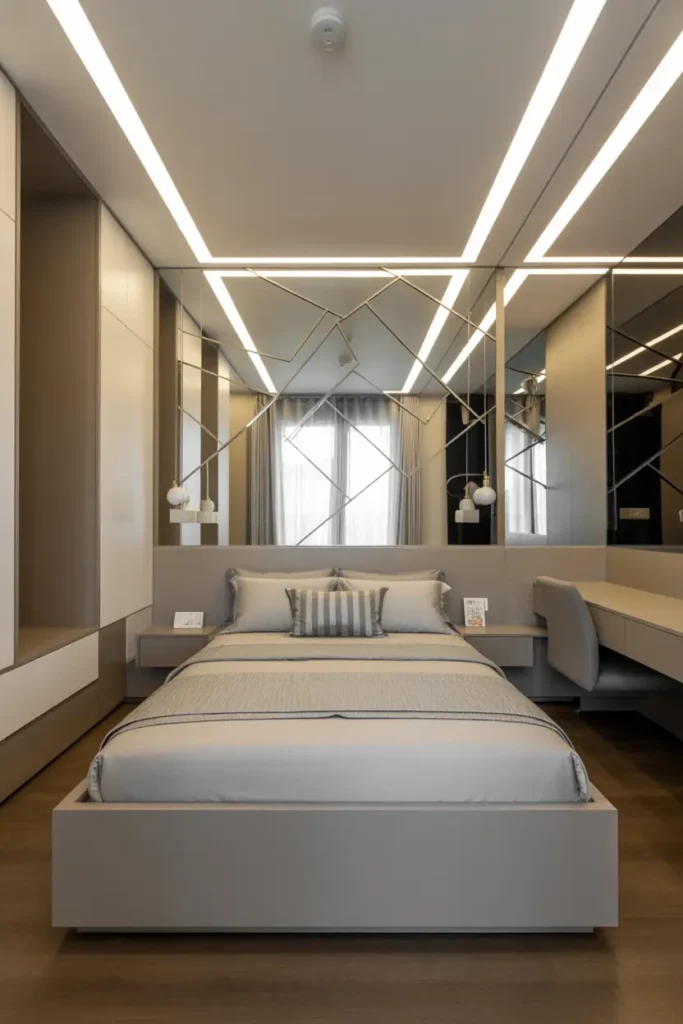
4. Hang a Large Mirror to Double the Room
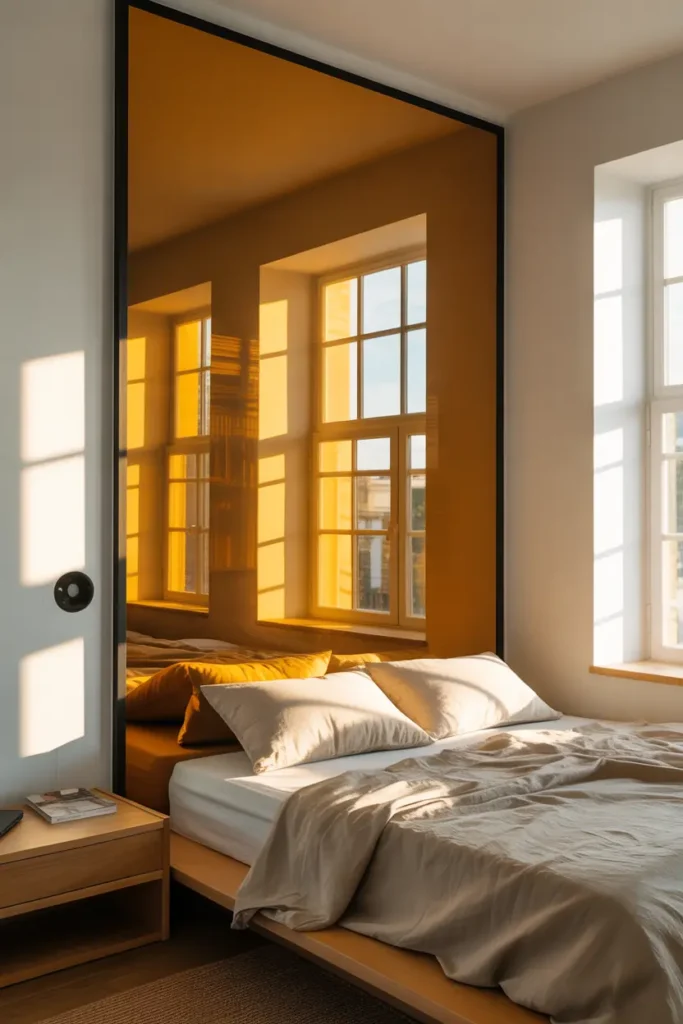
A large mirror is the oldest small-room trick because it works: it bounces light, creates the illusion of depth, and effectively doubles whatever it’s reflecting. In a small bedroom, one big mirror beats three small decorative ones — go as large as the wall allows, ideally opposite or adjacent to the window.
Lean a full-length mirror against the wall if you can’t hang it (renters, rejoice — no holes needed). A 60-inch leaner mirror costs $80–$150 and makes a 10-foot room feel like 14. Frame it to match your style — thin black for modern, wood for warm, arched for soft. And keep what it reflects tidy; a mirror doubles your mess too.
5. Mount Your Lighting on the Wall
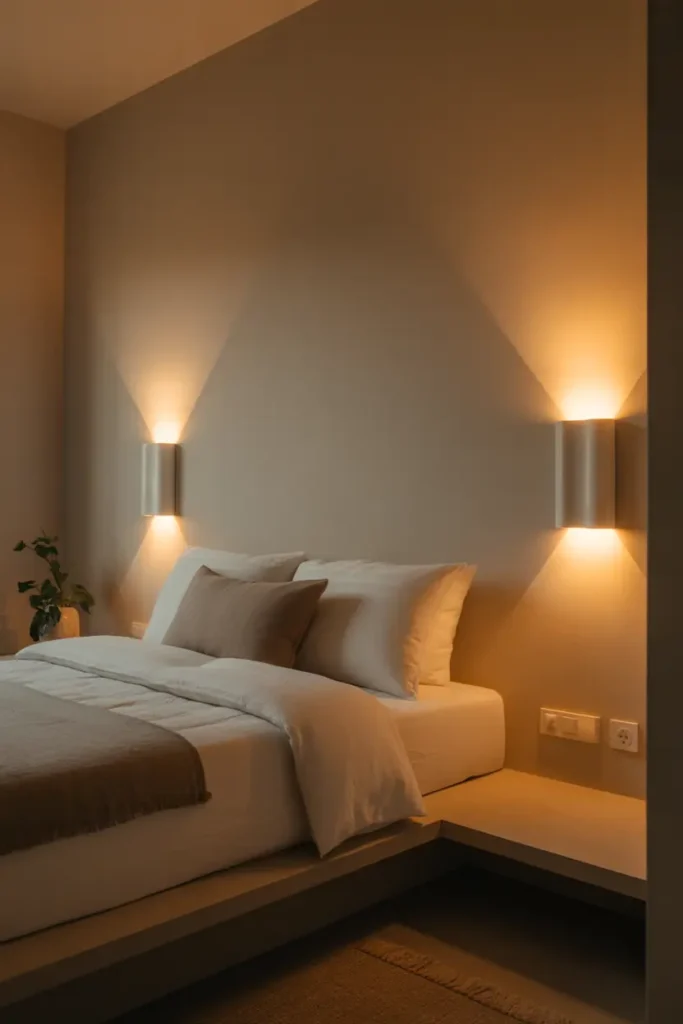
Table lamps eat nightstand space you don’t have. Wall-mounted sconces or plug-in swing-arm lights free up the entire bedside surface while adding a designed, intentional look. This is one of those changes that makes a small bedroom feel like a boutique hotel room.
Plug-in sconces are the renter-friendly hero — no hardwiring, just a cord cover painted to match the wall. Mount them 48–52 inches from the floor, roughly at shoulder height when you’re sitting up in bed reading. Pair with warm 2700K bulbs and you’ve upgraded both the lighting and the wall decor in one move, typically for $40–$80 per side.
6. Hang Something Soft: Fabric Wall Art
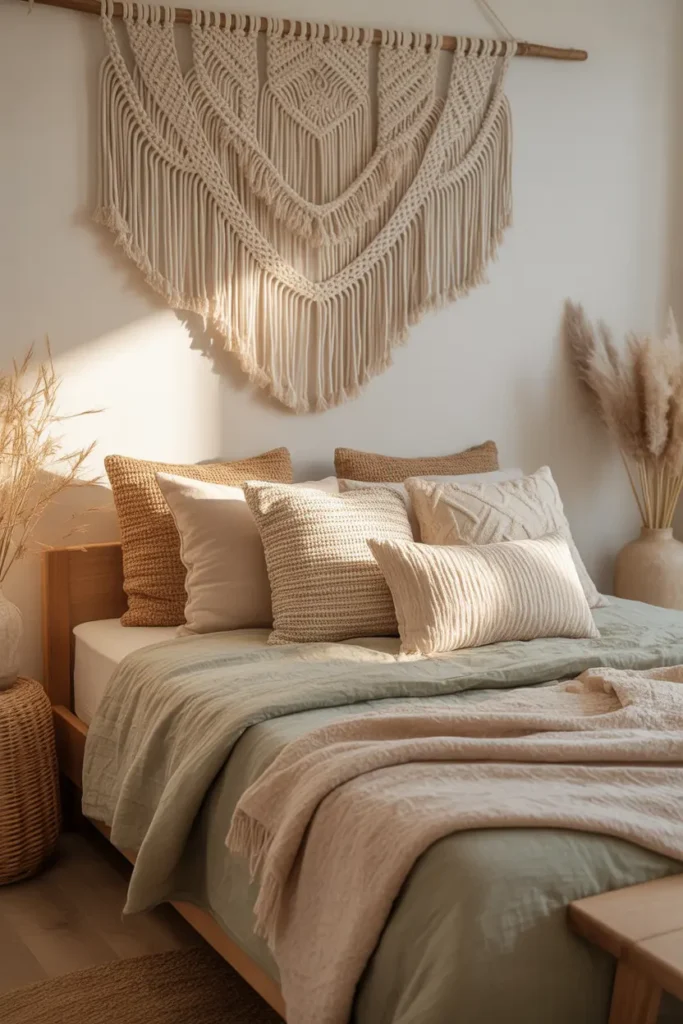
Bedrooms need softness, and fabric wall hangings deliver it in a way framed prints can’t. A macramé piece, a woven wall hanging, or even a beautiful textile (a vintage scarf, a block-printed cloth) adds texture, absorbs sound, and warms up the room — all while being completely renter-safe on a single hook.
Scale it right: the hanging should be roughly two-thirds the width of the furniture below it. A small macramé over a wide dresser looks lost; a large textile over a narrow nightstand overwhelms. And here’s a free version: drape a beautiful throw or quilt over a curtain rod mounted on the wall. Instant textile art, zero crafting required.
7. Draw the Eye Up With Vertical Lines
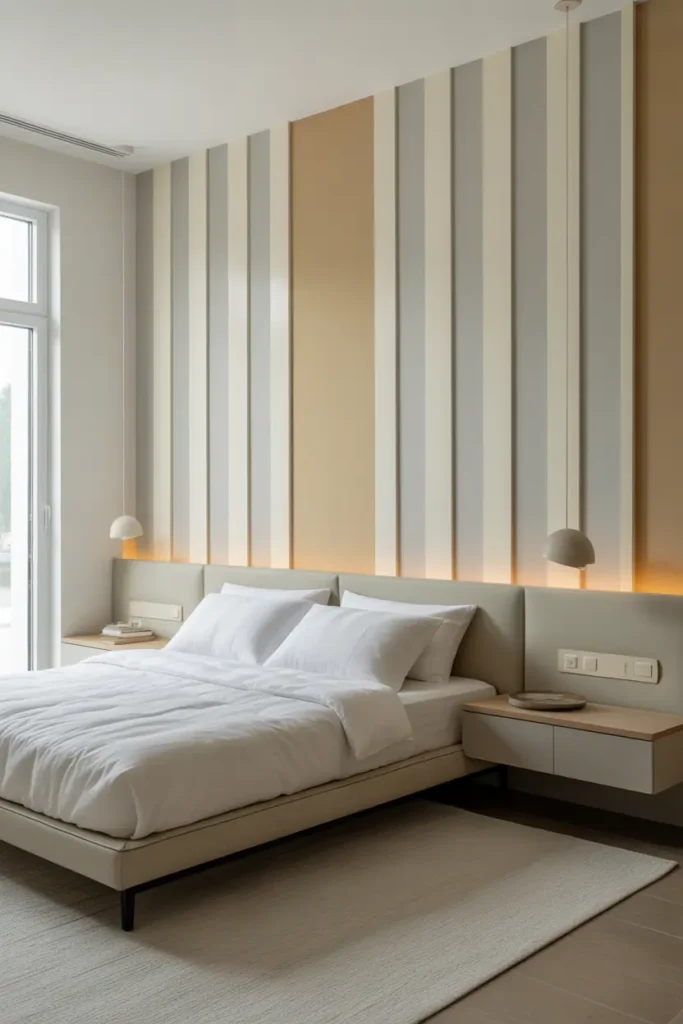
Low ceilings make small bedrooms feel cramped; vertical lines fix the perception. Painted vertical stripes, vertical shiplap, tall narrow art, or even floor-to-ceiling curtains all pull the eye upward and make the ceiling feel higher than it is. It’s a visual trick, but your brain doesn’t care — it works.
The cheapest version: painter’s tape and two paint colors. Vertical stripes in tone-on-tone colors (same color, one sheen flat and one eggshell) add texture and height without shouting. Keep stripes 6–12 inches wide — too narrow looks busy, too wide loses the effect. One striped wall is plenty; four is a circus tent.
8. Put Up Hooks That Look Good Empty
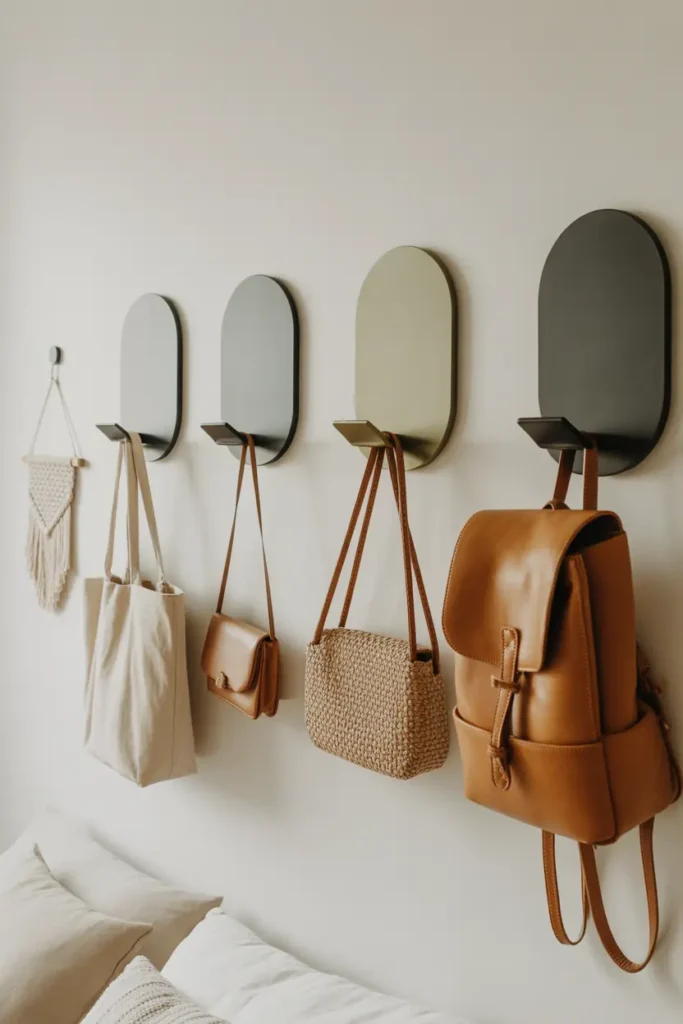
Wall hooks are the small-bedroom multitasker: they hold tomorrow’s outfit, your bag, a hat, a robe — and when styled well, they look like decor even when empty. A row of three beautiful hooks (brass, matte black, wooden pegs) on an otherwise bare wall is both sculpture and storage.
Mount a proper hook rail or individual statement hooks at about 60 inches high — reachable but out of the visual clutter zone. The key: hooks you love looking at. A $5 plastic hook holds a coat just as well as a $15 brass one, but only one of them improves the room when the coat isn’t there. In small rooms, everything visible is decor, whether you planned it or not.
9. String Up a Photo Display With Lights
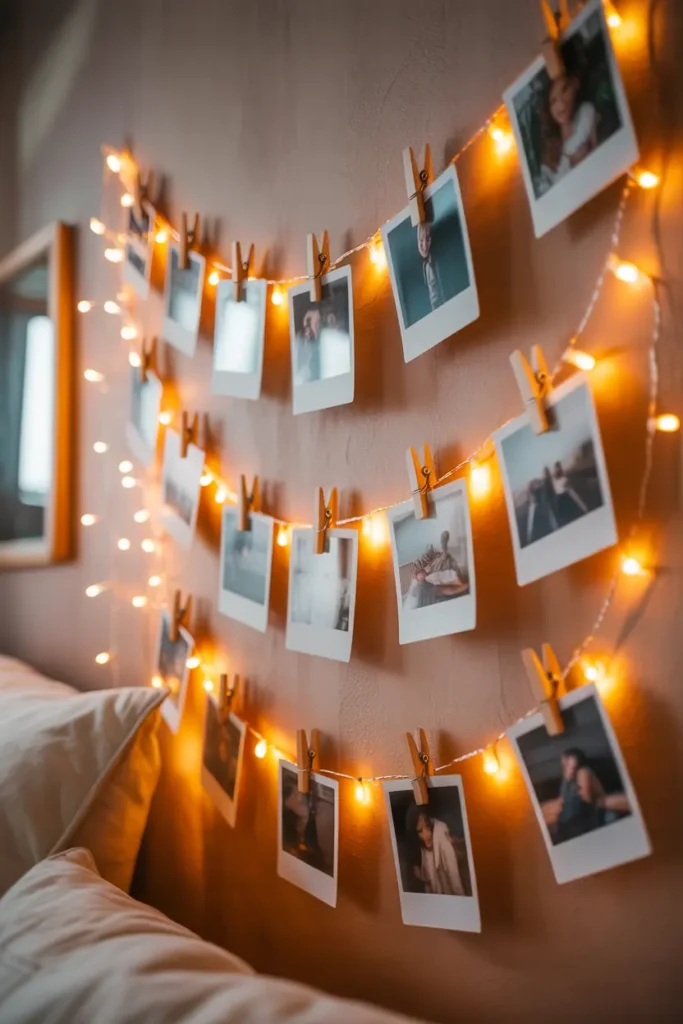
Fairy lights with clipped photos are the cozy classic for a reason: they combine lighting and personal decor in one, they cost almost nothing, and they make any bedroom feel instantly warmer. Drape a strand along the wall above the bed or desk, clip on your favorite prints, done.
Upgrade it from dorm-room to designed: use warm white (not multicolor) copper-wire lights, print photos in consistent sizes (4×6 or 5×7, all the same), and use matching mini clips. Keep the strand to one wall — lights everywhere stops being cozy and starts being Christmas. Total cost: under $25 for something you’ll actually love looking at.
10. Choose Calm, Neutral Art
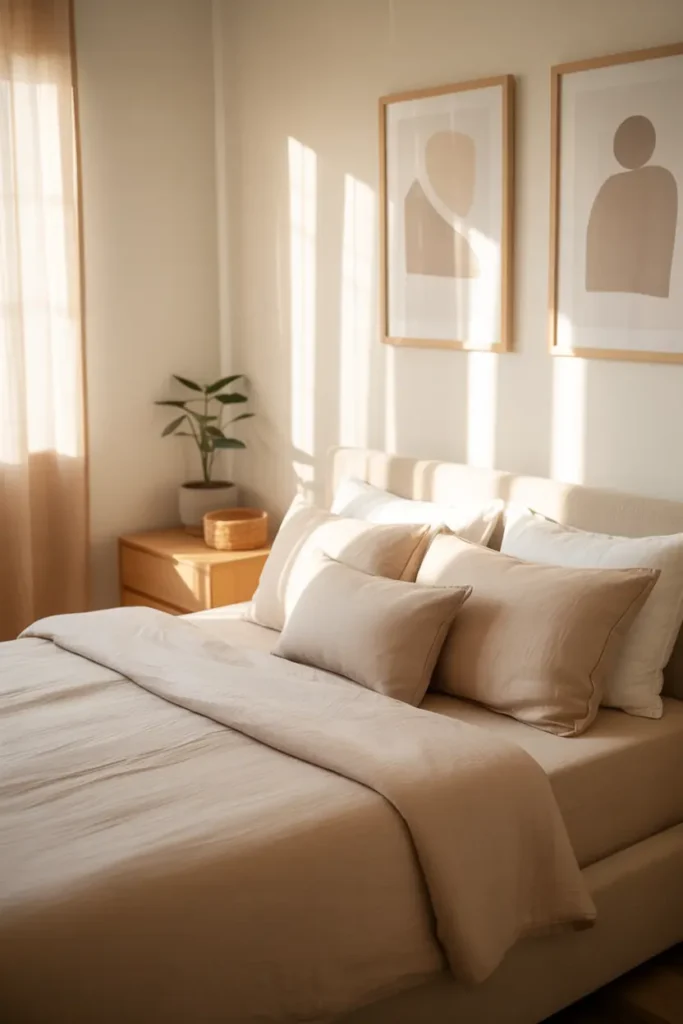
In a small bedroom, loud art on the walls competes with rest — and rest is the room’s job. Neutral, muted artwork (soft abstracts, black-and-white photography, tonal landscapes) keeps the visual noise down while still giving the walls personality. Save the bold statement piece for the living room.
The 60-30-10 of bedroom art: 60% neutral tones matching your bedding, 30% one soft accent color, 10% dark for grounding. Free art sources are everywhere — museum websites offer high-res public domain downloads, and your own phone photos printed large look surprisingly gallery-worthy. One $10 large print in a thrifted frame beats a $100 small print in a cheap frame.
11. Let a Clock Be the Focal Point
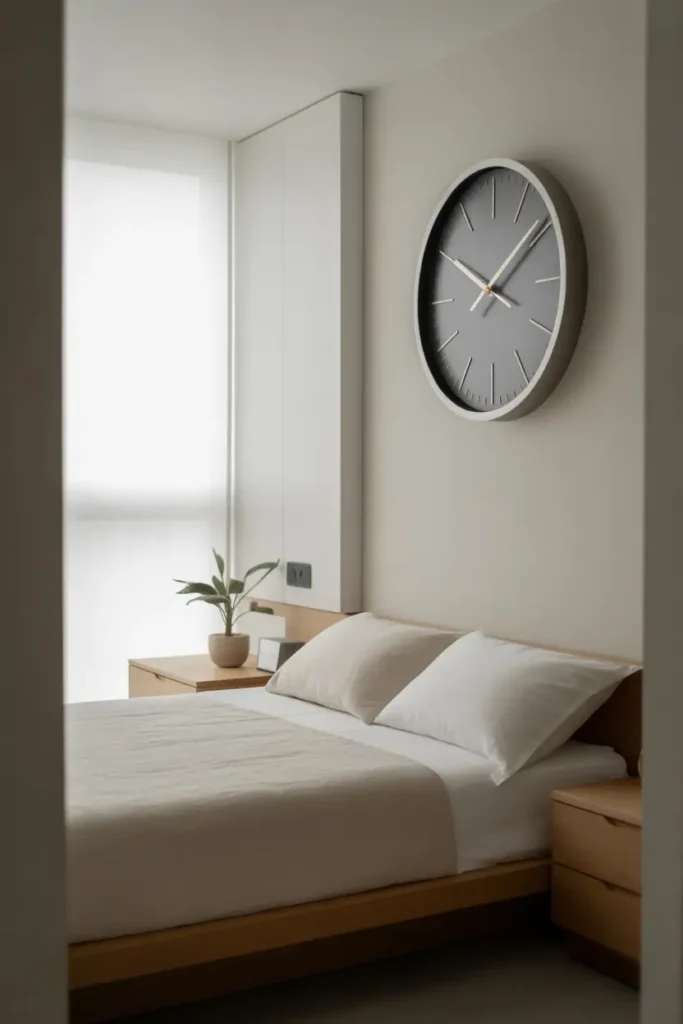
A great wall clock is decor that earns its place twice: it fills an empty wall with intention and it tells time. In a small bedroom, one oversized clock (24 inches or more) on an otherwise bare wall creates a focal point with zero clutter — it’s the minimalist’s statement piece.
Pick a style that echoes the room: minimal face with no numbers for modern, Roman numerals for classic, wood for warm. Hang it where you’ll see it from bed — above the dresser or on the wall opposite. And get a silent-sweep movement; a ticking clock in a small quiet bedroom is a special kind of torture.
12. Use a Wall Grid for Changeable Displays
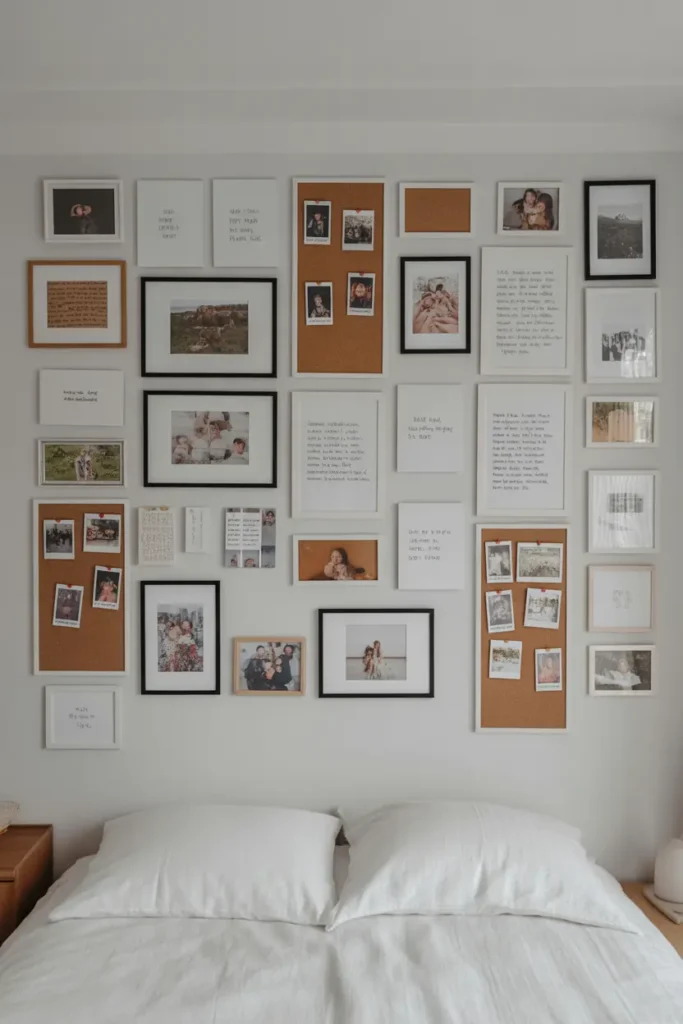
A wire wall grid is the commitment-phobe’s gallery wall: clip on photos, notes, dried flowers, small art — rearrange weekly if you like. It’s decor that evolves with you, which is perfect for small bedrooms where tastes change faster than leases.
Keep it curated, not chaotic: limit the grid to one theme or color story at a time, and don’t fill every inch — negative space is what makes it look designed. A 2×3-foot grid above a desk is the sweet spot. When it starts looking cluttered, that’s the signal to edit, not to buy a bigger grid.
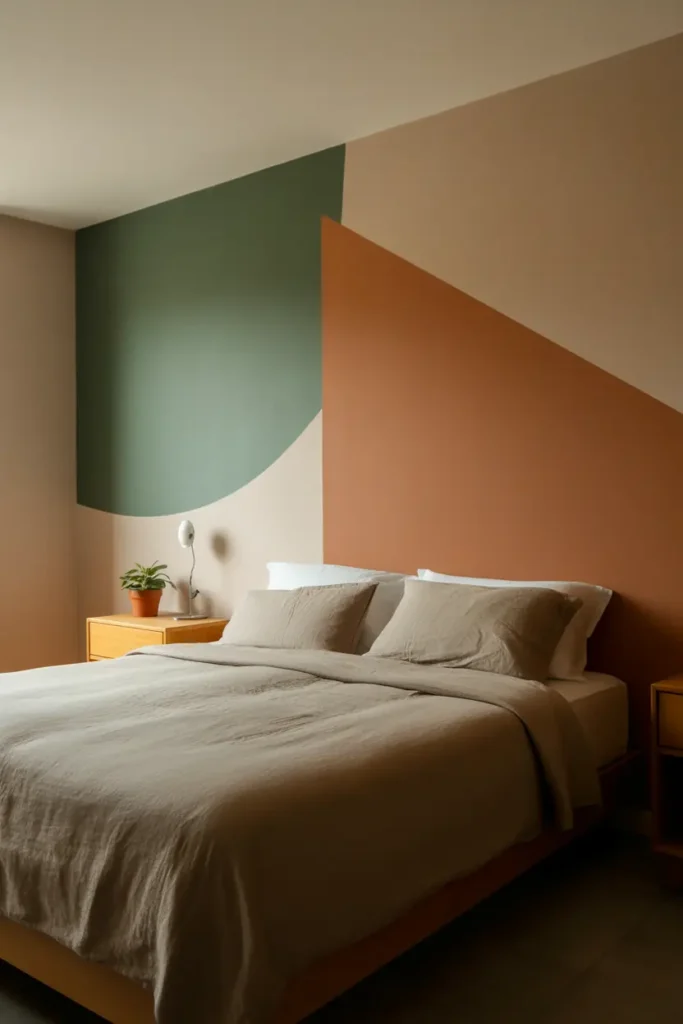
13. Paint a Half Wall
Half-wall paint — color on the bottom, white on top (or vice versa) — is the budget statement wall. One quart of paint, one roll of painter’s tape, one afternoon: you get architectural interest, a two-tone effect that adds depth, and a look that costs a fraction of wallpaper. It also visually widens the room by emphasizing the horizontal line.
The line placement matters: the classic split is at 36–48 inches (chair-rail height), but going higher — 60 inches — feels more modern. Use a laser level or a long spirit level; a wavy line ruins the effect instantly. Crisp edge, two tones, done. For extra polish, add a thin picture ledge or trim along the line.
14. Add a Wood Panel Accent
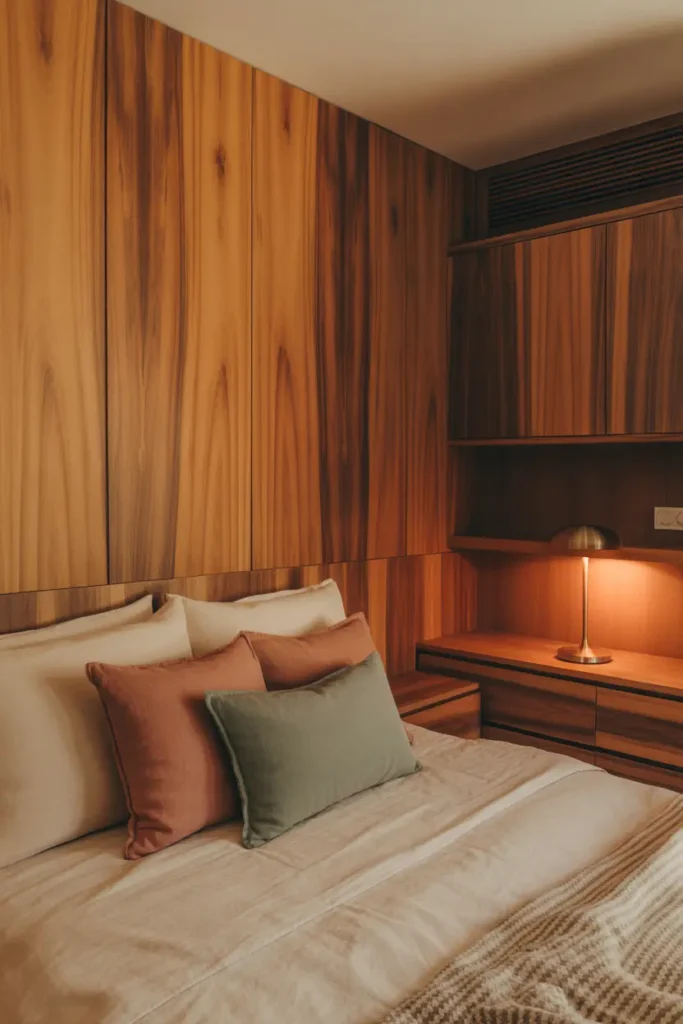
Wood on bedroom walls adds the warmth that paint alone can’t. You don’t need a full slat wall — even a 4-foot section of wood panels behind the bed creates a headboard effect with real texture. Peel-and-stick wood-look panels have gotten convincingly good and are fully renter-safe.
Real wood wins on texture: thin pine slats, a reclaimed-wood section, or even plywood stained warm. Keep it to one wall or one section — wood everywhere in a small room can feel like a sauna. And seal it if it’s near a window where condensation collects; bedroom humidity is sneaky.
15. Hang Curtains as Wall Decor
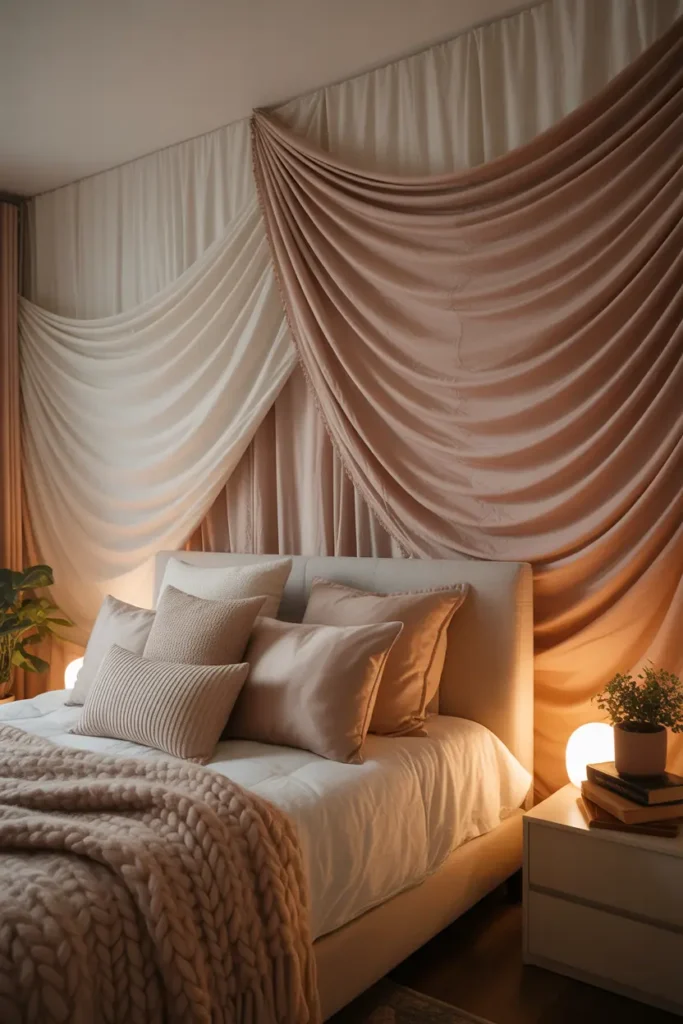
Curtains aren’t just for windows. A curtain panel hung on the wall behind the bed — floor to ceiling, wall to wall if you’re bold — creates a soft, upholstered-headboard effect that adds luxury and sound absorption. It’s the coziest wall treatment on this list and one of the cheapest.
Hang the rod 4–6 inches below the ceiling and extend it 6–12 inches beyond the bed on each side; the extra width and height is what makes it look expensive rather than improvised. Choose a fabric with some weight — linen, velvet, or a heavy cotton — so it drapes rather than clings. Two $25 curtain panels can look like a $500 headboard wall.
16. Use the Space Above the Bed
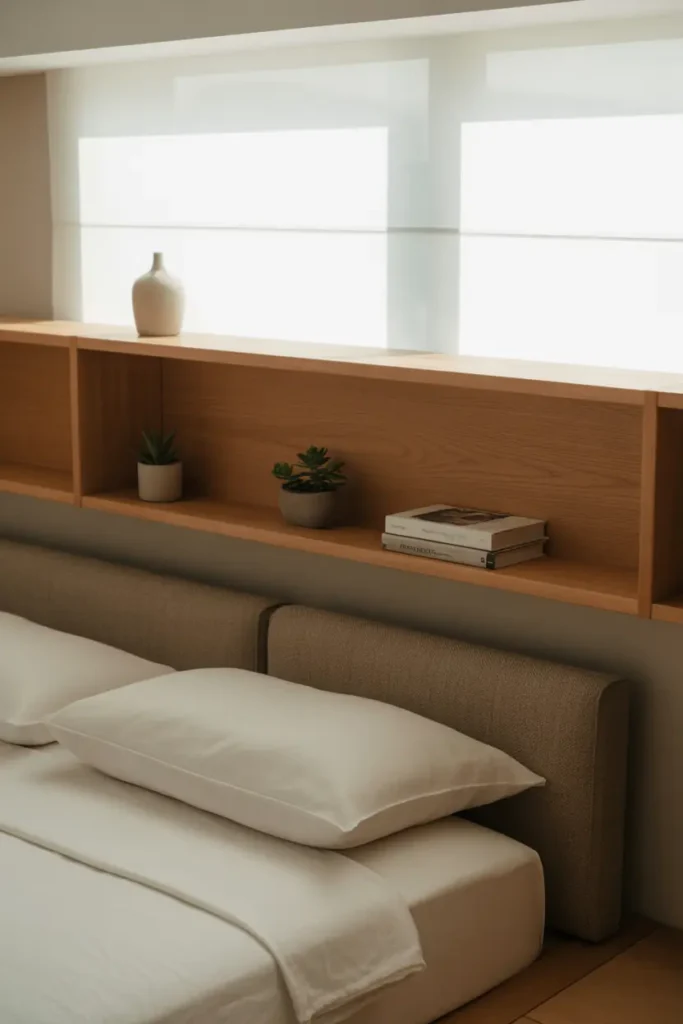
The wall above the bed is prime real estate that most people waste — it’s the first thing you see from the doorway and the largest uninterrupted wall in most small bedrooms. One floating shelf, a single large art piece, or a small gallery: whatever you choose, make it deliberate, because this wall sets the room’s tone.
Safety first: anything above a bed must be mounted into studs — no exceptions, no adhesive-only solutions above where you sleep. Keep it light (frames, not books) and not too deep (a 6-inch shelf, not a 12-inch one). One shelf with three beautiful objects beats a cluttered ledge every time.
17. Bounce Light With Reflective Decor
Metallic frames, mirrored trays, glossy ceramics, glass — reflective surfaces act as secondary light sources, scattering brightness into corners that paint can’t reach. In a small bedroom with one window, strategic reflectives can noticeably lift the whole room’s light level.
You don’t need a disco ball: a brass-framed mirror, a couple of metallic picture frames, a glass vase on the dresser. Place reflectives where they’ll catch the window light — opposite or adjacent to it, not in the dark corner. The effect is subtle but real: the room feels brighter without a single additional bulb.
18. Try Wall Decals for Instant Change
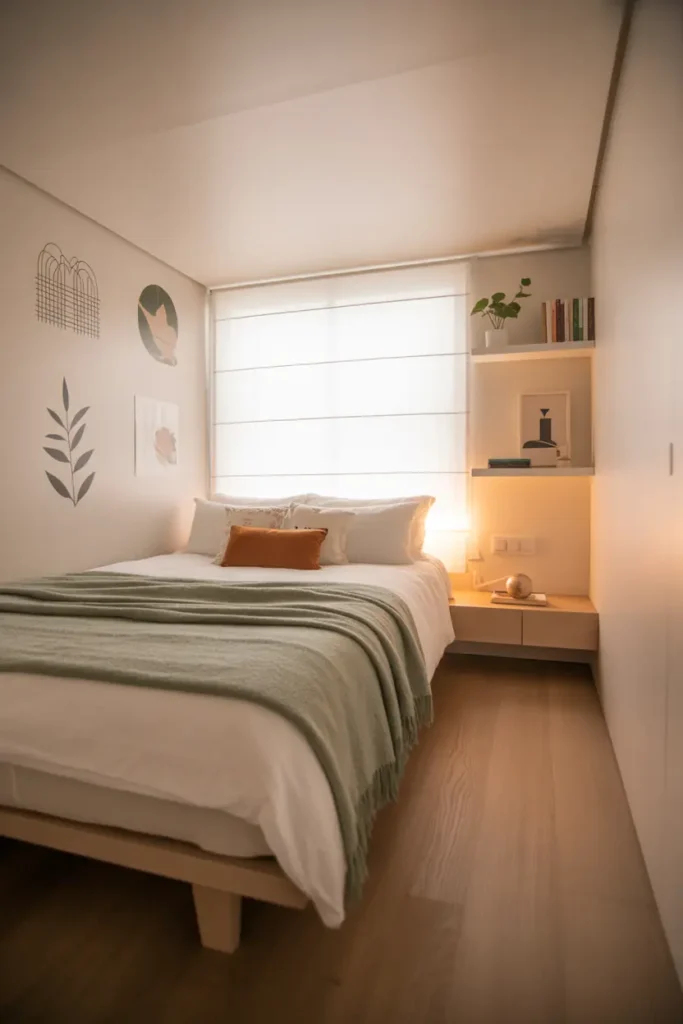
Wall decals are the fastest room transformation available: peel, stick, done in twenty minutes, removable whenever. Modern decals have grown up — subtle arches, botanical silhouettes, abstract shapes in muted tones look genuinely designed, not like a kid’s room (unless you want that).
The key is restraint and placement: one decal composition on one wall, scaled generously. A large arch behind the bed or a botanical spray in a corner reads as intentional; twenty small stars scattered randomly reads as chaotic. Quality matters — cheap decals peel and bubble; spend the extra $10 for a reputable brand.
19. Style Existing Niches Like Displays
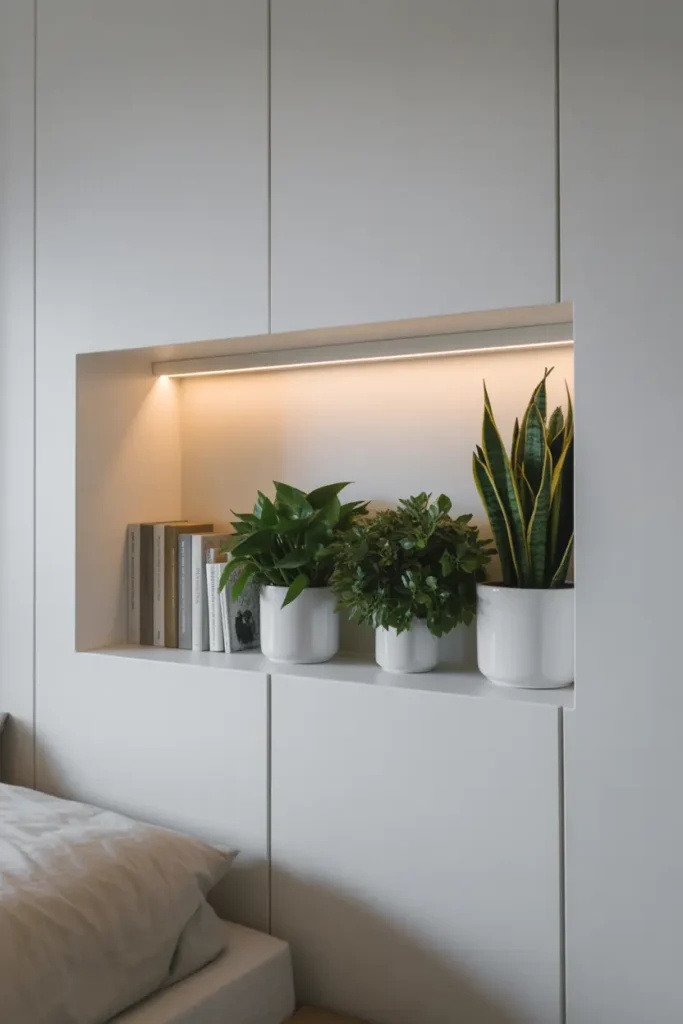
If your bedroom has wall niches, alcoves, or awkward recesses, don’t fight them — feature them. A niche with a small light (battery puck lights cost $10 for a pack) and two or three beautiful objects becomes a built-in display case. Paint the niche’s interior a shade darker than the walls for instant depth.
No niches? Create the effect: a shallow picture ledge or a recessed-look frame arrangement gives a similar layered depth. The principle is the same — use the wall’s depth, not just its surface. Flat walls get art; deep walls get displays.
20. Know When to Stop
The final idea is the most important: in a small bedroom, restraint is the design. Every wall doesn’t need something. Blank space gives the decorated walls room to breathe and makes the whole room feel larger and calmer. If you’re unsure whether to add one more thing, the answer is almost always no.
The test: photograph the room. If your eye bounces frantically between competing focal points, edit. If it rests comfortably on one or two, you’re done. The best small bedrooms look almost empty in photos and feel perfectly complete in person — that’s the paradox, and it’s the whole game.
Related Decor Ideas
If you liked these ideas, you can also explore:
- Small bedroom decor ideas for modern homes
- Cozy bedroom lighting ideas for small spaces
- Minimalist bedroom design trends for 2026
Conclusion
Small-bedroom walls are an opportunity disguised as a limitation. With the floor off-limits, the walls become your canvas, your storage, and your personality — and nearly everything on this list costs less than a dinner out. Mirrors for space, shelves for function, art for soul, and restraint over everything.
Start with the wall you see from the doorway — it’s your room’s first impression. One deliberate change there (a mirror, a gallery, an accent wall) transforms the whole space. Then stop, live with it, and let the room tell you what it needs next. Small rooms reward patience more than spending.
Pro Tips
- Hang art at 57 inches. Gallery standard: the center of the piece sits 57″ from the floor. In bedrooms, cheat slightly lower (54–56″) since you’re often viewing from bed. Consistent height across pieces is what makes arrangements look professional.
- Use painter’s tape to preview. Before committing to any arrangement, tape the outlines on the wall and live with it for a day. It’s free, it’s fast, and it prevents 90% of “that looks wrong” regret.
- Invest in the hanging hardware. Monkey hooks, Hercules hooks, and proper anchors hold serious weight with tiny holes. A $10 variety pack prevents both fallen art and landlord disputes.
- Photograph before you buy. Take a photo of the bare wall to the store (or keep it on your phone for online shopping). Shopping against the actual wall — its color, light, and proportions — prevents the “looked great in the store” problem.
FAQs
How much wall decor is too much for a small bedroom?
If you can’t find a resting spot for your eyes, it’s too much. A good rule: decorate 60–70% of available wall space at most, and keep at least one wall mostly bare. In a 10×12 room, one gallery wall plus one statement piece is usually the sweet spot.
What’s the most renter-friendly wall decor?
Peel-and-stick wallpaper, wall decals, leaner mirrors (no hanging needed), and anything on adhesive hooks rated for the weight. Command strips hold up to 16 lbs per set — enough for most frames. Just follow the removal instructions exactly when you leave.
Should bedroom walls be light or dark in a small room?
Light walls make small rooms feel bigger — that’s physics, not opinion. But one dark accent wall (behind the bed) adds depth without shrinking the feel, because dark recedes visually. The winning combo: three light walls, one moody accent.
How do I make a small bedroom look bigger with decor?
Large mirror opposite the window, vertical lines to fake height, consistent light color palette, and clear floor space. The single biggest factor is actually decluttering — a tidy small room always looks bigger than a decorated-but-messy one.

HowDecor is a home decor blog sharing simple, practical decorating ideas for everyday spaces. We believe a beautiful home should feel comfortable, personal, and full of warmth — and that great style does not require a huge budget. Our goal is to inspire readers to create spaces that feel peaceful, welcoming, and truly their own — one room at a time.