Let’s address the fear first: yes, you can paint a bathroom midnight blue. No, it won’t look like a cave — unless you do it badly, in which case it absolutely will. Dark bathrooms are a high-wire act, and midnight blue is the wire. Done right, it’s the most cinematic color in interior design: deep, enveloping, the color of a hotel you’ll never forget. Done wrong, it’s a laundry room at midnight.
The difference is never the paint color. It’s the light. Every idea below comes with its lighting prescription, because in a midnight blue bathroom, lighting isn’t decoration — it’s architecture. Get the light right and the dark does the rest.
Table of Contents
- Idea 1: Midnight Blue Accent Wall
- ✨ Idea 2: Midnight Blue Vanity Cabinets
- ✨ Idea 3: Midnight Blue Marble Walls
- ✨ Idea 4: Midnight Blue and Gold Combo
- ✨ Idea 5: Midnight Blue Tile Shower
- ✨ Idea 6: Midnight Blue Ceiling
- ✨ Idea 7: Midnight Blue Wallpaper
- ✨ Idea 8: Midnight Blue Bathtub Area
- ✨ Idea 9: Midnight Blue Sink Basin
- ✨ Idea 10: Midnight Blue and White Balance
Idea 1: Midnight Blue Accent Wall
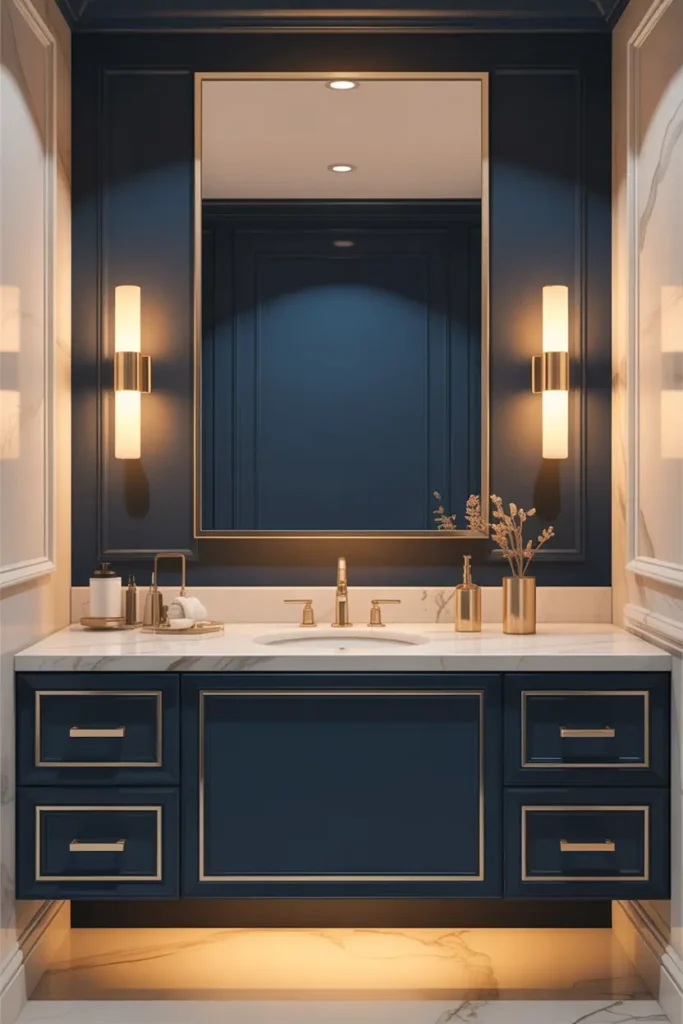
One wall in midnight blue — the wall behind the vanity is the classic choice — gives you 80% of the drama at 20% of the commitment. The deep blue recedes visually, which paradoxically makes the wall feel farther away; dark colors in small rooms create depth, not closeness, as long as the other three walls stay light. That’s the physics most people get backwards.
The lighting prescription: a pair of sconces flanking the mirror at face height (60–65 inches), 2700K, plus one overhead on a dimmer. Sconces wash the blue wall with warm light and prevent the flat, dead look that a single ceiling fixture creates on dark paint. Without the sconces, skip the accent wall — flat-lit dark blue is just dark.
Idea 2: Midnight Blue Vanity Cabinets
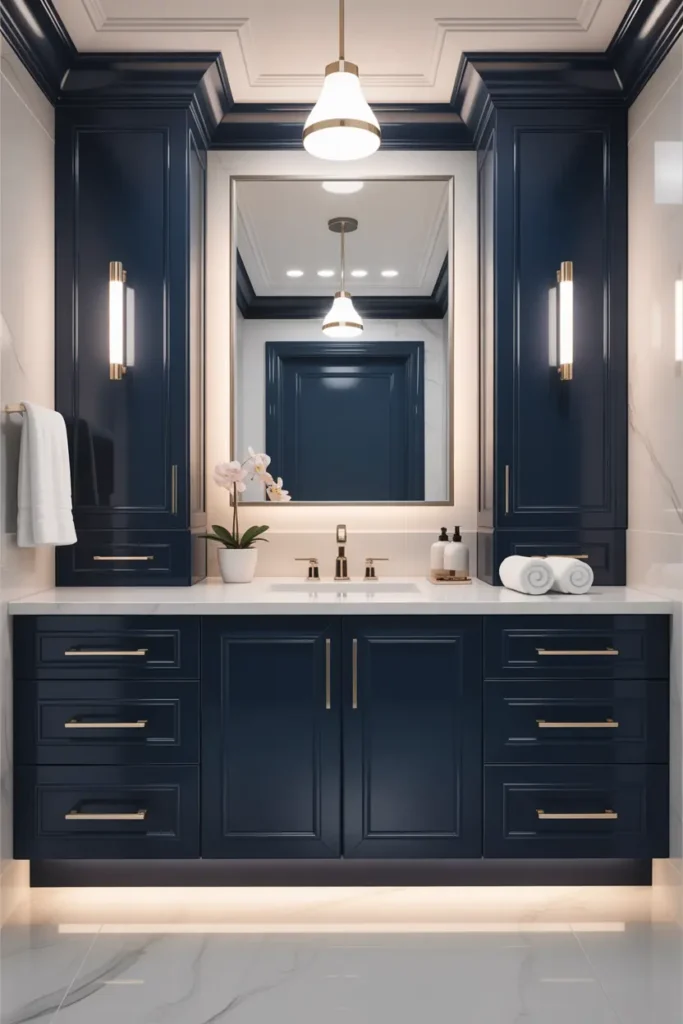
A vanity in midnight blue — Hale Navy and its cousins are the reference points — is the most forgiving way to go dark. It’s furniture-scale, not room-scale, so the commitment is a quart of cabinet enamel, not a gallon of wall paint. Against a white countertop and light walls, it reads as tailored, almost like a good suit: dark, structured, confident.
Because the color is so saturated, the finish matters enormously. Satin or semi-gloss enamel reflects light and keeps the blue luminous; flat or matte paint on a vanity absorbs light and can read as black in a dim bathroom. And the hardware is the jewelry — brushed brass or gold against midnight blue is the combination that launched a thousand powder rooms. Don’t cheap out on the pulls; they’re the whole contrast story.
Idea 3: Midnight Blue Marble Walls
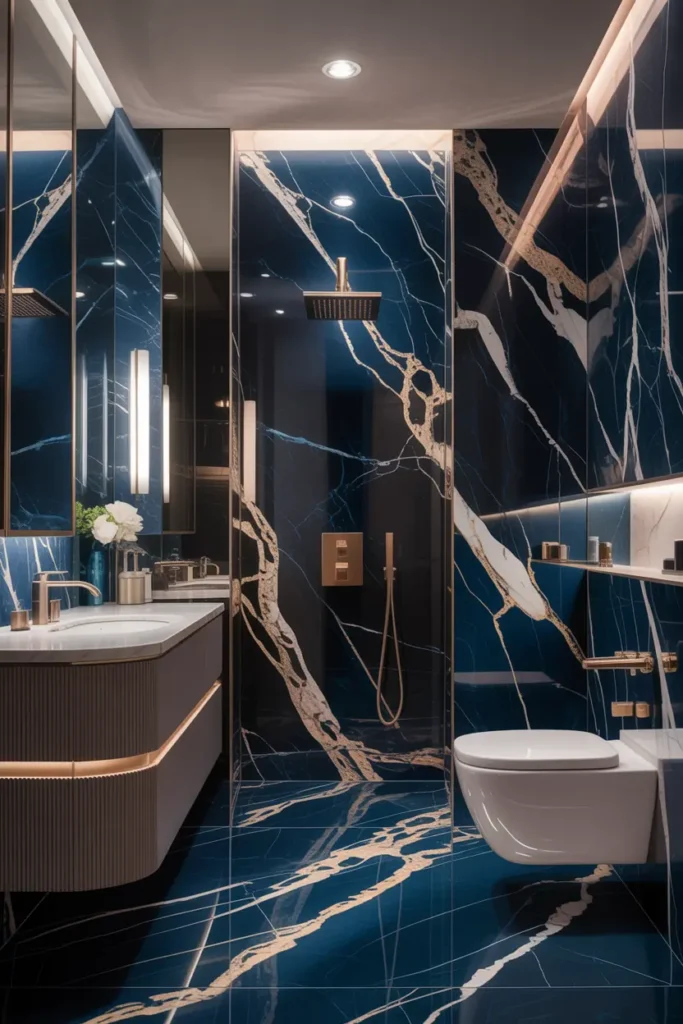
Dark blue marble — Azul Macaubas and its relatives, veined in gold and white — is what midnight blue wants to be when it grows up. The veining breaks up the darkness with light, so the wall never goes flat; it has movement, depth, the sense that something is happening inside the stone. It’s the difference between a dark wall and a dark event.
Use it as the single dramatic surface — the shower wall, the vanity wall — with everything else quiet: white fixtures, simple hardware, minimal accessories. Dark marble plus busy anything else is visual overload. And budget with eyes open: real blue marble runs $40–$100+/sq ft installed. The porcelain lookalikes at $10–$20/sq ft are genuinely convincing at this darkness, because dark hides the tells.
Idea 4: Midnight Blue and Gold Combo
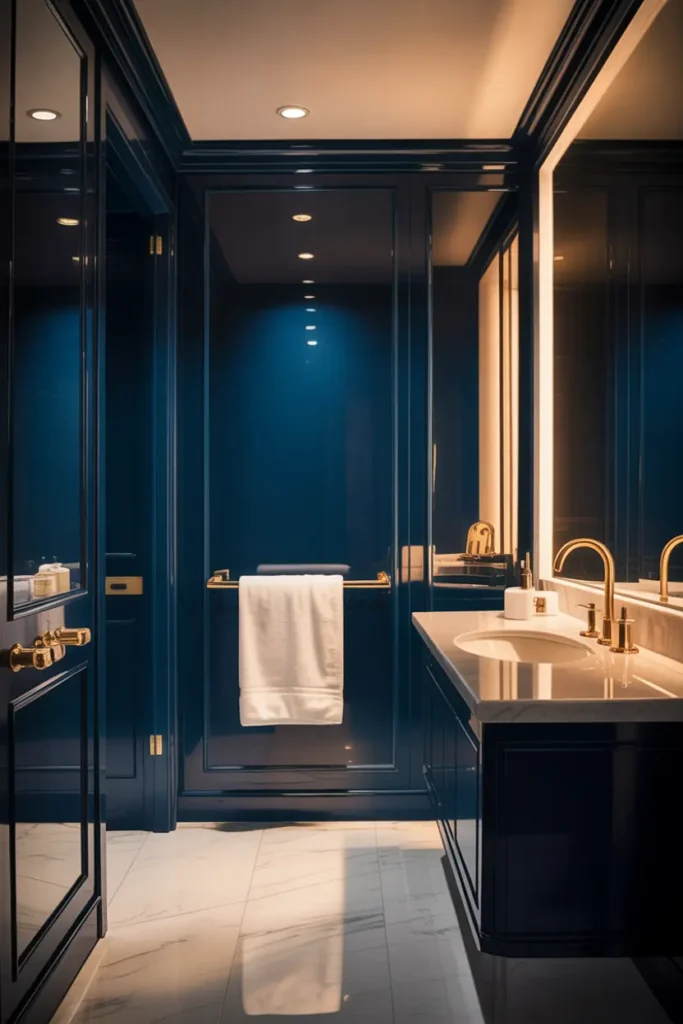
This is the pairing that made midnight blue famous: deep blue, warm gold, and the contrast between them doing all the work. The gold’s job is to catch light and throw it back — which is exactly what a dark room needs. Faucet, mirror frame, sconces, towel bar: every gold element is a tiny lamp, bouncing warm highlights across the blue.
The discipline: one gold finish, used consistently, and everything else restrained. Brushed or satin gold — never polished, which reads cheap against dark blue. White ceiling, white fixtures, and let the blue-and-gold do their duet. This combination is so strong it needs almost no other decor; a plant and a folded towel complete it. Anything more is gilding the lily, literally.
Idea 5: Midnight Blue Tile Shower
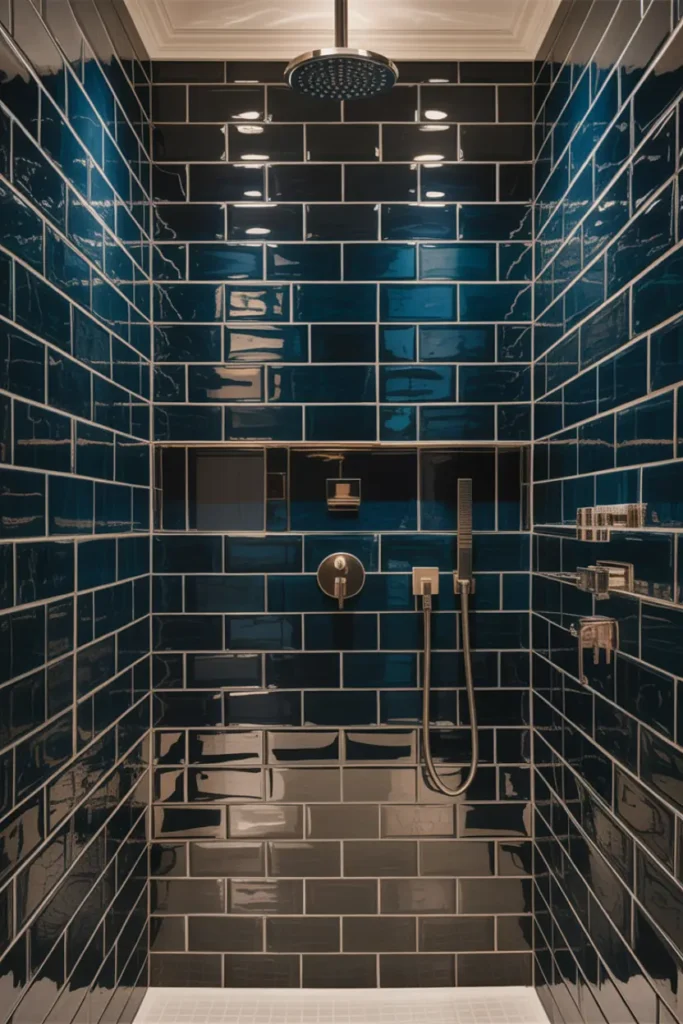
A shower in glossy midnight blue tile is the closest thing to bathing inside a sapphire. The gloss is doing critical work here — in a dark shower, matte tile absorbs what little light exists, while gloss multiplies it, bouncing every lumen around the enclosure. This is one application where glossy isn’t just prettier, it’s functionally necessary.
Light the shower itself: a recessed waterproof downlight (IP65 rated) directly overhead, 3000K, on the same dimmer circuit as the room. An unlit dark shower is a safety hazard and a mood killer; a lit one is a grotto. Clear glass doors are mandatory — frosted glass on a dark shower turns it into a very expensive dark box nobody can see into.
Idea 6: Midnight Blue Ceiling
The boldest move on this list and, counterintuitively, one of the safest: a midnight blue ceiling over light walls. The eye reads ceilings as “above,” so a dark ceiling doesn’t close the room in the way dark walls do — instead it creates the feeling of night sky over a bright room. It’s dramatic without being oppressive, which is a rare combination.
This lives or dies on the wall color below it: crisp white or very pale grey walls keep the contrast clean; anything mid-tone muddies it. And the ceiling needs a light source that acknowledges it — a flush-mount or pendant that washes upward, or at minimum a bright central fixture. A dark ceiling under a dim bulb is just a dark ceiling. Flat paint, always — gloss on a ceiling shows every flaw.
Idea 7: Midnight Blue Wallpaper
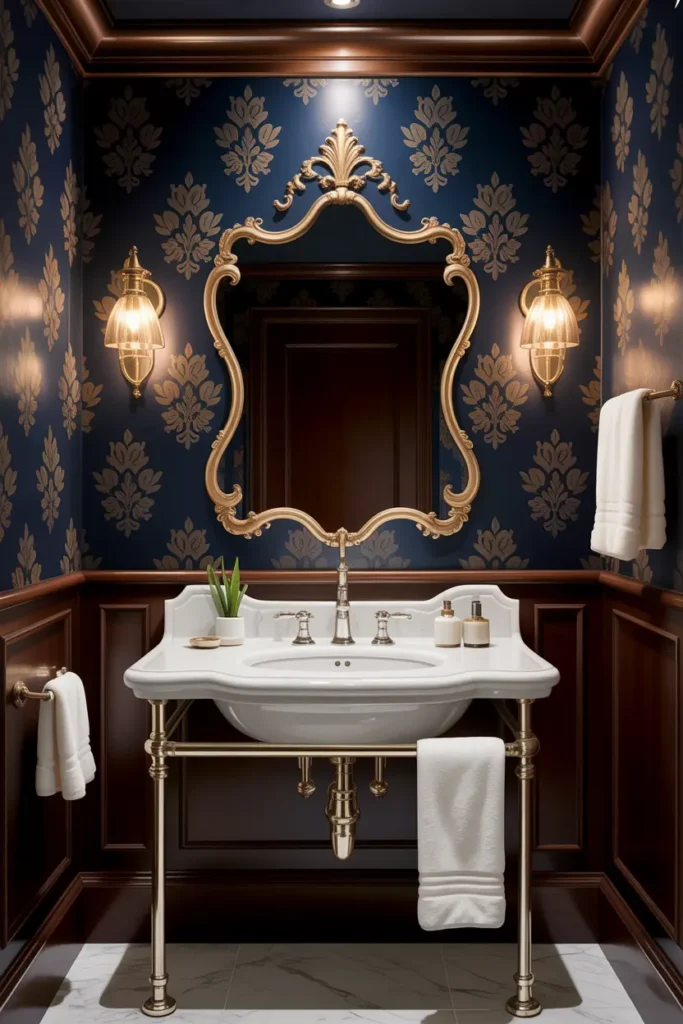
Wallpaper lets midnight blue carry pattern — a gold-on-navy botanical, a dark art-deco fan, a subtle damask — which solves the flatness problem inherent to dark paint. The pattern catches light differently across its surface, so the wall has life even under modest lighting. In a powder room, one patterned navy wall is the highest drama-per-dollar in all of decorating.
Keep it to one wall, and keep the pattern’s background truly dark — wallpapers that read “navy” in the store but “medium blue” on the wall lose the whole effect. Vinyl-coated for bathroom humidity, and away from direct shower spray. The remaining walls stay light; the wallpaper is the soloist, and soloists need a quiet stage.
Idea 8: Midnight Blue Bathtub Area
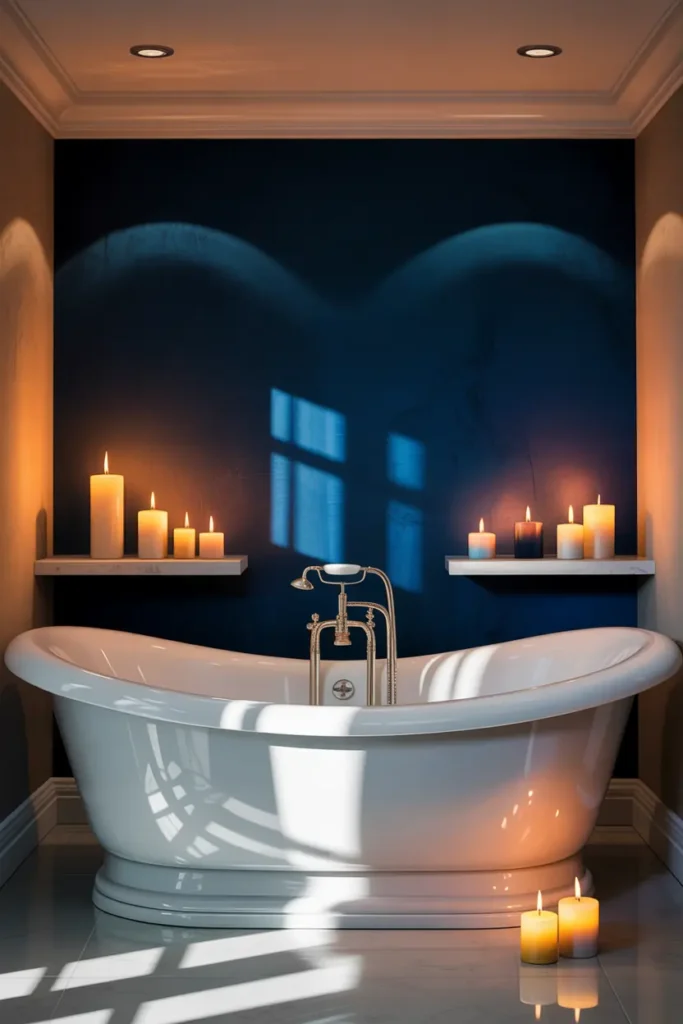
Frame the tub in midnight blue — the wall behind it, floor to ceiling — and the bath becomes a destination. There’s a reason high-end hotels do exactly this: dark surroundings make candlelight and lamplight feel ten times warmer by contrast. A white tub against a midnight wall, lit by two candles, is the cheapest luxury experience in the home.
The tub itself should stay white or very light; a dark tub in front of a dark wall disappears, and you lose the contrast that makes the composition work. Add one warm light source at tub height — a small lamp on a stool, a wall sconce — because overhead light alone creates harsh shadows on dark walls. This is about the evening bath; design for 9 p.m., not 9 a.m.
Idea 9: Midnight Blue Sink Basin
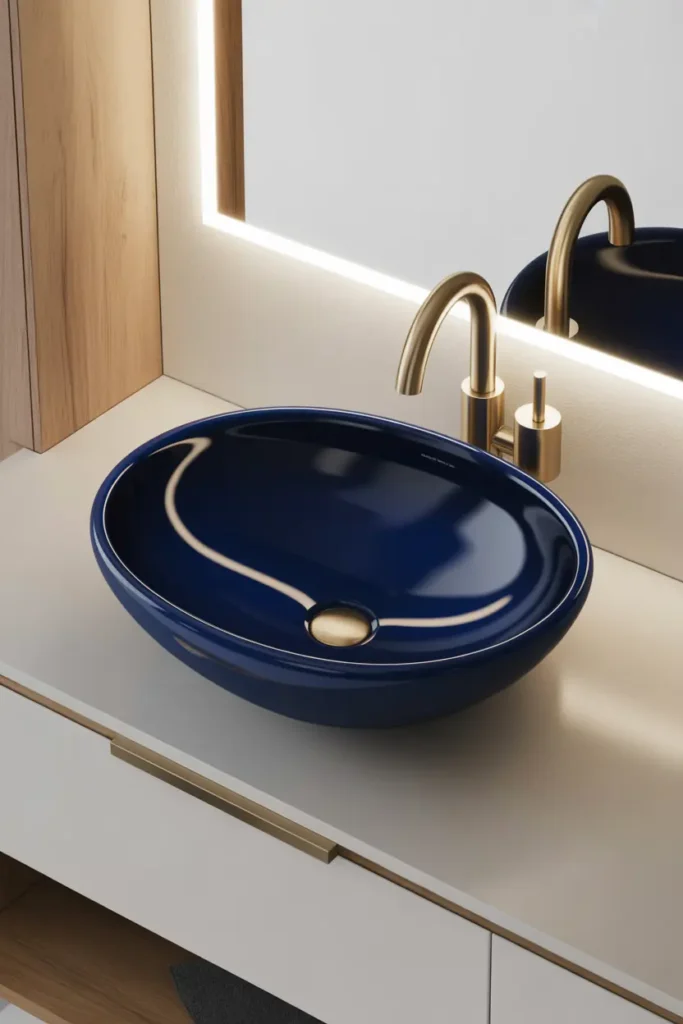
A midnight blue vessel basin is a shot of drama in a small glass — perfect for powder rooms, where you want maximum impression in minimum square footage. Against a light counter and wall, the dark basin becomes a sculptural object, the thing guests photograph. It’s the bathroom equivalent of a bold lip: small area, huge effect.
The faucet pairing matters: brushed gold or brass against midnight blue continues the classic duet, while matte black goes moodier and more modern. Either way, the basin needs a vessel-height or wall-mounted faucet — standard short faucets can’t clear a 6-inch vessel. Keep the counter clear; a dark basin surrounded by clutter just looks like a dark mess.
Idea 10: Midnight Blue and White Balance
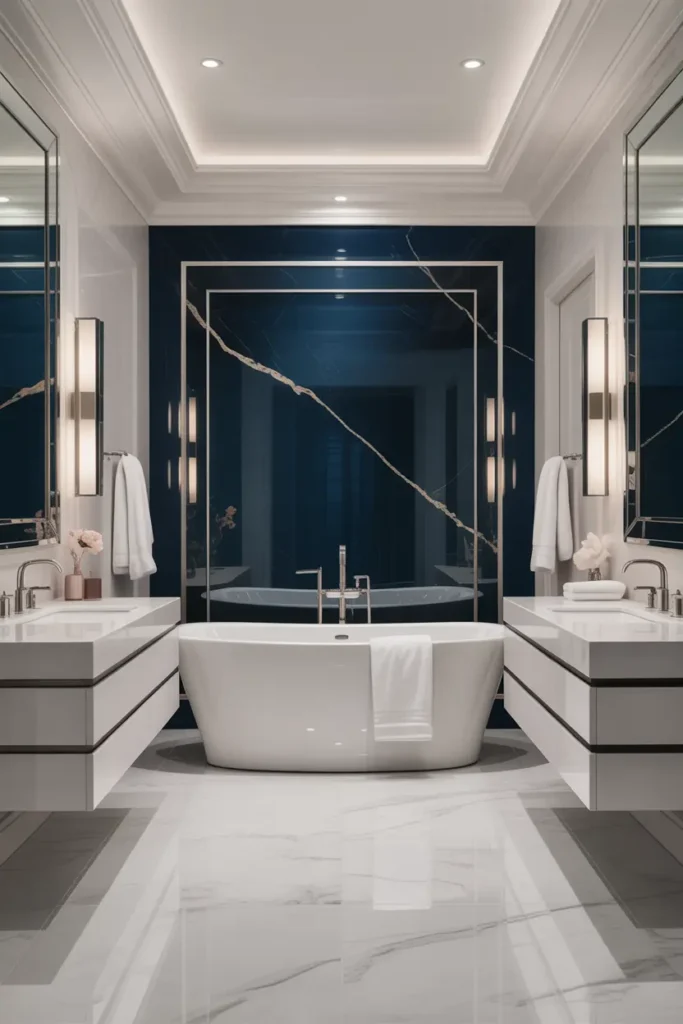
The timeless formula: midnight blue for depth, white for light, and the tension between them doing all the design work. White subway tile with navy walls above. A navy vanity under a white quartz top. The ratio that works is roughly 60% white, 40% blue — enough dark to feel intentional, enough light to feel open.
White is doing structural work here, not just filling space: it bounces light into the blue areas and gives the eye somewhere to rest. Without enough white, midnight blue overwhelms; without enough blue, it’s just another white bathroom. The balance point is personal, but if you’re unsure, err toward more white — you can always add blue, but removing it means repainting.
Pro Tips
- Light the dark, don’t fight it. Every midnight blue surface needs a dedicated light source washing it — sconces, picture lights, or well-placed recessed lights. Dark paint with only a central ceiling fixture looks flat and dead, always.
- Sample at night. Midnight blue looks completely different under artificial light than daylight. Paint your test square and judge it at 9 p.m. under your actual bulbs — that’s when you’ll be living with it.
- Warm bulbs only. 2700K is the ceiling for dark blue bathrooms; anything cooler turns midnight blue grey and lifeless. This single spec matters more than the exact paint color.
- Commit to the trim. White trim, ceiling, and fixtures against midnight blue walls create the crisp contrast that makes dark rooms feel designed rather than gloomy. Skimp on the white and the room has nowhere for light to land.
FAQs
Will midnight blue make my bathroom look smaller?
Not necessarily — dark colors recede visually, so a midnight blue accent wall can actually add depth. The risk is poor lighting, not the color itself. With layered warm lighting and enough white contrast (ceiling, fixtures, trim), even small bathrooms handle midnight blue beautifully.
What lighting is best for a dark blue bathroom?
Layered and warm: sconces at face height flanking the mirror (2700K), an overhead on a dimmer, and ideally one accent light washing the darkest surface. Avoid cool-white bulbs entirely — they turn midnight blue flat and grey.
What metal finish goes with midnight blue?
Brushed brass or satin gold is the classic pairing — the warmth contrasts the cool blue and reflects light in dark rooms. Matte black works for a moodier, more modern take. Avoid polished chrome unless you’re deliberately going for a crisp, cool contrast.
Can I do midnight blue in a bathroom with no windows?
Yes, but the lighting plan becomes critical: you’ll need brighter, well-distributed warm light to compensate for zero daylight. Keep the ceiling white, use glossy finishes to bounce light, and put the darkest blue on one wall or the vanity rather than all four walls.

HowDecor is a home decor blog sharing simple, practical decorating ideas for everyday spaces. We believe a beautiful home should feel comfortable, personal, and full of warmth — and that great style does not require a huge budget. Our goal is to inspire readers to create spaces that feel peaceful, welcoming, and truly their own — one room at a time.