Let’s be honest about what makes a Harry Potter bedroom work: it’s not the merchandise. A room plastered in licensed posters looks like a gift shop, not Hogwarts. The rooms that actually feel magical are the ones that capture the atmosphere — candlelight, old wood, heavy fabrics, books everywhere, and that specific cozy-mysterious feeling of the Gryffindor common room at midnight.
The design secret is that Hogwarts is really just dark academia done perfectly: moody colors, vintage furniture, layered textures, and warm light. Nail that foundation and the Potter details become the finishing touch rather than the whole personality. Here’s how to build it, from the walls outward.
1. Paint One Wall Deep and Moody
Every Hogwarts room starts with shadow. A feature wall in charcoal, deep forest green, oxblood, or midnight navy instantly creates the mysterious depth the theme needs. Behind the bed is the natural choice — it’s the backdrop for everything and the first thing you see from the door.
Go matte or eggshell, never gloss — shine kills the ancient-castle illusion. And here’s the trick that sells it: paint the wall, then add texture on top. A stone-look wallpaper, a limewash effect, or even just a darker glaze ragged over the base coat gives the flat wall the aged, uneven character of real castle stone. One wall, done properly, does more than four walls done flat.
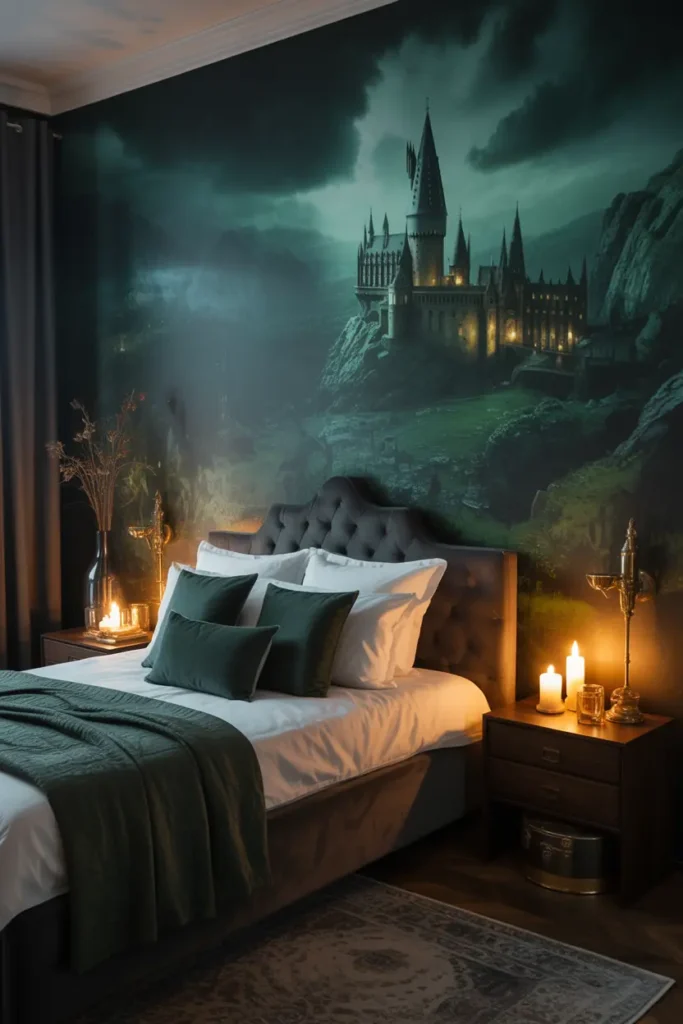
2. Furnish It Like a Dorm Room (the Good Kind)
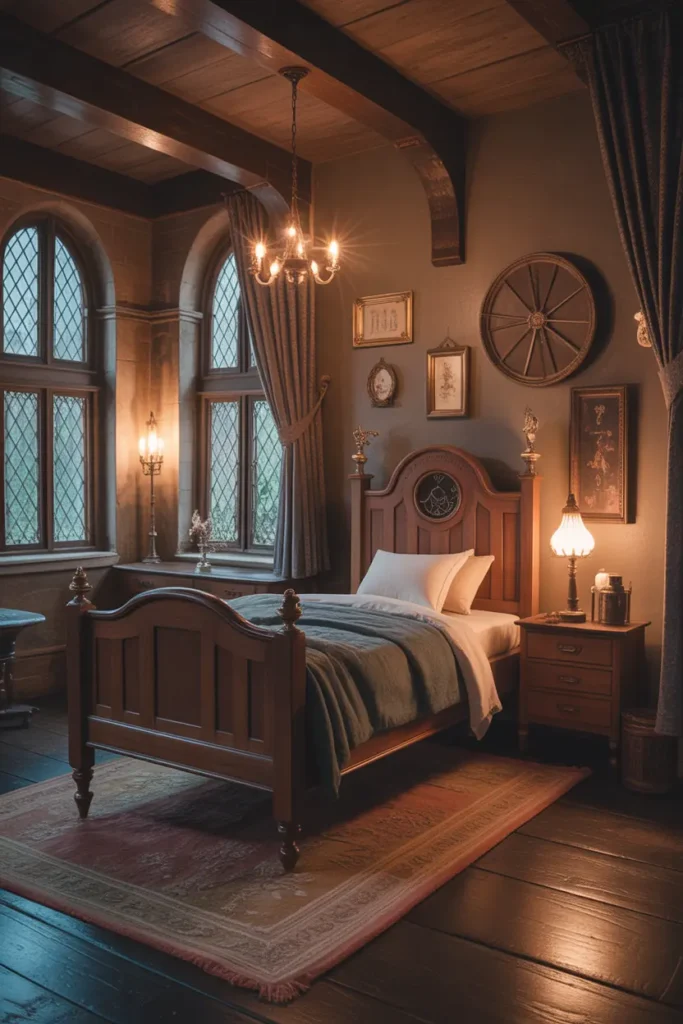
Hogwarts furniture is heavy, wooden, and old — four-poster beds, chunky nightstands, pieces that look like they’ve survived centuries of students. You don’t need actual antiques; you need wood with visible grain in dark or medium tones, simple sturdy shapes, and nothing glossy or modern. Thrift stores and Facebook Marketplace are goldmines for this.
The bed is the anchor: a wooden frame, ideally with posts (curtains optional but encouraged). Flank it with matching nightstands — symmetry reads as “dormitory” in the best way. And avoid anything with clean Scandinavian lines or chrome; one IKEA-white piece in the room breaks the spell faster than anything. If you’re stuck with modern furniture, dark wood-look contact paper on drawer fronts is a shockingly effective disguise.
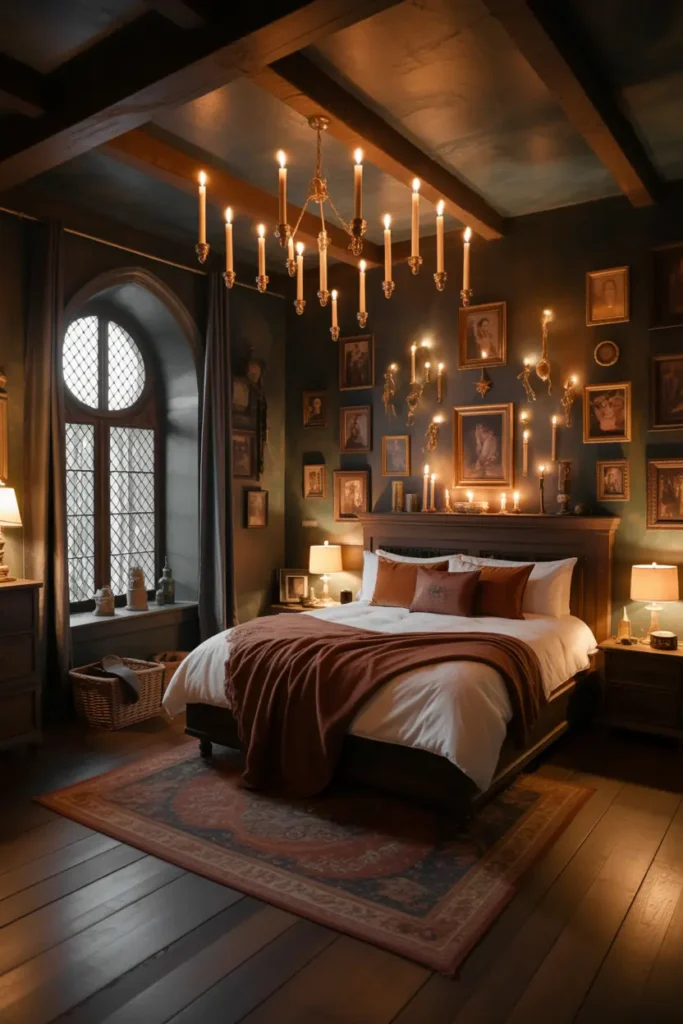
3. Hang Floating Candles
The Great Hall ceiling is the single most iconic Potter visual, and it’s surprisingly easy to fake. Battery-operated LED taper candles hung from the ceiling on clear fishing line, at varying heights, create the floating effect — especially with the flicker setting on. Above the bed or in the center of the room, it’s pure magic.
Practical notes: use LED only (real candles on strings above a bed is a fire department’s nightmare), vary the heights by 6–12 inches for a natural look, and hang them from small clear ceiling hooks. A dozen candles costs $20–$30 and takes an hour. Turn off the overhead light, switch the candles on, and the room transforms. This is the highest wow-per-dollar move on the entire list.
4. Dress the Bed in House Colors
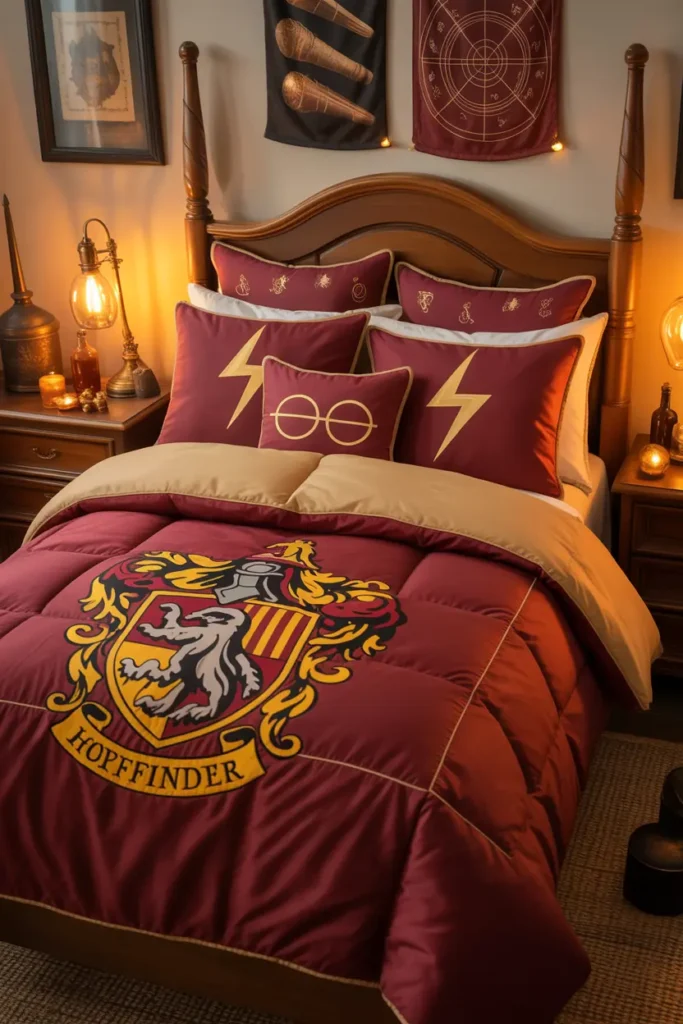
Bedding is the largest color statement in any bedroom, so it’s where your house allegiance belongs. Gryffindor’s deep red and gold, Slytherin’s forest green and silver, Ravenclaw’s blue and bronze, Hufflepuff’s yellow and black — pick your house and build the bedding around it. The key to keeping it classy rather than costume-y: use the colors, not the logos.
Layer it like the dorm beds: a dark duvet in the house color, cream or white sheets, a textured throw in the secondary color, and pillows in mixed fabrics (velvet, linen, knit). A crest throw pillow is fine — one. Ten logo items is a gift shop. The restraint is what makes it feel like an actual wizard’s bedroom instead of a theme park.
5. Build a Reading Corner
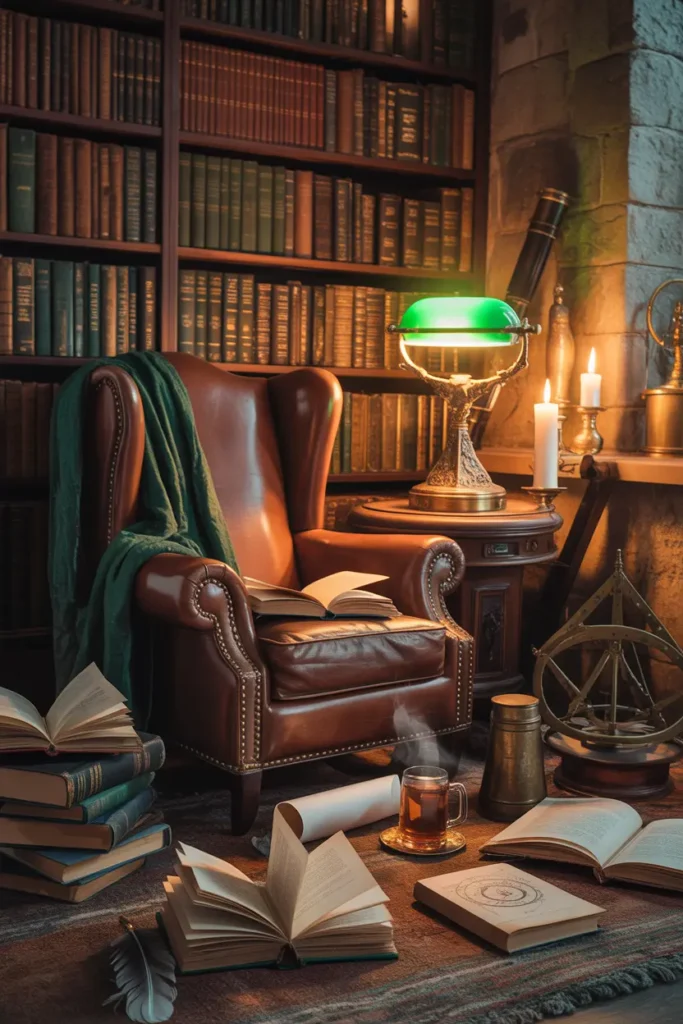
Every Hogwarts bedroom needs the corner where you’d curl up with a book during a thunderstorm. An armchair (leather or velvet, ideally a thrifted wingback), a small side table, a warm lamp, and a stack of books — that’s the whole formula. It doesn’t need much space; a 4×4-foot corner is plenty.
The books are non-negotiable: visible, abundant, slightly chaotic. Organize by color if you’re tidy, by chaos if you’re authentic — either way, they should look read, not displayed. Add a throw blanket over the chair arm and a candle-style lamp on the table, and you’ve built the most-used spot in the room.
6. Store Things in Trunks
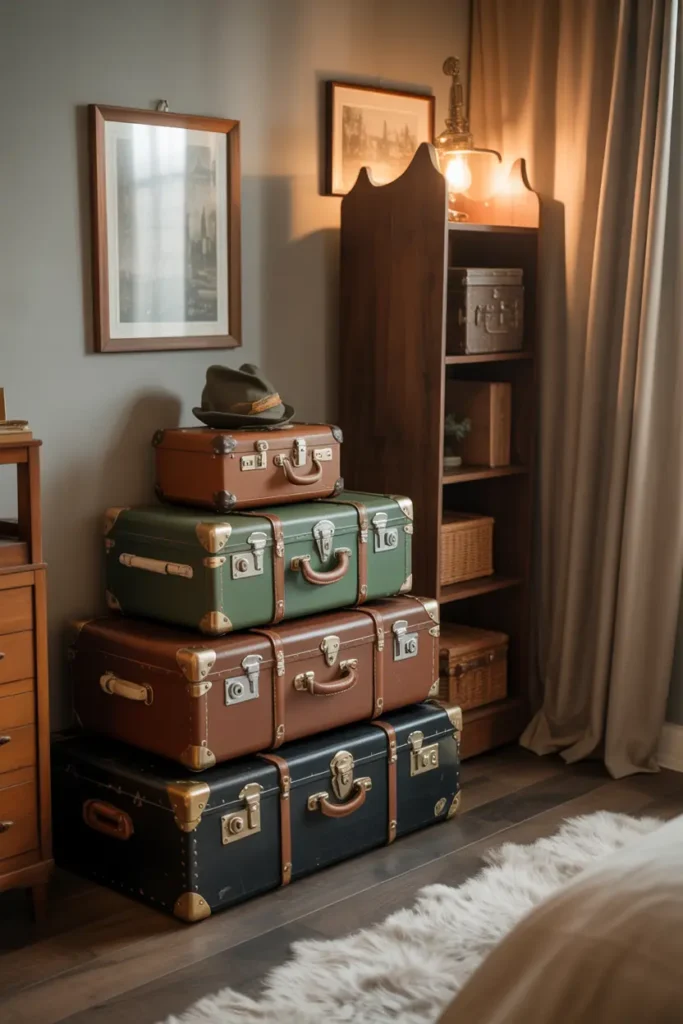
Modern plastic storage bins are the enemy of the aesthetic; vintage trunks are its best friend. A trunk at the foot of the bed, a stack of old suitcases in the corner — they hold clothes, blankets, and clutter while looking like you just arrived at Platform 9¾. Function and theme in perfect agreement.
Real vintage trunks run $40–$100 at flea markets and antique malls; new “vintage-style” ones cost less and work just as well for storage. Check that the latches work and give the interior a good clean (old trunks can smell like the last century — baking soda and sunshine fix most of it). Bonus: a trunk is also a bench, a side table, and a nightstand in a pinch.
7. Map the Walls
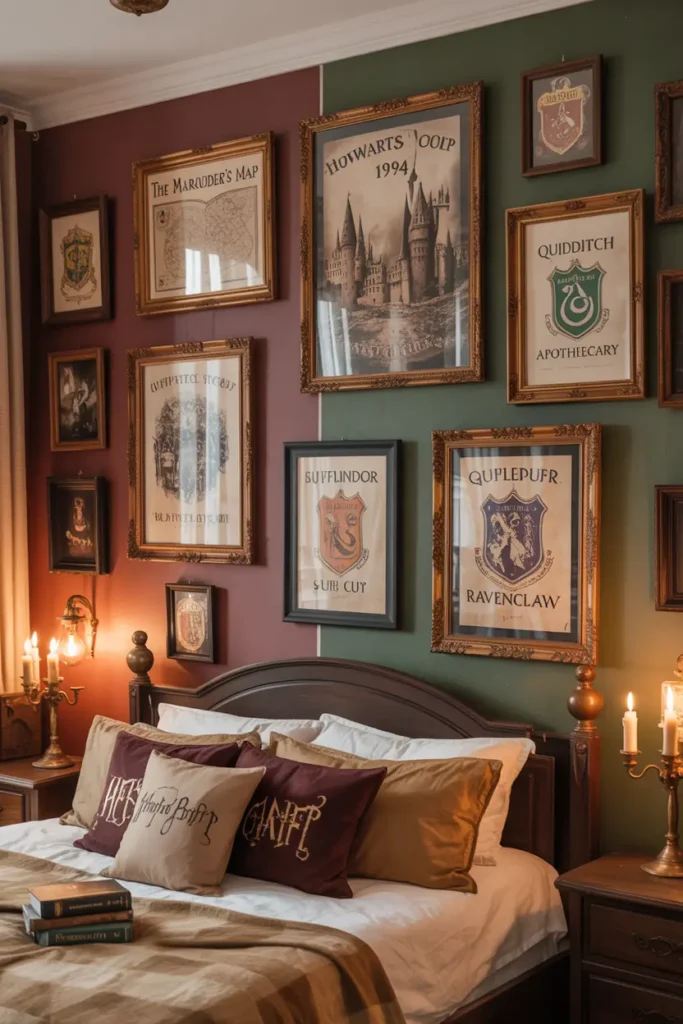
Walls are your storytelling surface. Vintage-style maps (the Marauder’s Map aesthetic), constellation charts, aged parchment prints, botanical illustrations of “magical” plants — these read as wizarding artifacts rather than merchandise. Frame them in dark wood or aged brass for the full effect.
Keep the frames consistent — all dark wood, all brass, all black — so a wall of different prints reads as a collection rather than clutter. One large map as a centerpiece beats ten small posters. And the DIY version is excellent: tea-stain regular paper, burn the edges carefully, print an old map, and frame it. Aged parchment is one of the easiest fakes in crafting.
8. Weave in Fairy Lights
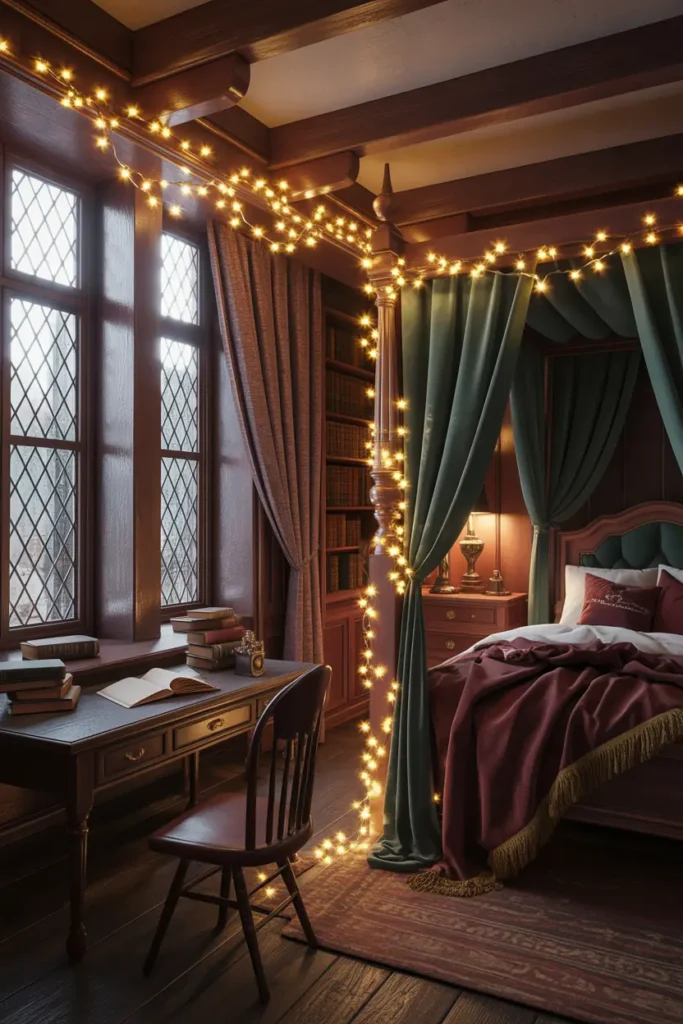
Fairy lights are the ambient magic that ties the dark palette together. Draped along shelves, around the headboard, or across the window, warm-white micro lights add the starry, enchanted glow that overhead lighting can’t provide. They’re the difference between “dark room” and “magical dark room.”
Copper-wire LED strings are the best version — nearly invisible wire, tiny warm bulbs, battery or USB powered. Avoid multicolor and avoid cool white; both break the spell instantly. One or two strands is plenty; the goal is glimmer, not illumination. Put them on a timer so the magic turns itself on at dusk.
9. Work the Green and Gold
Deep green and gold is the most Hogwarts color combination that isn’t house-specific — it echoes the Great Hall, the Slytherin common room, and about half the movie’s production design. Use it in the textiles: green velvet cushions, gold-toned throws, green curtains with brass tiebacks. Rich, moody, unmistakable.
This is an accent palette, not a wall palette — deep green walls plus green textiles is too much. Let the walls stay charcoal or navy and let the green-and-gold live in the soft furnishings, where it’s easy to adjust. Velvet is the fabric that sells this combination; its depth and sheen are what make green and gold look expensive.
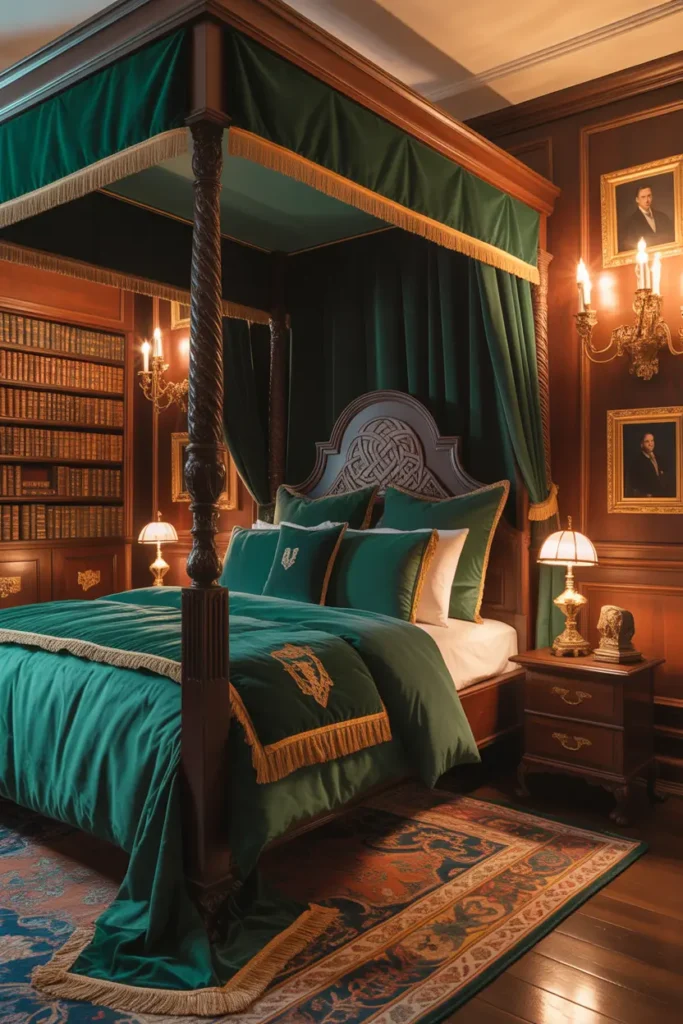
10. Drape the Bed
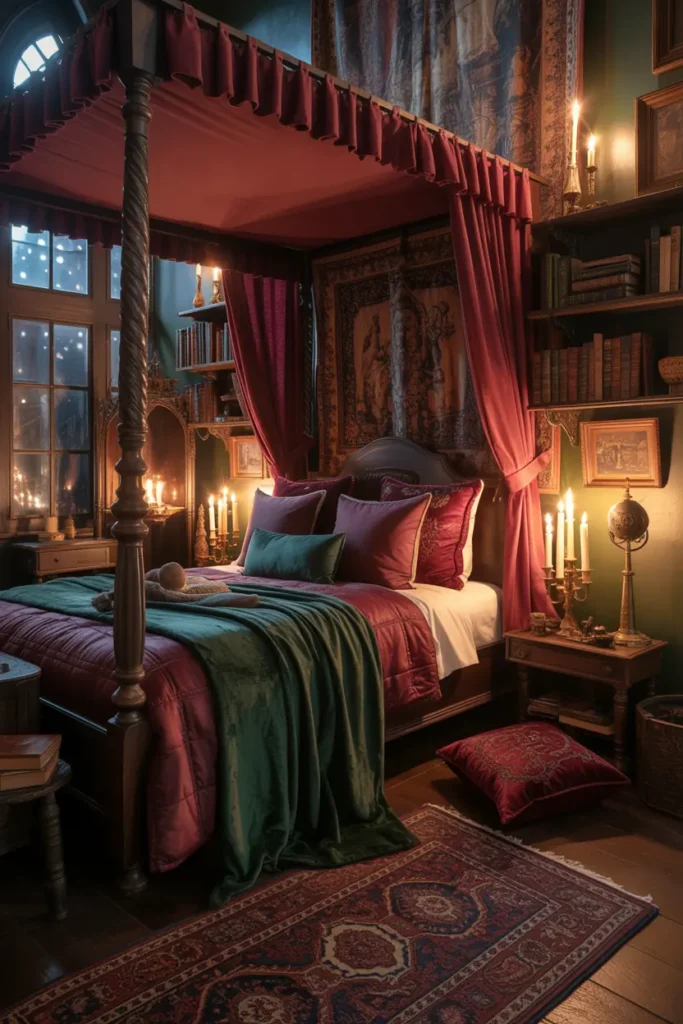
A canopy or bed drapes transform an ordinary bed into a four-poster dormitory bed — the single most transformative furniture move on this list. You don’t need an actual canopy frame: ceiling-mounted curtain tracks, or even fabric draped from hooks, create the enclosed, private feeling of the Hogwarts dorms.
Dark, heavy fabric (velvet, brocade, dark linen) for full drama; sheer dark voile for a softer version that still lets light through. Leave the foot end open so it doesn’t feel claustrophobic, and make sure the fabric is washable — bed drapes collect dust. The enclosed feeling is deeply cozy once you’re inside; it’s the bedroom equivalent of a blanket fort, but elegant.
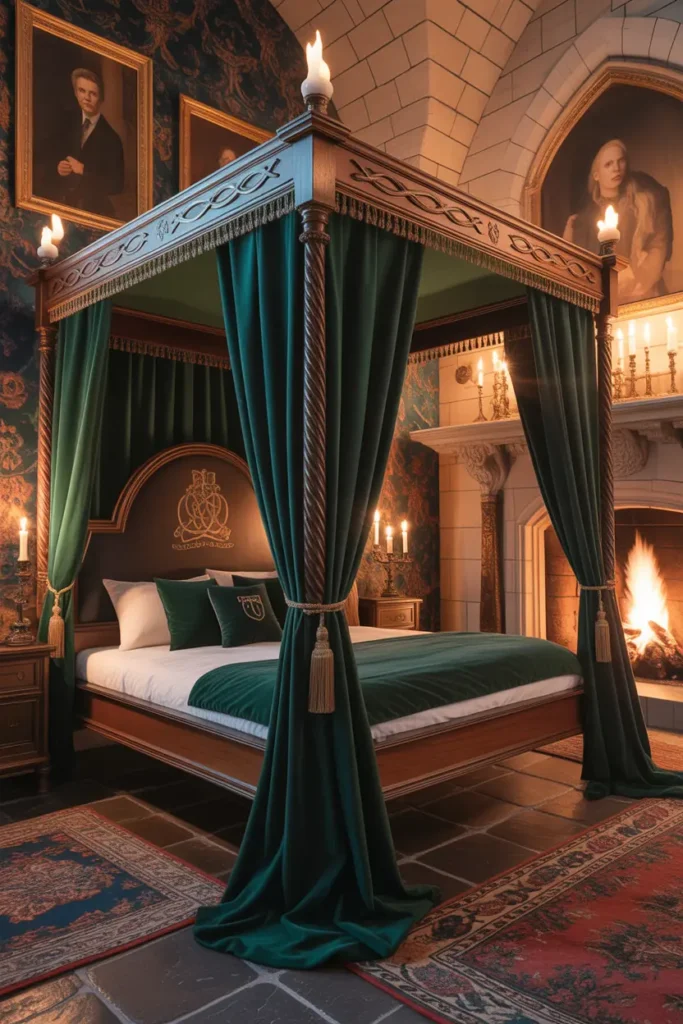
11. Bottle Your Potions
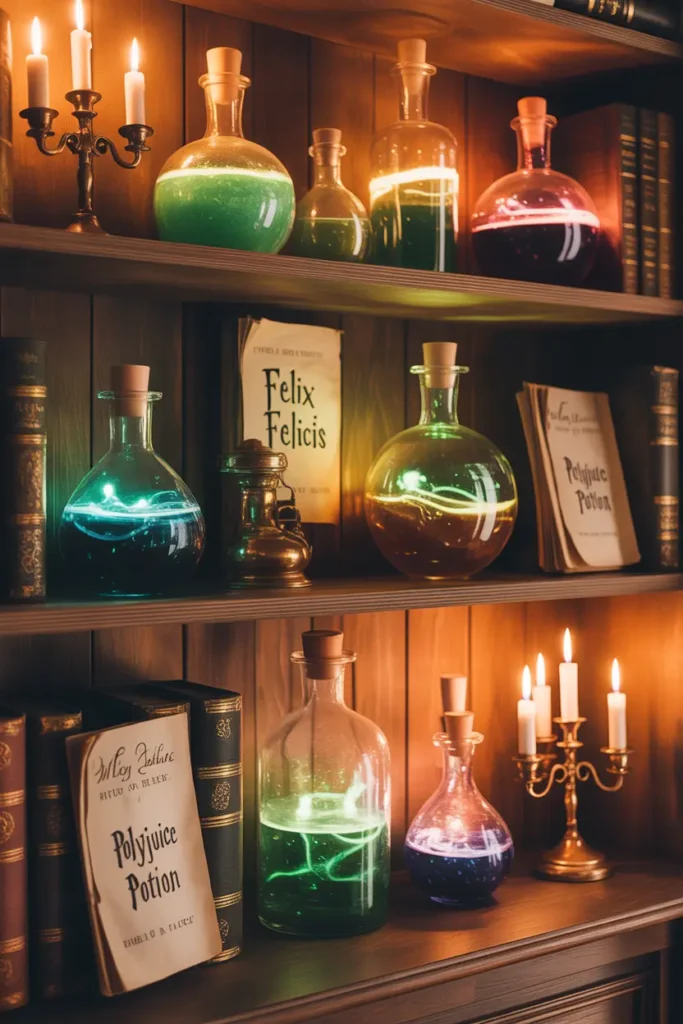
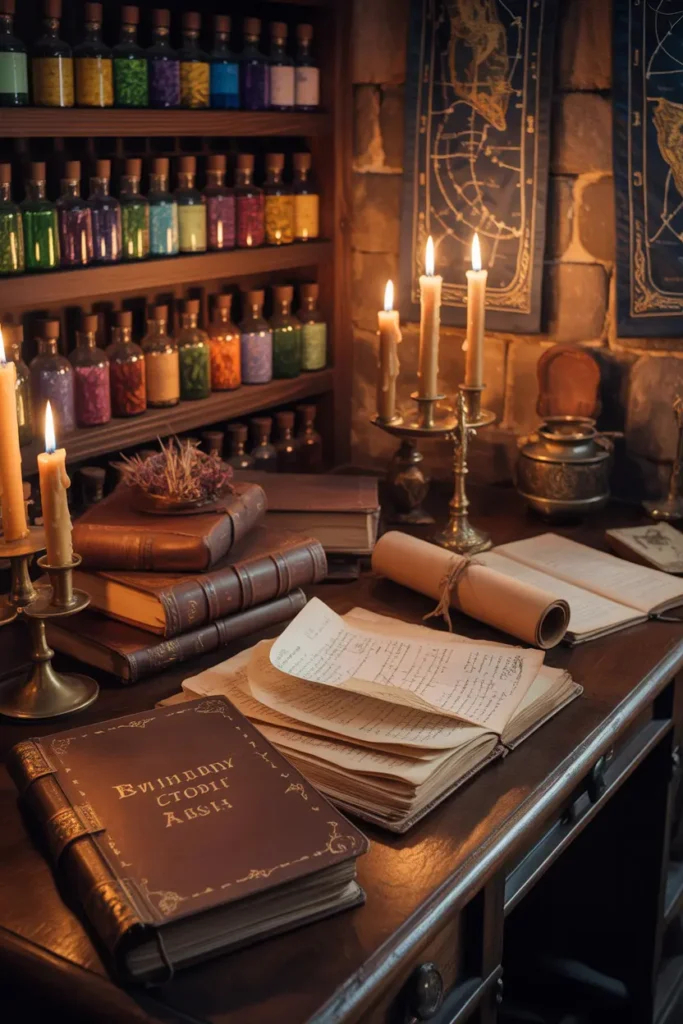
A shelf of apothecary bottles is the detail that makes visitors grin. Collect interesting glass bottles — vintage shops, thrift stores, even interesting empties — fill some with colored water, dried herbs, or fairy lights, label a few with aged tags (“Polyjuice,” “Felix Felicis,” “Butterbeer”), and arrange them on a shelf or desk. Instant Potions classroom.
The styling matters: group in odd numbers, vary heights, and backlight them if possible — a $10 LED strip behind the shelf makes the bottles glow like they contain something actually magical. Keep it to one shelf or one corner; potion bottles throughout the whole room crosses from charming to cluttered.
12. Fake the Castle Walls
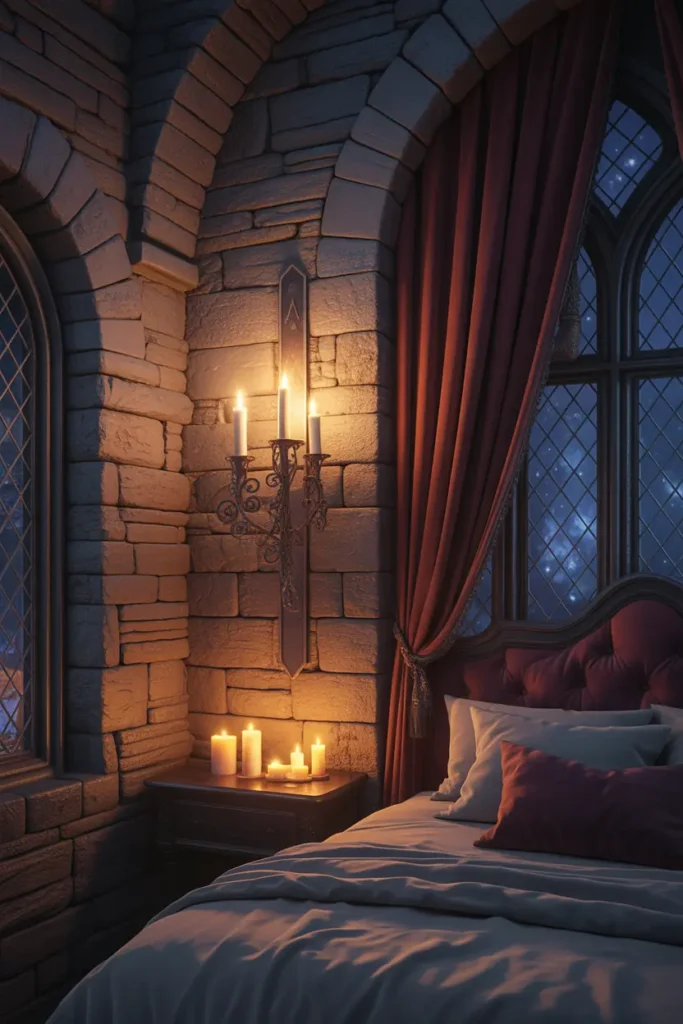
Stone or brick-effect wallpaper on one wall is the fastest way to feel like you’re sleeping inside the castle. Modern textured wallpapers have gotten remarkably convincing — from two feet away, good stone wallpaper reads as real masonry. One wall behind the bed is all you need; the texture does the rest.
Peel-and-stick versions make this renter-friendly and commitment-free. Choose a gray-toned stone rather than red brick — gray stone reads as “ancient castle,” red brick reads as “loft apartment.” And keep the other walls simple; the stone wall is the statement, and statements need quiet around them.
13. Set Up a Wizard’s Desk
A small wooden desk styled as a study area doubles as decor and function. Quills in an inkwell (or just interesting pens in a jar), a stack of old books, a candle-style lamp, a magnifying glass, some rolled “parchments” — it’s a still life that happens to be where you do homework. The best themed decor is decor you actually use.
Keep the desk itself simple and wooden — the styling provides the theme, not the furniture. A desk organizer in dark wood or leather keeps it functional; the magical items should look collected over time, not purchased as a set. One authentic-looking piece (a real brass compass, an actual old book) anchors the whole arrangement.
14. Go Heavy on the Fabrics
Hogwarts is a tactile place — velvet curtains, heavy tapestries, thick blankets. Layering rich fabrics is what makes the room feel enveloping rather than just dark. Velvet cushions, a brocade throw, heavy drapes, a thick rug: the weight of the textiles is the point.
Velvet is the star fabric — its light-absorbing depth is unmatched — but use it in the jewel tones of the palette (deep green, burgundy, navy, gold). Mix in one nubby texture (a knit throw, a woven rug) so it’s not all smooth luxury. And everything should be touchable; the room should invite you to sink in, not just look at it.
15. Whisper the House Pride
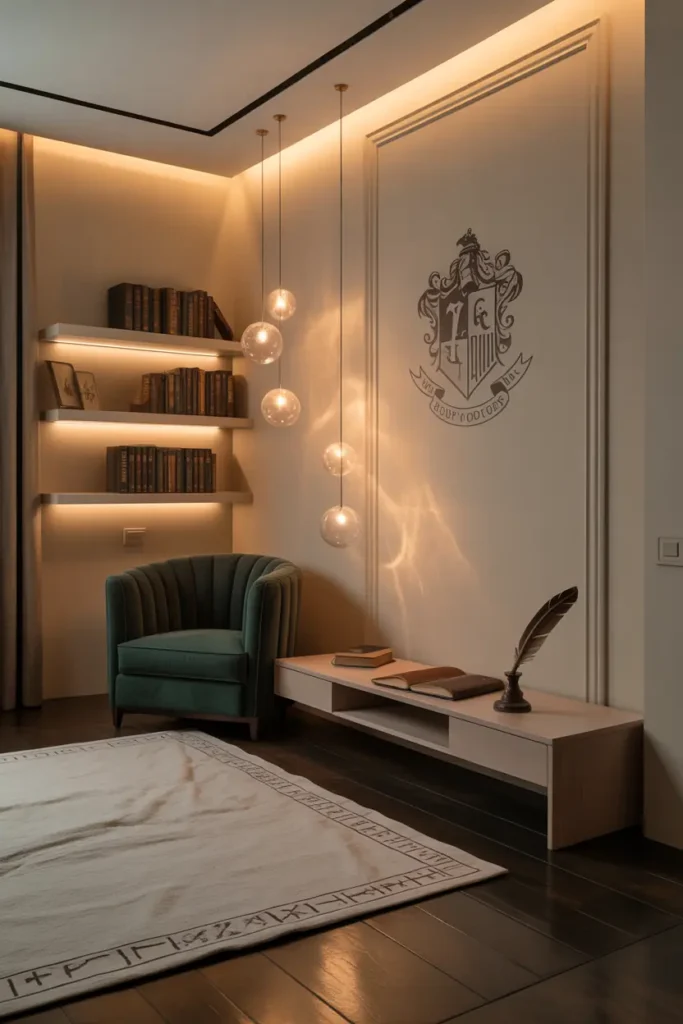
The difference between tasteful and tacky is volume. Instead of a giant house crest banner, use house colors in the textiles, a small crest on one pillow, the house animal in a piece of art, a scarf draped over a chair. People who know will recognize it instantly; people who don’t will just see a well-designed room.
The one-large-item rule: you get one overt house item (a crest pillow, a house banner, a themed blanket). Everything else should be color and texture. This restraint is what separates a room designed by a fan from a room decorated by a marketing department.
16. Claim the Window
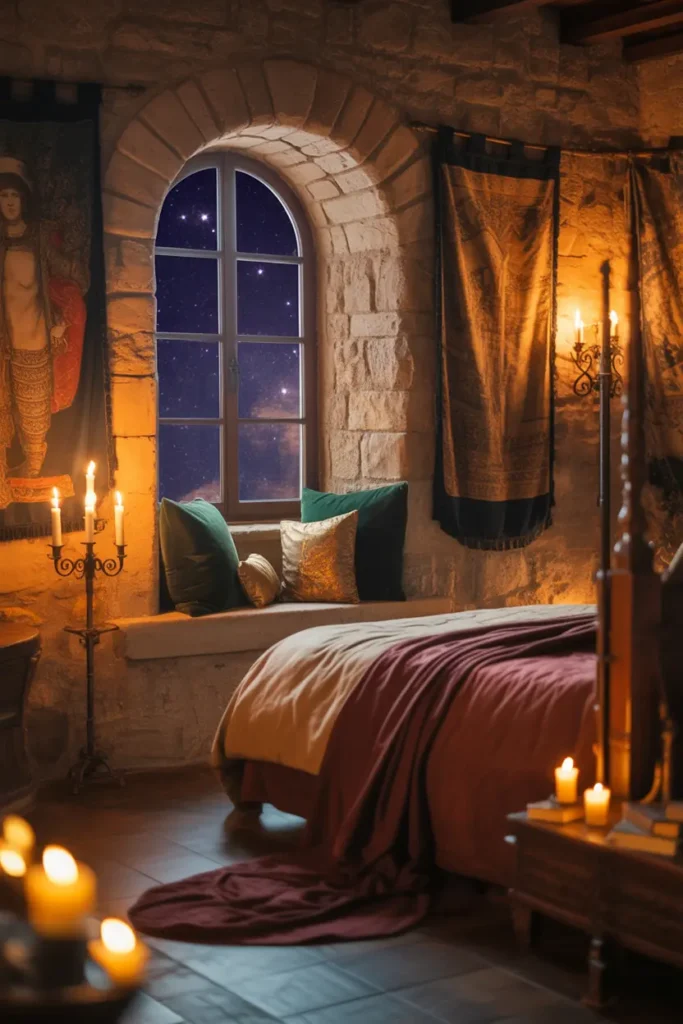
A window seat or styled window area becomes the castle lookout — the spot for dramatic staring-into-the-distance. Even without a built-in seat, a cushion on a wide sill (or a chair pulled up to the window), heavy drapes, and a view dressed with fairy lights creates the nook. It’s about framing the outside world like a painting.
If the view is uninspiring, make the window itself the feature: dramatic drapes, a stained-glass-effect film, or plants on the sill that draw the eye. At night, the window becomes a black mirror — dress it accordingly with the drapes closed and candles nearby. The nook should feel like a secret, not like seating.
17. Layer the Rugs
Castle floors are stone and cold; layered rugs fix that while adding the texture the theme demands. A large flat-weave base rug in a dark tone, with a smaller vintage-patterned rug on top at an angle — the layering looks collected and intentional, and your feet will thank you every morning.
Choose rugs with some age to them (or good reproductions): Persian-style, kilim, or vintage-look patterns in deep reds, blues, and golds. The layers should overlap casually, not align perfectly — precision looks modern, and modern is not the goal. And use rug pads; layered rugs slide, and sliding rugs are a hazard.
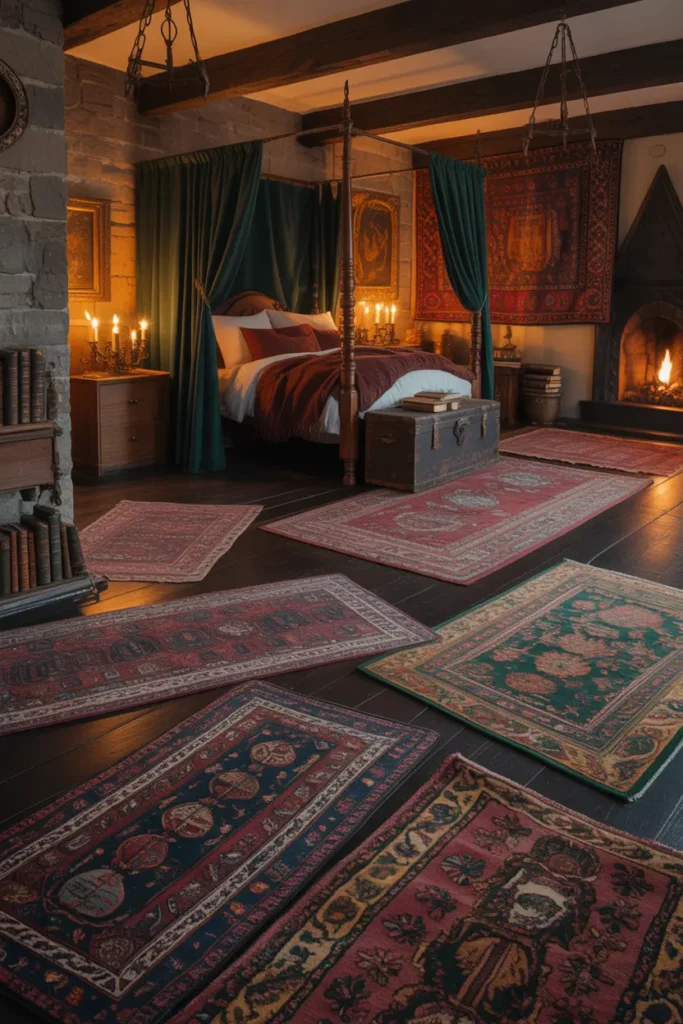
18. Light It With Candle-Style Lamps
Real candles everywhere is a fire hazard; candle-style LED lamps are the safe version that looks nearly as good. Flameless pillar candles with flicker effects, candle-style wall sconces, lantern-style table lamps — they provide the warm, dancing light that defines the atmosphere without any of the risk.
Cluster them: three flameless pillars of varying heights on the nightstand, a lantern on the desk, sconces flanking the bed. The flicker setting is essential — steady LED light reads as electric, flickering reads as flame. Put the clusters on timers so the room lights itself at dusk like the castle’s enchanted candles.
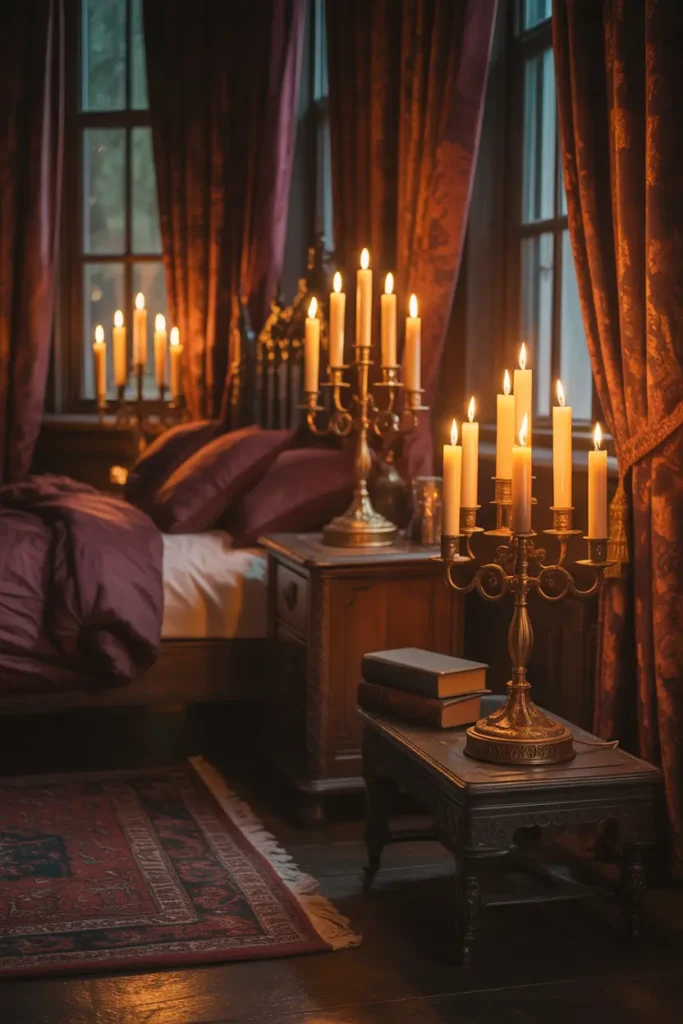
19. Hang Heavy Drapes
Light curtains have no place at Hogwarts. Heavy, floor-pooling drapes in dark velvet, brocade, or lined linen frame the windows like the Great Hall’s tapestries and add the acoustic softness that makes the room feel enclosed and safe. They’re also excellent blackout curtains, which is practical magic for sleep.
Hang them high (4–6 inches below the ceiling) and wide (6–12 inches beyond the window frame) — the oversized scale is what makes them look expensive and dramatic. Let them kiss or slightly pool on the floor; precisely hemmed curtains look tailored, and tailored is not the aesthetic. Weight is everything: hold the fabric up in the store — if light passes through easily, it’s not heavy enough.
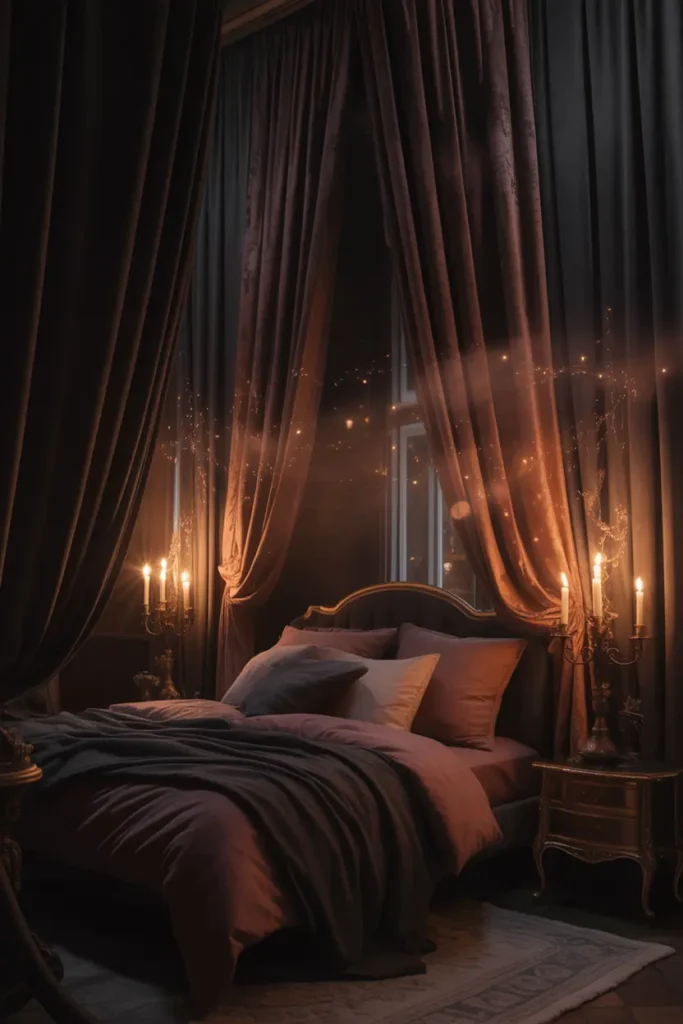
20. Build the Library Wall
Books are the soul of the Hogwarts aesthetic — floor-to-ceiling, wall-to-wall, slightly chaotic books. Dedicate one wall (or one large bookcase) to books: yours, thrifted, borrowed-and-never-returned. Organize by color for visual calm or by chaos for authenticity; either way, the sheer volume of spines creates the scholarly, ancient feeling.
Fill gaps with magical objects — the potion bottles, a brass telescope, a globe, framed botanical prints. A bookcase styled with 80% books and 20% objects reads as a library; 50/50 reads as a display shelf. And actually read them — a library of unread books is just expensive wallpaper. The best-decorated Hogwarts room is one where the books are worn.
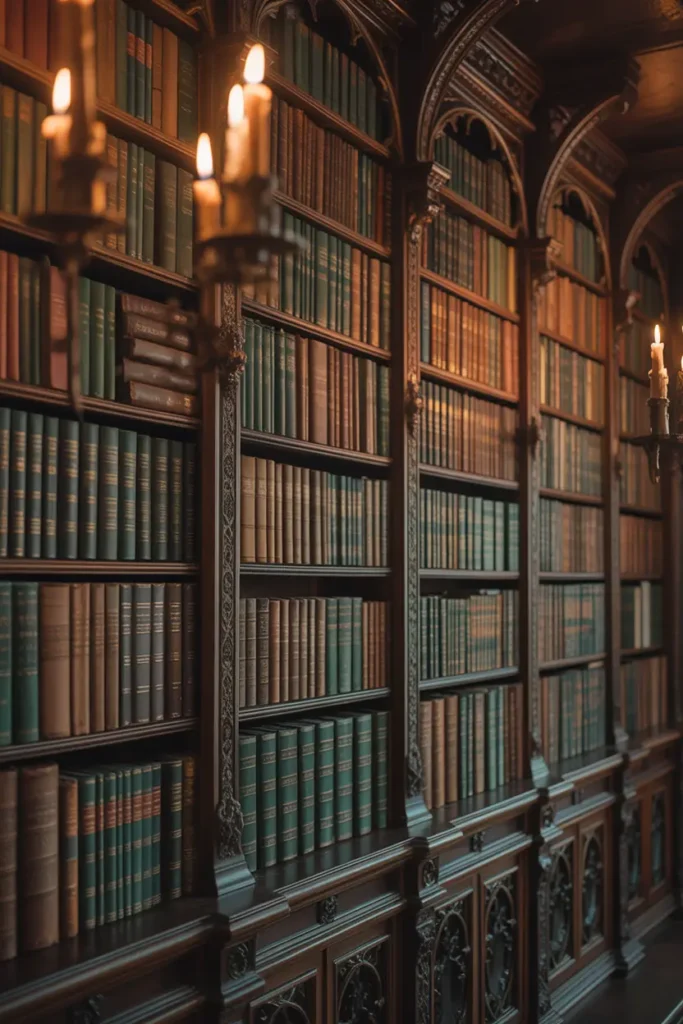
21. Add Metallic Glints
Gold and bronze details are the jewelry of the theme — candle holders, picture frames, drawer pulls, a brass telescope on the desk. Against all the dark wood and moody color, metallics catch the candlelight and glint, which is exactly the kind of small magic the room needs.
Aged brass and bronze beat shiny gold here — they look like they’ve been in the castle for centuries. Keep it to small accents; the metals should glint at the edges of vision, not dominate. Three to five metallic touches per sightline is plenty. Tarnish is a feature, not a flaw — polish only the pieces you want to shine.
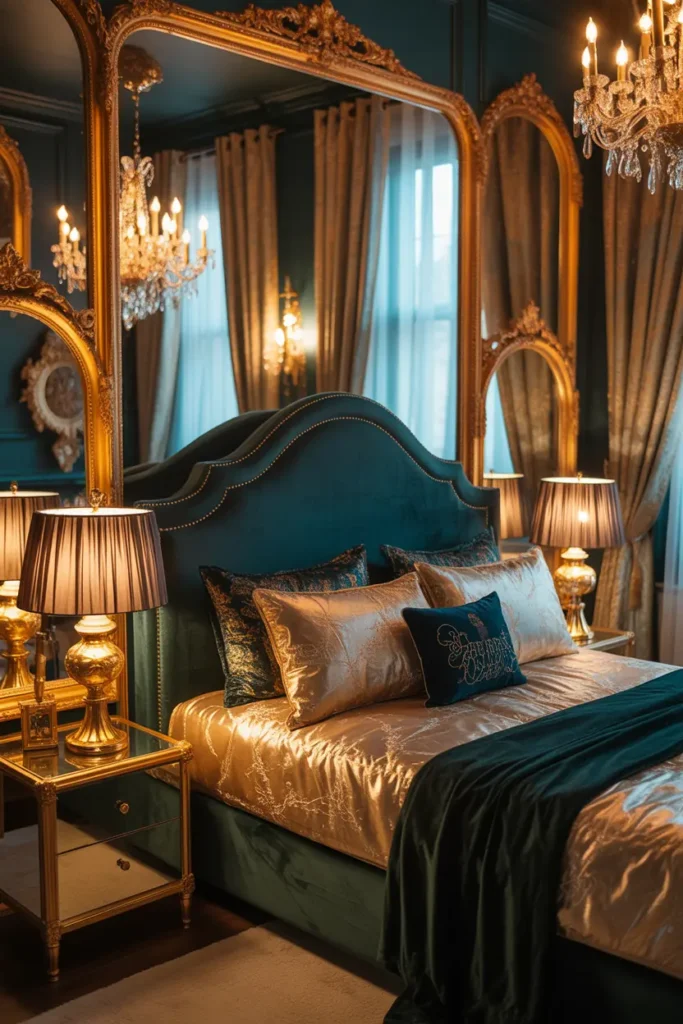
22. Keep It Cozy, Not Cramped
Hogwarts dorms are intimate — four posters close together, low light, everything within reach. Recreate the feeling (enclosed, safe, cozy) without the reality (tripping over furniture). Pull furniture slightly closer than you normally would, keep the lighting low and warm, and let the textiles do the enclosing instead of the furniture.
The line between cozy and cramped is clear pathways: you should be able to walk from door to bed to window without sidestepping anything. If you can’t, edit. Cozy is a feeling created by light and fabric; cramped is a reality created by too much stuff. The room should hug you, not trap you.
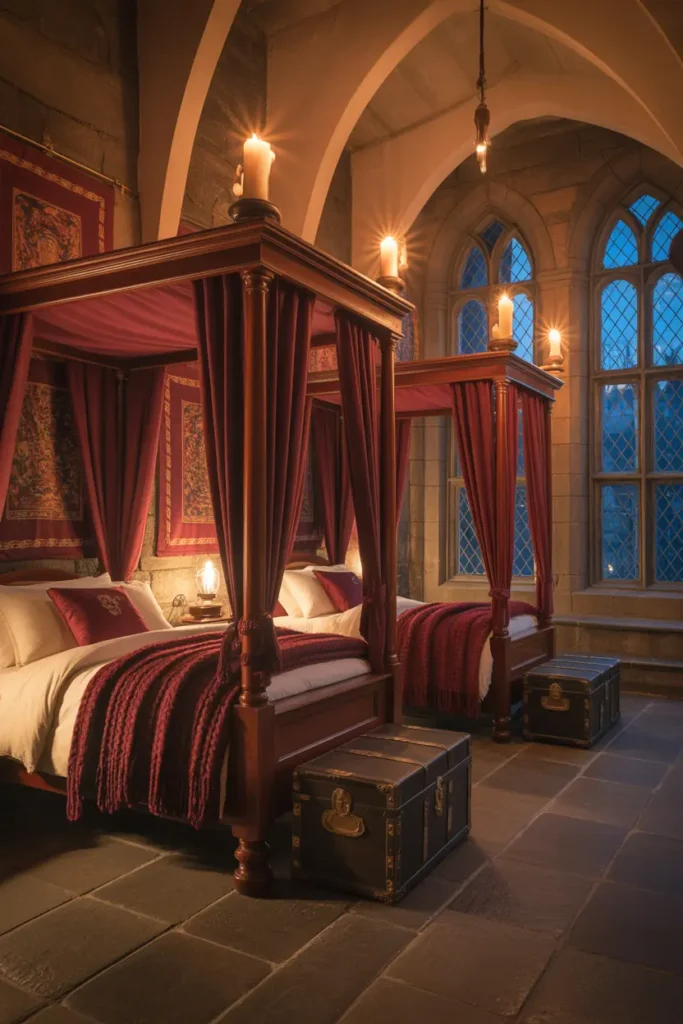
23. Pile On the Throws
Throw blankets are the exclamation point of a cozy room, and in a Hogwarts bedroom they should be abundant: one folded at the foot of the bed, one draped over the reading chair, one within arm’s reach of the window nook. Chunky knits, plaids, faux fur — texture and weight are what matter.
Stick to the palette (deep reds, forest greens, golds, charcoals) so the abundance reads as intentional rather than chaotic. And buy throws you’ll actually use — the best-styled throw is the one that’s slightly rumpled from being grabbed during a movie. A pristine, never-touched throw is just expensive decoration.
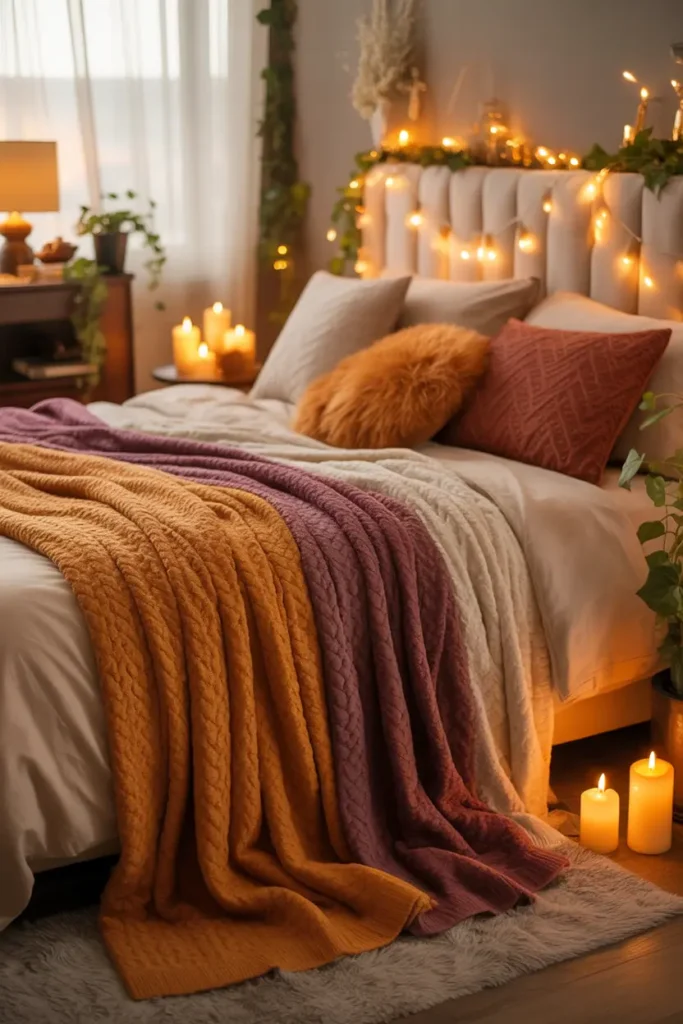
24. Let Modern Comfort Hide Underneath
The final secret of great themed rooms: they’re secretly comfortable. Under the vintage aesthetic, keep the modern essentials — a genuinely good mattress, blackout capability in those heavy drapes, enough outlets (hidden in the nightstand), and decent heating. A beautiful room you can’t sleep in is a museum, not a bedroom.
Hide the modern stuff: cord covers painted to match the wall, a charging station inside a vintage box, the Wi-Fi router behind books. The theme should be what you see; the comfort should be what you feel. That’s the real magic — a room that looks like 1995 but sleeps like 2026.
Related Decor Ideas
If you enjoyed these ideas, you might also like:
- Vintage farmhouse bedroom ideas
- Dark academia bedroom styling inspiration
- Small bedroom decor ideas for creative themes
- Cozy lighting ideas for modern bedrooms
Conclusion
The magic of a Harry Potter bedroom was never about the merchandise — it’s about atmosphere. Candlelight, old wood, heavy fabrics, books everywhere, and the feeling of being somewhere ancient and safe. Get those right and the theme takes care of itself; get them wrong and no amount of licensed bedding will save the room.
Start with light and fabric — floating candles and heavy drapes transform a room in a single weekend. Then build the layers: the maps, the trunks, the library wall. And remember the golden rule of themed design: if a guest who’d never heard of Harry Potter walked in, they should still think it’s a beautiful room. That’s when you know the magic is real.
Pro Tips
- LED only for anything hanging or unattended. Floating candles, fairy lights, lanterns — all flameless. Real candles are for the tub-side and the desk, where you can see them, and never left burning when you leave the room.
- Thrift first, buy new second. The aesthetic requires aged, imperfect things — which is exactly what thrift stores sell cheapest. New “vintage-style” items cost more and look less authentic. Budget 2–3 months of casual thrifting for the best finds.
- Keep one wall calm. With this much theme, one plain wall (painted deep, no decor) gives the eye somewhere to rest. It’s the difference between immersive and overwhelming.
- Test the theme at night. This room lives after dark — that’s when the candles, fairy lights, and shadows do their work. Evaluate every change in evening light, not daylight. What looks moody at night can look merely dark at noon.
FAQs
How do I do a Harry Potter bedroom without it looking childish?
Lean into the dark academia foundation — moody colors, vintage wood, real books, quality fabrics — and keep branded merchandise to an absolute minimum (one item max). An adult guest should read the room as “moody vintage library bedroom” first and “Potter fan” second. Sophistication comes from materials, not logos.
What’s the cheapest way to get the floating candle effect?
A 12-pack of flickering LED taper candles ($15–$25) plus a spool of clear fishing line ($5) and small clear ceiling hooks. Hang at varying heights over the bed. Total cost under $35, total time about an hour, and it’s the single most transformative move in this guide.
Can this work in a small bedroom?
Yes — small rooms actually suit the cozy dormitory feeling. Focus on the high-impact, low-footprint moves: dark accent wall, floating candles, layered bedding, fairy lights, and one trunk instead of a dresser. Skip the canopy (eats visual space) and keep pathways clear.
Is it okay to mix Hogwarts houses in one room?
Design-wise, pick one house palette and commit — mixed house colors (red + green + blue + yellow) read as chaotic. If household members support different houses, give each person their zone (bedding vs. desk area) in their colors, tied together with shared neutrals like charcoal and brass.

HowDecor is a home decor blog sharing simple, practical decorating ideas for everyday spaces. We believe a beautiful home should feel comfortable, personal, and full of warmth — and that great style does not require a huge budget. Our goal is to inspire readers to create spaces that feel peaceful, welcoming, and truly their own — one room at a time.