There’s a particular blue — the blue of shallow water over white sand, of a morning sky just after the stars give up — that does something to a bathroom nothing else can. Pale blue doesn’t decorate a bathroom so much as change its weather. Rooms painted in it feel cooler in summer, calmer at 6 a.m., and somehow cleaner even when they’re not.
The trick with pale blue is that it’s a quiet color, so it needs confident decisions around it. Wishy-washy blue with wishy-washy everything else just looks faded. These ten ideas are about giving pale blue the strong, simple partners it needs — white, wood, stone, light — so the whole room breathes.
Table of Contents
- Idea 1: Pale Blue Minimal Spa Bathroom
- ✨ Idea 2: Pale Blue and White Classic Combo
- ✨ Idea 3: Pale Blue Vanity Cabinets
- ✨ Idea 4: Pale Blue Tile Shower
- ✨ Idea 5: Pale Blue Cottage Bathroom
- ✨ Idea 6: Pale Blue Marble Walls
- ✨ Idea 7: Pale Blue Ceiling Touch
- ✨ Idea 8: Pale Blue Wallpaper Accent
- ✨ Idea 9: Pale Blue Sink Basin
- ✨ Idea 10: Pale Blue and Wood Balance
Idea 1: Pale Blue Minimal Spa Bathroom
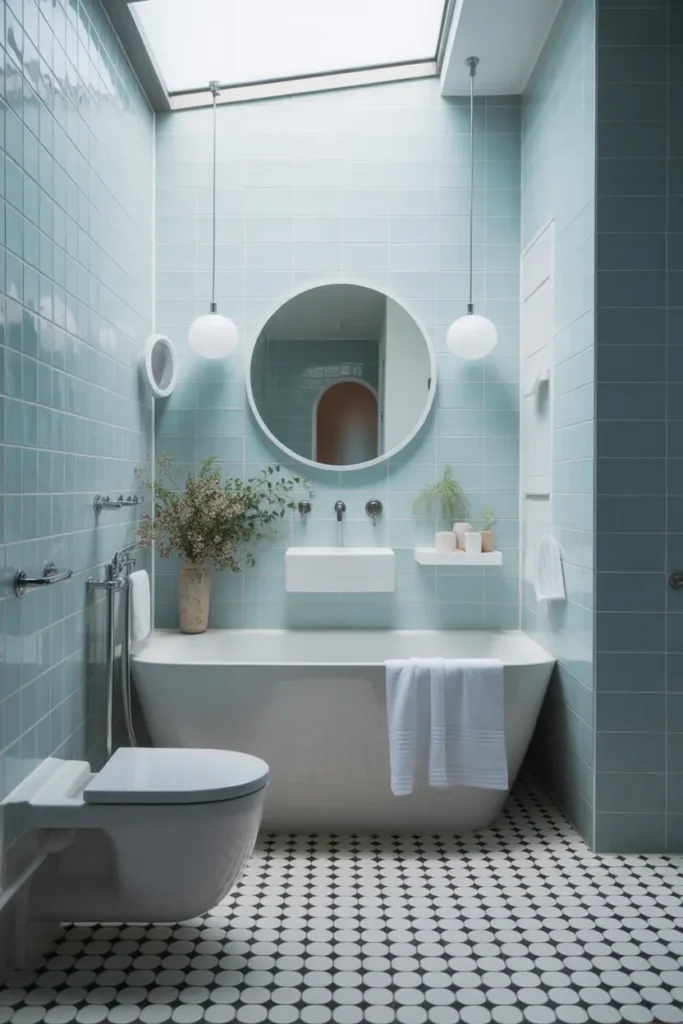
The spa look isn’t about stuff — it’s about the absence of stuff, plus three deliberate choices: pale blue walls, white fixtures, and one living thing. A eucalyptus stem in a glass bottle on the vanity, a small fern on the windowsill. That single note of green keeps the blue from feeling cold, the way one warm lamp keeps a white room from feeling clinical.
Keep surfaces clear enough that you can wipe the counter in ten seconds — that’s the real spa test. Decant soap and lotion into two matching dispensers, fold one white towel instead of stacking five, and let the pale blue do the talking. Spas feel calm because nothing competes for your attention; your bathroom can do the same with about twenty minutes of editing.
Idea 2: Pale Blue and White Classic Combo
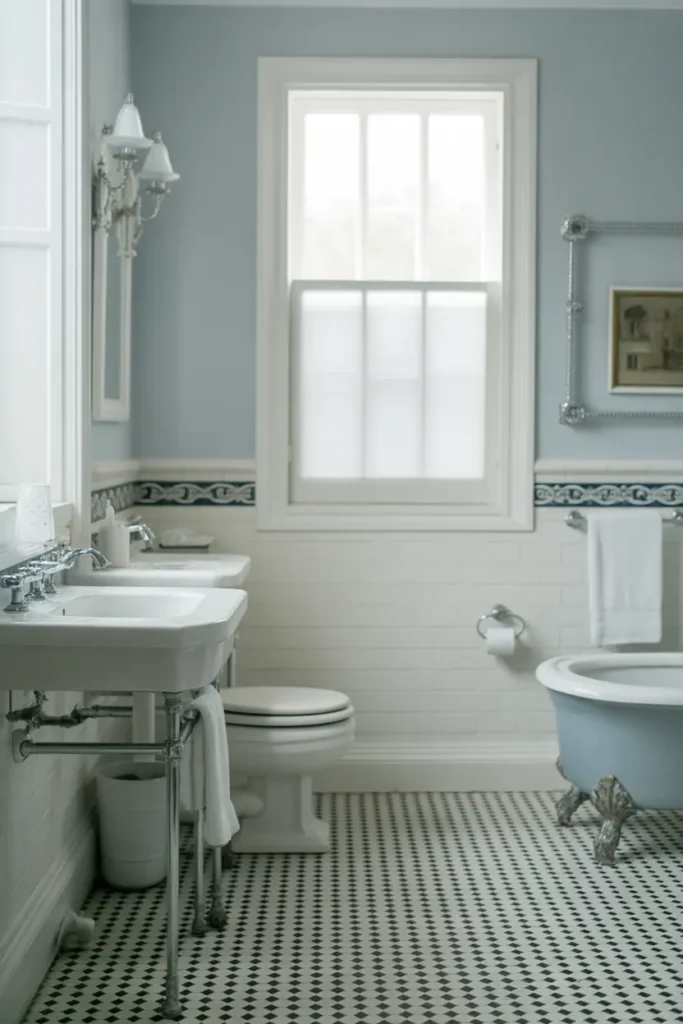
Some combinations survive because they’re true, not because they’re trendy. Pale blue and white is one of them — it’s worked in bathrooms for a century because white reflects light and blue softens it. The classic execution: white subway or square tile, pale blue walls above, white fixtures throughout. Nothing to date, nothing to tire of.
The refinement is in the whites. Use the same white on tile, trim, and ceiling so the room reads as one continuous bright shell, then let the pale blue sit inside it like water in a basin. Chrome or polished nickel fixtures suit this pairing best — their cool shine belongs to the same family as the palette. Warm brass fights it; save brass for warmer schemes.
Idea 3: Pale Blue Vanity Cabinets

A vanity in pale blue — powder blue, whisper blue, the color of faded denim — is the gentlest possible statement. Against a white countertop and white walls, it reads as a breath of color rather than a commitment, which makes it perfect for anyone nervous about color. It’s there, it’s lovely, and it never shouts.
Because the color is so soft, the hardware matters more than usual: it becomes the jewelry. Slim brushed-nickel bar pulls keep it modern; small round porcelain knobs push it cottage. Paint it yourself with cabinet enamel (sand, prime, two thin coats, cure a week) or order it — but whatever you do, don’t pair pale blue cabinetry with a busy granite. White quartz or marble keeps the whole composition quiet.
Idea 4: Pale Blue Tile Shower
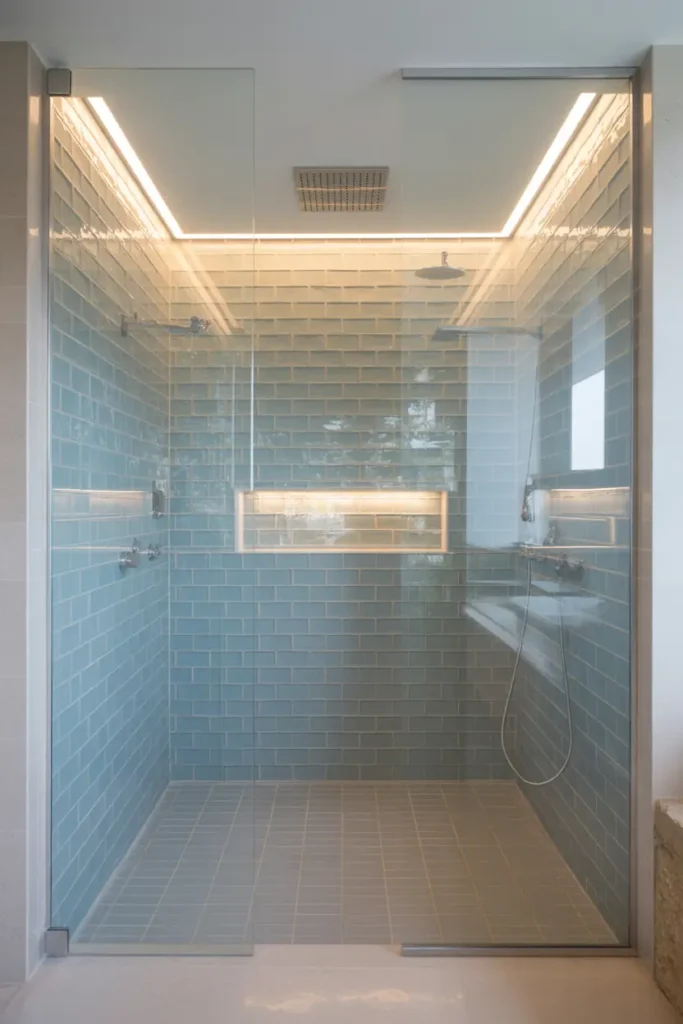
A shower in pale blue tile is the closest most of us get to bathing in the Aegean. Glossy pale blue tile — subway, square, or the elongated 2×8 planks — reflects water and light until the whole enclosure glows. Run it floor to ceiling; a half-tiled shower with painted drywall above breaks the spell exactly where your eye goes.
Keep the grout close to the tile color. White grout on pale blue tile creates a grid that shouts “tile!”; matching grout lets the color read as one continuous wash of blue, which is the entire point. Clear glass (not frosted, not patterned) keeps the glow visible from the rest of the room — the shower becomes the bathroom’s lantern.
Idea 5: Pale Blue Cottage Bathroom
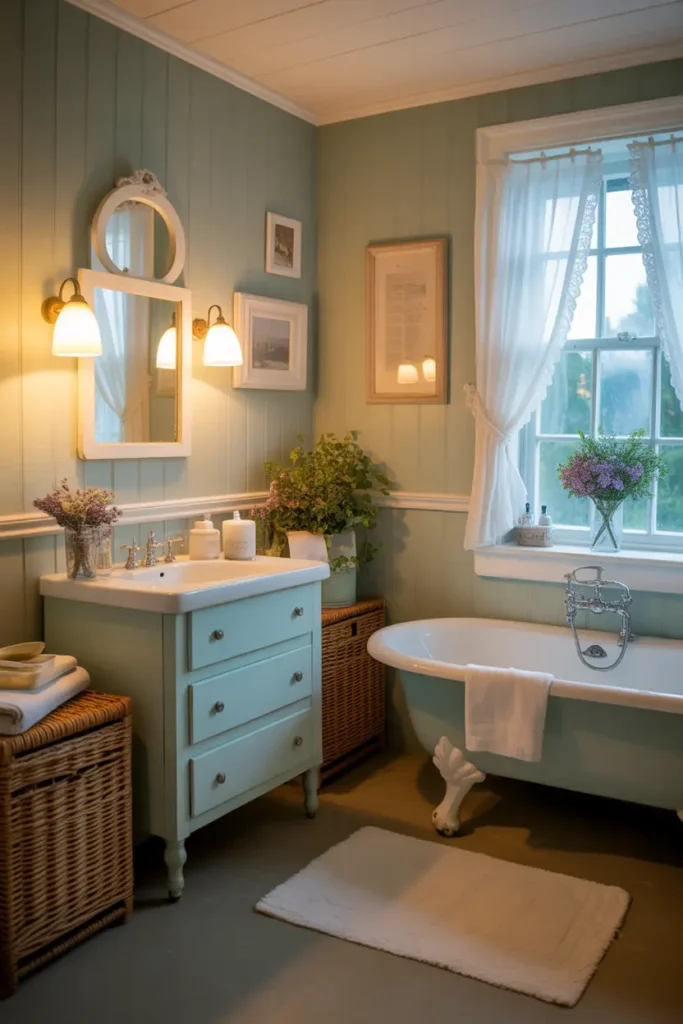
Pale blue is cottage style’s home turf — beadboard painted powder blue, a vintage-style faucet, a floral curtain that isn’t trying too hard. The cottage formula: pale blue on the beadboard or wainscot, warm white above, and texture everywhere — a woven hamper, a ruffled shower curtain, towels with actual fringe. Texture is what makes cottage feel collected rather than decorated.
The line between charming and fussy is a short one. One vintage element (the mirror, the light fixture, the faucet) per bathroom is plenty; three vintage elements plus florals plus ruffles tips into theme. Let the pale blue be the through-line and keep everything else simple — cottage is a feeling, not a checklist.
Idea 6: Pale Blue Marble Walls
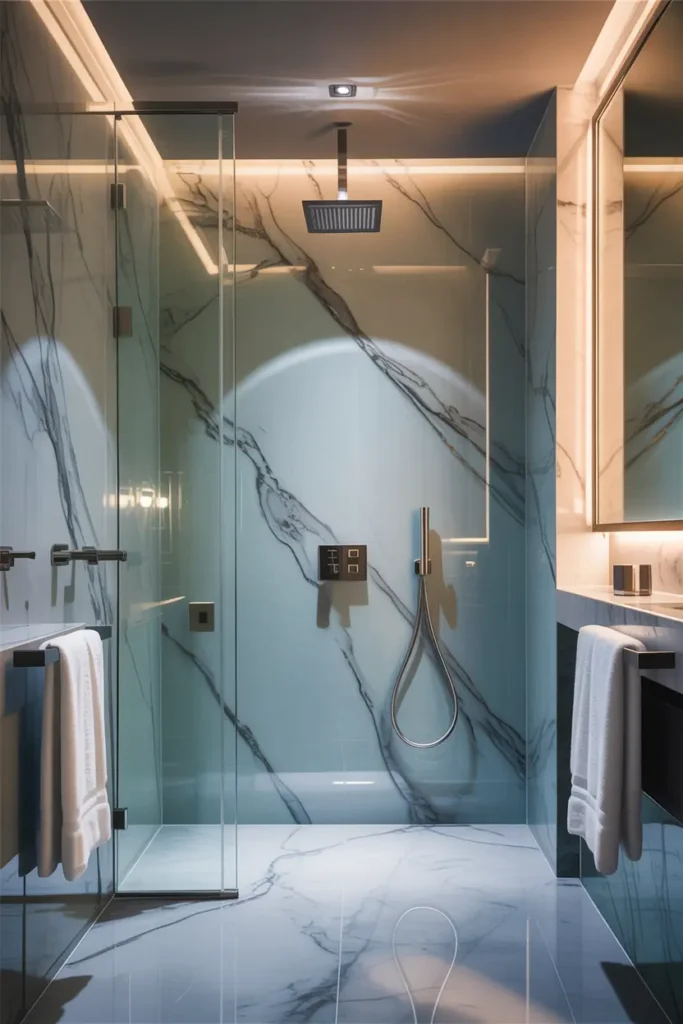
Blue marble — or the pale blue-grey marbles like Azul Cielo — brings veining into the palette, which is what pale blue usually lacks: movement. A marble wall behind the vanity, veined in soft blue-grey on white, gives the room a natural artwork that no paint can imitate. It’s the most luxurious application of pale blue there is, because the color comes from the earth, not a can.
Use it where you’ll see it up close — the vanity wall, the shower — not across vast expanses where the cost multiplies and the effect dilutes. And seal it: marble is porous, and a bathroom is wet. A penetrating sealer every 6–12 months is the price of admission. If the maintenance gives you pause, the large-format porcelain marbles ($8–$15/sq ft) capture the look faithfully.
Idea 7: Pale Blue Ceiling Touch
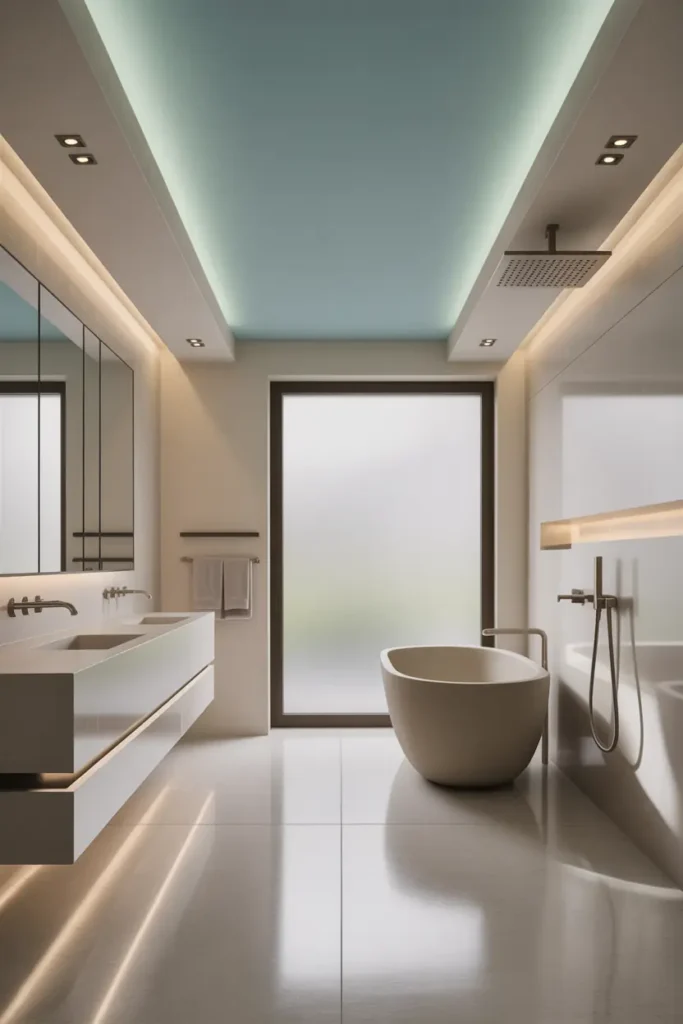
The traditional Southern porch ceiling — haint blue, meant to mimic the sky and, legend says, confuse spirits — belongs in bathrooms too. A pale blue ceiling over white walls lifts the room in a way that’s hard to describe until you stand under it: the ceiling stops being a lid and starts being sky. It costs a sample pot and an afternoon.
Flat paint only — ceilings show every roller mark in anything glossier. And this works best with genuinely white walls; against cream or beige, pale blue can read as a mistake rather than a choice. In a bathroom with a skylight or generous window, the effect doubles: real sky above, painted sky below.
Idea 8: Pale Blue Wallpaper Accent
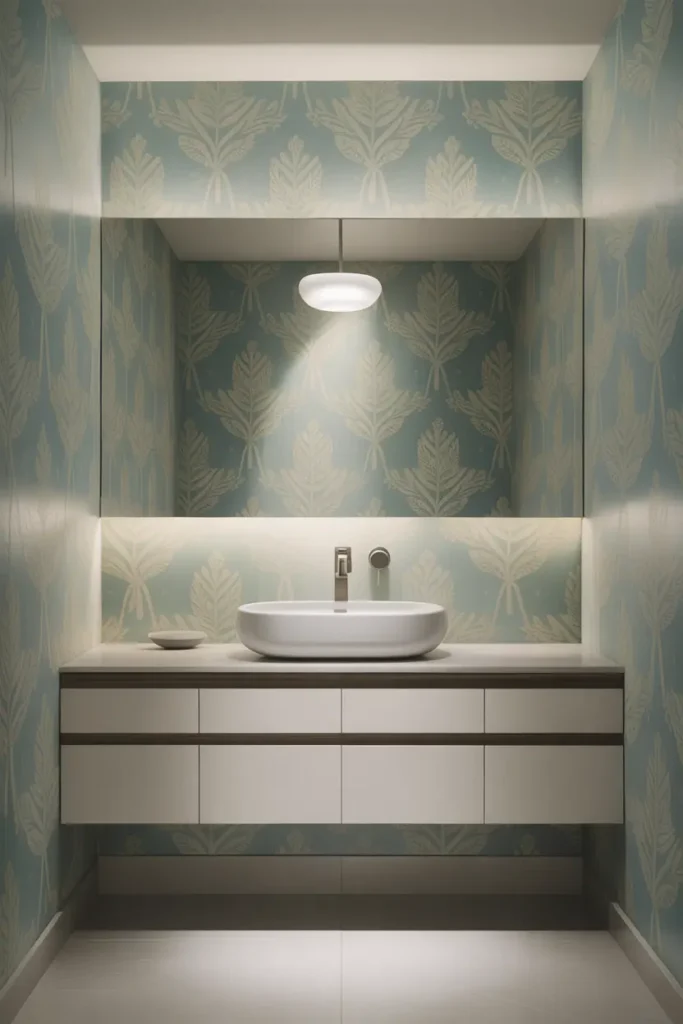
Wallpaper is where pale blue gets to have a personality — a soft stripe, a faded botanical, a small-scale trellis in powder blue on white. One wall, ideally the one you face from the doorway, so the pattern greets you. Everywhere else stays quiet; wallpaper is a soloist, not a choir.
In bathrooms, use vinyl or vinyl-coated wallpaper (it tolerates humidity) and keep it off the wall inside the shower’s splash zone. Peel-and-stick versions make this renter-friendly and commitment-free. The pattern scale matters in small bathrooms: small repeats recede, large repeats dominate. When in doubt, go smaller.
Idea 9: Pale Blue Sink Basin
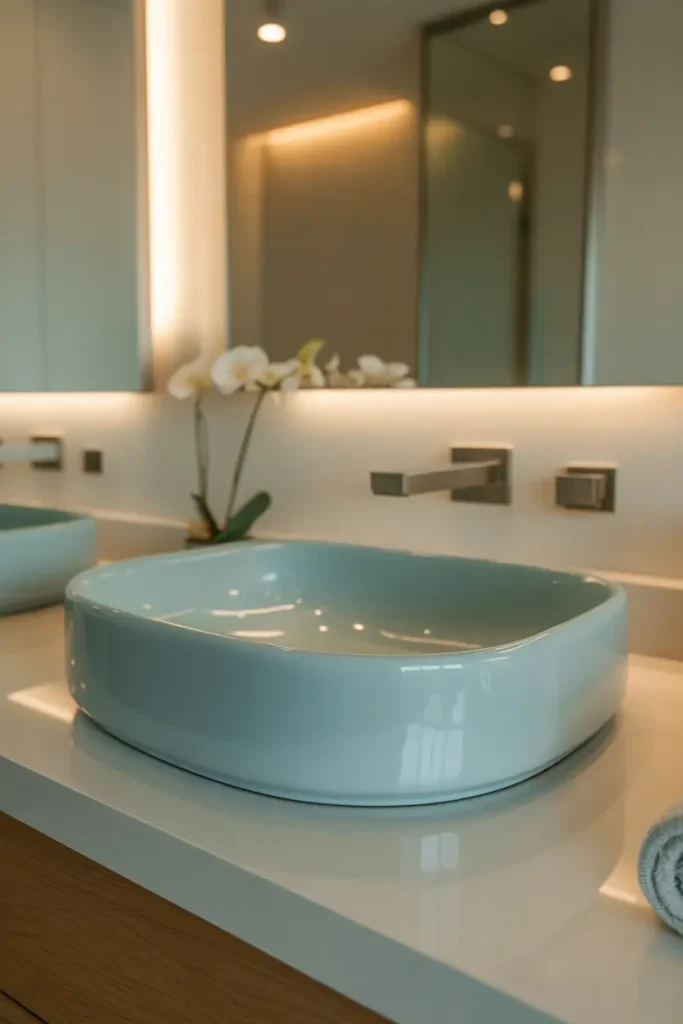
A pale blue vessel basin is a whisper of a statement — visible, delightful, and utterly low-commitment compared to blue tile or blue walls. It sits on the counter like a piece of pottery, and because it’s the only blue object in the room, it gets all the attention. Powder rooms are its natural home: small space, big impression, guests who notice.
Keep the counter and faucet quiet — white or light wood counter, simple chrome or nickel faucet — and let the basin be the room’s one artwork. Check the height math: vessel basins sit 5–6 inches proud of the counter, so you need a tall vessel faucet or a wall-mounted one. A standard faucet will have you washing hands at an angle.
Idea 10: Pale Blue and Wood Balance
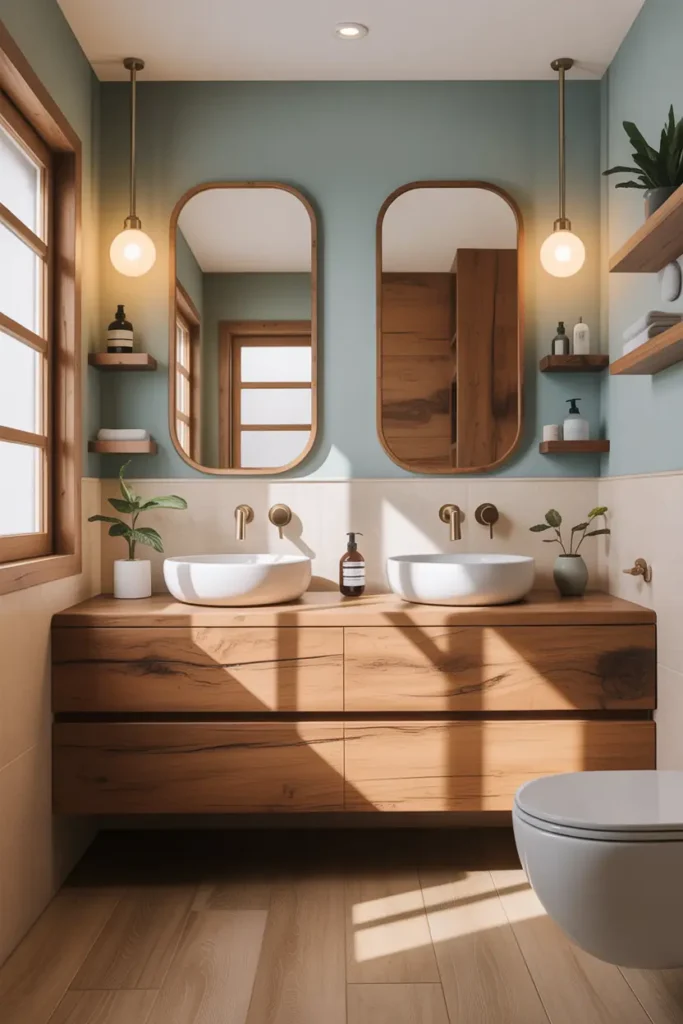
Every pale blue bathroom needs one warm thing, and wood is the best warm thing. A teak bath mat, an oak vanity, open cedar shelves — the wood’s honey tones keep the blue from drifting into chill. It’s color temperature physics: cool blue plus warm wood equals balanced, the way shade plus sunlight equals comfortable.
One wood tone, used two or three times: the vanity, the mirror frame, the stool. Scattered single wood items in different tones look accidental; repeated wood looks designed. In wet areas, stick to teak or sealed white oak — they handle humidity gracefully, aging to silver-grey if you let them, which is honestly beautiful against pale blue.
Pro Tips
- Sample pale blues on the wall, not on paper. Pale blue shifts more than any other color between store lighting and bathroom lighting. Paint a 2-foot test square and live with it for three days, morning and evening.
- Warm the light, not the paint. If pale blue feels chilly, the fix is usually 2700K bulbs, not a warmer paint color. Light temperature changes the room more honestly than repainting does.
- One pattern maximum. Pale blue plus one pattern (wallpaper, or veined marble, or a patterned floor — pick one) stays serene. Two patterns compete; three is chaos. Let the color breathe.
- Plants are part of the palette. A green plant isn’t decor in a pale blue bathroom — it’s the complementary color that completes the scheme. Even a single eucalyptus stem changes the whole feeling.
FAQs
What shade of pale blue works best in a bathroom with no windows?
Go lighter and warmer than you think — a pale blue with a whisper of green or grey (rather than a icy blue) won’t go gloomy under artificial light. Pair it with bright 3000K lighting and plenty of white to keep the room luminous.
How do I keep a pale blue bathroom from feeling cold?
Add warmth through light (2700K bulbs), wood (a teak mat or oak vanity), and textiles (cream or white towels rather than stark white). One warm element is usually enough — pale blue only feels cold when everything around it is also cool.
Is pale blue wallpaper okay in a humid bathroom?
Yes if you choose vinyl or vinyl-coated wallpaper and keep it away from direct shower spray. Ventilation is the deciding factor — with a good exhaust fan, it lasts years; in a steamy unventilated bath, even the best wallpaper struggles.
What fixtures go with a pale blue and white bathroom?
Polished chrome or brushed nickel — cool-toned metals that belong to the same family as the palette. Avoid warm brass or oil-rubbed bronze unless you’re deliberately pushing the scheme toward cottage, where the contrast becomes part of the charm.

HowDecor is a home decor blog sharing simple, practical decorating ideas for everyday spaces. We believe a beautiful home should feel comfortable, personal, and full of warmth — and that great style does not require a huge budget. Our goal is to inspire readers to create spaces that feel peaceful, welcoming, and truly their own — one room at a time.