Blue onyx is the drama queen of natural stone — translucent, veined like frozen ocean, and capable of glowing from within when backlit. It’s also soft, porous, expensive, and utterly unforgiving of the wrong application. This list isn’t a fantasy catalog. It’s a practical guide to where blue onyx earns its keep in a bathroom, where it causes heartbreak, and where a $12/sq ft porcelain lookalike gets you 90% of the effect.
The honest numbers first: real blue onyx slabs run $50–$150+ per square foot installed, it scratches more easily than marble (about 3 on the Mohs scale), and it etches on contact with anything acidic — toothpaste, citrus cleaners, even some soaps. Seal it every 6 months. With that said, used correctly, nothing else looks like it.
Table of Contents
- Idea 1: Blue Onyx Accent Wall
- Idea 2: Blue Onyx Vanity Countertop
- Idea 3: Blue Onyx Shower Wall
- Idea 4: Blue Onyx Bathtub Surround
- Idea 5: Blue Onyx Sink Basin
- Idea 6: Blue Onyx Floor Tiles
- Idea 7: Blue Onyx Backlit Wall
- Idea 8: Blue Onyx Shelf Details
- Idea 9: Blue Onyx Mirror Frame
- Idea 10: Blue Onyx and White Marble Combo
Idea 1: Blue Onyx Accent Wall
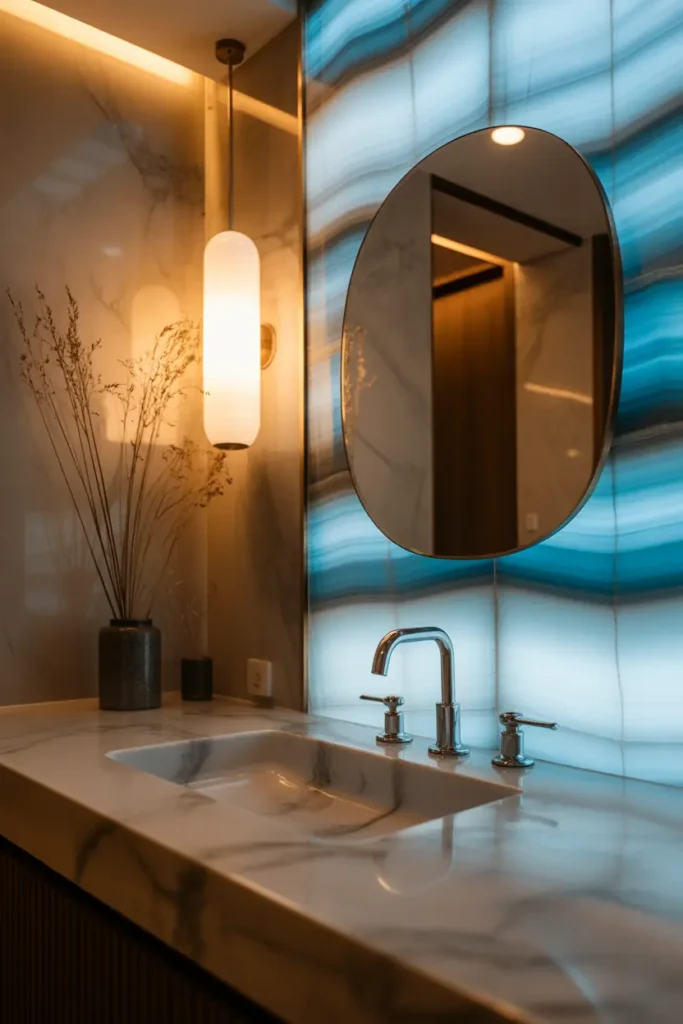
The accent wall is onyx’s natural habitat: a dry(ish) vertical surface where nobody sets down a toothpaste tube. Behind a freestanding tub or the vanity, a book-matched pair of slabs — two mirror-image cuts from the same block — creates a symmetrical composition that looks like art. Book-matching is the move that separates a luxury installation from “nice stone”; insist on seeing the slab pairing at the fabricator before cutting.
Keep everything around it quiet: large-format neutral tile, white fixtures, minimal hardware. Onyx this dramatic doesn’t need competition — one strong vein pattern per room is the rule. And budget honestly: a single 5×10-foot accent wall in real blue onyx, installed, typically runs $3,000–$7,000 depending on the stone grade. The porcelain lookalikes ($8–$15/sq ft) are worth a serious look at that price.
Idea 2: Blue Onyx Vanity Countertop
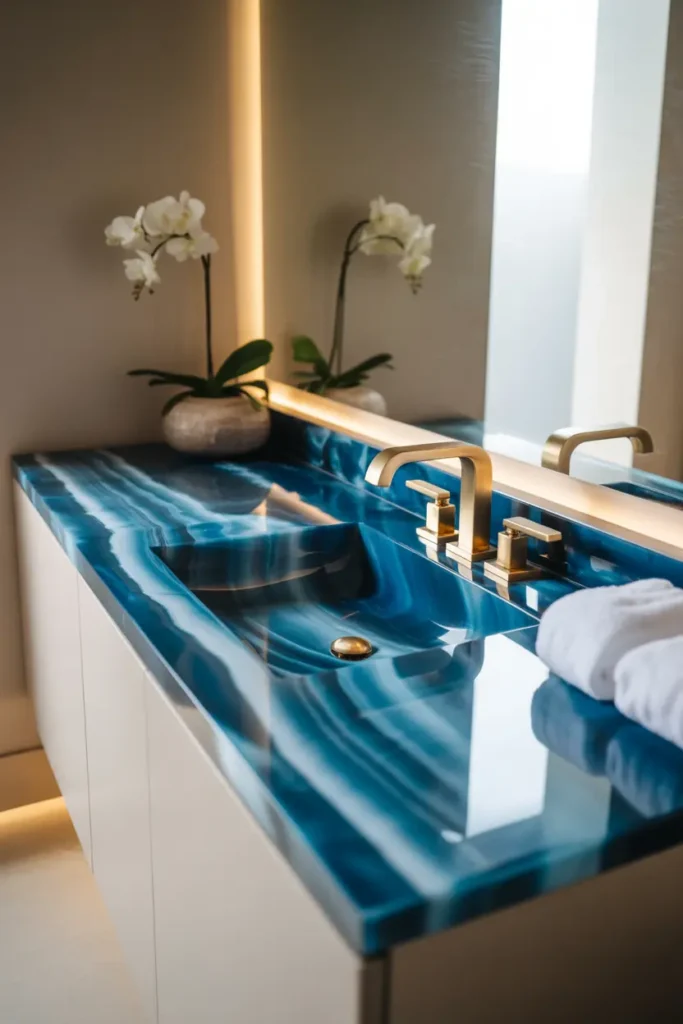
A vanity top is the smallest real-onyx commitment you can make — roughly 6–10 square feet — and it puts the stone exactly where you’ll see and touch it daily. The translucency shows at the edges, especially on a mitered edge detail where the light catches the stone’s depth. Pair it with a simple undermount white sink so the stone, not the basin, is the event.
The maintenance reality: wipe up toothpaste, mouthwash, and anything citrus immediately. Onyx etches on contact — it won’t stain so much as lose its polish in dull spots, and repolishing means calling the fabricator. Use only pH-neutral stone cleaner, never vinegar or bleach-based sprays. If that sounds like too much vigilance for a family bathroom, this is your sign to use onyx in the powder room instead.
Idea 3: Blue Onyx Shower Wall

I’ll be direct: a full onyx shower is the riskiest application on this list. Constant water, soap, shampoo, and cleaning products attack the stone daily, and onyx in a shower needs resealing every 3–6 months to survive. It looks otherworldly — like showering inside a glacier — but it’s a maintenance marriage, not a fling.
The smarter version: one onyx feature wall in the shower (the back wall, usually) with the other walls in a complementary porcelain. You get the visual impact at a third of the cost and a third of the upkeep. Use epoxy grout, not cement grout — it’s waterproof and stain-proof, which matters enormously next to a stone this delicate. And install a water softener if your water is hard; mineral deposits on onyx are brutally visible.
Idea 4: Blue Onyx Bathtub Surround
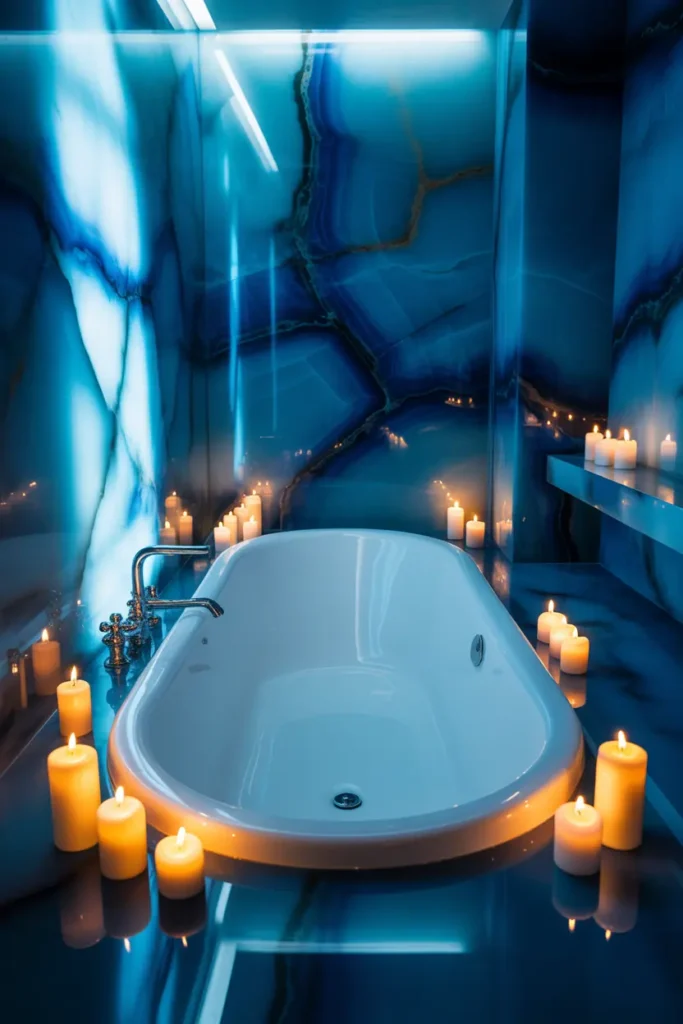
A tub surround splits the difference nicely: less water exposure than a shower, more presence than a vanity. The onyx wraps the tub deck and the wall behind it, framing the bath like a grotto. This is the application where onyx’s spa associations pay off hardest — candlelight on blue onyx is genuinely one of the most beautiful things a bathroom can do.
Detail it right: the tub deck should be at least 4–6 inches wide for candles and a book, and the onyx should run behind the tub to the ceiling, not stop at some arbitrary line. Caulk — not grout — at every change of plane (tub-to-stone, stone-to-stone corners), because those joints move and grout cracks. Use 100% silicone in a color matched to the stone.
Idea 5: Blue Onyx Sink Basin
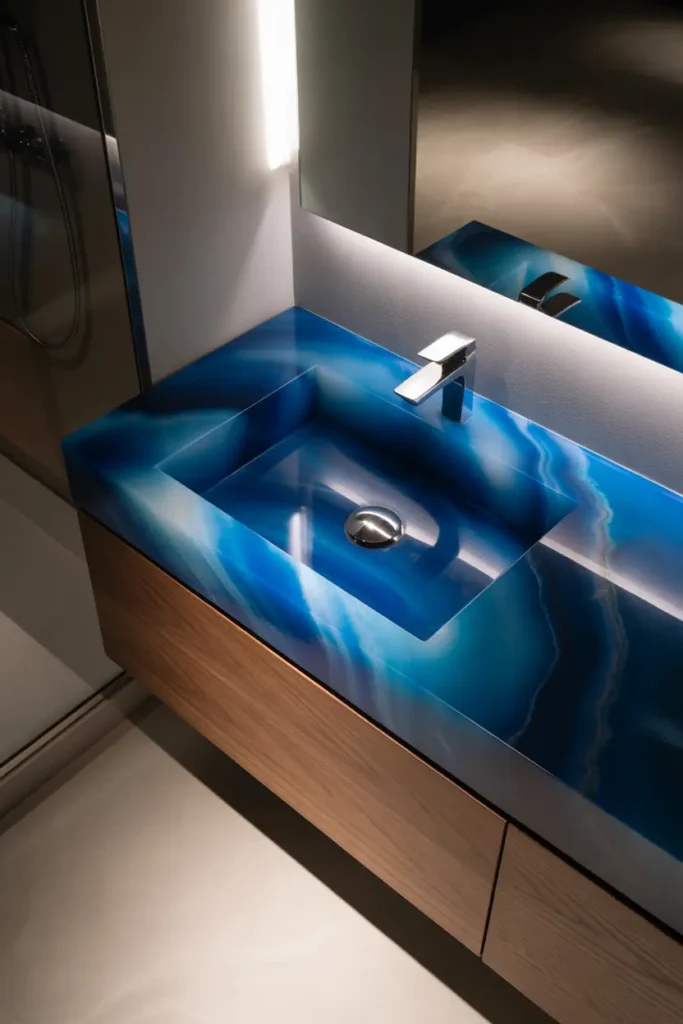
A carved onyx vessel basin is a sculpture that happens to hold water — and in a powder room, where it sees light use, it’s close to the perfect onyx application. Each basin is cut from a single block, so the veining flows around it continuously. No two are alike, which is the entire point of natural stone.
Mount it as a vessel (sitting on the counter) rather than undermount — cutting onyx thin enough for an undermount rim wastes its translucency. Pair with a tall vessel faucet in brushed brass or matte black, and keep the counter underneath simple: a floating wood or white vanity. Clean only with a soft cloth and neutral cleaner; the basin’s curves collect residue in ways flat counters don’t.
Idea 6: Blue Onyx Floor Tiles
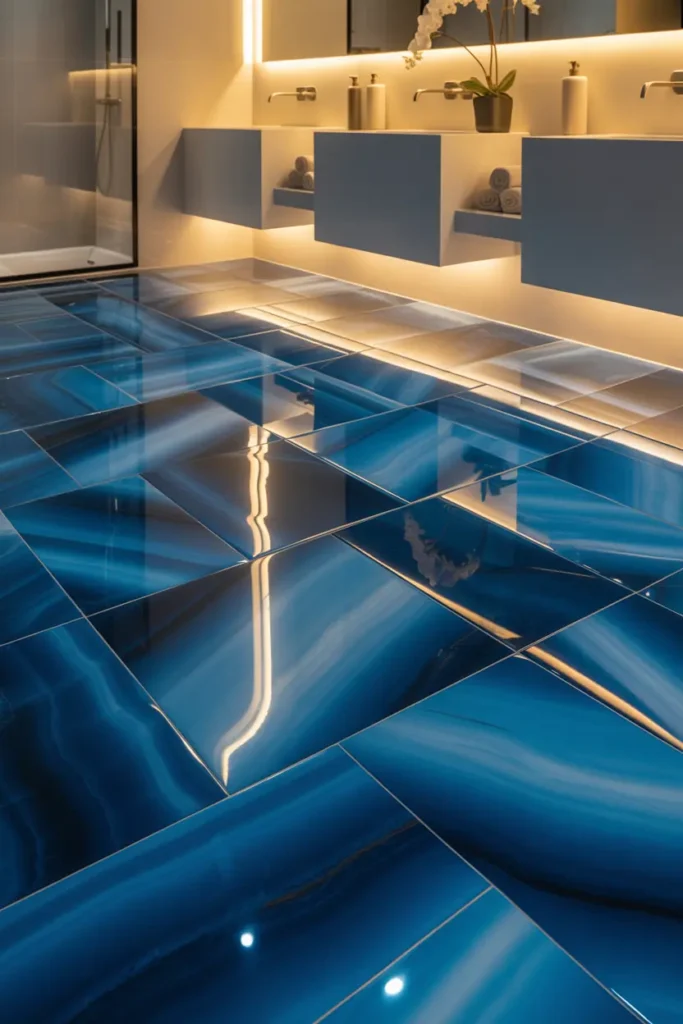
Onyx floors are beautiful and, frankly, impractical in most bathrooms — the stone is soft enough to scratch under grit, slippery when polished and wet, and every dropped bottle is a potential chip. If your heart is set on it, use a honed (matte) finish for grip, keep it to a powder room or a low-traffic master bath, and commit to felt pads and a no-shoes policy.
The compromise that works: onyx-look porcelain on the floor (slip-rated, $8–$15/sq ft, zero maintenance) with real onyx on the wall above it. Nobody can tell the difference at floor level, and you get the serene blue underfoot without the anxiety. If you do use real onyx tile, go large format — 24×24 inches — to minimize grout lines, and use epoxy grout throughout.
Idea 7: Blue Onyx Backlit Wall
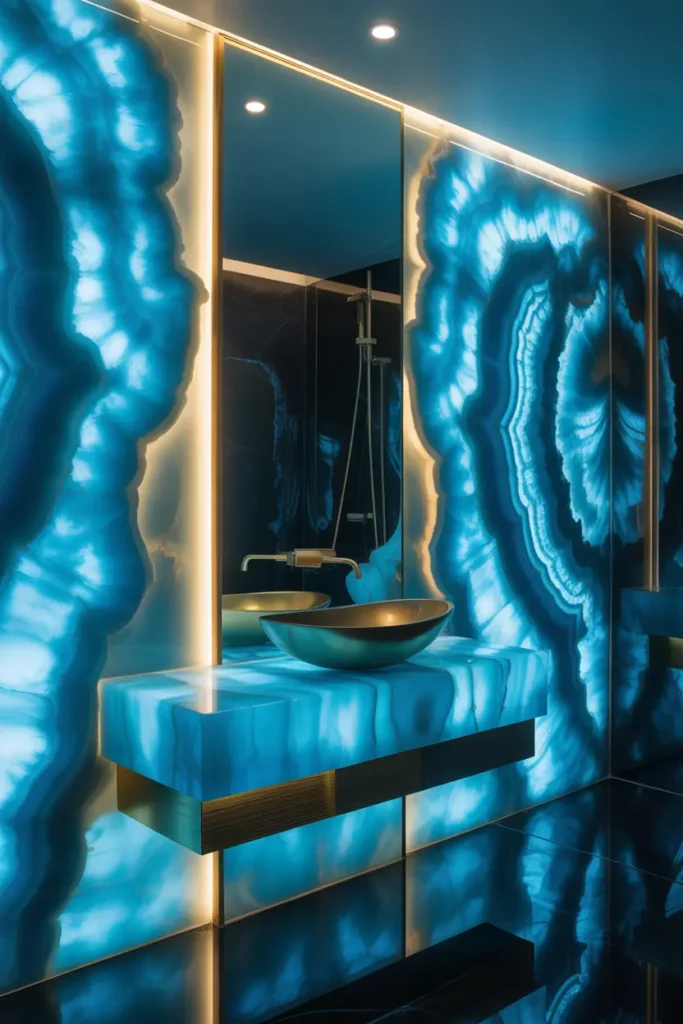
This is the signature move — the reason blue onyx exists in bathrooms at all. Onyx transmits light, so LED panels mounted behind a 3/4-inch slab turn the wall into a glowing, veined lantern. The effect at night, with the room’s other lights low, is unmatched by any other material. It’s the closest thing to having a permanent sunset in your bathroom.
The installation is specialist work: the slab must be uniformly thin (resin-backed for strength), the LEDs evenly diffused (no hot spots), and the whole assembly serviceable — LEDs eventually need replacing, so the panel must be removable. Budget $200–$400/sq ft installed for a proper backlit system. Use 2700–3000K LEDs; cooler temperatures turn blue onyx greenish-grey and kill the magic.
Idea 8: Blue Onyx Shelf Details
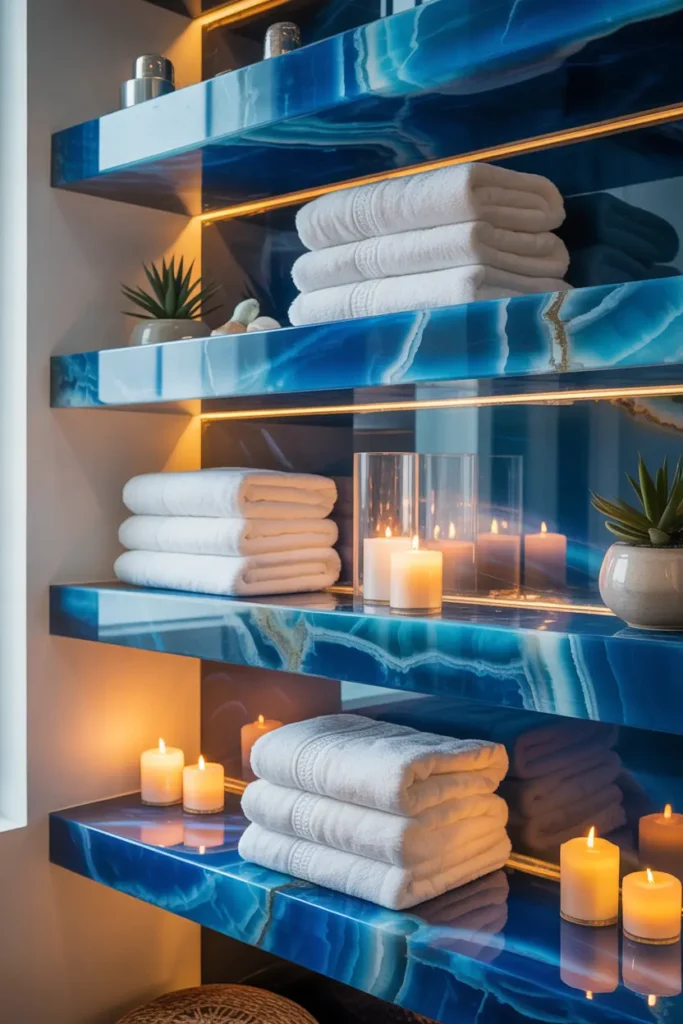
Can’t justify a slab? Onyx offcuts become floating shelves, shower niches, and window sills — small doses of the stone where the cost is measured in hundreds, not thousands. A fabricator’s remnant yard is the place to shop: pieces too small for countertops sell for a fraction of slab prices, and a 24-inch shelf needs only a remnant.
A backlit onyx shower niche — a small recessed shelf with an LED strip above it — is the single best value in onyx design. Maybe $300–$600 installed, and it gives you the glow, the veining, and the luxury signal every single shower. It’s the tasting menu instead of the full dinner, and honestly, it’s enough.
Idea 9: Blue Onyx Mirror Frame
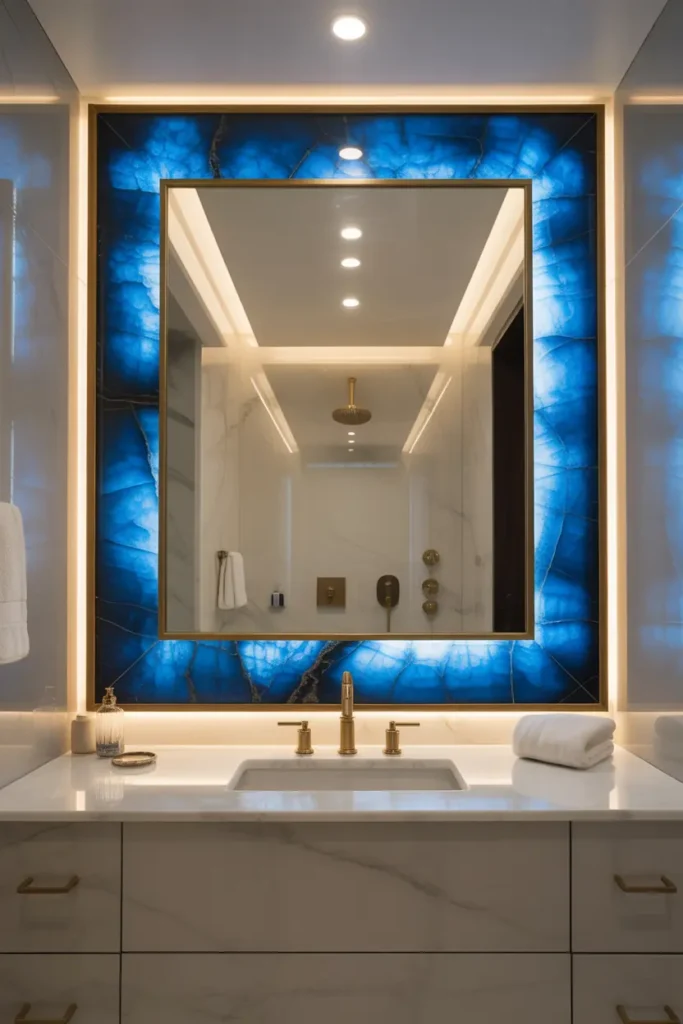
Framing a mirror in onyx tile or thin stone strips turns the vanity wall into a composition — the mirror floats inside a border of blue veining. It works in any style bathroom because the frame reads as jewelry: small, precious, deliberate. Keep the frame slim (2–3 inches) so it frames rather than overwhelms.
This is a genuinely DIY-able onyx project if you buy pre-cut onyx mosaic or trim strips rather than cutting slabs. Miter the corners at 45 degrees for a furniture-grade look, and use a stone adhesive rated for vertical application. Seal the finished frame — bathroom mirrors collect toothpaste splatter, and onyx remembers everything.
Idea 10: Blue Onyx and White Marble Combo
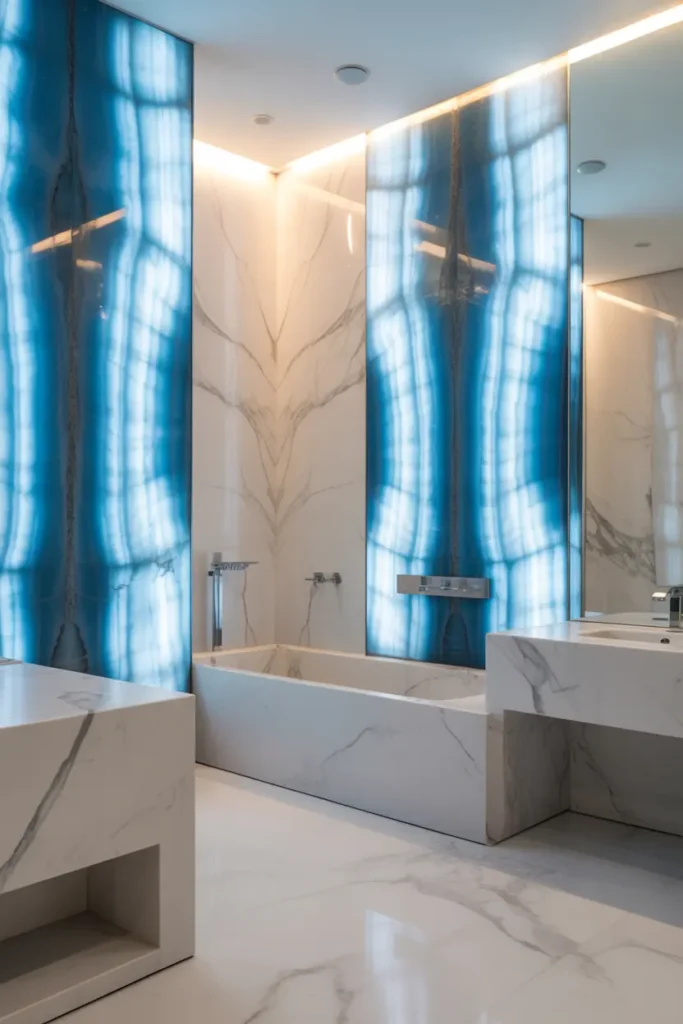
The classic luxury pairing: white marble for the big quiet surfaces (floor, main walls), blue onyx for the one moment of drama (the vanity wall, the tub surround). The white marble keeps the room bright and timeless; the onyx keeps it from being boring. It’s the combination you see in high-end hotel spas, and it works for the same reason — contrast with restraint.
The ratio matters: roughly 80% marble, 20% onyx by visual weight. More onyx than that and the room tips from “serene” to “busy” — two dramatic natural stones compete instead of complementing. Keep the white marble simple (a quiet Carrara or a white porcelain) so the onyx’s veining is the only pattern show in town.
Pro Tips
- Buy the slab in person. Onyx varies enormously — two slabs of “blue onyx” can look like different stones. Photograph the exact slabs, get the bundle number in writing, and approve the layout at the fabricator before cutting.
- Resin-backing is non-negotiable. Quality onyx slabs come reinforced with resin and mesh on the back. It prevents cracking during install and is essential for any backlit application. If a supplier offers unbacked onyx, walk away.
- Budget 20% over the stone quote. Onyx fabrication has more waste and more breakage risk than granite or quartz. The final invoice surprises people who budgeted to the penny — build in the cushion.
- Test the porcelain alternative first. Live with an onyx-look porcelain sample ($5) for a month. If you stop noticing it, you didn’t want onyx — you wanted the idea of onyx, and the porcelain will make you just as happy for a tenth of the price.
FAQs
Is blue onyx practical in a bathroom, or just for looks?
It’s practical in low-exposure applications — accent walls, powder-room vanities, niches, mirror frames — where it sees little water and no harsh cleaners. In showers and high-traffic floors, it’s beautiful but demanding; onyx-look porcelain is the pragmatic choice there.
How much does blue onyx cost compared to marble?
Expect $50–$150+ per square foot installed for real blue onyx, versus $15–$40 for marble and $8–$15 for onyx-look porcelain. Backlit installations run $200–$400/sq ft. The stone is rare and fragile to fabricate, which drives the premium.
How do you clean and maintain blue onyx?
Only pH-neutral stone cleaner and a soft cloth — never vinegar, bleach, or abrasive pads. Wipe up acids (toothpaste, citrus, wine) immediately, and reseal every 6 months (every 3–6 in showers). Etch marks need professional repolishing.
Can onyx really be backlit, and is it worth it?
Yes — onyx’s translucency is its defining trait, and a backlit wall is its finest application. It’s worth it as a single focal point (behind a tub or vanity), installed by a specialist with serviceable LED panels. As a whole-room treatment it’s prohibitively expensive and visually overwhelming.

HowDecor is a home decor blog sharing simple, practical decorating ideas for everyday spaces. We believe a beautiful home should feel comfortable, personal, and full of warmth — and that great style does not require a huge budget. Our goal is to inspire readers to create spaces that feel peaceful, welcoming, and truly their own — one room at a time.