Small bathrooms are where budgets go to die — everything costs more per square foot, and every mistake is visible from the doorway. But blue is the great equalizer: it’s the one color that makes a 40-square-foot bathroom feel intentional instead of cramped, and most of the ideas below cost less than a tank of gas. I’ve priced every one of these honestly, because “budget-friendly” should mean a number, not a vibe.
The ground rule for small blue bathrooms: light blues recede (walls feel farther), dark blues advance (walls feel closer). In a small space, that single fact decides almost everything. Here’s how to use it, ten ways, cheapest first.
Table of Contents
- ✨ Idea 1: Soft Blue Minimal Walls
- ✨ Idea 2: Blue Vanity on a Budget
- ✨ Idea 3: Blue Tile Accent Wall
- ✨ Idea 4: Blue and White Classic Combo
- ✨ Idea 5: Blue Shower Curtain Style
- ✨ Idea 6: Blue Accessories Touch
- ✨ Idea 7: Pale Blue Ceiling
- ✨ Idea 8: Blue Wallpaper Accent
- ✨ Idea 9: Blue Sink Basin
- ✨ Idea 10: Blue and Wood Balance
Idea 1: Soft Blue Minimal Walls
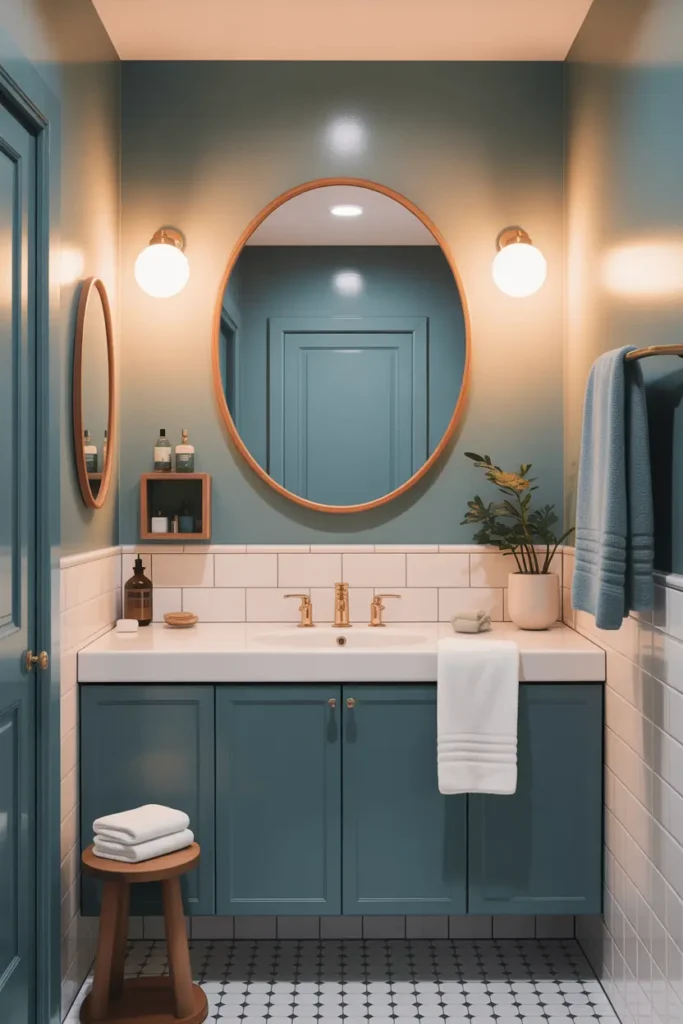
Cost: ~$30–$50. One gallon of washable bathroom paint (look for “bathroom” or “kitchen & bath” on the label — it has mildewcide built in) covers a small bathroom’s walls with paint to spare. Choose a pale blue with high light reflectance — LRV 65+ — and the walls will bounce light instead of absorbing it, which is the entire trick in a windowless 5×8-foot bath.
Prep is the job: wash the walls with TSP substitute, fill holes, and tape once, carefully. Two thin coats beat one thick coat every time — thick coats drip, and drips on a pale wall show forever. Eggshell or satin finish; flat paint in a bathroom grows mildew spots within a year. Total time: one Saturday, most of it waiting for coats to dry.
Idea 2: Blue Vanity on a Budget
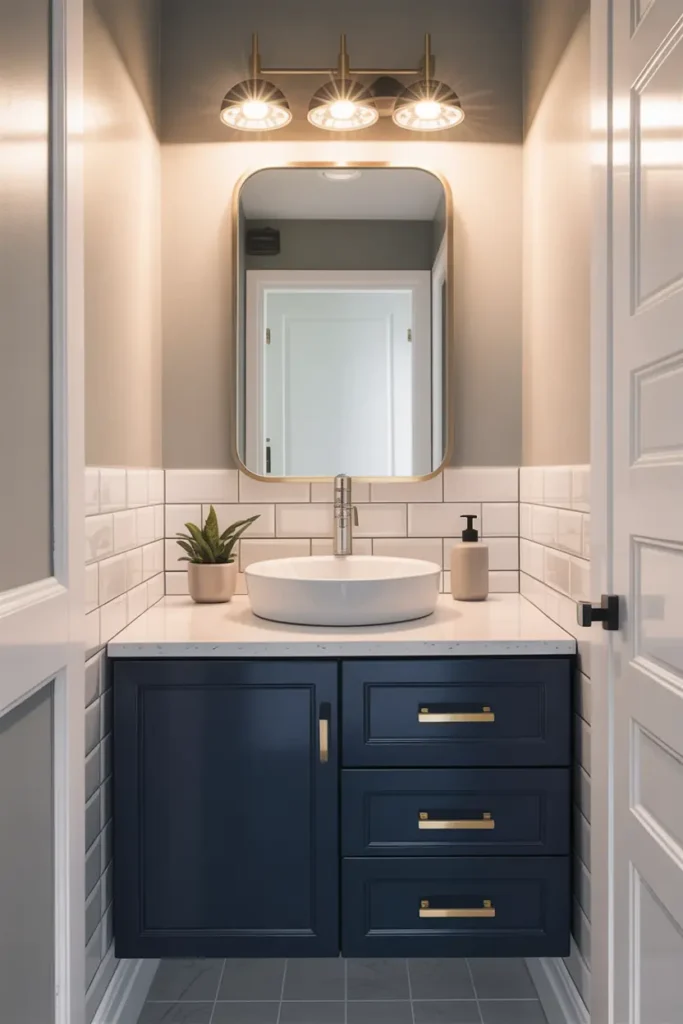
Cost: ~$25–$40. Don’t buy a blue vanity — paint the one you have. A quart of cabinet enamel ($20–$25), a $5 foam roller set, and an afternoon. The non-negotiable steps: remove the doors and hardware, degrease with TSP, sand with 220-grit, prime with a bonding primer, then two thin enamel coats. Skip the sanding and the paint peels by spring; I’ve seen it happen a dozen times.
Dusty blue, slate blue, or a muted teal-blue all work against white countertops — the white does the brightening, the blue does the personality. Swap the hardware while you’re at it: a $12 two-pack of matte black pulls transforms a dated vanity more than the paint does. Let the doors cure a full week before rehanging, or fingerprints become permanent texture.
Idea 3: Blue Tile Accent Wall
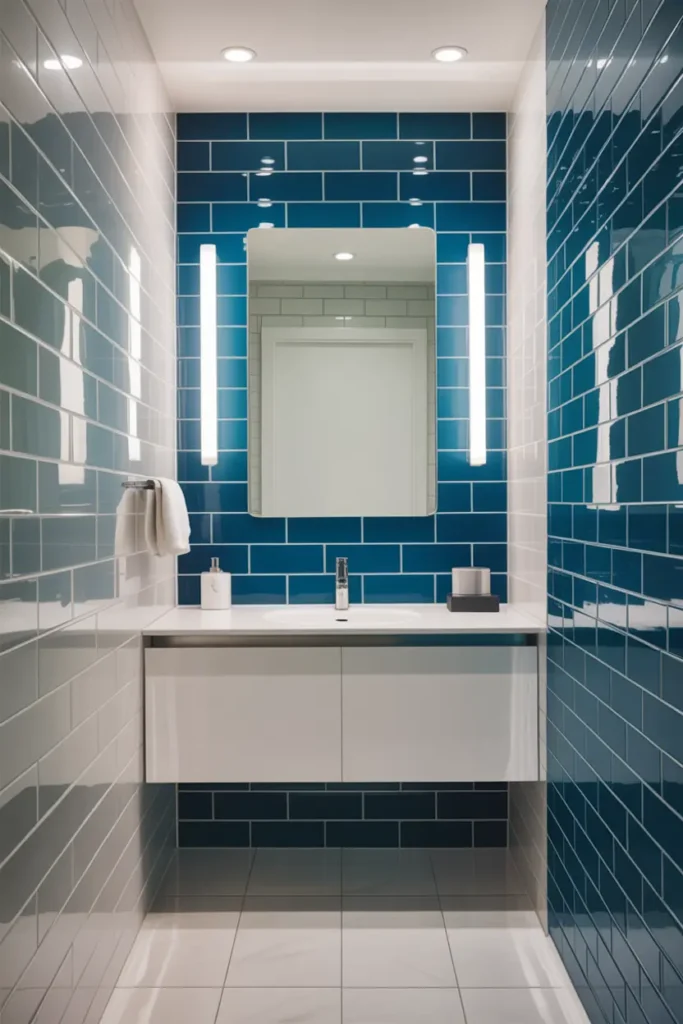
Cost: ~$60–$120. One wall in blue tile — the wall behind the vanity is the classic pick — gives you the tiled look at a quarter of the full-bathroom price. A 3×8-foot vanity wall needs about 24 sq ft of tile; at $2–$4/sq ft for ceramic subway or square tile, that’s $50–$100 plus thinset and grout.
Peel-and-stick tile ($5–$8/sq ft) is the renter-friendly alternative and genuinely looks good for 2–3 years in low-splash areas — but keep it off the shower walls, where steam kills the adhesive. For real tile, large format (12×24) on an accent wall means fewer grout lines and a more expensive look; subway tile means more grout lines and a more classic look. Both are correct; pick the one that matches your fixtures’ era.
Idea 4: Blue and White Classic Combo
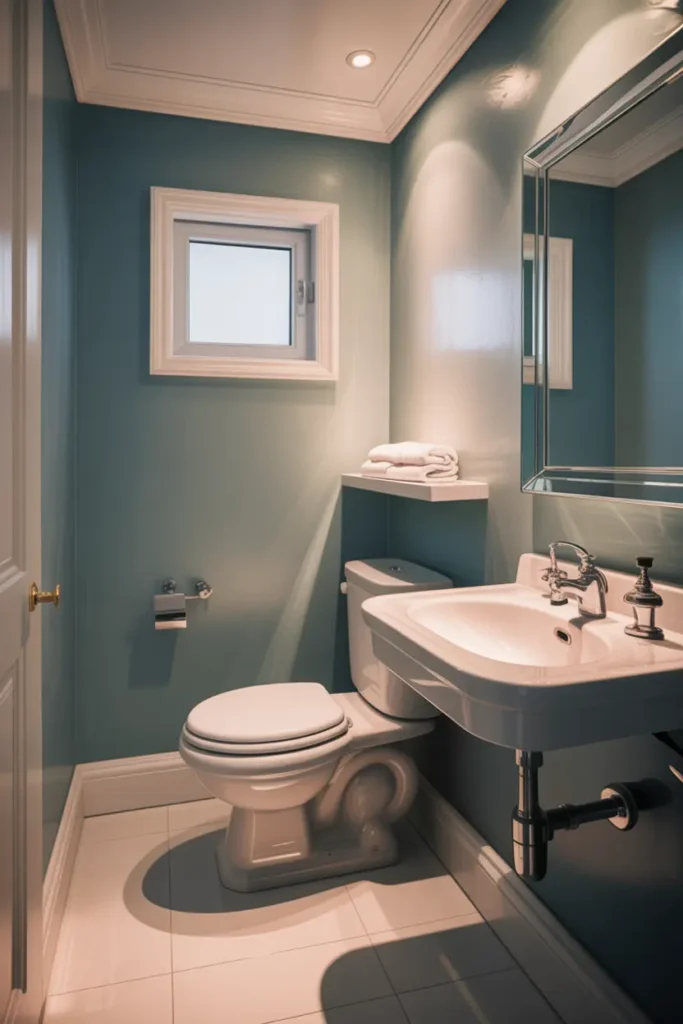
Cost: ~$40–$80. The ratio is the design: roughly 70% white (walls, fixtures, tile you already have) to 30% blue (towels, curtain, accessories, one painted element). White does the heavy lifting of making the room feel bigger; blue’s job is to keep it from feeling sterile. Get the ratio wrong — 50/50 — and a small bathroom feels busy instead of calm.
The cheapest execution: white walls you already own, plus blue in three textiles — shower curtain ($20–$30), two bath towels ($10 each), one bath mat ($15). Three blue items, all replaceable, all washable. When the palette bores you in two years, you’re out $60 and one shopping trip, not a renovation.
Idea 5: Blue Shower Curtain Style
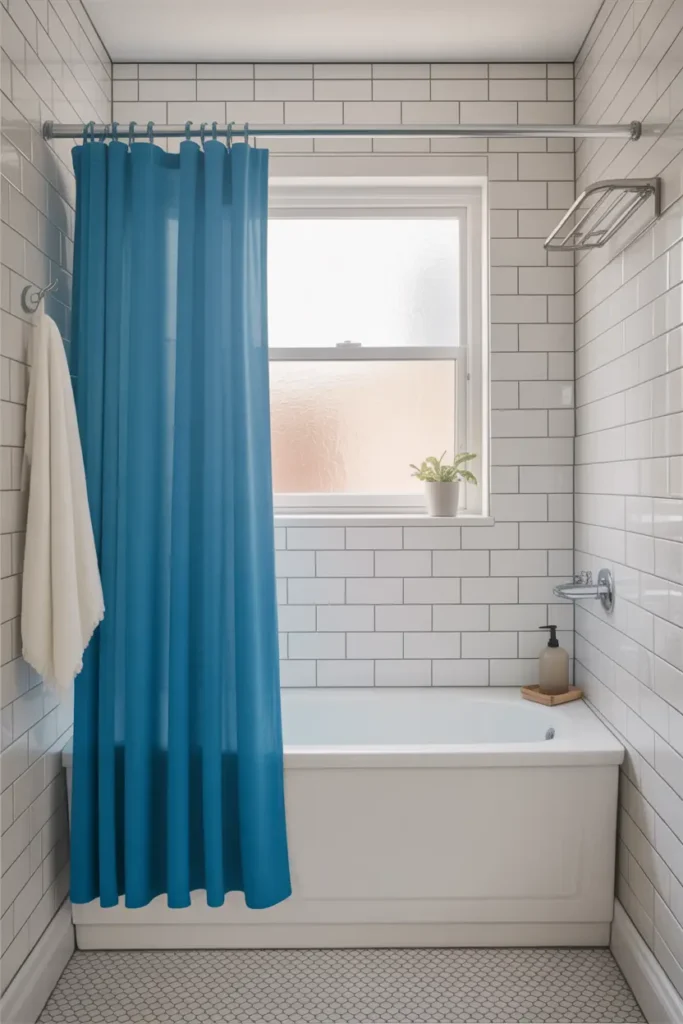
Cost: ~$20–$35. The single fastest bathroom change in existence: unhook, rehook, done. But the details decide whether it looks like a refresh or a dorm room. Buy a fabric or fabric-feel curtain (not shiny vinyl), hang the rod as high and wide as possible — ideally near the ceiling and 3–4 inches past the tub on each side — and let the curtain fall straight without pooling.
Pattern guidance for small bathrooms: small-scale patterns or textures (waffle weave, subtle stripe) recede; big bold prints advance and shrink the room visually. A solid dusty blue or a tone-on-tone pattern is the safe power move. And replace the plastic liner yearly — a yellowed liner ruins a $30 curtain’s whole effect.
Idea 6: Blue Accessories Touch
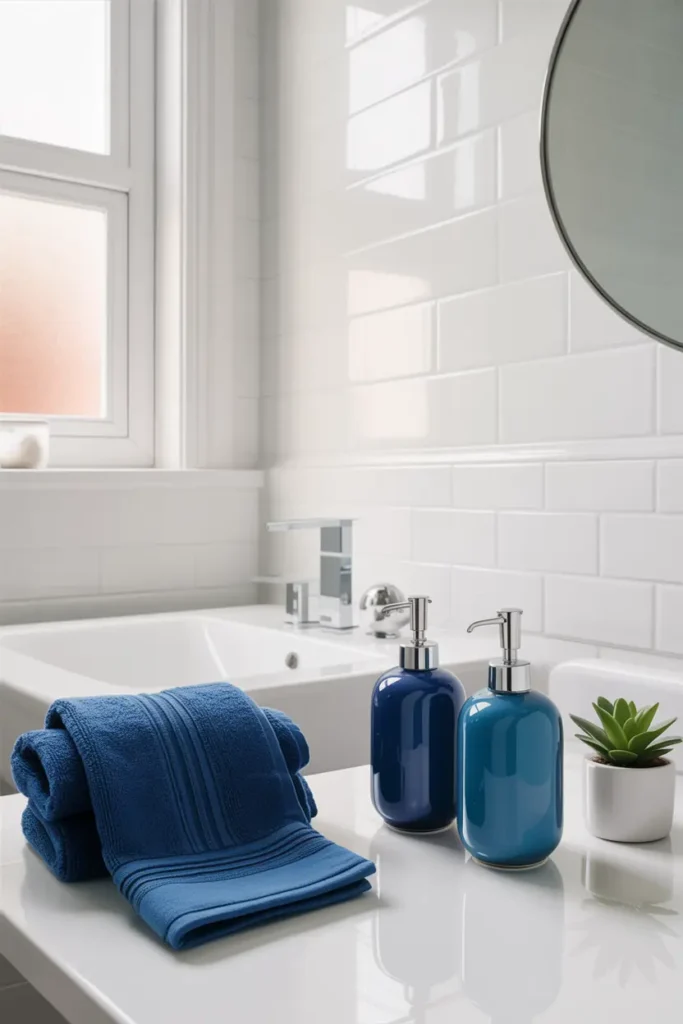
Cost: ~$30–$60. The no-commitment tier: soap dispenser, tray, folded towels, a small plant pot, a bath mat — all in one blue family. The trick is the family part: pick blues within two shades of each other, or the accessories read as random clutter instead of a scheme. Hold them together in the store before buying; your eye knows instantly.
This is also the testing tier. Live with blue accessories for a month before committing to blue paint or tile — you’ll learn whether you actually like the color at 7 a.m. or just liked the idea of it. Accessories are market research you can return.
Idea 7: Pale Blue Ceiling

Cost: ~$10–$15. A sample pot of paint is all a bathroom ceiling needs, and the payoff is absurd for the money. Pale blue overhead draws the eye up, makes 8-foot ceilings feel taller, and reads as a deliberate design choice — the kind of detail that makes visitors ask who your designer was. Flat ceiling paint hides imperfections; never use gloss overhead.
Go two to three shades lighter than any blue on the walls — a ceiling darker than the walls presses the room down. This pairs best with white or very pale walls; against dark walls, a pale blue ceiling looks like a mistake. One coat is usually enough on a ceiling, and cutting in is the only skill required.
Idea 8: Blue Wallpaper Accent
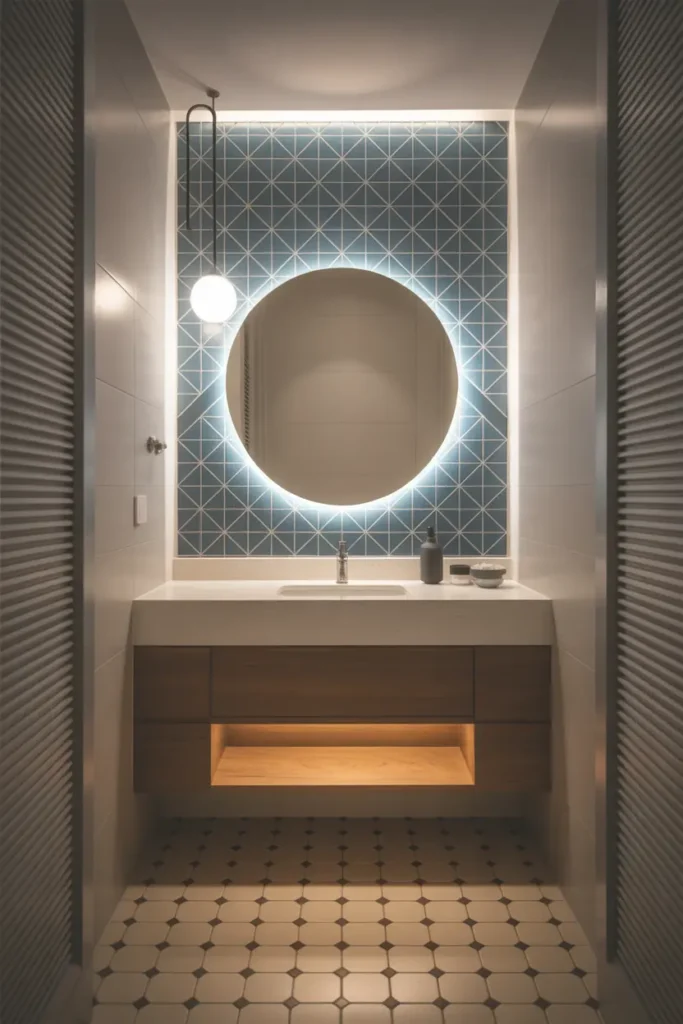
Cost: ~$40–$90. One wall in peel-and-stick blue wallpaper — a soft stripe, a small-scale botanical, a subtle geometric — gives you pattern and color with zero permanence. Measure the wall, order 10% extra, and start hanging from the most visible corner. A 8×5-foot wall needs roughly 2–3 rolls depending on pattern repeat.
Bathroom-specific warning: keep wallpaper off walls that get direct shower spray, and run the exhaust fan religiously — trapped humidity is what kills peel-and-stick adhesion. In a powder room or a well-ventilated bath, it lasts years. In a steamy family bathroom with no fan, budget for replacing it in 18 months.
Idea 9: Blue Sink Basin
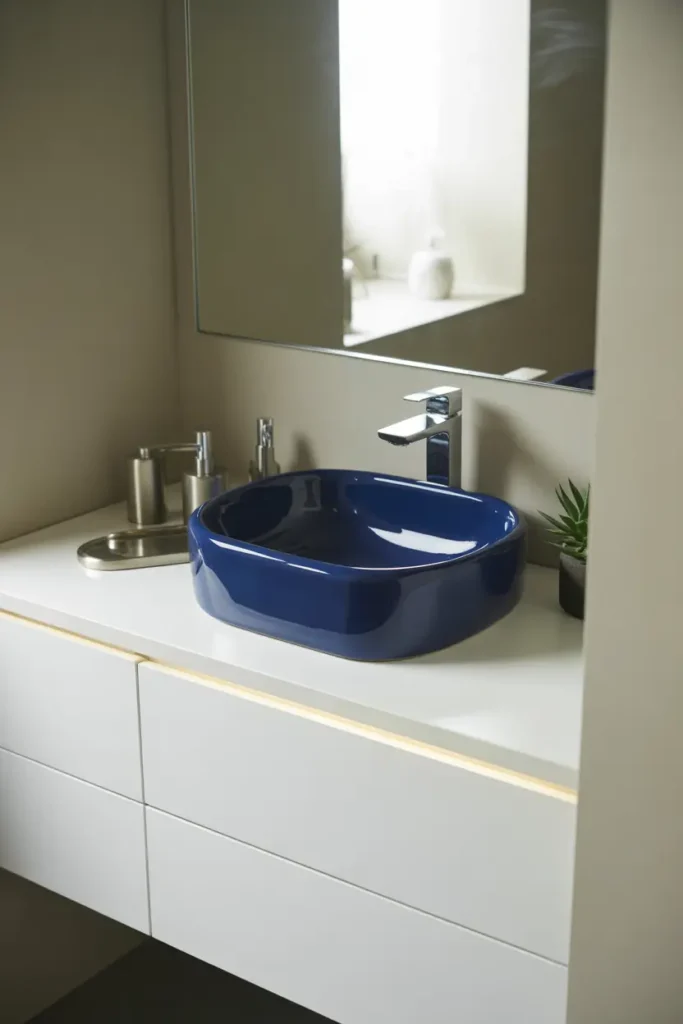
Cost: ~$80–$200. A colored vessel basin — sitting on top of the vanity rather than set into it — is the jewelry-box move for small bathrooms. It uses zero extra space (it replaces the existing sink footprint) while becoming the room’s focal point. Installation is genuinely simple: one drain hole, one faucet hole, silicone seal.
Keep everything around it neutral — white or wood vanity, plain mirror, simple faucet — because the basin is doing all the talking. And check the height: vessel basins add 5–6 inches above the counter, so the faucet needs to be a tall vessel-style model or wall-mounted. A standard short faucet with a vessel basin means hand-washing gymnastics.
Idea 10: Blue and Wood Balance
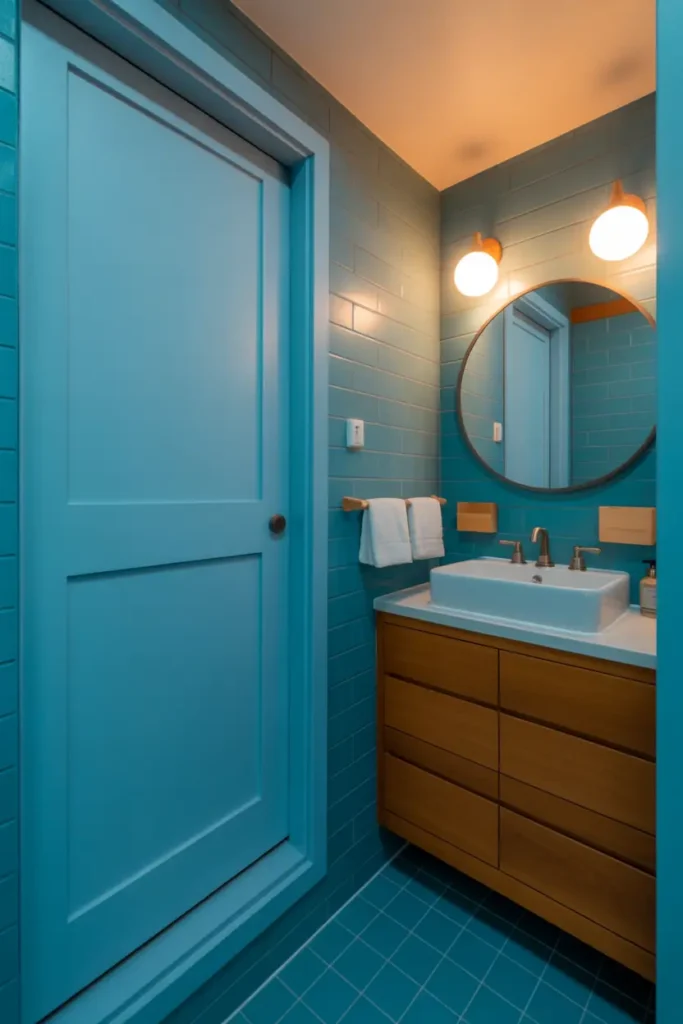
Cost: ~$30–$70. Blue cools a room down; wood warms it back up. In a small blue bathroom, one or two wood elements — a teak bath mat ($25–$40), a wooden stool, open oak shelves — keep the palette from feeling chilly. The wood doesn’t need to be expensive; it needs to be consistent — one tone, not three.
Teak and white oak handle bathroom humidity best; raw pine warps. A teak mat on the floor does double duty as warmth underfoot and visual warmth for the room. Keep wood away from constant direct water (inside the shower is too much for most woods) and oil it once a year — five minutes with teak oil keeps it from greying.
Pro Tips
- Spend on what you touch. In a budget bathroom, put money into the faucet, the towels, and the bath mat — the things your hands and feet meet daily. Cheap paint and expensive towels beat expensive paint and cheap towels.
- One blue, committed. Pick your blue from a physical sample in the room’s light, then buy everything in that family. Five “close enough” blues look accidental; one repeated blue looks designed.
- Ventilate like you mean it. A $30 humidity-sensing fan switch runs the exhaust automatically and prevents the mold, peeling paint, and wallpaper failure that eat budget renovations. It’s the highest-ROI $30 in the bathroom.
- Measure twice, order once. Tile, wallpaper, and curtains all punish guessing. Measure every wall, photograph the measurements, and order 10% extra. Returns on cut materials don’t exist.
FAQs
What is the cheapest way to add blue to a small bathroom?
A blue shower curtain ($20–$35) plus two blue towels — under $60 total, ten minutes of work, fully reversible. If you want one step more, a quart of cabinet enamel to paint the vanity runs about $25 and transforms the room’s focal point.
Will dark blue make my small bathroom feel smaller?
Yes, on large surfaces — dark blues advance visually and close a small room in. Use dark blue only as an accent (one wall, the vanity, accessories) and keep the main walls pale. Light blues with high reflectance do the opposite and can make walls feel farther away.
Can I use peel-and-stick tile in a bathroom?
In low-moisture areas, yes — backsplashes and vanity walls hold up well for 2–3 years. Keep it away from direct shower spray and run the exhaust fan; steam and standing water are what kill the adhesive. For showers, use real tile.
How do I make a rental bathroom look better without losing my deposit?
Stick to the reversible layer: shower curtain, towels, accessories, bath mat, and peel-and-stick wallpaper on one dry wall. Avoid paint, drilling, and adhesive tile in the shower. Everything on this list except paint and real tile is renter-safe.

HowDecor is a home decor blog sharing simple, practical decorating ideas for everyday spaces. We believe a beautiful home should feel comfortable, personal, and full of warmth — and that great style does not require a huge budget. Our goal is to inspire readers to create spaces that feel peaceful, welcoming, and truly their own — one room at a time.