A black bathroom in a small space sounds like a terrible idea until you see one done right — and then nothing else looks as sharp. The fear is real: dark colors absorb light, and small bathrooms are already short on it. But black done strategically doesn’t shrink a bathroom. It does the opposite, adding the kind of depth and contrast that makes a 40-square-foot bathroom feel like a boutique hotel.
The whole trick is managing light like a resource. Black walls are fine if the light bounces. Black fixtures are fine if the surfaces around them reflect. Every idea below is really about the same thing: how to keep a bold, dark bathroom bright enough that it feels dramatic instead of cave-like. Get the light right and black becomes the easiest color in the world to decorate with.
1. Confine Black to One Feature Wall
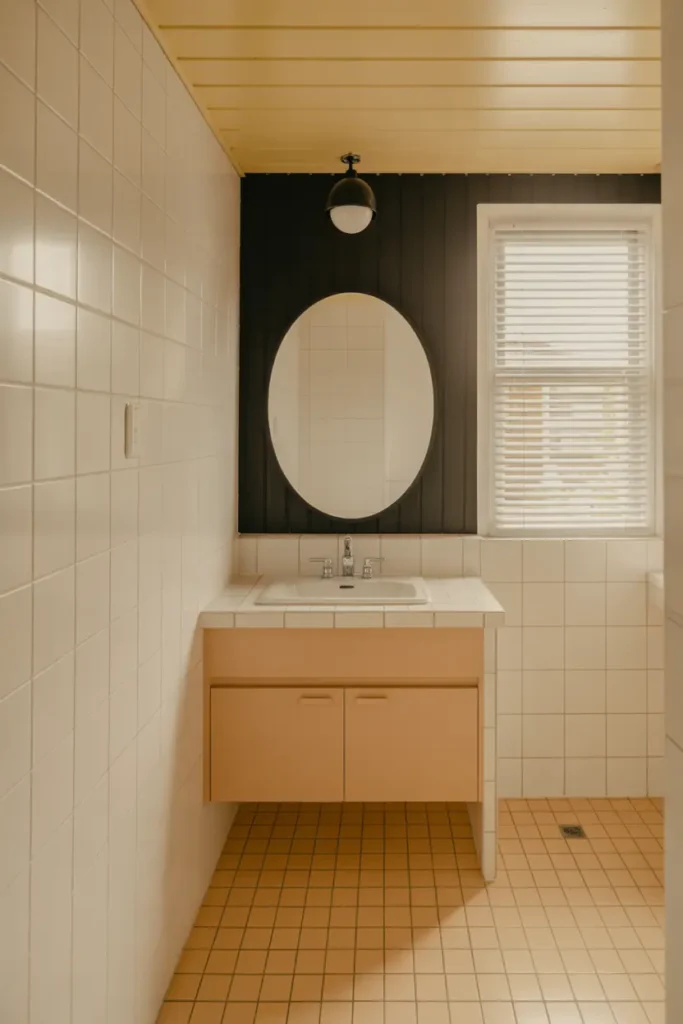
Painting all four walls black in a small bathroom is how you get a cave. Painting one wall black — the vanity wall, or the wall behind the mirror — is how you get drama. A single dark wall recedes visually, which paradoxically makes the room feel deeper, while the other three walls (kept light) do the job of bouncing light around.
The vanity wall is the best candidate because it’s where your eye goes first and it’s usually the smallest wall. Use a paint with a Light Reflectance Value (LRV) under 10 for true depth — but choose a satin or semi-gloss finish, not flat, because sheen reflects what little light you have. Matte black walls in a windowless bathroom are a rookie mistake; satin black walls in the same room look intentional.
2. Surround Black With Bright White
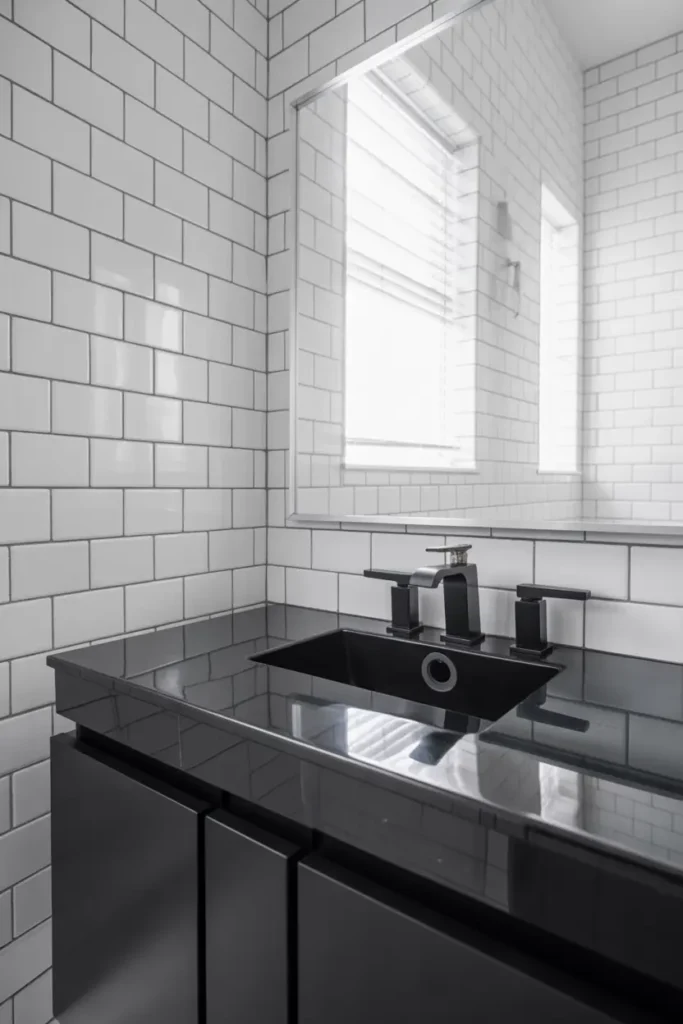
Black needs white the way a stage needs a spotlight. White sanitary ware, a white countertop, white ceiling — these are your reflectors. In a black-and-white bathroom, the white surfaces are doing structural work: bouncing light from the window or fixtures back into the room. Without them, black just sits there absorbing everything.
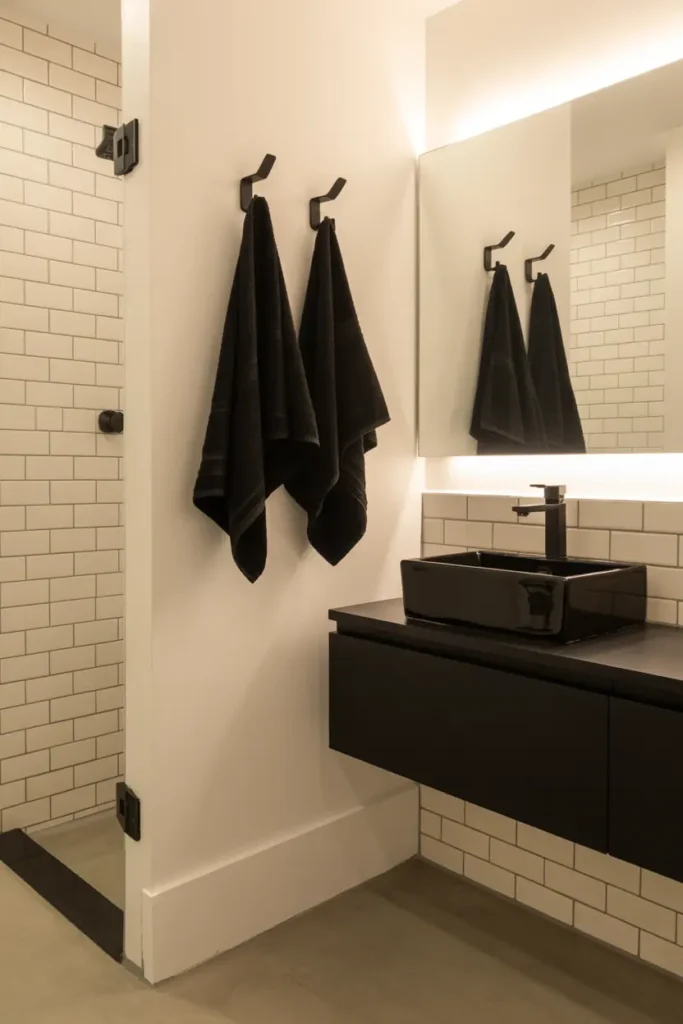
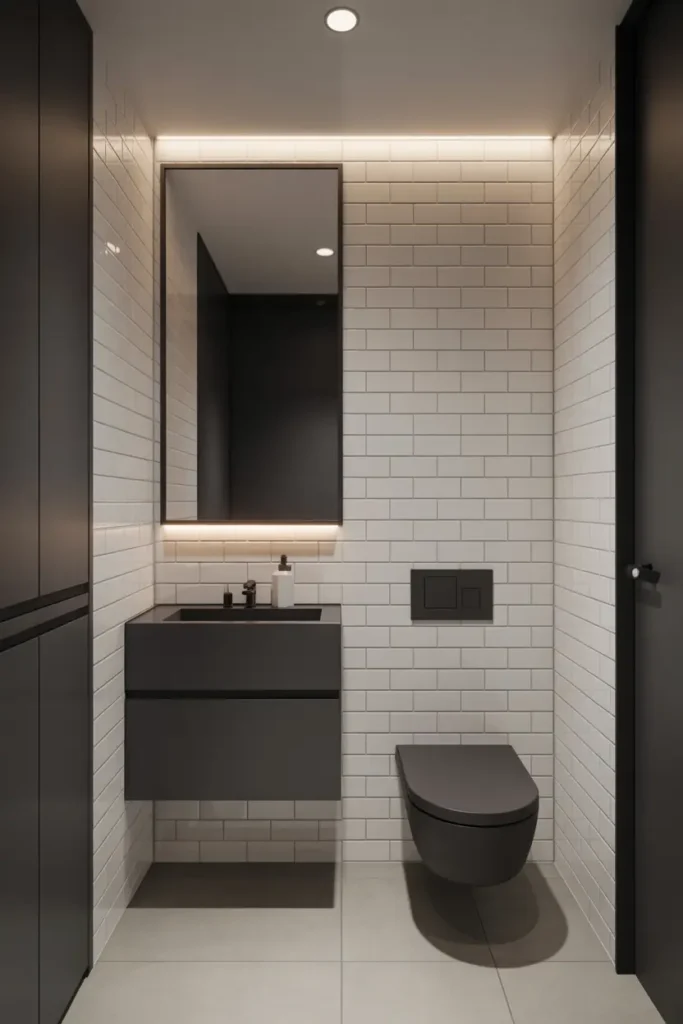
The classic move is white subway tile against a black vanity or black-framed mirror. Keep grout lines tight and light — dark grout on white tile in a small bathroom creates visual noise that reads as clutter. And keep the ceiling white, always. A dark ceiling in a small bathroom lowers the perceived height instantly; a white one keeps the room breathing upward.
3. Go Big on the Mirror
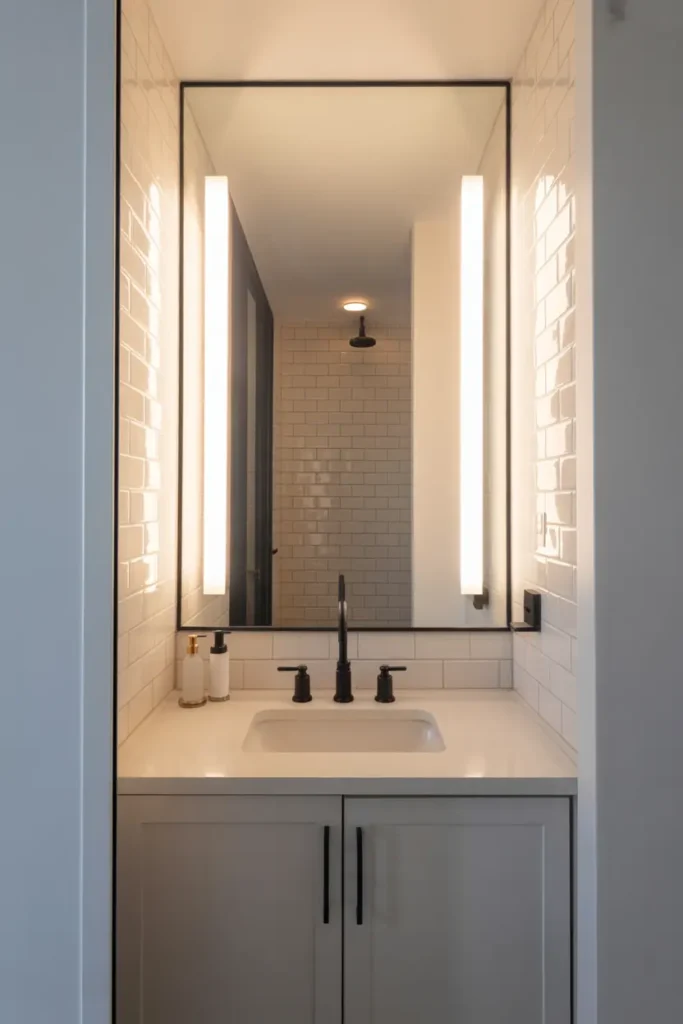
In a small black bathroom, the mirror is not an accessory — it’s a lighting fixture. A large mirror (as wide as the vanity, or a full-width medicine cabinet with a mirrored front) doubles whatever light exists by reflecting it back into the room. In windowless bathrooms, this is the single most important brightness move you can make.
Skip the small decorative mirror and go architectural: a frameless mirror that runs wall to wall above the vanity, or a tall leaner mirror if floor space allows. Backlit or front-lit mirrors are even better — integrated LED strips around a mirror add both task light and a glow that lifts the whole room. Expect to pay $150–$400 for a good backlit mirror; it’s worth every cent in a dark bathroom.
4. Choose Gloss Over Matte for Black Surfaces
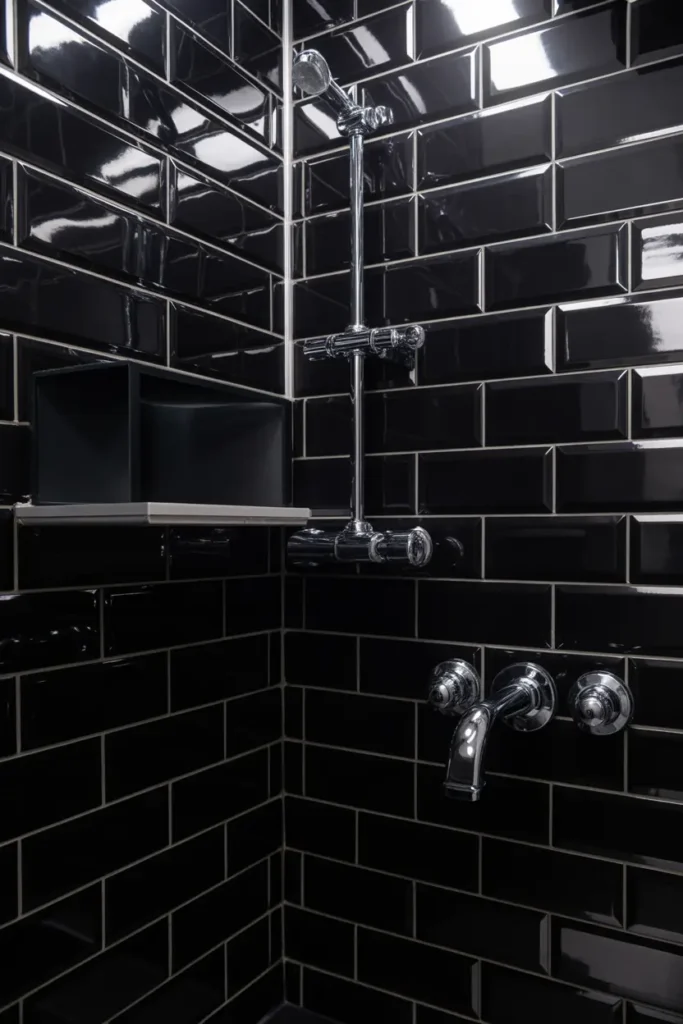
Finish matters more than color here. Matte black absorbs light — that’s its job. Glossy black reflects it, which means glossy black tile, a glossy vanity front, or a high-sheen black paint all contribute brightness instead of stealing it. In a small bathroom, that difference is the line between moody and murky.
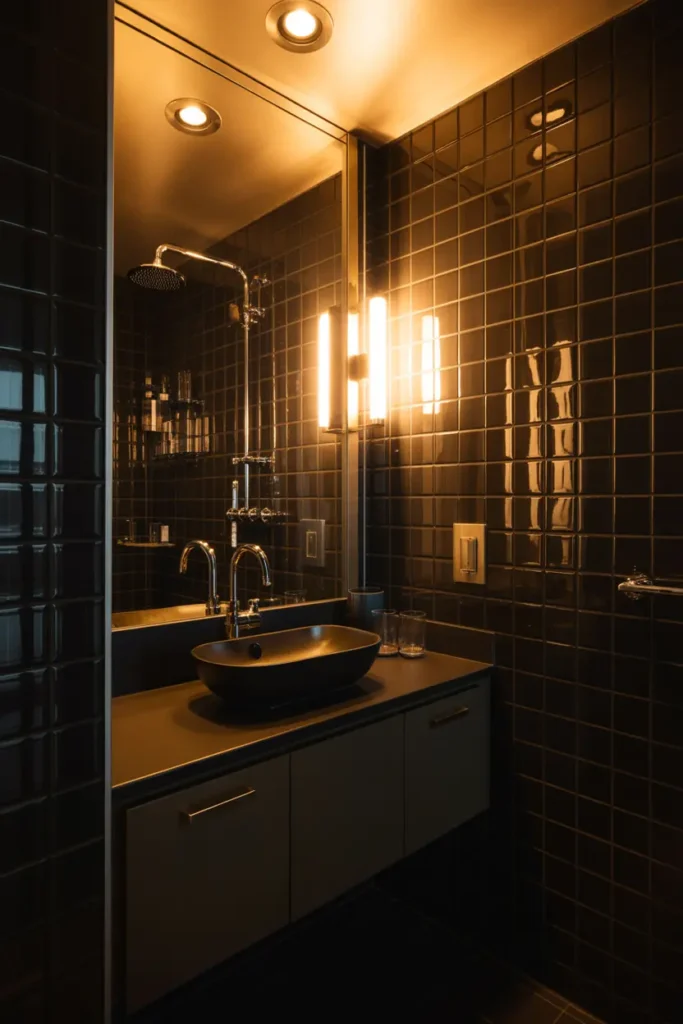
Glossy black subway tile is the standout choice: the sheen bounces light across the room and the tile format keeps it classic rather than trendy. One caution — gloss shows water spots and fingerprints more than matte, so it’s best on walls and vanity fronts, not on the floor where it’ll show every footprint. Pair glossy black with chrome fixtures to double down on the reflective effect.
5. Layer Warm Light at Three Heights
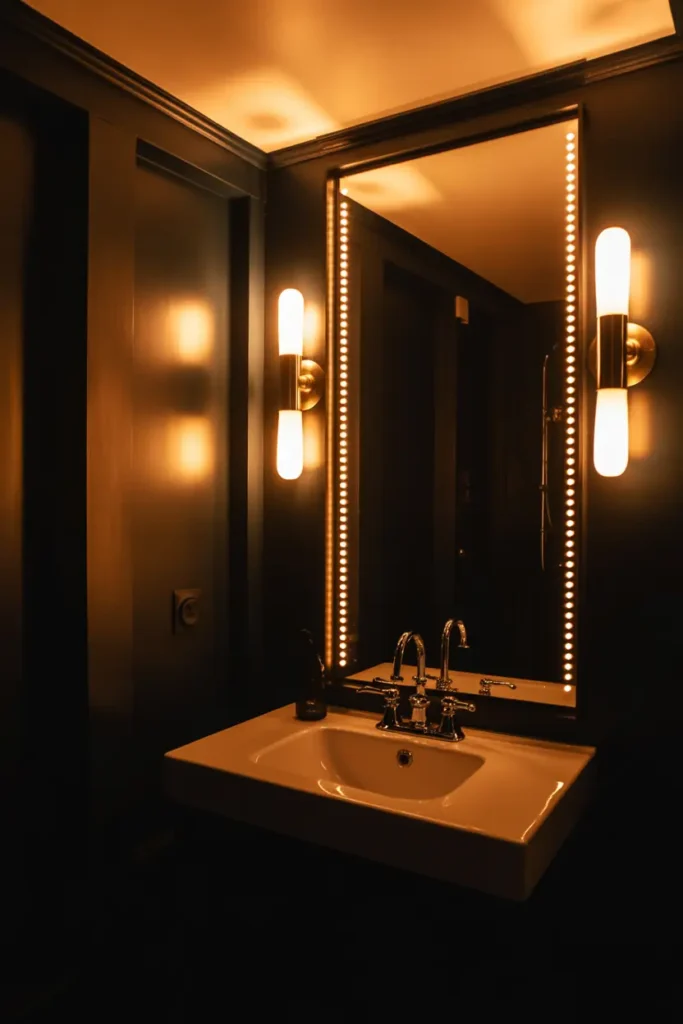
Black bathrooms live or die on lighting, and one ceiling light won’t cut it. You need light at three levels: overhead (a bright, dimmable ceiling fixture), face level (sconces or a lit mirror at the vanity — this is non-negotiable for actually seeing yourself), and low level (under-vanity or toe-kick lighting that washes the floor with a soft glow).
Keep everything at 2700K–3000K warm white. Cool white light against black tile looks like a nightclub bathroom; warm light makes it feel like a spa. Budget around $200–$500 total for a layered setup, and put the vanity lights on their own switch so the bathroom can go from bright morning mode to soft evening mode. That dimmer is the difference between a bathroom you use and a bathroom you enjoy.
6. Warm It Up With Light Wood
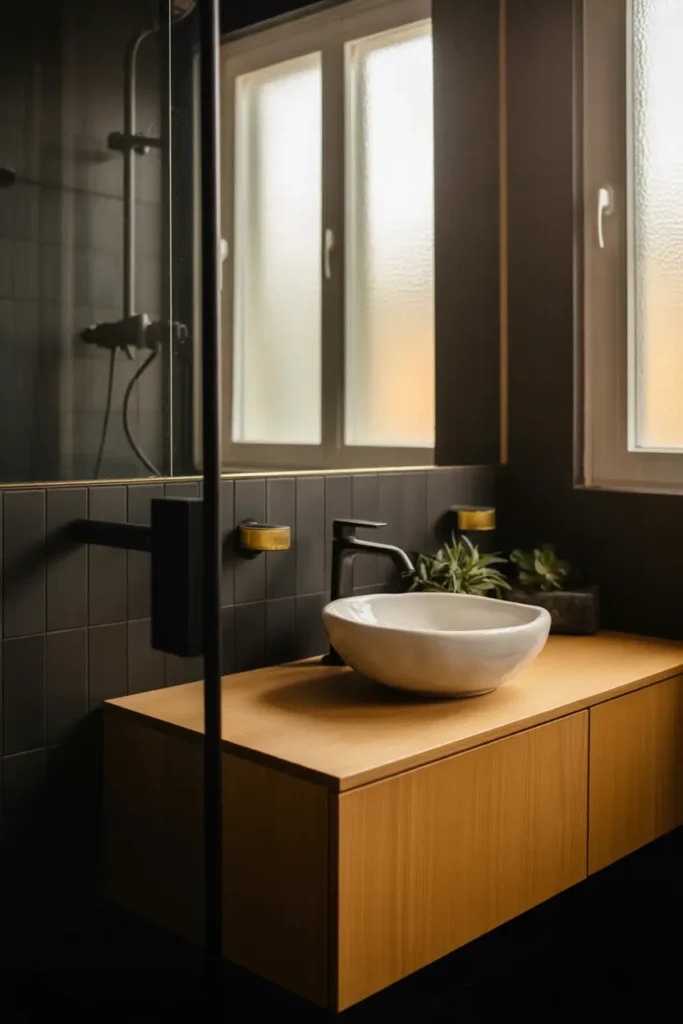
Black and white alone can feel cold and graphic. Light wood — oak, ash, bamboo, even pale teak — is the peacemaker: it adds warmth and an organic note that keeps the contrast from feeling sterile. A floating oak vanity against a black wall is one of the most reliably beautiful combinations in bathroom design.
You don’t need much. One wooden element is enough: the vanity, an open shelf, a bath mat, a stool, even just a wooden tray on the counter. Keep the wood light and natural rather than dark-stained — dark wood plus black walls pushes the room back toward cave territory. The ratio to aim for is roughly 70% light surfaces, 20% black, 10% wood.
7. Keep the Floor Light
The floor is the largest single surface in the room and the one your eye registers first when you walk in. A light floor — pale tile, light wood-look porcelain, even a light bath mat over a dark floor — reflects light upward and keeps the room feeling grounded rather than heavy. Dark floors in small bathrooms show every speck of dust and make the room feel smaller.
Large-format light tiles (12×24 or larger) with minimal grout lines are ideal: fewer grout lines means less visual noise and a more expansive feel. If replacing the floor isn’t in the budget, a light, washable runner or bath mat achieves 80% of the effect for $30. Just make sure it has a non-slip backing — wet tile and sliding mats are a bad combination.
8. Use Glass to Keep Sightlines Open
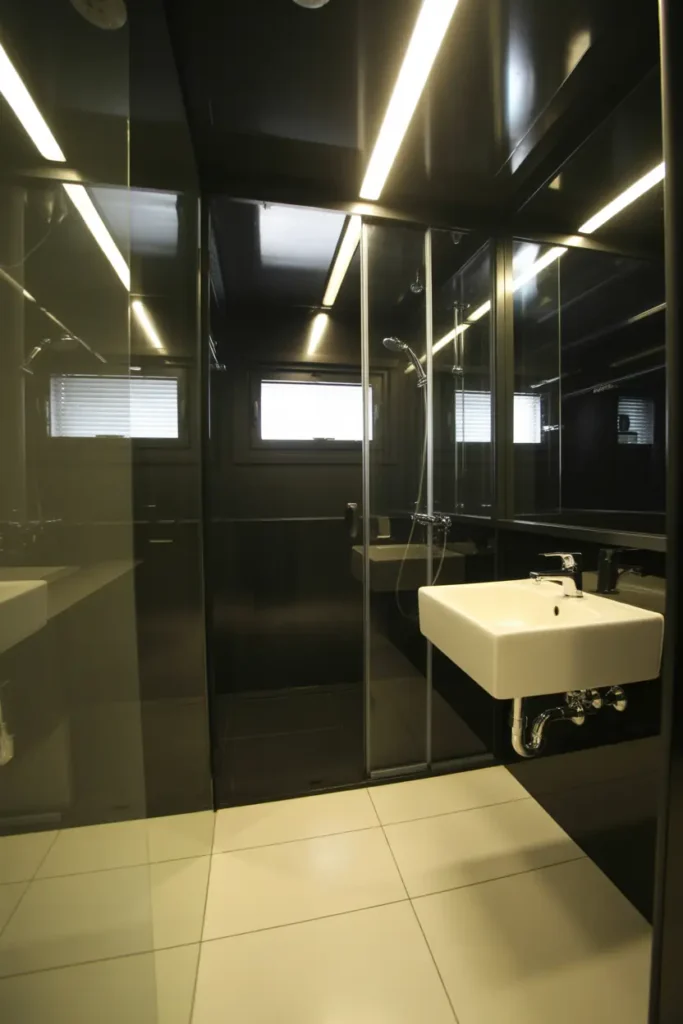
Every visual barrier in a small bathroom costs you perceived space. A frosted or heavy shower curtain chops the room in half; a clear glass shower panel lets your eye travel the full length of the room. In a black bathroom, that uninterrupted sightline is precious — it’s what keeps the dark tones feeling expansive rather than enclosing.
Frameless or minimal-frame glass is best. If a full glass panel isn’t practical, even switching a dark curtain for a clear or lightly frosted one helps. Extend the same thinking to accessories: glass soap dispensers, a clear acrylic tray, glass shelving — anything that lets light pass through instead of blocking it. The rule is simple: if it doesn’t need to be opaque, don’t make it opaque.
9. Edit Down to Almost Nothing
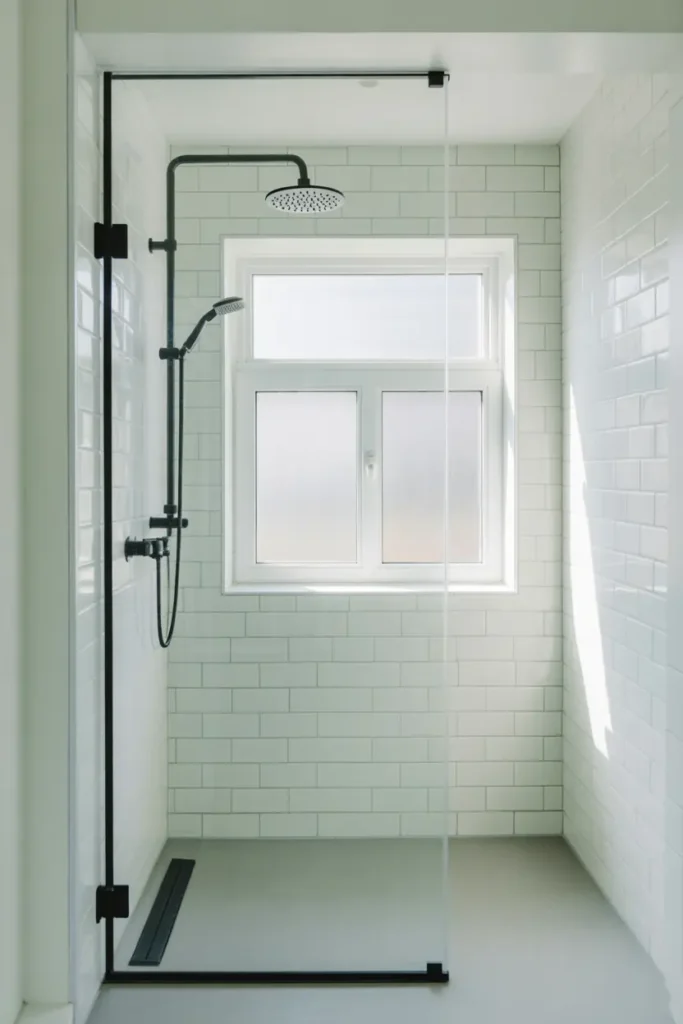
Black is a strong flavor — it doesn’t need garnish. In a small black bathroom, three to five visible accessories is the maximum; beyond that, the contrast starts working against you and the room looks busy instead of bold. Pick your few pieces deliberately: one great soap dispenser, one plant, one piece of art, one beautiful towel.
Corral the everyday stuff. Matching pump bottles, a single tray for counter items, and closed storage for everything else. The black elements are the decoration here — they don’t need competition. This restraint is also what makes the bathroom easy to clean, which is the real luxury in a small space.
10. Add Metallics as Light Catchers
Metallic finishes are tiny mirrors scattered around the room, and in a black bathroom they earn their keep. Brushed brass or matte gold warms up the contrast; polished chrome or nickel doubles down on the sleek modern look. Either way, faucets, mirror frames, cabinet pulls, and even a metallic trash can catch light and throw it back into the room.
Pick one metal and commit — mixing chrome, brass, and black nickel in a small bathroom looks accidental. Brass and gold pair best with warm lighting and wood; chrome and nickel suit cooler, more minimal schemes. And don’t overlook the small stuff: a metallic-framed mirror and matching pulls can tie the whole room together for under $100.
11. Draw the Eye Up With Vertical Lines
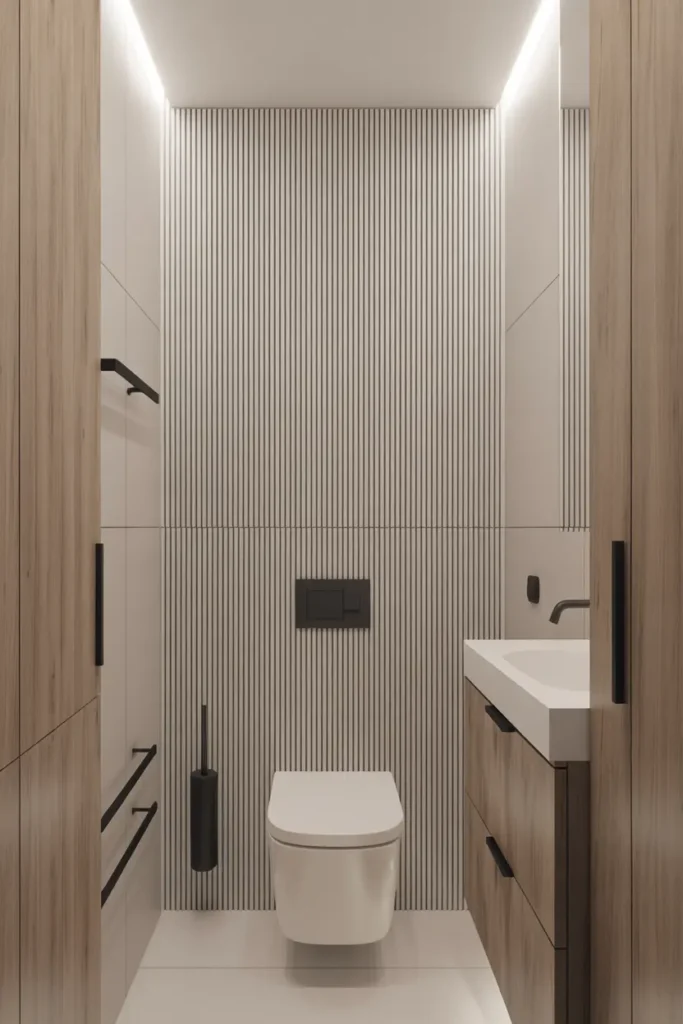
Low ceilings make small bathrooms feel cramped, and black can emphasize that. Vertical lines — floor-to-ceiling tile, vertical shiplap, tall narrow mirrors, even a striped shower curtain — trick the eye into reading the room as taller. It’s the oldest visual trick in design and it works every time.
Vertical subway tile (stacked, not staggered) is the high-impact version: it modernizes the classic look and adds height. If you’re not retiling, a tall mirror and a vertical piece of art achieve the same effect for a fraction of the cost. Avoid horizontal banding — chair rails, horizontal tile borders, wide stripes — in low-ceilinged bathrooms; they chop the height you’re trying to gain.
12. Install Under-Vanity Lighting for the Floating Effect
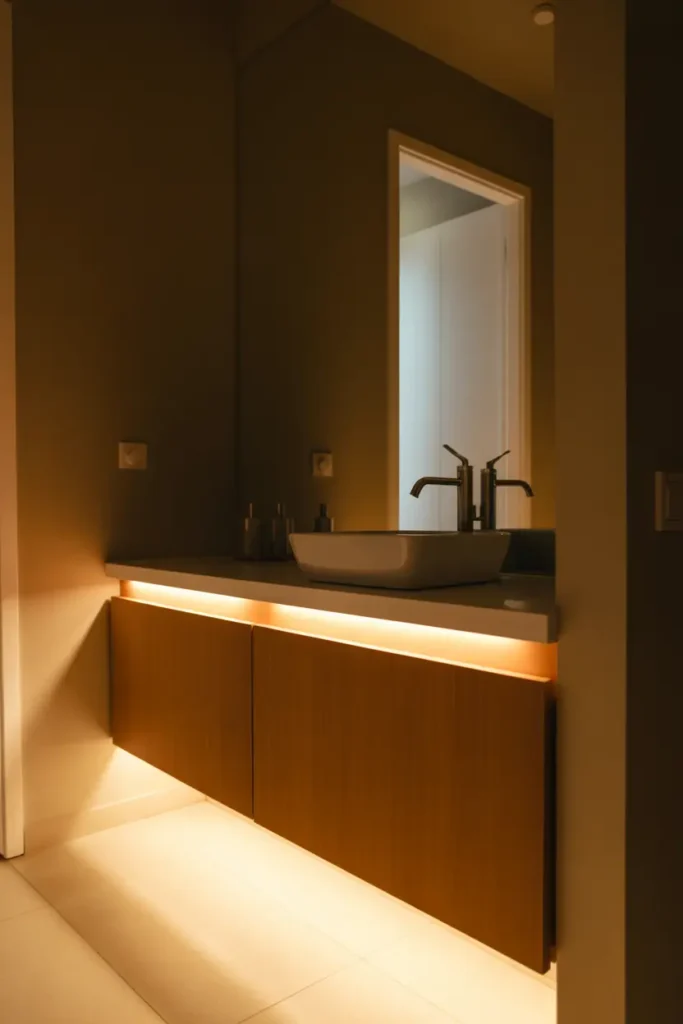
This is the move that makes guests ask what you did. A strip of warm LED under a floating vanity washes the floor with light, making the vanity look like it hovers and the floor look like it extends beneath it. The bathroom instantly feels larger because your eye reads continuous floor instead of a dark cabinet base.
LED strip kits cost $15–$30 and many are plug-in or battery-powered — no electrician needed. Mount the strip set back an inch or two from the vanity’s front edge so you see the glow, not the hardware. Put it on a motion sensor or timer and you get a free nightlight that makes 3am bathroom trips feel luxurious instead of blinding.
13. Swap Closed Cabinets for Open Shelving
Bulky closed cabinets eat visual space in small bathrooms. One or two open shelves — in light wood, glass, or even black metal — provide the same storage while letting light and air move through. The key is styling them: rolled towels, a plant, a couple of beautiful bottles. Open shelves that look curated feel spacious; open shelves that look stuffed feel worse than cabinets.
The 70% rule keeps them honest: never fill open shelves more than about 70% full, and group items in odd numbers. If you can’t commit to the styling, a single open shelf plus one closed cabinet is the compromise — display the pretty stuff, hide the rest. Either way, you gain the airy feeling without losing function.
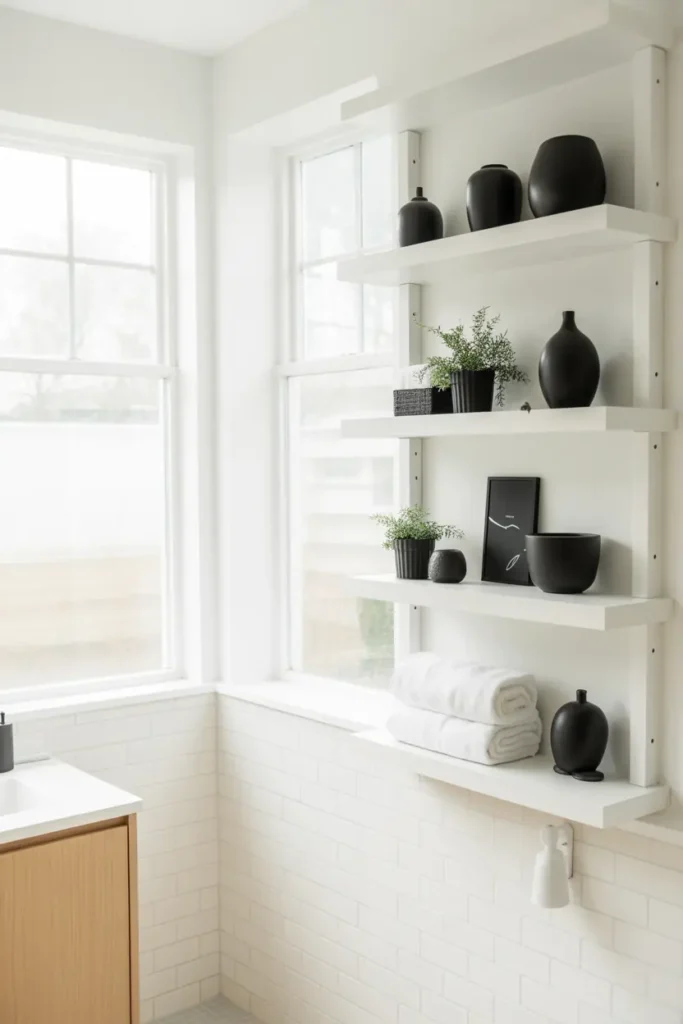
14. Add One Living Plant
Green against black is one of the most striking color combinations in nature, and a single plant delivers it for the price of a coffee. A pothos trailing from a shelf, a snake plant in the corner, or a small fern on the vanity adds life, softens all the hard surfaces, and gives the eye somewhere gentle to land amid the contrast.
Bathrooms are actually great for plants — the humidity from showers mimics a tropical environment. Choose low-light tolerant varieties if there’s no window: pothos, snake plants, and ZZ plants all thrive on neglect and bathroom steam. One healthy plant beats three struggling ones, so start with a single forgiving species.
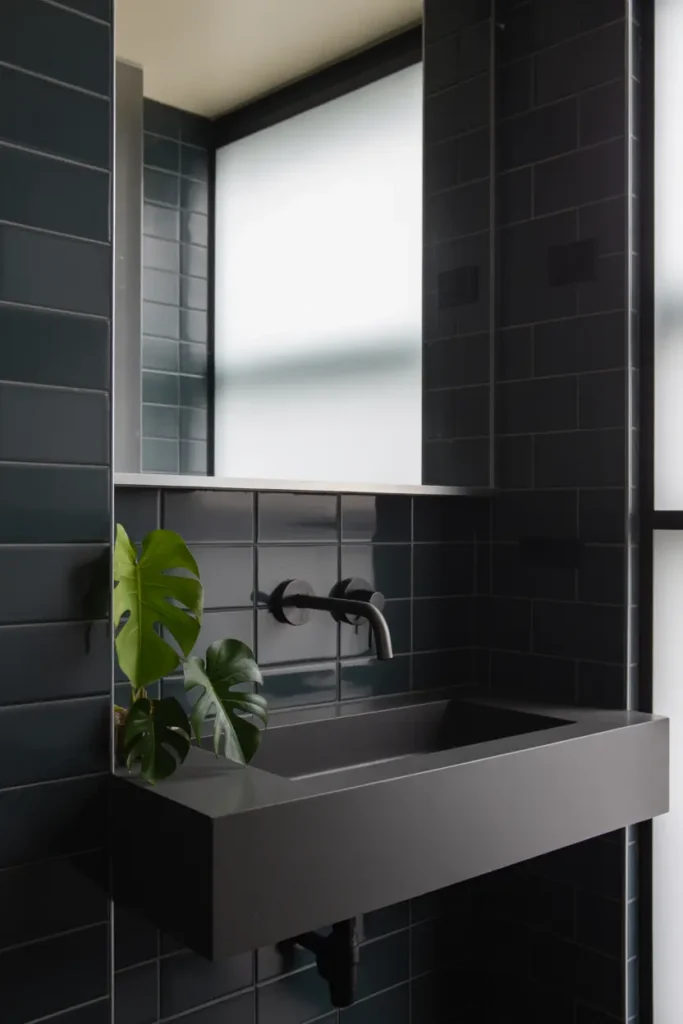
15. Balance, Balance, Balance
If there’s one rule that governs all fourteen above, it’s this: for every dark move, make a light one. Black wall? White ceiling and light floor. Dark vanity? Bright mirror and warm lighting. The goal is tension — light pushing against dark — because that tension is what makes the room feel designed rather than just dark.
Step back and squint at the room (designers actually do this). If it reads as mostly one tone, adjust: add a light textile, swap a dark accessory for metallic, or brighten one more light source. When the balance is right, a small black bathroom doesn’t feel small or dark — it feels like the most confident room in the house.
Related Decor Ideas
If you liked these ideas, you might also explore:
- Minimalist bathroom design trends for 2026
- Small bathroom decor ideas for modern homes
- Neutral bathroom styling with warm tones
Conclusion
Black in a small bathroom isn’t a risk — it’s a strategy. Used as an accent rather than a blanket, paired with white reflectors, glossy finishes, warm layered light, and a few natural materials, black gives a small bathroom the one thing beige never can: character. The rooms people remember are never the safe ones.
Start with the moves that cost the least and matter the most: a bigger mirror, warmer bulbs, and editing the clutter. Then commit to one bold black element — a feature wall, a vanity, a tile choice — and build the light around it. Done right, your small black bathroom won’t just look bigger. It’ll look like you hired someone.
Pro Tips
- Test black paint in the actual bathroom light. Blacks have undertones — some read blue, some brown, some green. Paint a large swatch and check it morning and night before committing.
- Seal the grout. Dark grout in a steamy bathroom stains fast. A $15 grout sealer applied once a year keeps black-and-white tile looking crisp.
- Ventilate aggressively. Steam dulls glossy finishes and feeds mildew in dark corners you can’t see. Run the exhaust fan 20 minutes after every shower — a humidity-sensing switch ($25) does it automatically.
- Keep one spare warm bulb. When a vanity bulb dies and you replace it with a cool white spare, the whole room’s mood breaks. Match the temperature (2700K–3000K) every time.
FAQs
Will black make my small bathroom look smaller?
Not if you balance it. Black used as an accent — one wall, the vanity, the fixtures — with light floors, white ceilings, and good lighting actually adds depth, which reads as spaciousness. The mistake is covering every surface in matte black with one dim ceiling light.
What’s the best black paint finish for a bathroom?
Satin or semi-gloss. Bathrooms need moisture-resistant paint anyway, and the sheen reflects light that matte finishes absorb. Look for paints labeled bathroom/kitchen formula, and always use a mold-resistant primer underneath.
Can I do a black bathroom with no window?
Yes — but lighting becomes everything. You’ll want a bright dimmable ceiling fixture, lit vanity mirror or sconces at face level, and under-vanity LED glow. With three light layers at warm temperatures, a windowless black bathroom can feel like an evening spa.
Is black tile hard to keep clean?
Glossy black tile shows water spots and soap film more than light tile, so it needs a quick squeegee after showers — thirty seconds, done. The payoff is that it hides very little and always looks intentional when maintained. A daily squeegee is the whole maintenance routine.

HowDecor is a home decor blog sharing simple, practical decorating ideas for everyday spaces. We believe a beautiful home should feel comfortable, personal, and full of warmth — and that great style does not require a huge budget. Our goal is to inspire readers to create spaces that feel peaceful, welcoming, and truly their own — one room at a time.