Coastal bathrooms have a reputation problem: most people picture a gift shop exploded — rope mirrors, “beach” signs, a jar of shells. The real thing is quieter and much better. True coastal design isn’t about decorating with the beach; it’s about borrowing the beach’s best qualities — the light, the air, the calm — and building a bathroom that makes you exhale the moment you walk in.
Modern coastal has grown up. It’s less theme park, more seaside hotel: pale blues, sun-bleached wood, linen that moves in the breeze, and light that seems to come from everywhere. Here’s how to get that feeling without a single kitschy anchor in sight.
1. Build on Soft Blue and White
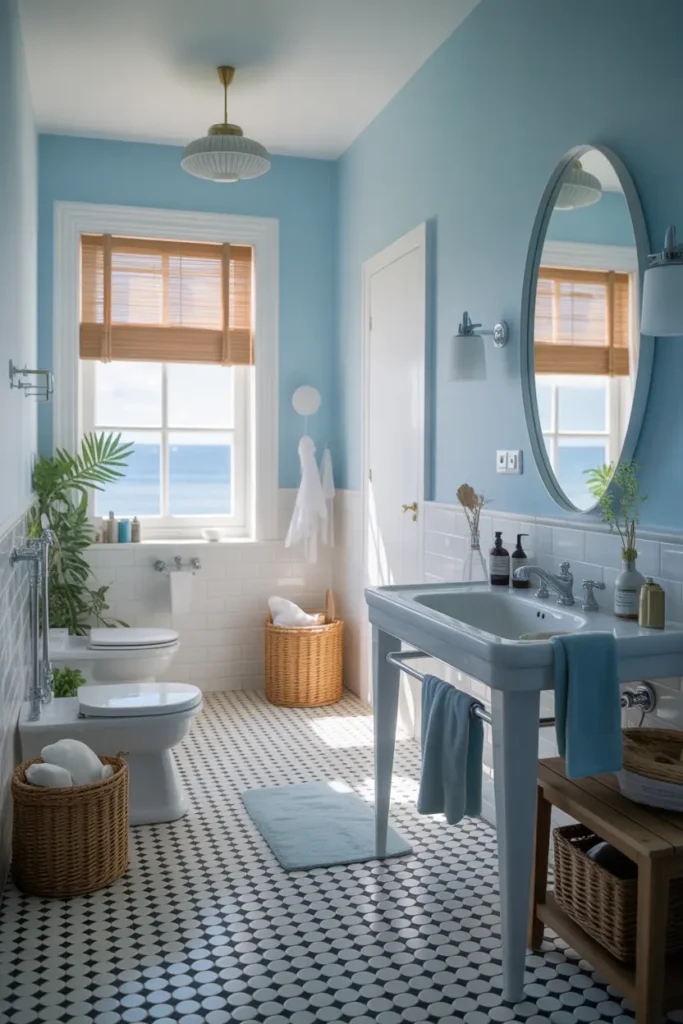
Soft blue and white is the coastal foundation for a reason — it genuinely lowers your heart rate. The trick is choosing the right blue: dusty, grayed-out blues (think sea glass, not swimming pool) feel calm and sophisticated, while bright turquoise reads as themed. Paint or tile in a muted blue-gray, keep fixtures and ceiling white, and the room does half the relaxing for you.
In small bathrooms, keep blue to one or two surfaces — an accent wall, the vanity, or just textiles — and let white carry the rest. Blue on all four walls in a windowless bath can feel cold rather than coastal. And always test your blue in the room’s actual light: blues shift dramatically between morning sun and evening bulbs, and a color that looks serene at noon can look icy at night.
2. Warm It With Light Wood
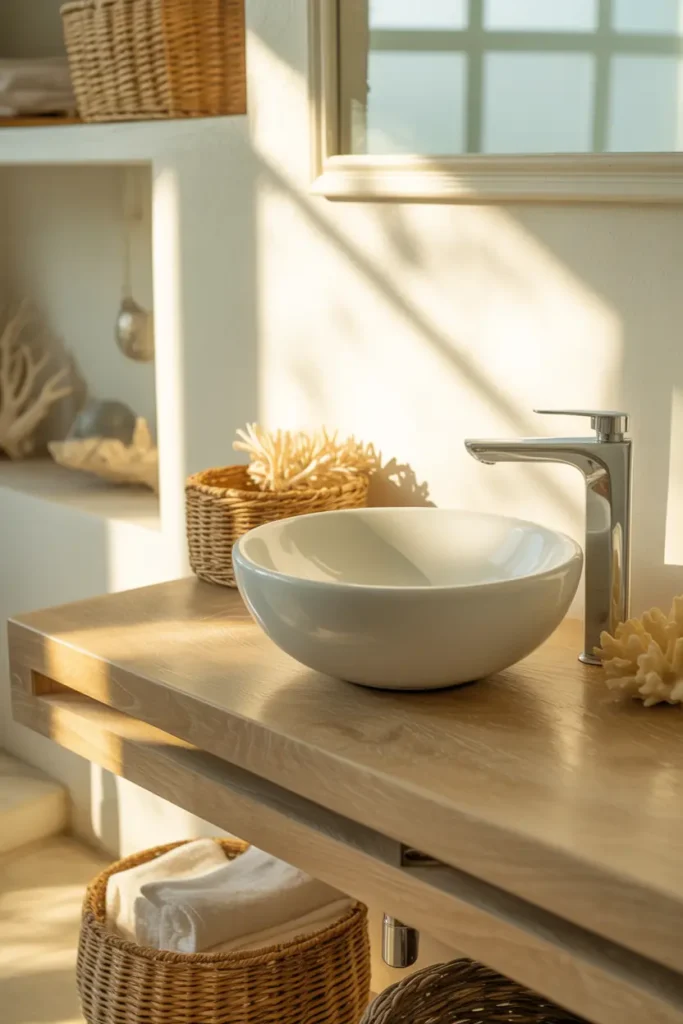
All blue and white with no wood feels like a laboratory; add wood and it becomes a beach house. Light, sun-bleached tones — white oak, ash, pale teak, bamboo — bring the warmth that keeps coastal from feeling sterile. A wooden vanity, a teak bath mat, or open oak shelving is all it takes.
The wood should look weathered, not polished — matte finishes, visible grain, nothing glossy. In wet areas, teak and iroko handle moisture without complaint; for vanities, properly sealed oak works fine. One caution: keep wood away from direct splash zones unless it’s rated for it. A teak stool next to the tub is perfect; an unsealed pine shelf inside the shower is a science experiment.
3. Let Light In Through Sheers
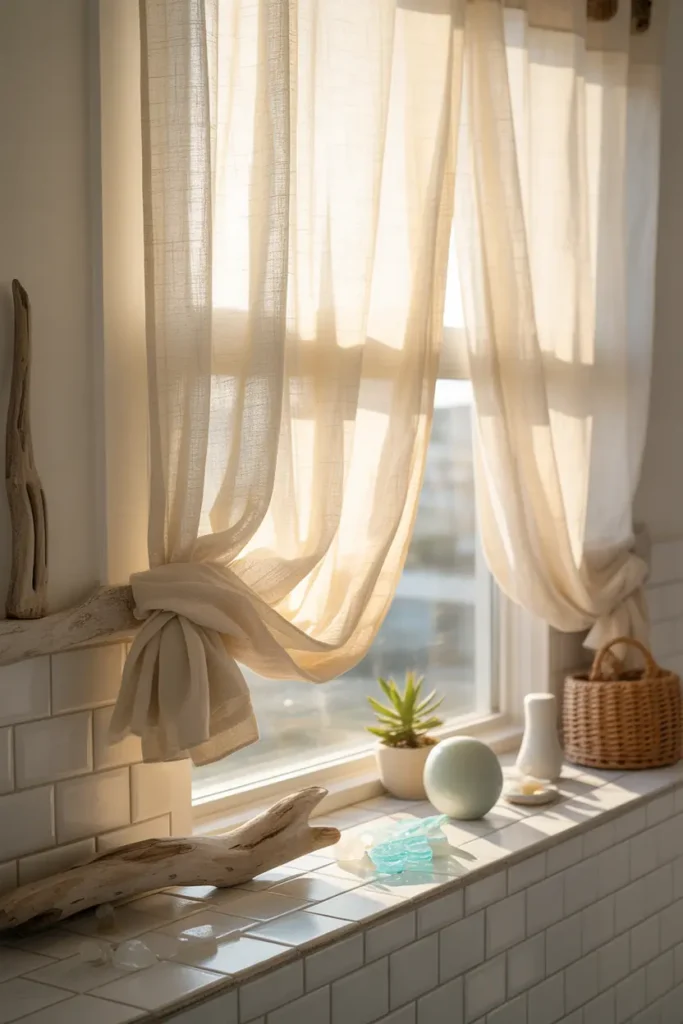
Heavy curtains and coastal don’t mix. Sheer white or ivory curtains filter sunlight into that soft, diffused glow that defines beachside interiors — bright but never harsh. In a bathroom, they also solve the privacy problem without killing the light the way frosted glass or blinds do.
Choose moisture-friendly sheers (polyester voile rather than cotton, which mildews in steamy bathrooms) and hang them high and wide so the window looks larger. If you have no window, fake the effect: a backlit mirror or a daylight-balanced bulb (5000K) behind a sheer shower curtain creates a similar luminous softness. Light is the whole aesthetic here — protect it.
4. Layer Natural Textures
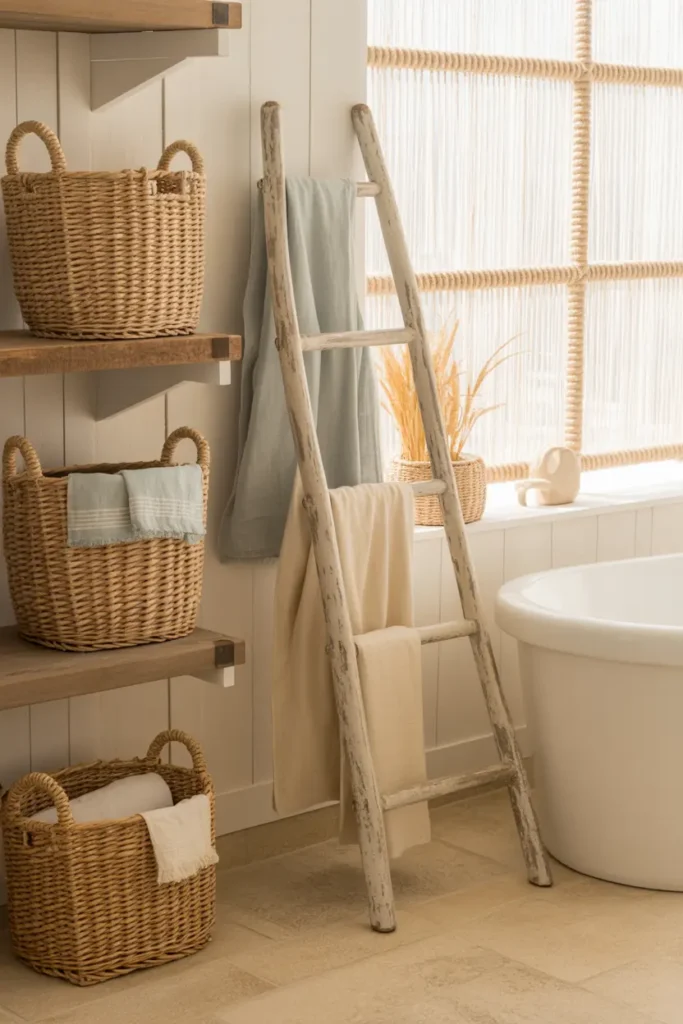
Coastal texture is what separates the look from “blue bathroom.” Woven seagrass baskets, nubby linen towels, a jute rug, rattan trays — these natural fibers add the tactile richness that makes the room feel collected rather than decorated. Texture is doing the job that pattern does in other styles.
The rule: mix three textures minimum, and let them be honestly natural — real fibers, real weaves, not plastic imitations. A seagrass basket for towels, linen hand towels, and a woven rug is a complete texture story for a small bathroom. Keep them in the same pale tonal family so they read as calm rather than busy.
5. Hang Art That Suggests, Not Shouts
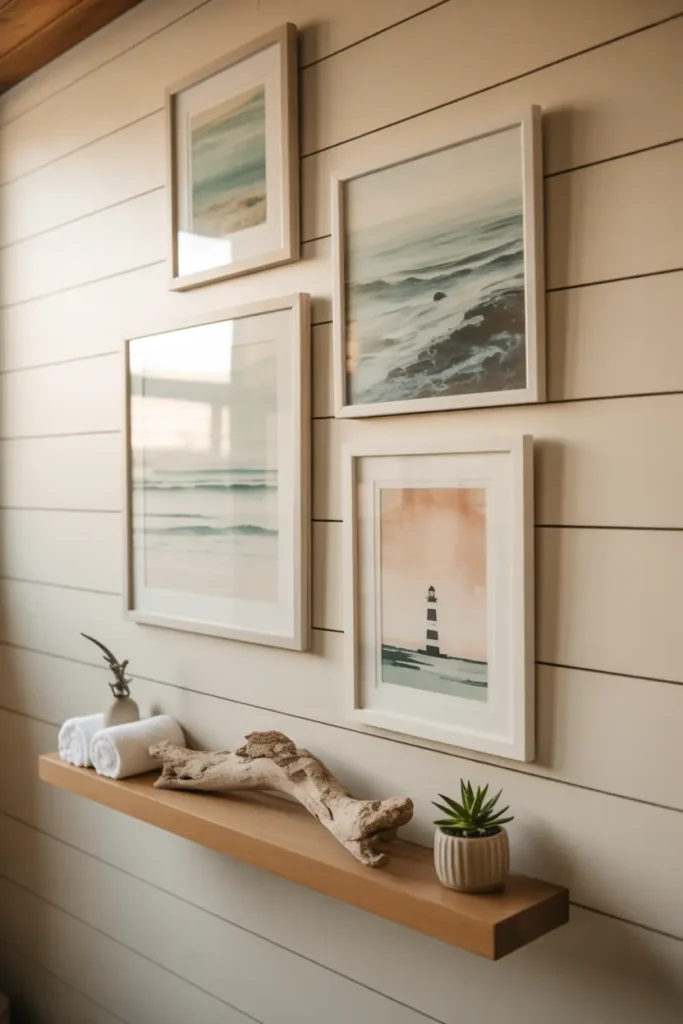
One well-chosen piece of art does more for the coastal feeling than a dozen beach trinkets. Abstract seascapes, soft watercolor waves, misty shoreline photography in muted tones — art that suggests the ocean rather than illustrating it. Muted and minimal beats literal every time.
Scale matters: one large piece over the tub or beside the mirror beats a cluster of small prints in a bathroom (humidity and small frames are a bad combination anyway). Frame simply — thin white, pale wood, or frameless — and keep the palette of the art inside the room’s blue-white-beige range. The art should disappear into the calm, not interrupt it.
6. Ground It With Sandy Neutrals
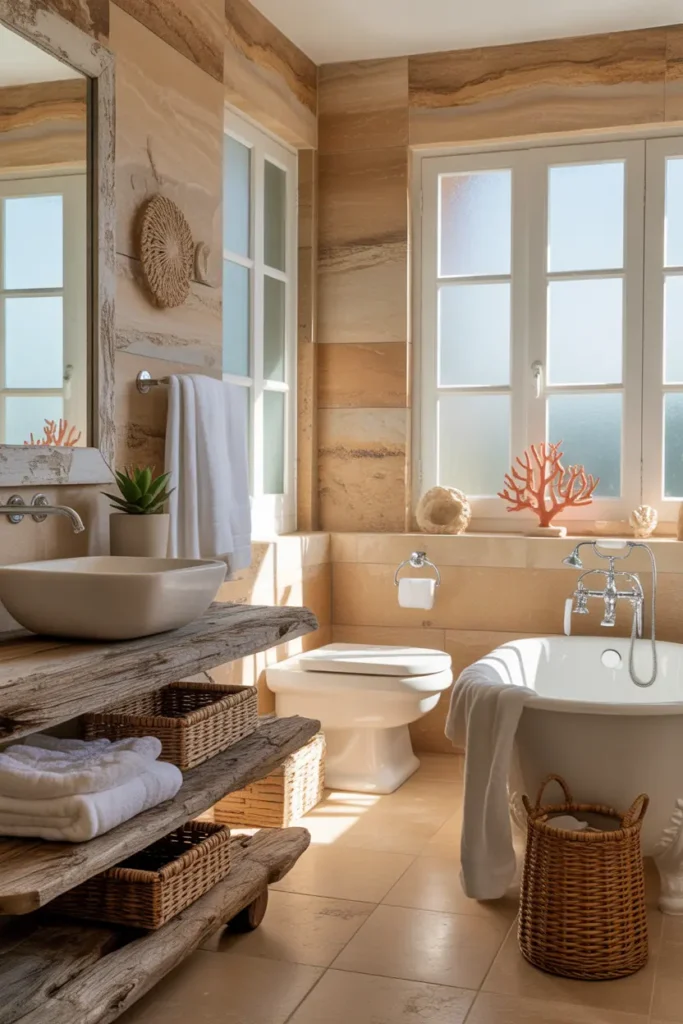
Blue and white need an earthy third player or the room floats away. Sandy beige, warm greige, pale stone — these are the colors of the beach itself, and they ground the palette the way sand grounds the shoreline. They work beautifully on floors, where they hide wear and feel warm underfoot.
Large-format beige tile with minimal grout lines is the workhorse choice; it reads as calm and expansive. If you’re not retiling, a sandy-toned bath mat or woven rug over existing floors achieves the grounding effect for very little. Keep the beige warm-toned — gray-beige plus blue can turn chilly, while warm sand plus blue feels like sunlight.
7. Keep It Transparent With Glass
Coastal is about air and light, and nothing kills air faster than visual barriers. Clear glass shower panels, glass dispensers, open glass shelving — anything transparent keeps sightlines long and light moving. In a small coastal bathroom, a glass shower enclosure instead of a curtain can make the room feel nearly twice as large.
Frameless or minimal-frame glass is the goal; heavy black framing fights the airy aesthetic (save that for the black bathroom article). A squeegee habit keeps glass spotless — thirty seconds after a shower, done. And decant the colorful plastic bottles into simple glass dispensers; it’s a tiny change that removes a surprising amount of visual noise.
8. Add Blue in Small, Changeable Doses
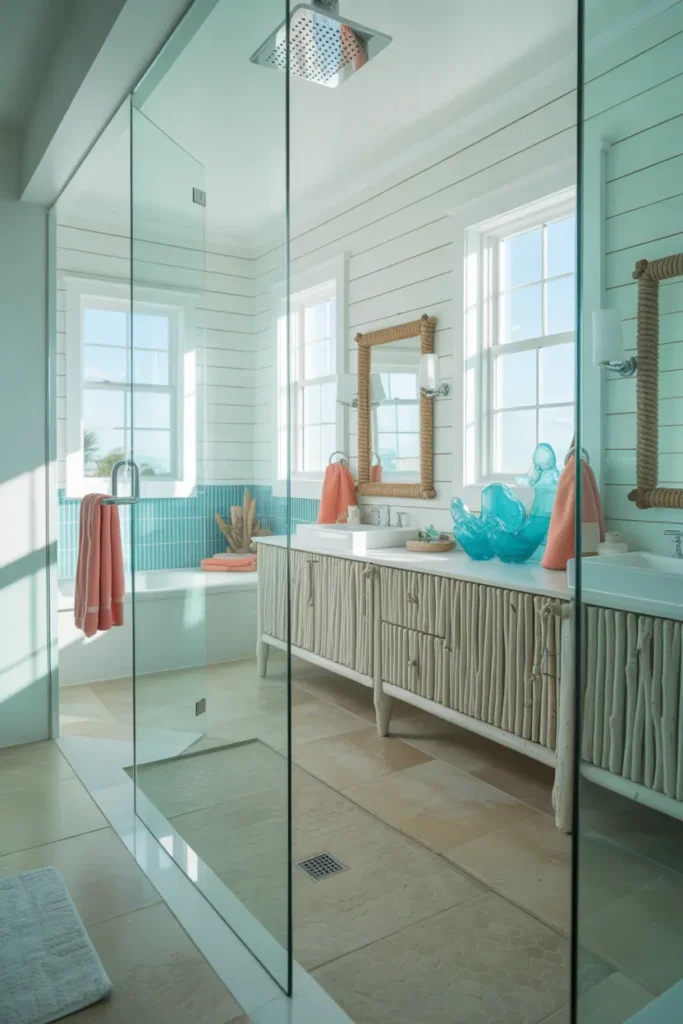
Commitment-phobes, this one’s for you: you can get 80% of the coastal feeling from accessories alone. Blue towels, a striped shower curtain, a ceramic soap dispenser, a small rug — all changeable, all affordable, all removable when you want a different mood. This is also the smart move for renters.
The key is picking one blue and repeating it three or more times. Three touches of the same dusty blue (towels, art, a vase) looks intentional; five different blues looks like a clearance sale. Buy the textiles as a set or bring a swatch when shopping so the blues actually match.
9. Splurge on the Freestanding Tub (If You Can)
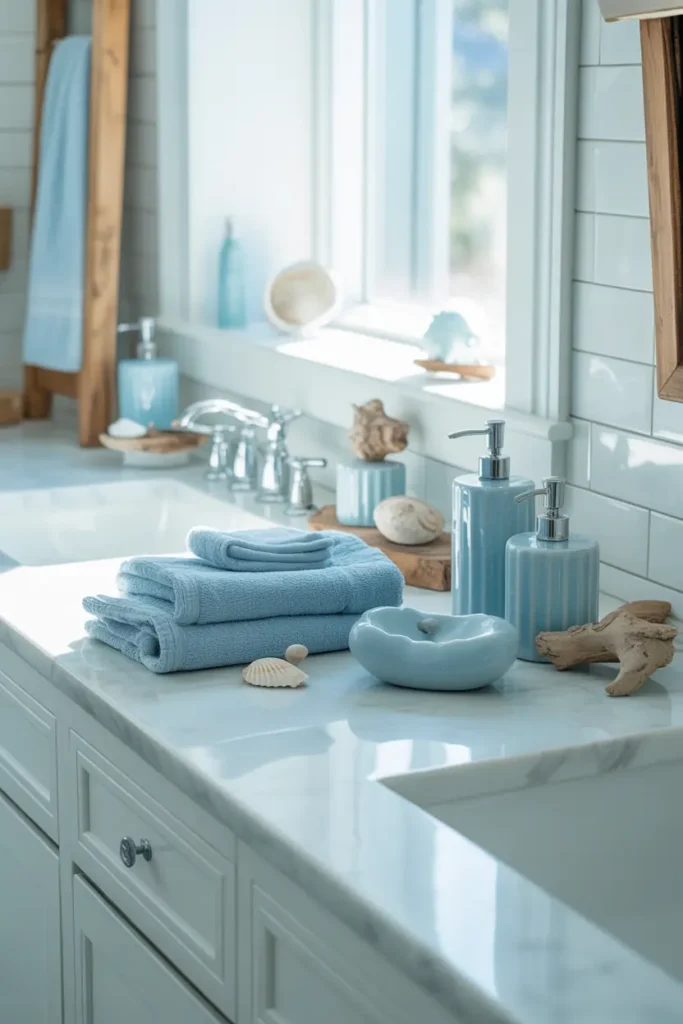
Nothing says coastal spa like a freestanding tub — it’s the sculptural centerpiece that turns a bathroom into a retreat. Against pale walls with natural light, a simple white oval tub looks like it belongs in a seaside resort. This is the fantasy piece, and in the right bathroom it’s worth every penny.
Be realistic about the requirements: you need floor space (at least 5×3 feet clear around it), a floor that can take the weight (a filled tub plus person can exceed 500 pounds — check your joists), and a freestanding or wall-mounted filler. If a full tub isn’t practical, a deep soaking tub in an alcove with the same pale palette delivers much of the feeling. And if you have one — use it. A tub you never use is just an expensive sculpture.
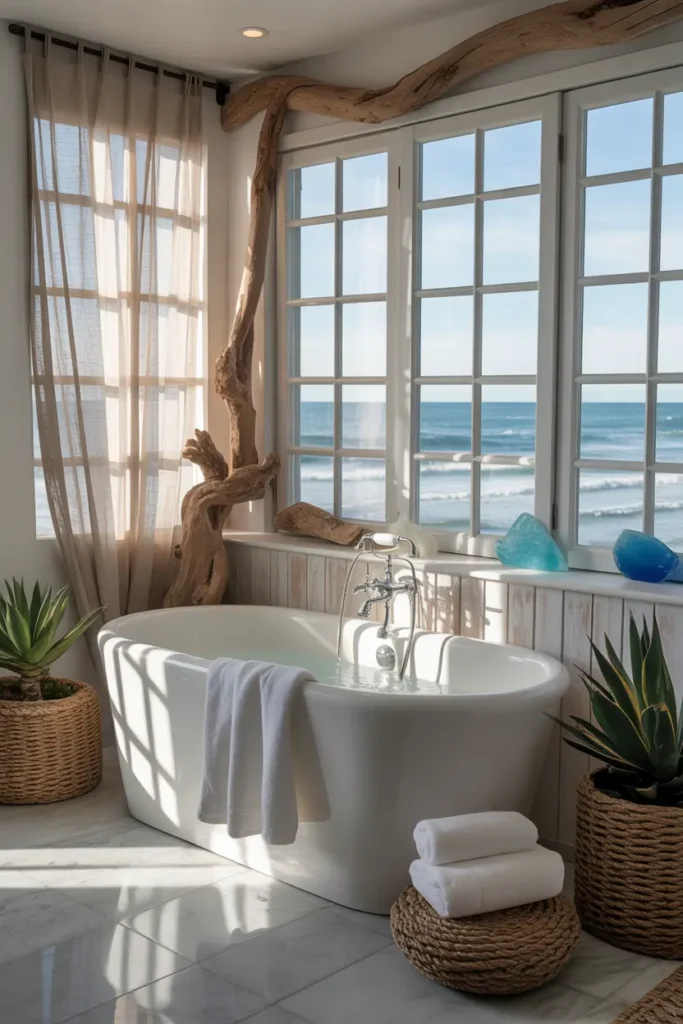
10. Use Weathered Wood Like You Found It
Driftwood and weathered wood carry the actual story of the coast — sun, salt, and time did the finishing work. A driftwood mirror frame, a weathered wood shelf, or even a single piece of found driftwood as sculpture adds authenticity that new “coastal-style” products can’t fake. It’s the difference between a beach souvenir and a beach memory.
Source it honestly: real driftwood from beaches (where collecting is legal), reclaimed wood dealers, or convincingly weathered reproductions. If you find your own, scrub it, soak it in a bleach solution, dry it thoroughly, and seal it before bringing it indoors — beach wood can harbor salt and critters. One or two pieces is enough; this is an accent, not a lumber yard.
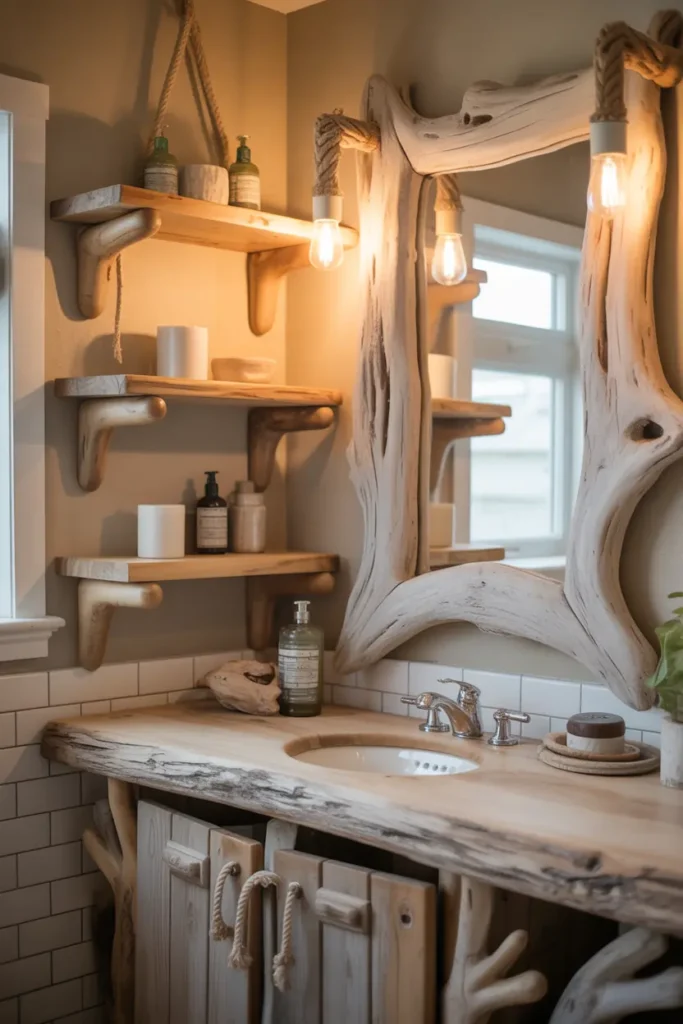
11. Keep Everything Pale
This is the non-negotiable rule of coastal: when in doubt, go lighter. Dark colors absorb the light that the whole style depends on. Walls, floors, ceiling, large fixtures — keep them in the palest range you’re comfortable with. The airiness is the design; everything else is supporting cast.
That doesn’t mean stark white everywhere — pale blues, soft beiges, warm whites all count as “light.” What it does mean is avoiding the heavy contrast moves (black vanities, dark floors) that belong to other styles. If a dark element sneaks in, balance it with twice as much pale around it. Coastal should feel like morning, not midnight.
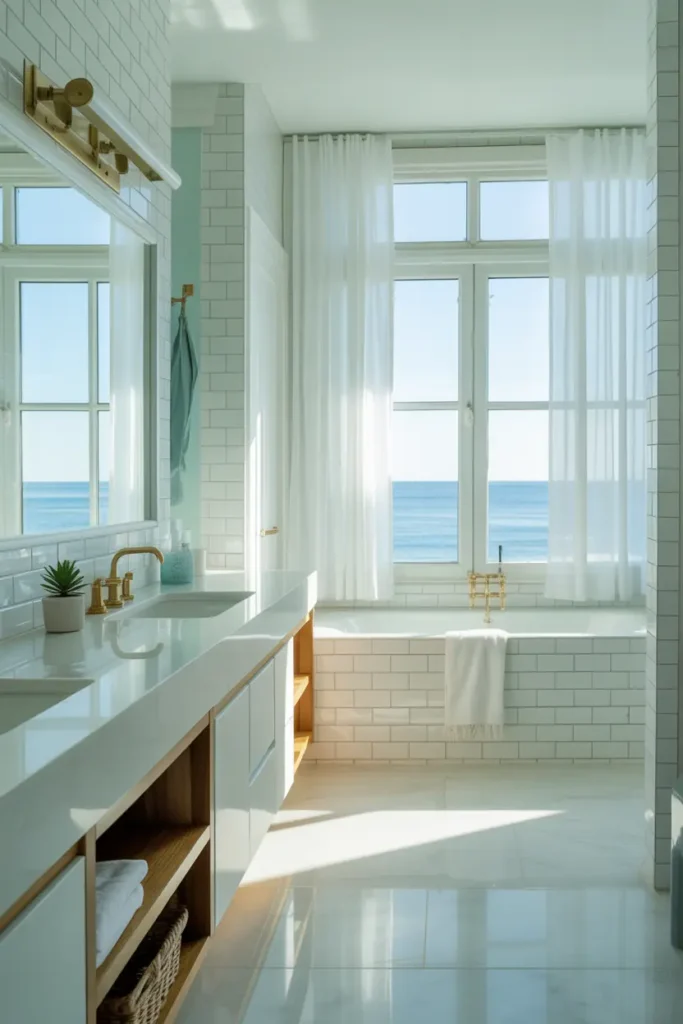
12. Add Plants That Love Steam
Bathrooms are secretly ideal for plants — the shower creates the humidity tropical species crave. In a coastal bathroom, greenery adds the living, organic note that keeps all the pale surfaces from feeling sterile. A trailing pothos, a Boston fern, or an orchid on the vanity: one plant changes the room’s energy completely.
Coastal-appropriate choices lean lush and soft rather than spiky: ferns, pothos, peace lilies, orchids. Hang them high where the steam rises, or place them where they’ll catch natural light. Skip the cacti and succulents here — they’re desert plants, and they send the wrong geographic signal in a room trying to feel like the shore.
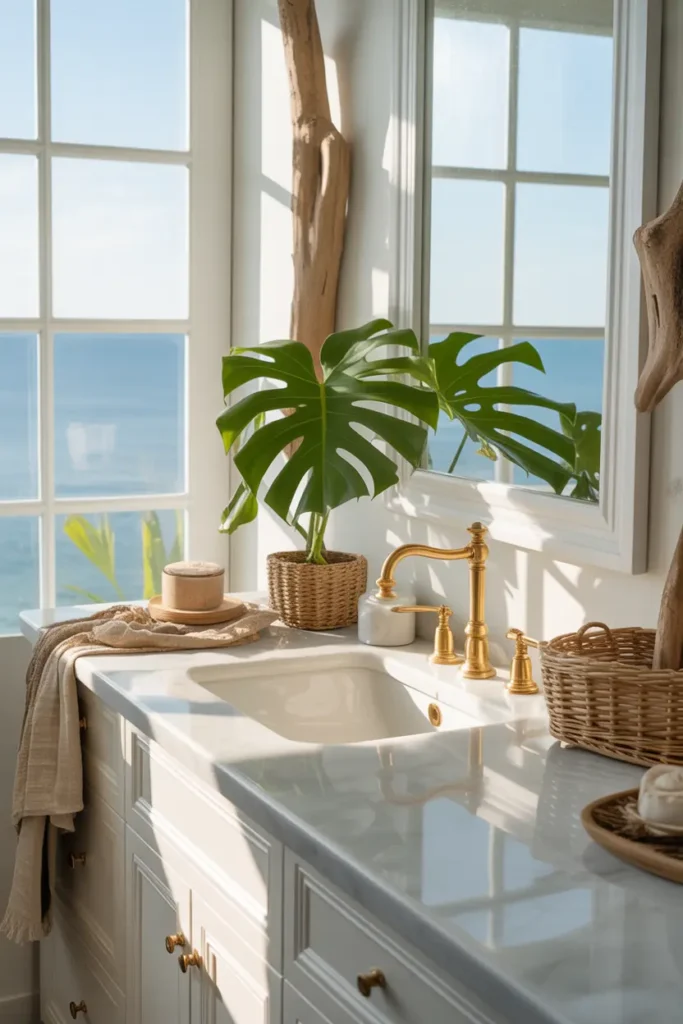
13. Edit Until It’s Serene
Coastal calm dies in clutter. Every visible object in a coastal bathroom should earn its place by being beautiful, useful, or both — ideally both. Three to five visible accessories is the sweet spot; beyond that, the serenity starts leaking out. This is the style where “less” isn’t just more, it’s everything.
The practical version: decant toiletries into matching containers, hide cleaning supplies completely, and give every daily item a home (tray, niche, drawer). What remains visible should be the pretty stuff — the linen towels, the plant, the art, the natural textures. A coastal bathroom with clear surfaces practically cleans itself, visually speaking.
14. Light It Like Golden Hour
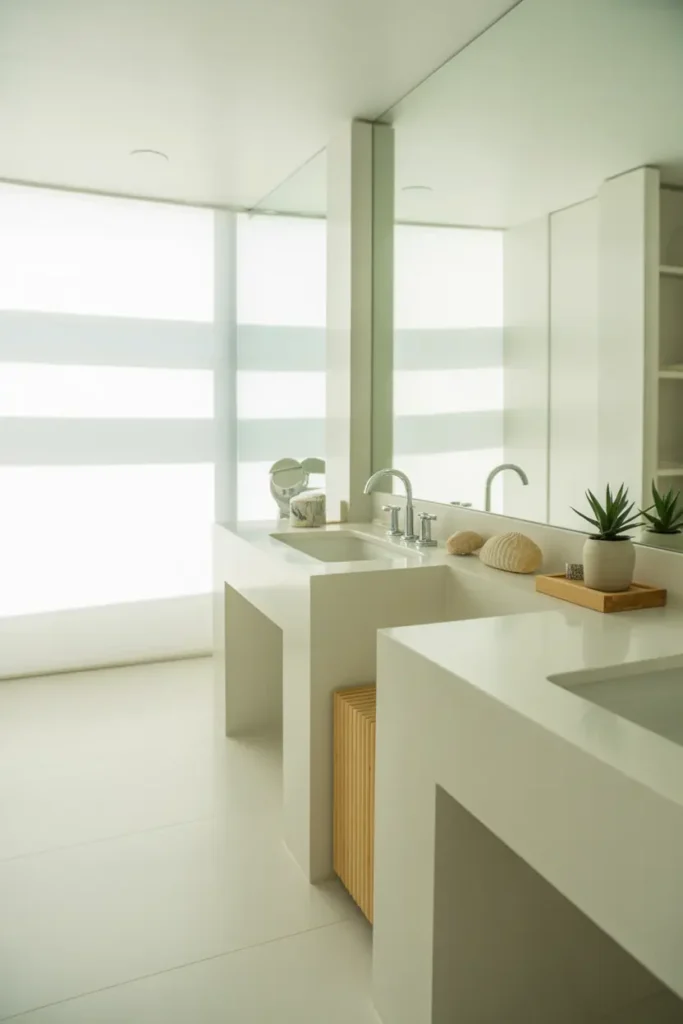
Evening is when coastal bathrooms either succeed or fail. Harsh overhead light at night destroys the whole illusion; warm, low, layered light preserves it. Sconces at the mirror, a small lamp on a shelf if you have the space, candles by the tub — the goal is the warm glow of late afternoon, on demand.
Keep bulbs warm (2700K) and dimmable everywhere. A dimmer on the main light is the single best investment — full brightness for cleaning and makeup, low glow for baths. And candles are practically mandatory in a coastal bathroom: the flicker, the scent (sea salt, driftwood, linen), the ritual of lighting them. It’s the cheapest spa upgrade that exists.
15. Mix Modern Fixtures With Natural Warmth
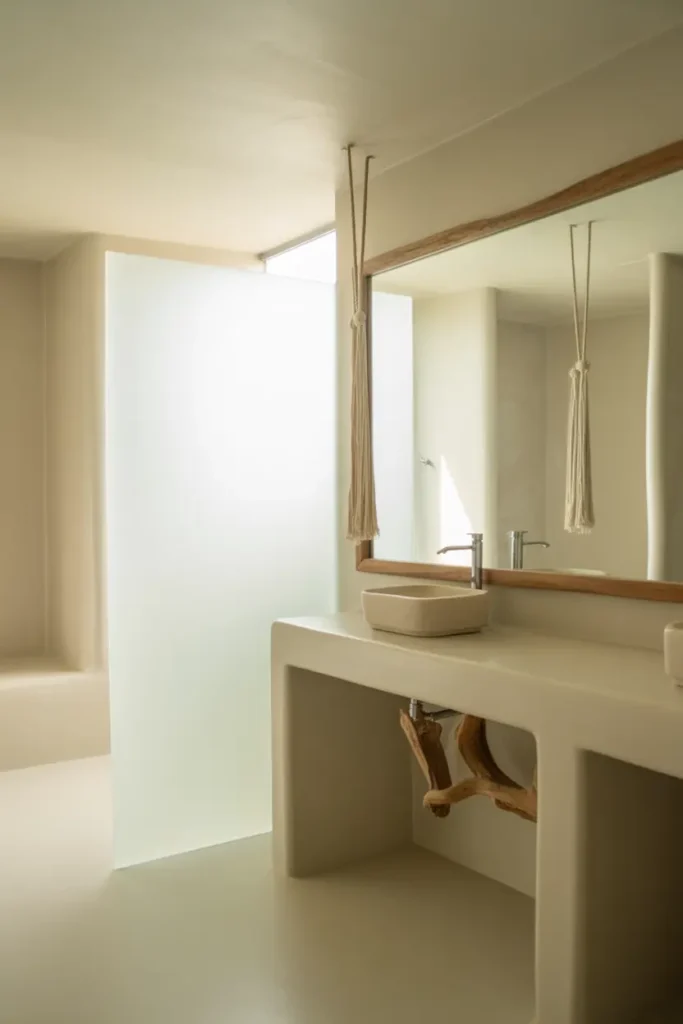
The final balance: contemporary fixtures keep the bathroom feeling current, natural materials keep it feeling coastal. A sleek modern faucet in brushed nickel, a minimalist vanity, clean-lined tile — paired with wood, linen, and woven textures. Neither side should dominate; the tension between polished and organic is the whole aesthetic.
When choosing fixtures, favor soft shapes over sharp ones — curved faucets, rounded mirrors, oval vessels. Sharp minimalism reads as urban; soft minimalism reads as coastal. And keep metals warm or neutral: brushed nickel, champagne bronze, or classic chrome. The fixtures should feel like they belong at the beach house, not the penthouse.
Related Decor Ideas
If you love coastal bathroom decor ideas, you might also explore:
- Neutral bathroom decor ideas for a calm space
- Minimalist home decor trends for 2026
- Cozy bedroom decor ideas with soft lighting
Conclusion
The modern coastal bathroom isn’t a theme — it’s a feeling, built from light, air, pale color, and honest natural materials. No anchors required, no seashell borders, no “beach” spelled out in driftwood on the wall. Just the calm part of the shore, translated into tile and linen and morning light.
Start with the light: sheers, pale paint, a bigger mirror. Then add the textures: wood, linen, woven fibers. Finish with restraint: edit until the room feels like exhaling. That’s the whole formula, and it works whether you’re five minutes from the ocean or five hundred miles from it.
Pro Tips
- Fight mildew before it starts. Coastal bathrooms are humid by design (steam + natural fibers). Run the exhaust fan during and 20 minutes after showers, and choose quick-dry textiles. A humidity-sensing fan switch ($25) automates the whole thing.
- Wash the sheers monthly. Bathroom sheers collect moisture and dust fast. Machine-washable polyester voile goes straight in the laundry — cotton sheers will mildew and yellow, so avoid them.
- Seal natural wood in wet zones. Teak and sealed oak handle bathroom humidity, but reseal once a year. Unsealed wood near the shower will gray, warp, or grow things you don’t want to think about.
- Keep a “coastal edit” box. When the bathroom starts collecting non-coastal clutter (bright plastic bottles, random gadgets), toss them in the box instead of finding them homes. Monthly, deal with the box.
FAQs
How do I do coastal without it looking like a theme restaurant?
Ban the literal: no anchor motifs, no “beach” signage, no shell collections on display. Instead, work with the qualities of the coast — pale blue-gray color, natural light, weathered wood, linen texture. If someone walks in and feels calm before they identify the theme, you’ve nailed it.
Can a windowless bathroom still feel coastal?
Yes, but you have to manufacture the light. Use the palest palette you can, add a backlit mirror, install daylight-balanced bulbs (5000K) for daytime and warm dimmable ones for evening, and lean harder on texture and plants. It won’t have real sun, but it can still feel airy.
What colors should I avoid in a coastal bathroom?
Anything dark, saturated, or neon — black, navy, hot orange, lime green. They fight the pale, sun-bleached palette that defines the style. If you love a strong color, confine it to one small changeable accessory, not the architecture.
Is coastal decor expensive to achieve?
It’s one of the cheapest styles to fake well. Pale paint, sheer curtains, a woven basket, linen-look towels, and one plant can transform a bathroom for under $150. The expensive version (freestanding tub, marble, teak) is lovely, but the feeling comes mostly from light and restraint, which are free.

HowDecor is a home decor blog sharing simple, practical decorating ideas for everyday spaces. We believe a beautiful home should feel comfortable, personal, and full of warmth — and that great style does not require a huge budget. Our goal is to inspire readers to create spaces that feel peaceful, welcoming, and truly their own — one room at a time.