There’s a reason people drive three hours to stay in a cabin with a wood-stove bathroom: rustic spaces make you feel something modern bathrooms don’t. Grounded. Unhurried. Like the room itself is telling you to slow down. The good news is you don’t need a cabin in the woods — you need the right materials, the right light, and the restraint to let them speak.
Today’s rustic isn’t the antler-and-log-cabin cliché of twenty years ago. It’s refined: reclaimed wood with clean lines, stone that looks quarried rather than manufactured, warm light instead of harsh fluorescents. Here’s how to build that feeling, one honest material at a time.
1. Start With a Reclaimed Wood Wall
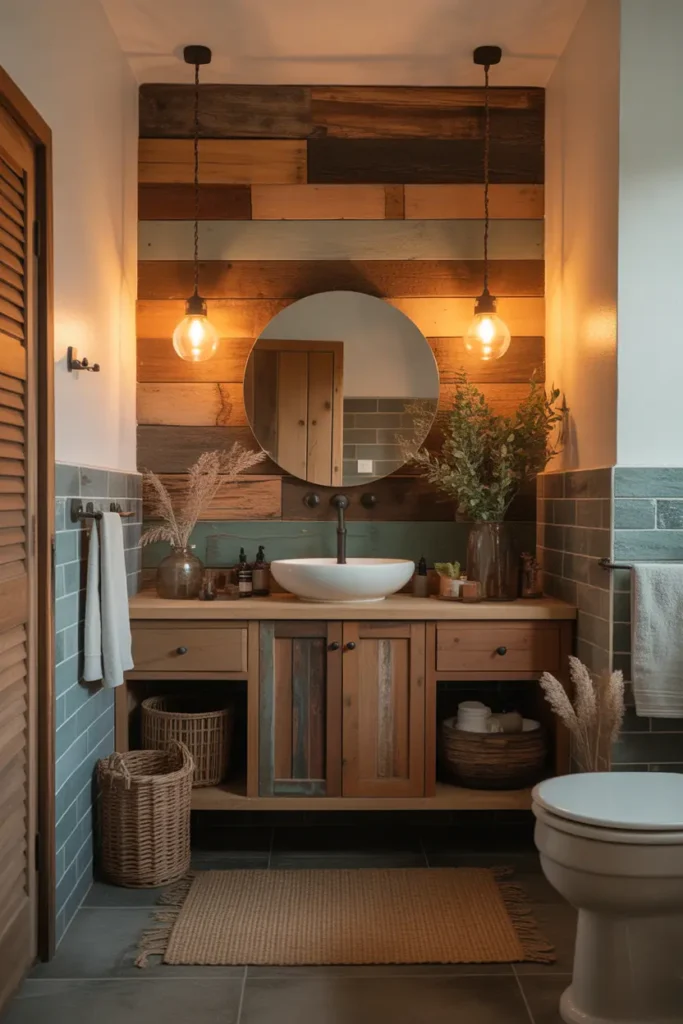
Nothing establishes rustic faster than real, aged wood on a wall. Reclaimed barn boards — with their saw marks, nail holes, and silvered patina — carry decades of character no new product can fake. Use it on one wall (behind the vanity is ideal) as a warm, textured backdrop that makes everything else in the room look intentional.
In a bathroom, moisture is the concern: use properly dried reclaimed wood and seal it with a marine-grade or bathroom-rated clear sealer, especially near splash zones. Keep it off the shower walls entirely — wood belongs on dry walls. Expect to pay $8–$15 per square foot for quality reclaimed boards; one 8×8 accent wall runs $500–$1,000 installed, and it will be the most-commented-on surface in your home.
2. Choose a Wooden Vanity With Soul
The vanity is the largest furniture piece in most bathrooms, so making it wood instantly sets the rustic tone. Look for solid wood with visible grain — oak, walnut, or reclaimed pine — in a matte or hand-rubbed finish. Distressed edges and simple shaker-style fronts read rustic; ornate carving reads Victorian. Know which one you want.
A clever budget move: convert a vintage dresser or sideboard into a vanity with a vessel sink on top. You’ll need to seal the top thoroughly and cut for plumbing, but the result is a one-of-a-kind piece for a fraction of custom cabinetry. Just confirm the height works — dresser (30″) plus vessel sink (6″) puts the rim at 36″, which is comfortable for most adults.
3. Bring In Real Stone
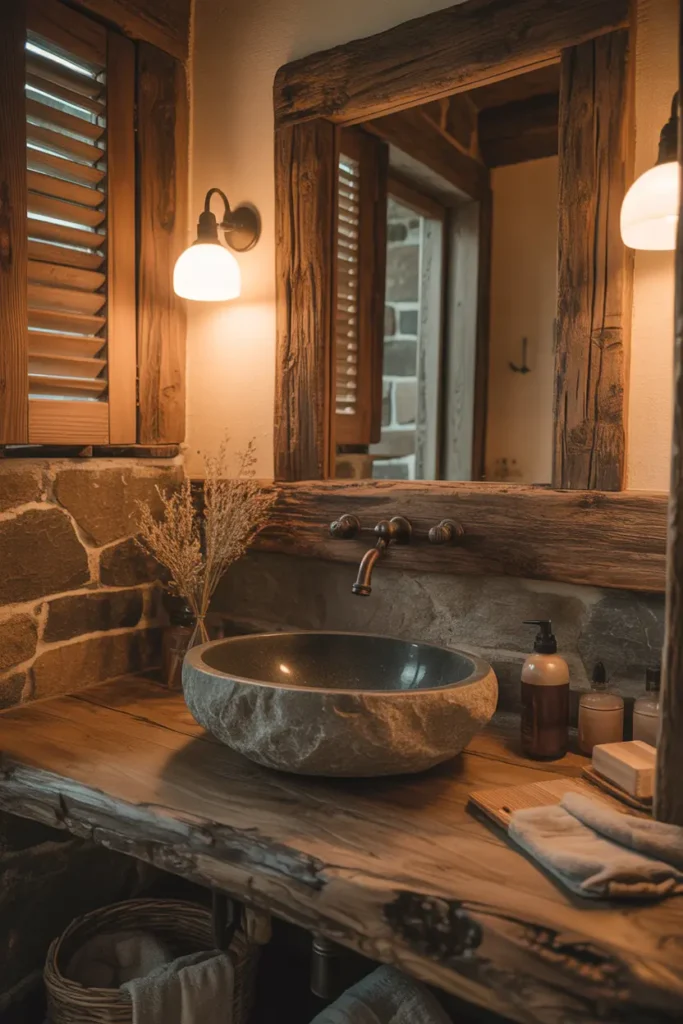
Stone is rustic’s other foundational material — the cool, permanent counterweight to wood’s warmth. A stone vessel sink, a pebble-tile shower floor, a rough-cut stone backsplash: these add the raw, geological texture that makes a bathroom feel carved out of the landscape rather than built in a subdivision.
Pebble shower floors are the standout application — they massage your feet, provide natural slip resistance, and look incredible. Use a dark grout (it hides everything) and seal the stone. For walls, stacked stone veneer on one wall creates dramatic texture; keep it out of direct water spray unless it’s rated for wet areas. Even small doses — a stone soap dish, a travertine tray — shift the room’s feeling.
4. Light It Like a Campfire, Not an Office
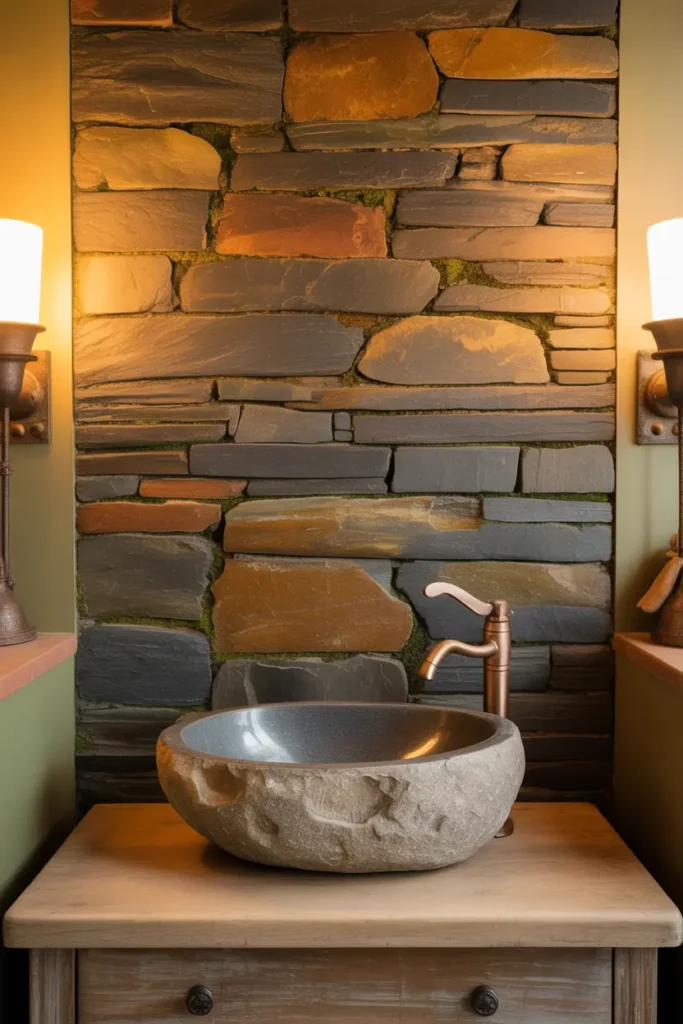
Rustic lighting should feel like firelight: warm, low, and a little flickery. That means 2200K–2700K bulbs (the warmest you can find), fixtures in dark metal or wood, and light sources at multiple heights rather than one blazing overhead. A bathroom lit only from above feels like an interrogation room; the same bathroom with sconces and candles feels like a retreat.
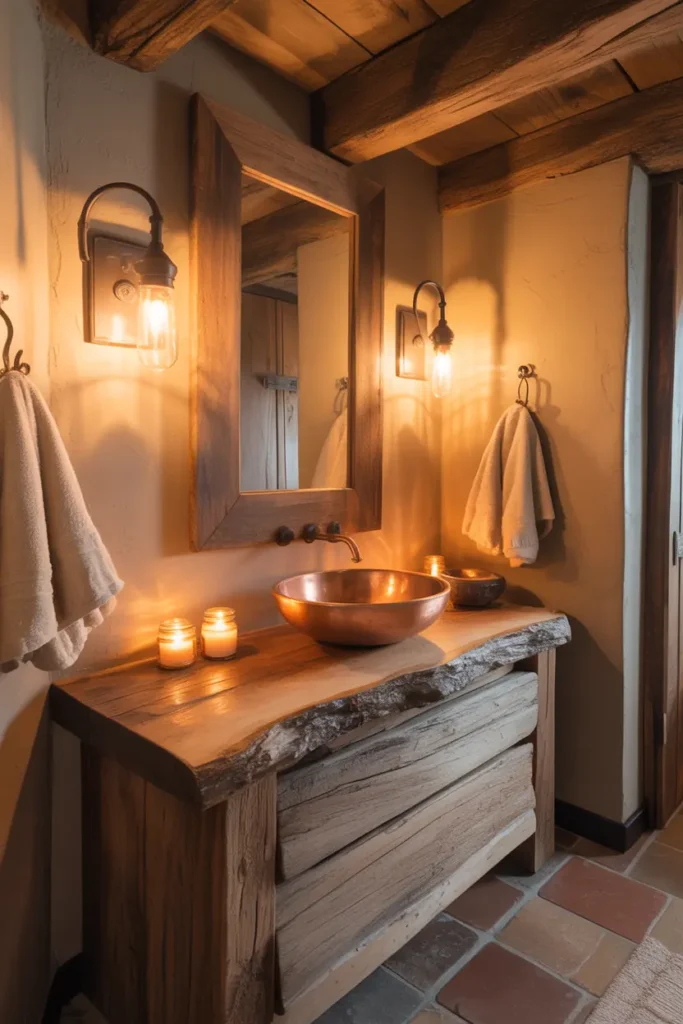
Edison-style filament bulbs in simple metal cages or wood-and-rope pendants deliver the look instantly. Put the main light on a dimmer — non-negotiable for evening baths. And don’t underestimate actual candles: a cluster of pillar candles on a wooden tray by the tub is the cheapest, most effective rustic atmosphere ever invented. Just keep them away from curtains and never leave them burning unattended.
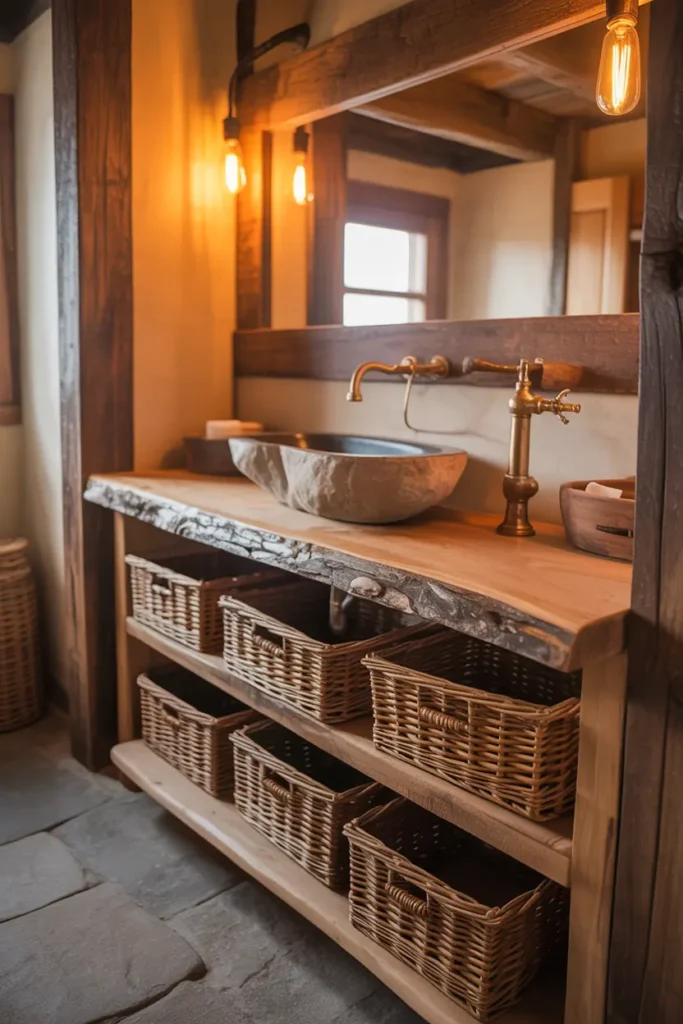
5. Store Things in Woven Baskets
Baskets are the rustic storage solution that needs no installation and never looks wrong. Seagrass, willow, or rattan baskets under an open vanity, beside the tub, or stacked in a corner hold towels, toilet paper, and toiletries while adding the woven texture that defines the style. They’re furniture, decor, and organization in one.
Size them to the job: large lidded baskets for towel storage (lids keep things looking tidy), small open ones for daily items. Line them if they’ll hold damp towels — a simple fabric liner prevents mildew on the basket itself. And buy real woven fiber, not plastic “wicker-look” — the real thing ages beautifully, the fake thing just looks tired.
6. Keep the Palette Earthy
Rustic color comes from the earth: warm whites, oatmeals, taupes, clay browns, soft grays, sage greens. These are colors that sit quietly and let the materials do the talking. The moment you introduce a saturated accent — bright red, electric blue — the rustic spell breaks. If you want color, let it come from nature: a green plant, the amber of wood grain.
Paint walls in warm whites (look for undertones of yellow or beige, not blue-gray) so the wood and stone glow against them. Cool grays fight rustic materials; warm neutrals embrace them. When in doubt, match your paint to the lightest tone in your wood — it creates a harmony that feels inevitable rather than chosen.
7. Hunt Down Vintage Fixtures
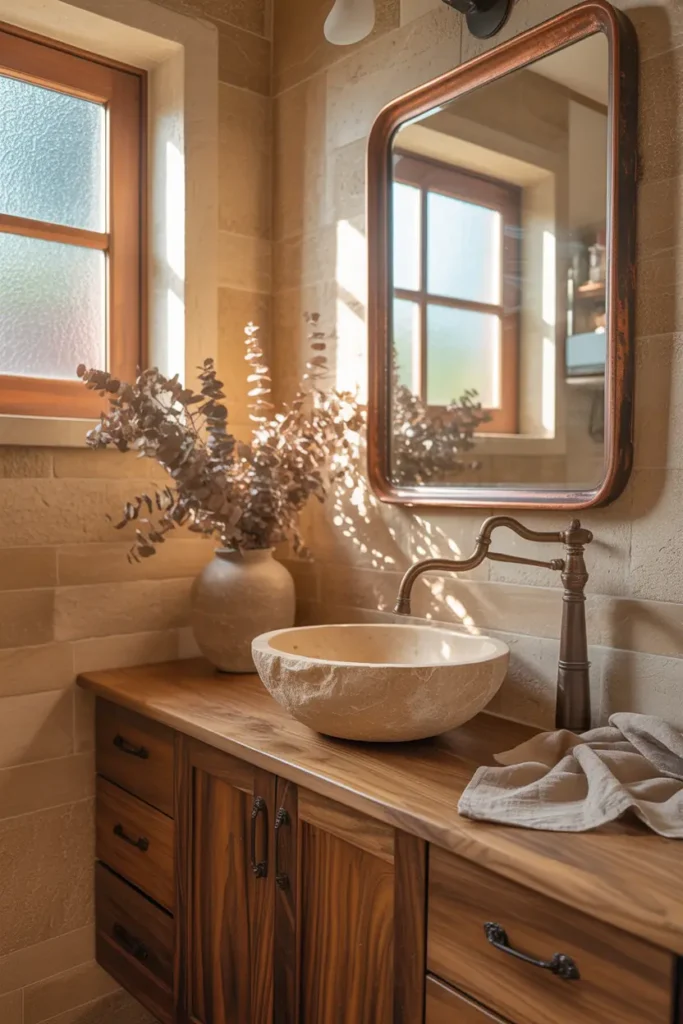
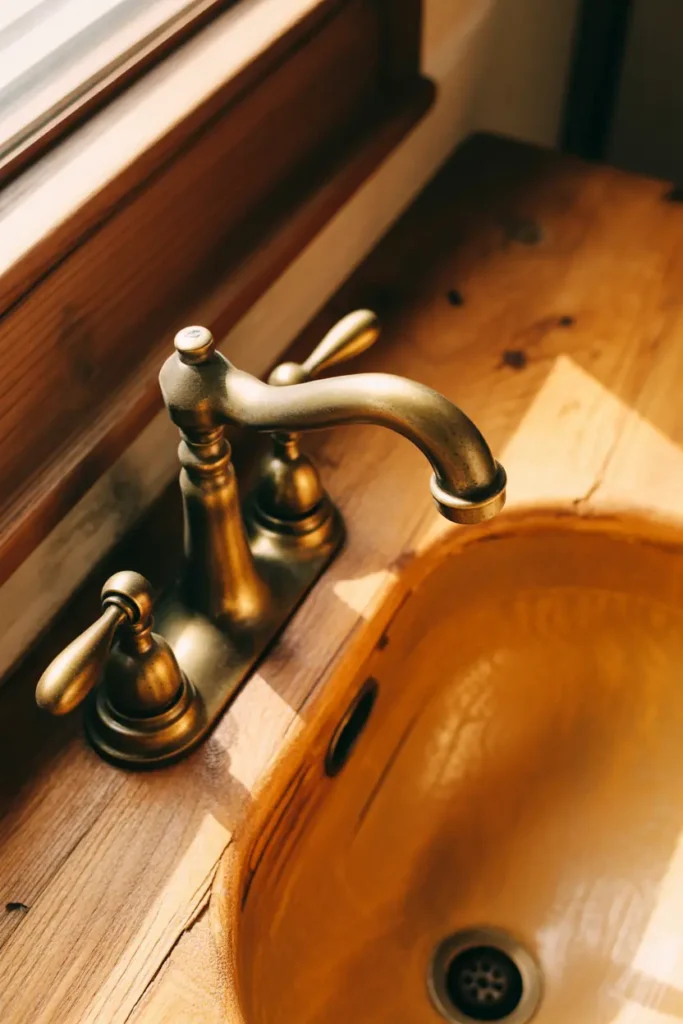
A brand-new chrome faucet in a rustic bathroom looks like a visitor from another planet. Vintage-style fixtures — cross-handle taps, exposed shower pipes, oil-rubbed bronze or aged brass finishes — speak the same language as the wood and stone. They don’t have to be actual antiques; good reproductions capture the look without the plumbing headaches.
Oil-rubbed bronze and unlacquered brass are the finishes that age gracefully — they develop patina instead of just wearing out. Avoid polished chrome and shiny nickel here; they’re too crisp for the aesthetic. And match your metals: pick one finish for taps, shower, and hardware. Mixed metals in a rustic room look accidental rather than eclectic.
8. Open Up With Wooden Shelving
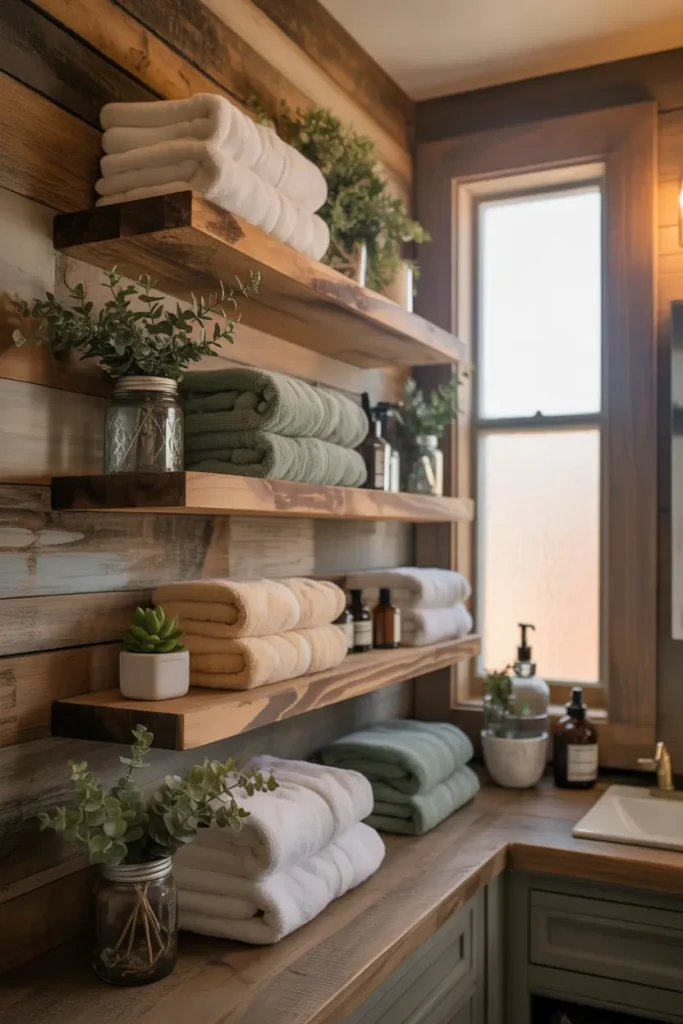
Open wood shelves are rustic storage at its best — functional, beautiful, and honest about what they hold. Thick reclaimed planks on black iron brackets is the classic combination: the wood brings warmth, the iron brings structure, and together they look like they belong in a farmhouse that’s been loved for generations.
Style them with the 70% rule — never more than about 70% full — and group items in odd numbers: three rolled towels, a plant, a couple of apothecary jars. What you display matters: this is no place for neon plastic bottles. Decant into glass or ceramic, and the shelves become decor instead of just storage.
9. Add Something Living
Wood, stone, and metal are all honest materials, but they’re all still — a plant is the living counterpoint that keeps the room from feeling like a museum. In rustic bathrooms, go for unfussy, wild-looking greenery: ferns, trailing pothos, eucalyptus stems in a jar. Nothing manicured or tropical; think forest floor, not resort lobby.
Eucalyptus deserves special mention — hang a bundle from the showerhead and the steam releases its scent every morning. It’s the rustic bathroom’s signature move: free aromatherapy, beautiful to look at, and it dries gracefully so there’s no maintenance guilt. Replace the bundle every few weeks when the scent fades.
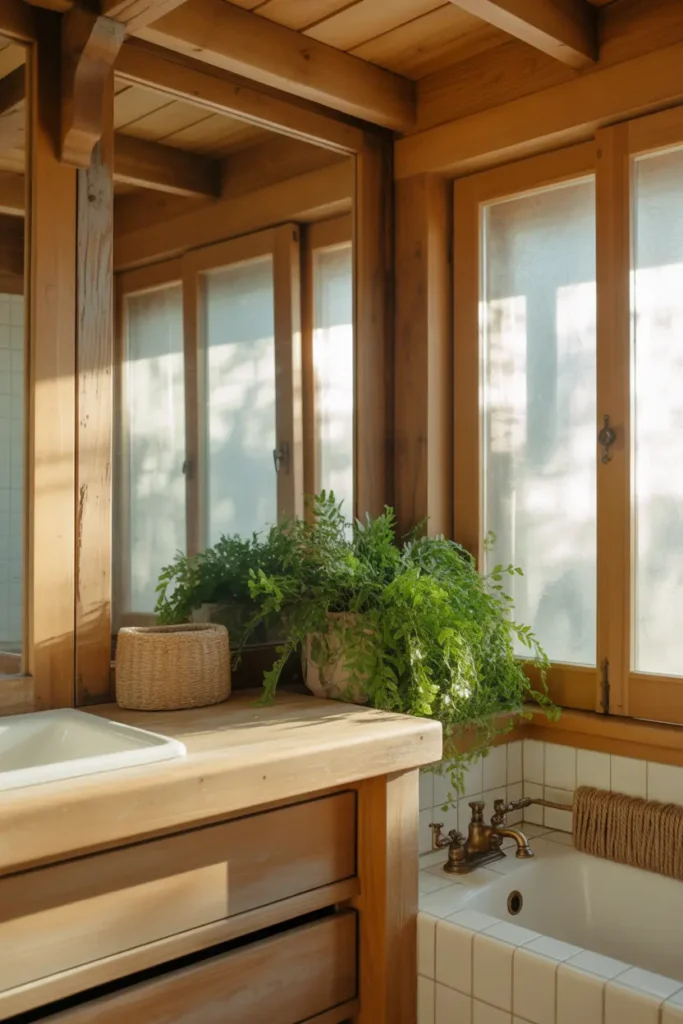
10. Choose Textiles With Texture
In a room of hard surfaces, textiles are the softness — and in rustic style, they should look like they were woven, not manufactured. Turkish towels with fringe, waffle-weave bath mats, chunky knit or crocheted accents: texture is the whole point. Flat, smooth microfiber has no place here.
Stick to the earthy palette — oatmeal, sage, clay, cream — and let the weave provide the interest. A $25 Turkish towel looks more expensive than a $60 plush one in a rustic setting because the texture is honest. And they get softer with every wash while taking up half the storage space of thick terry. Practical luxury.
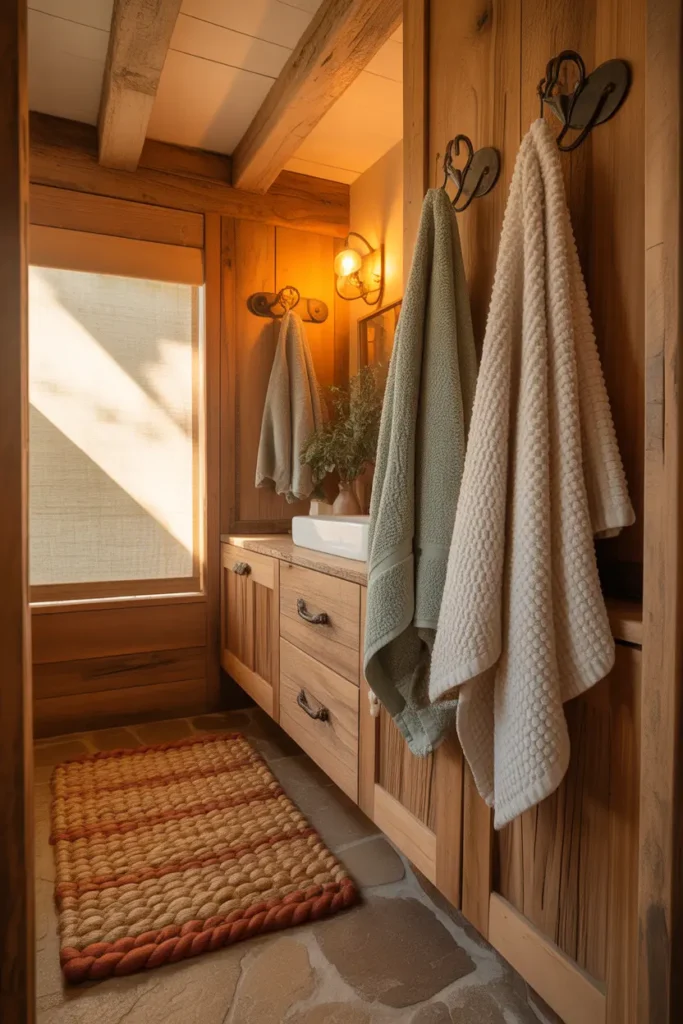
11. Mix Wood and Black Metal
Wood alone can drift toward “cabin kitsch”; black metal pulls it back to modern. This is the core tension of contemporary rustic: warm organic wood against crisp matte-black iron — shelf brackets, mirror frames, light fixtures, towel bars. The metal gives the wood structure; the wood gives the metal soul.
Matte black is the finish — not glossy, not chrome. Use it consistently across hardware, lighting, and accessories so it reads as a deliberate system rather than random dark objects. The ratio matters: roughly 80% wood and natural materials to 20% black metal. Too much black and the room goes industrial; too little and it goes country.
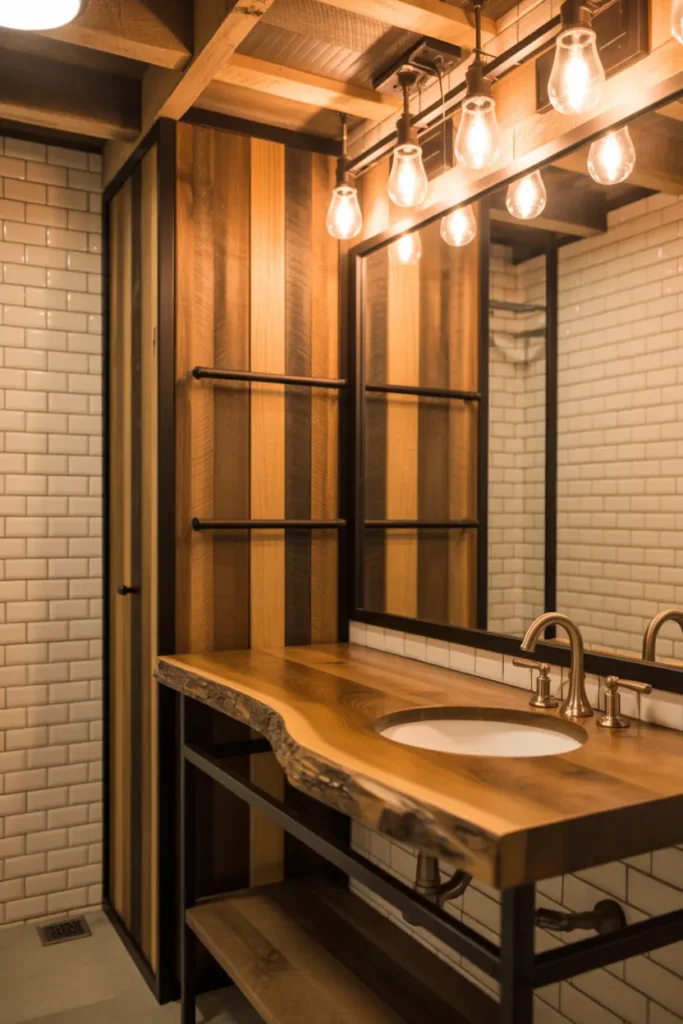
12. Frame the Mirror in Wood
The bathroom mirror is prime real estate, and a wood-framed mirror claims it for rustic. A thick reclaimed-wood frame, a live-edge slab, or even a simple barnwood frame transforms the most-used object in the room from an afterthought into a feature. Round mirrors soften the look; rectangular ones feel more farmhouse.
Size it generously — the mirror should be at least as wide as the vanity, ideally a few inches narrower on each side. In humid bathrooms, seal the back of the wood frame to prevent warping, and make sure the mirror itself is copper-free (bathroom-rated) so the edges don’t develop black spots. A $150 wood-framed mirror routinely looks better than a $500 designer one in this style.
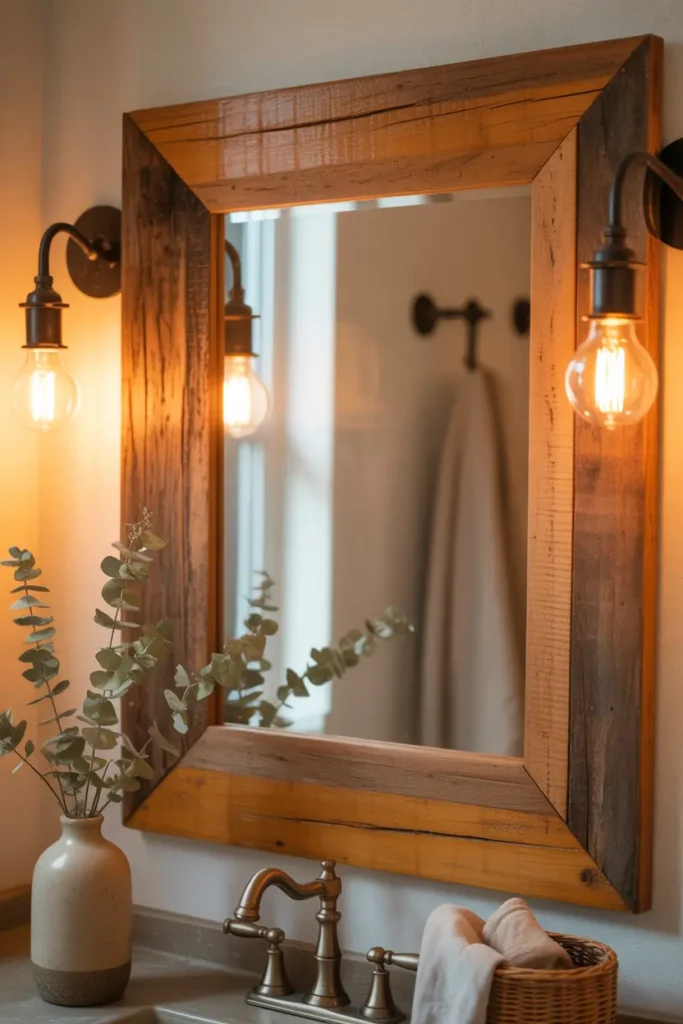
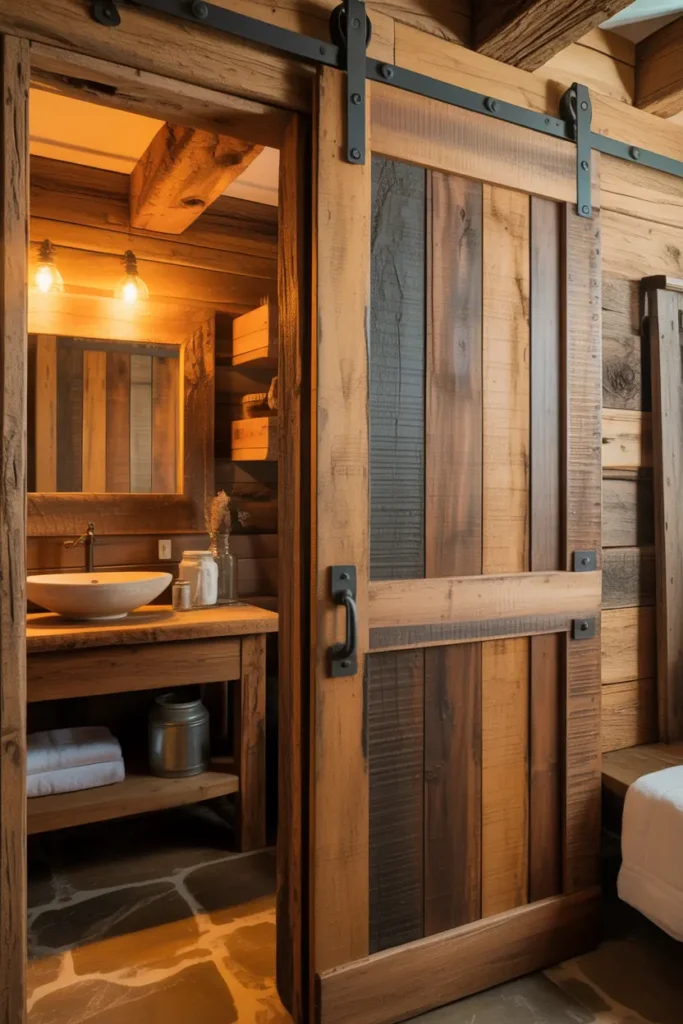
13. Consider a Sliding Barn Door
Few things say rustic like a sliding barn door — and beyond the look, it solves a real bathroom problem: swing doors eat up to 9 square feet of floor space in small bathrooms. A barn door on an exterior track reclaims all of it while becoming the room’s architectural statement.
The honest caveats: barn doors don’t seal like regular doors (there’s a gap at the edges — fine for a powder room, less ideal for the only bathroom in a house of guests), and they need solid wall or blocking to mount the track. Budget $200–$600 for the door and hardware. If the gap bothers you, add a simple latch and weatherstripping — it won’t be airtight, but it’ll feel private.
14. Light Candles, Not Just Bulbs
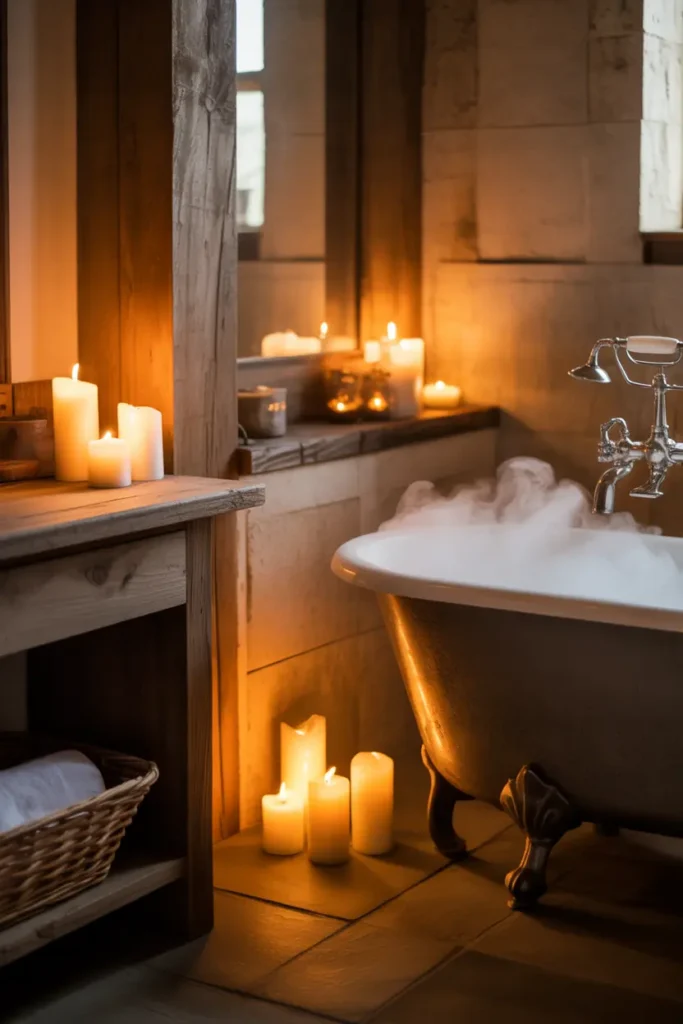
Candles are to rustic bathrooms what fireplaces are to living rooms — the living heart of the style. A cluster of pillar candles in varying heights on a wooden tray, tealights in mason jars along the tub edge, a single large candle on the vanity: the flickering warm light does things no bulb can replicate.
Go for unscented or naturally scented (beeswax, soy with essential oils) rather than overpowering synthetic fragrances — in a small bathroom, a strong candle becomes a headache. LED flameless candles have become genuinely convincing and eliminate the fire worry entirely; keep real flames for the tub-side ritual and use flameless for everyday ambience.
15. Use Mason Jars as Storage
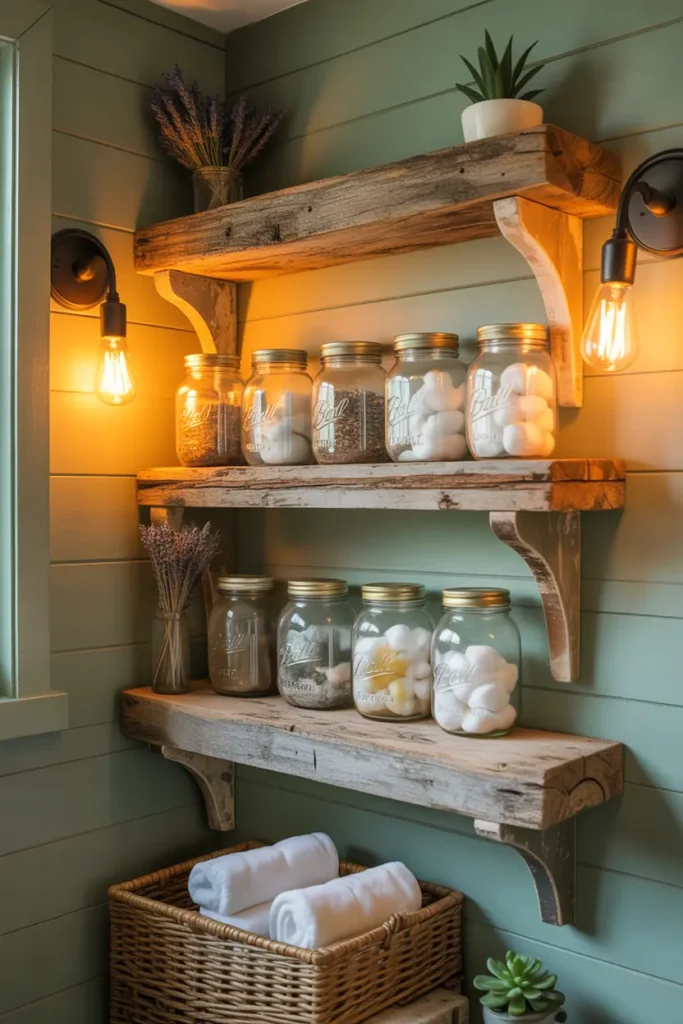
Mason jars are the rustic organizer that costs almost nothing and looks completely right. Cotton balls, bath salts, makeup brushes, toothbrushes — decanted into glass jars, everyday items become display pieces. A row of filled mason jars on an open shelf is practically the emblem of the style.
The trick is uniformity: same jar size, same contents grouped together, labels if you’re feeling organized. Mix in a couple of amber or blue vintage jars for character. And they’re dishwasher safe, endlessly reusable, and cost about a dollar each — the rare decor item that’s genuinely cheaper than the plastic alternative it replaces.
16. Layer the Light
One light source flatters nothing; three flatter everything. In a rustic bathroom, layer warm light at different heights: dimmable overhead for mornings, sconces at the mirror for tasks, and low accent light — candles, a small lantern, LED strips under a floating shelf — for evenings. Each layer gets its own switch or dimmer.
The evening layer is where rustic bathrooms become magical. Turn off the overhead entirely after dark and let the room live on sconce-and-candle light. Shadows become soft, wood grain glows, and the bathroom feels like a completely different, much more expensive room. This costs nothing if your fixtures are already in place — it’s just a habit.
17. Keep the Layout Honest
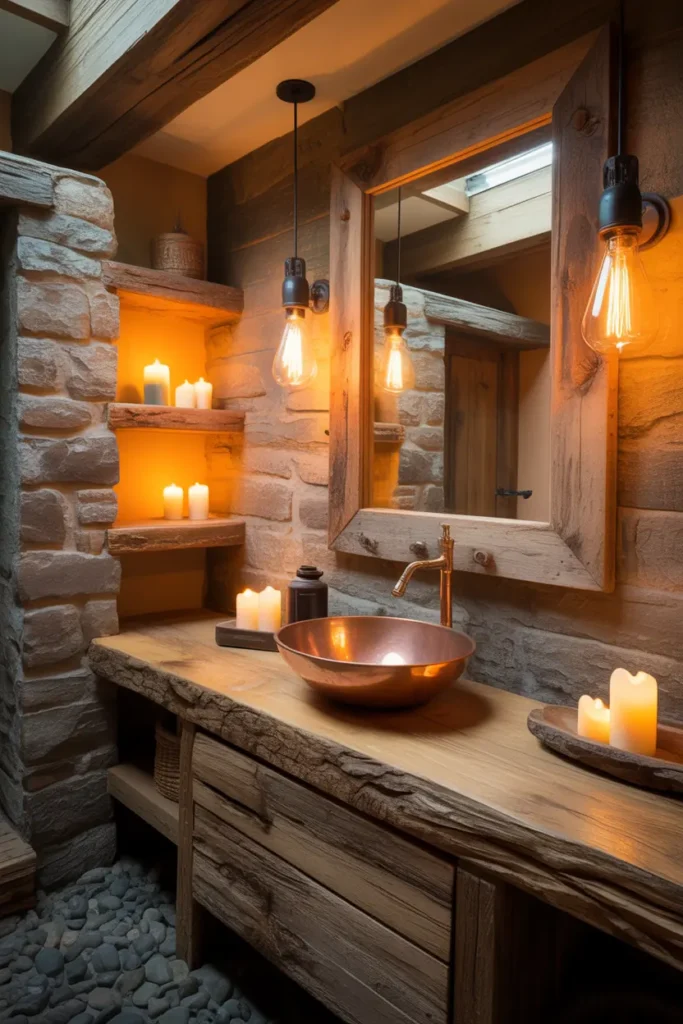
Rustic style hates clutter more than any other aesthetic — every extra object dilutes the calm. Keep the layout open: clear floor space, minimal visual barriers, nothing that doesn’t serve the room’s purpose. A rustic bathroom should feel like it has room to breathe, even if it’s small.
This means being ruthless about surfaces. If the vanity top holds more than a tray’s worth of items, something needs a drawer. If the shower has seven bottles, decant into two. The materials are the decoration here — wood, stone, linen, firelight. They don’t need help, and they definitely don’t need competition.
18. Add One Handmade Piece
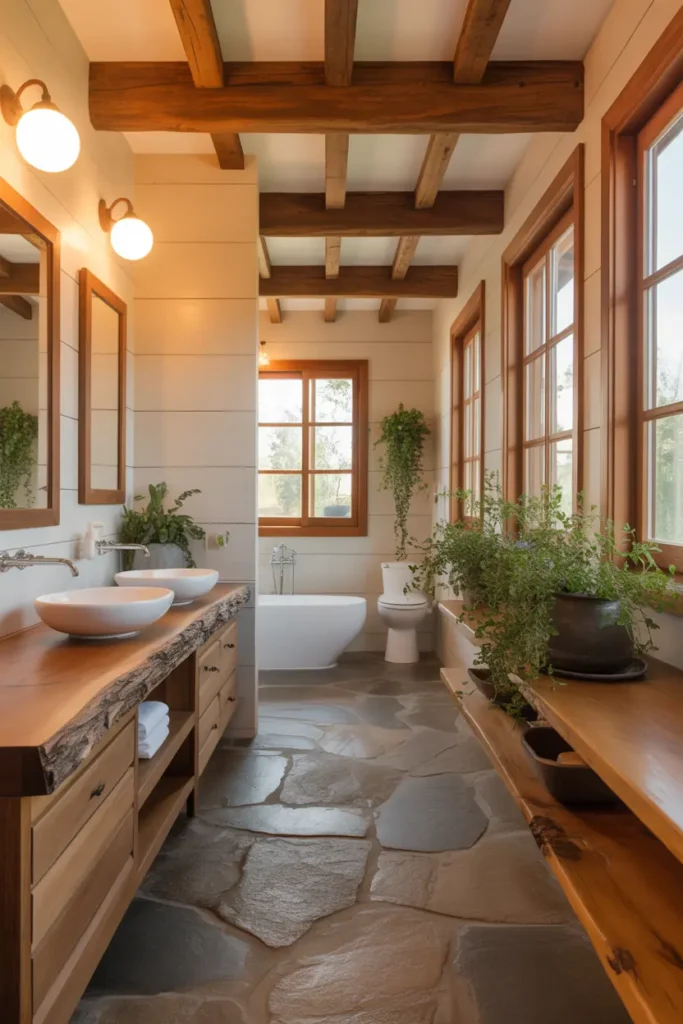
Mass-produced “rustic-style” decor is the enemy of actual rustic — the style is about the human hand. One genuinely handmade piece — a thrown ceramic soap dish, a hand-forged hook, a woven wall hanging from a local maker — carries more authenticity than an entire cart of factory-distressed signs. It doesn’t have to be expensive; it has to be real.
Farmers’ markets, craft fairs, and local potters are the sources. The slight irregularities — the uneven glaze, the hammer marks — are the point; they’re the visual evidence that a person made this. And every time you use it, the room feels a little more yours. That’s the whole philosophy of rustic in one object.
19. Soften With Linen
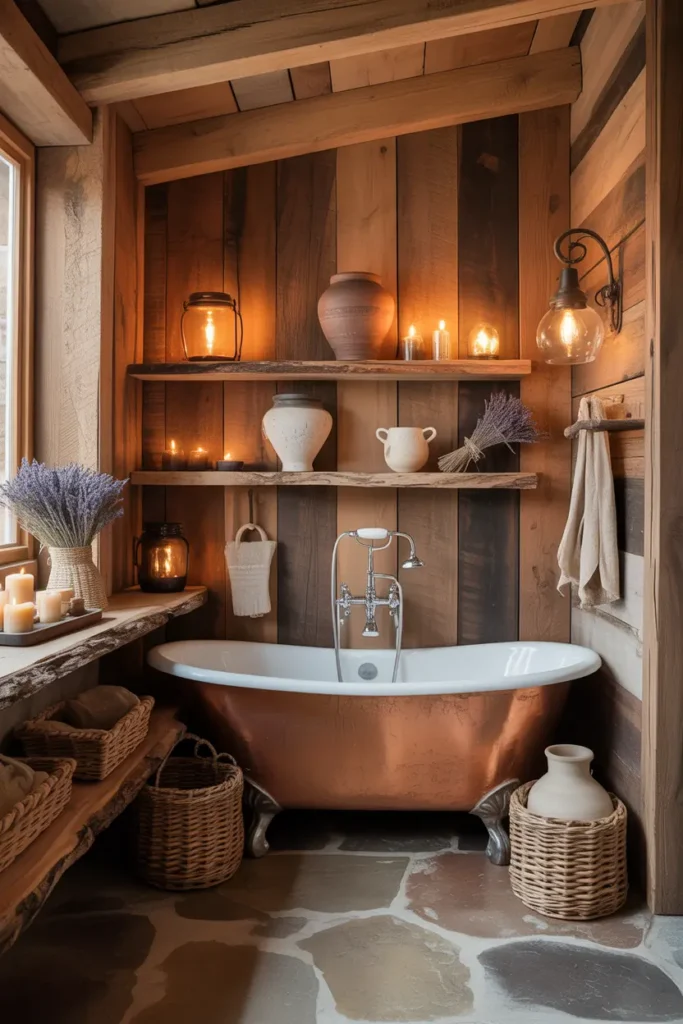
Linen is rustic’s perfect fabric: natural, textured, beautifully imperfect, and better with age. A linen shower curtain (instead of plastic), linen hand towels, a linen window covering — these soften all the hard wood and stone without introducing anything synthetic. The wrinkles aren’t a flaw; they’re the aesthetic.
Real linen costs more than cotton upfront but outlasts it and looks better doing it. In bathrooms, choose a medium weight — too light and it clings when damp, too heavy and it never dries. Wash it simply, skip the fabric softener (it coats the fibers), and embrace the lived-in look. Crisp is for hotels; linen is for homes.
20. Let Modern Comfort In
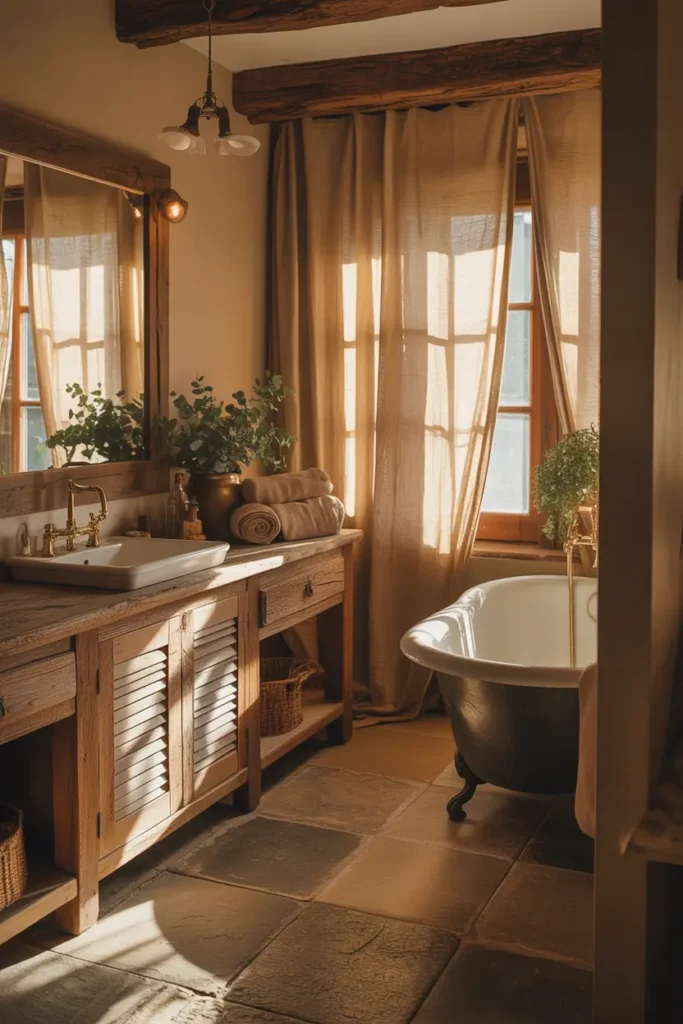
Here’s the secret of the best rustic bathrooms: they’re not actually primitive. Under the reclaimed wood and candlelight, there’s a heated floor, a great showerhead, a quiet exhaust fan, and good water pressure. Rustic is the feeling; modern comfort is the function. Never sacrifice the function for the feeling.
Radiant floor heat under tile is the ultimate example — invisible, silent, and it makes a stone floor feel like warm earth on winter mornings. A high-quality thermostatic shower valve, a humidity-sensing exhaust fan, soft-close everything: these modern comforts don’t show, but they’re what make the rustic bathroom livable every single day rather than just photogenic.
Related Decor Ideas
If you love rustic bathroom decor ideas, you might also explore:
- Small bathroom decor ideas for cozy spaces
- Modern farmhouse bathroom design inspiration
- Neutral bathroom styling with natural textures
- Cozy bedroom decor ideas with warm tones
Conclusion
Rustic bathrooms work because they’re honest — real wood, real stone, real firelight, real handmade things. There’s nothing to fake and nothing to maintain beyond the materials themselves, which only get better with age. That’s the quiet luxury of the style: it improves the longer you live with it, unlike trends that expire.
You don’t need all twenty ideas. Start with the materials — one wood element, one warm light source, one honest textile — and the feeling follows. The cabin in the woods was never about the location. It was about the materials, and those travel anywhere.
Pro Tips
- Seal wood in bathrooms, no exceptions. Even “bathroom-safe” wood needs a proper sealer, reapplied yearly in wet zones. Unsealed wood in a steamy bathroom will gray, warp, or mold within a year.
- Ventilate like you mean it. Rustic materials (wood, natural fiber, linen) are more vulnerable to sustained humidity than tile and plastic. Run the exhaust fan 20+ minutes after showers — a humidity-sensing switch does it automatically.
- Buy the vintage piece first. If you’re hunting flea markets for a vanity or mirror, find it before you pick paint colors. It’s easier to match paint to a $50 vintage find than to find a vintage piece that matches your paint.
- Test your “rustic” in evening light. Rustic lives or dies on warm light. Check material and paint samples at night under your actual bulbs — wood that looks rich at noon can look muddy under cool white LEDs.
FAQs
Will rustic decor make my bathroom look dated?
Only if you lean into kitsch — antler mounts, “live laugh love” signs, fake distressing. The modern rustic in this guide (clean lines, honest materials, minimal styling) is timeless because it’s based on natural materials, not trends. Wood and stone don’t expire.
Can I do rustic in a small bathroom?
Absolutely — in fact, small bathrooms suit rustic well because the style favors minimal styling. Focus on one wood element (vanity or shelving), warm lighting, and natural textiles. Skip the barn door (space hog) and the reclaimed wood wall (can overwhelm); keep it to materials and light.
How do I keep wood safe in a humid bathroom?
Three rules: seal it properly with a bathroom-rated sealer, ventilate aggressively (exhaust fan on a timer or humidity sensor), and keep wood out of direct water contact — no wood in the shower. With those three, wood lasts decades in bathrooms.
What’s the difference between rustic and farmhouse style?
Farmhouse is rustic’s tidier cousin — whiter, more polished, more “decorated.” Rustic leans rawer: more visible grain, more texture, more imperfection, darker and earthier. If farmhouse is a styled photoshoot, rustic is the actual cabin. This guide sits between them, borrowing farmhouse’s clean lines and rustic’s honest materials.

HowDecor is a home decor blog sharing simple, practical decorating ideas for everyday spaces. We believe a beautiful home should feel comfortable, personal, and full of warmth — and that great style does not require a huge budget. Our goal is to inspire readers to create spaces that feel peaceful, welcoming, and truly their own — one room at a time.