Walk into two minimalist living rooms and you can feel the difference in about ten seconds. One is calm. The other is just empty. Same amount of furniture, similar pale walls — but one feels like a home and the other feels like a waiting room. The difference is never the budget. It comes down to a handful of specific calls: the undertone of the paint, the height of the sofa, how many light sources the room has after dark.
The 2026 version of minimalism has quietly moved past the gallery-white look of a few years ago. These eight ideas keep a living room genuinely minimal while making it warmer, more livable, and harder to get wrong. Each one comes with the measurements, materials, and real-world costs that matter when you actually do it.
1. Warm Neutrals Take Over from Cold Whites
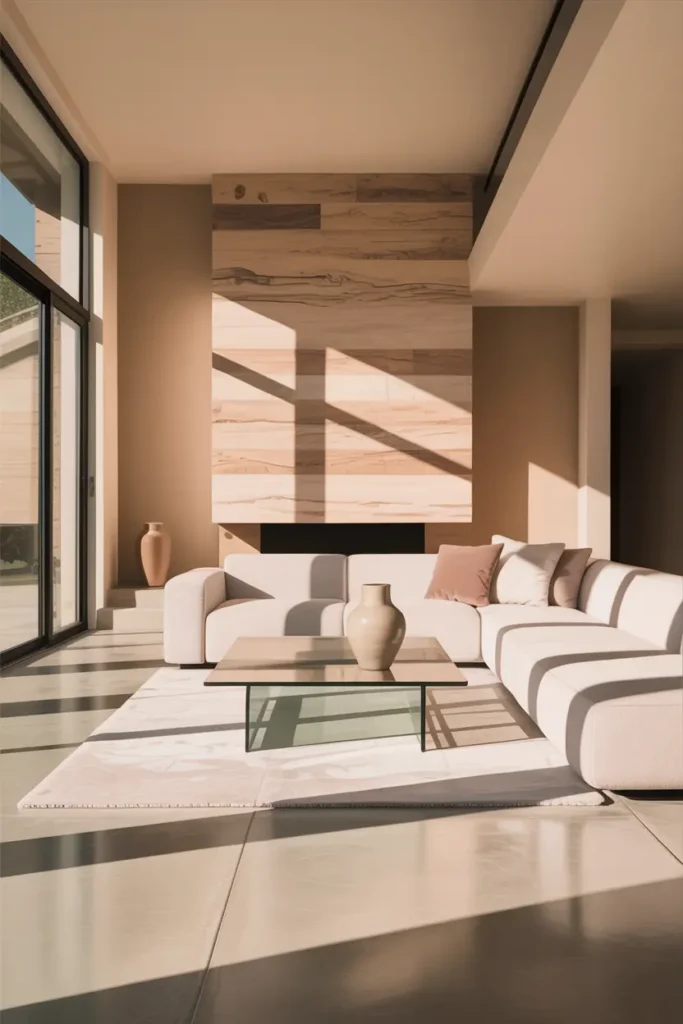
Cold, blue-white walls were the default minimalist backdrop for a decade, and they are finally being retired. In their place: warm whites, soft beige, taupe, and greige — colors with a yellow or red undertone that read as clean without reading as clinical. The practical test is simple. Paint a large swatch, at least 60 by 60 cm, on two different walls, and look at it in morning light, afternoon light, and under your evening lamps. A color that looks like warm paper at noon can turn pinkish or muddy at 9 p.m., and that is the one detail people skip.
If you are repainting, a warm white like Benjamin Moore White Dove or Dulux Natural Calico covers most living rooms in two coats; a 13 by 16 foot room typically needs 4 to 5 liters and a weekend. The common mistake is repainting the walls but keeping a cool-white ceiling, which makes the whole room feel disjointed. Paint the ceiling in the same color at 50 percent strength so it recedes without clashing.
2. Fewer Pieces, Chosen on Purpose
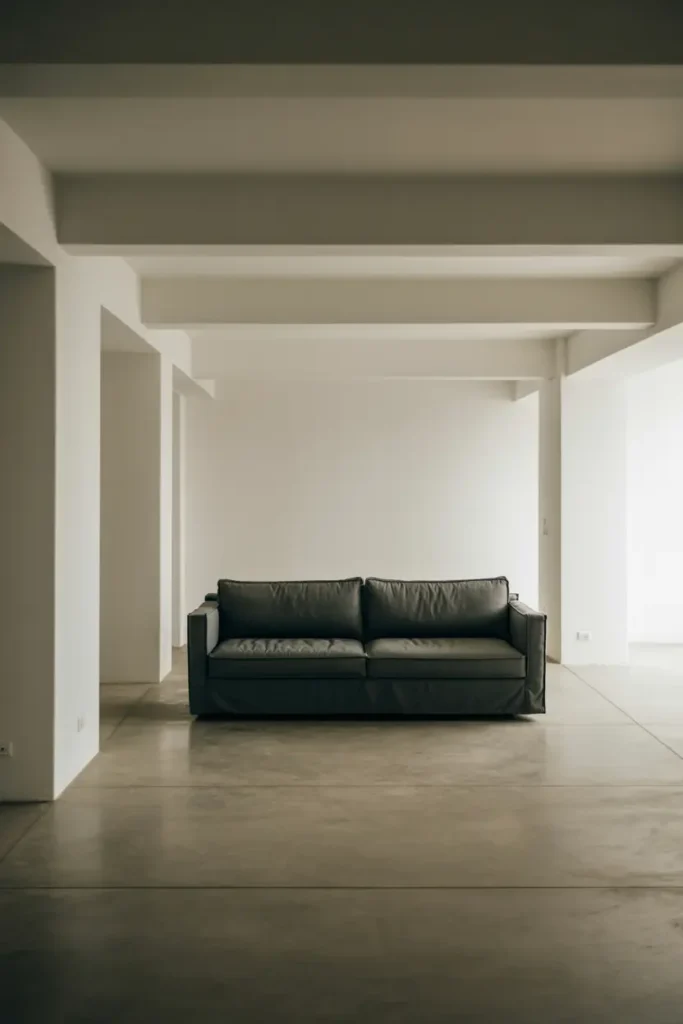
Minimalism fails most often not from owning too little but from buying pieces that were never really chosen — the matching set, the side table bought to fill a corner, the third chair nobody sits in. A better rule: for a standard living room, five pieces carry the whole room — a sofa, a coffee table, one lounge chair, one floor lamp, and one storage unit. Everything after that has to earn its place by being used weekly.
Before buying anything, tape out the footprint of each piece on the floor with painter’s tape and live with the outlines for two days. You will immediately see which walkways feel pinched and which corners were never needed. This costs nothing and prevents the classic error of buying furniture to fill space instead of furniture to use.
3. Low, Grounded Sofa Profiles
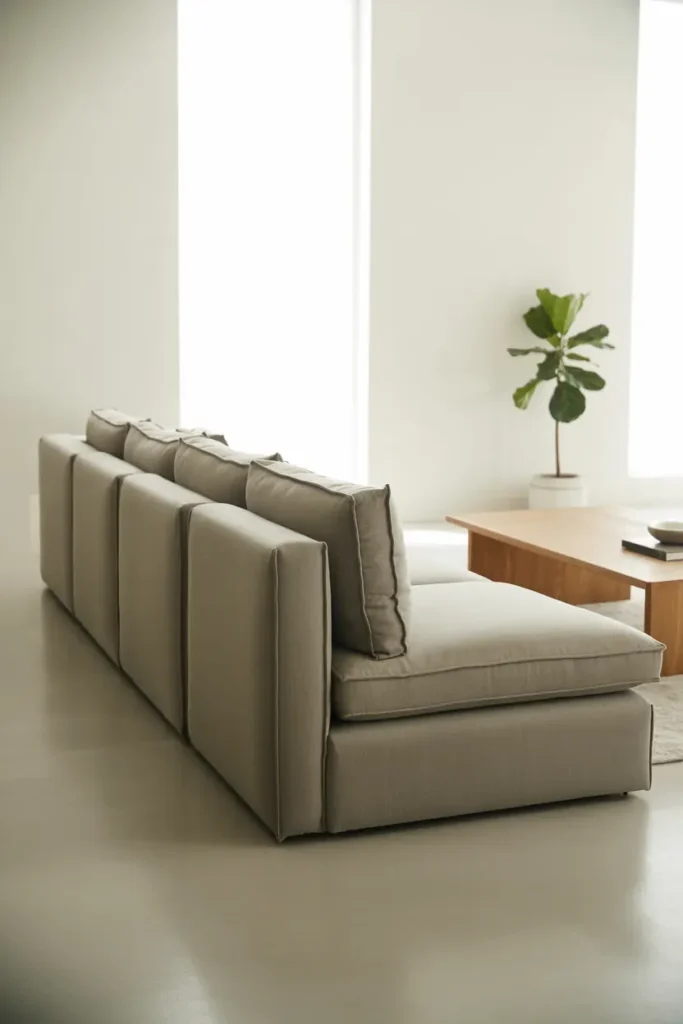
Low sofas keep dominating minimalist rooms for a mechanical reason, not just a fashionable one. A back height of 28 inches or less drops the room’s visual horizon, which makes ceilings read higher and the floor plan feel wider. Look for a seat height of 15 to 17 inches and arms that sit no higher than 24 inches — track arms or slim rolled arms keep the silhouette light. Expect to pay $900 to $1,800 for a decent low-profile two-seater in performance linen; anything much cheaper usually means a frame that sags within two years.
The mistake to avoid is pairing a deep seat — 24 inches or more — with a household of shorter sitters. Deep seats look inviting in photos but leave shorter legs dangling and backs unsupported, and then the sofa never gets used. Sit in it before buying, feet flat on the floor, back against the cushion. If your knees sit higher than your hips, the seat is too deep for you.
4. Texture Does the Decorating
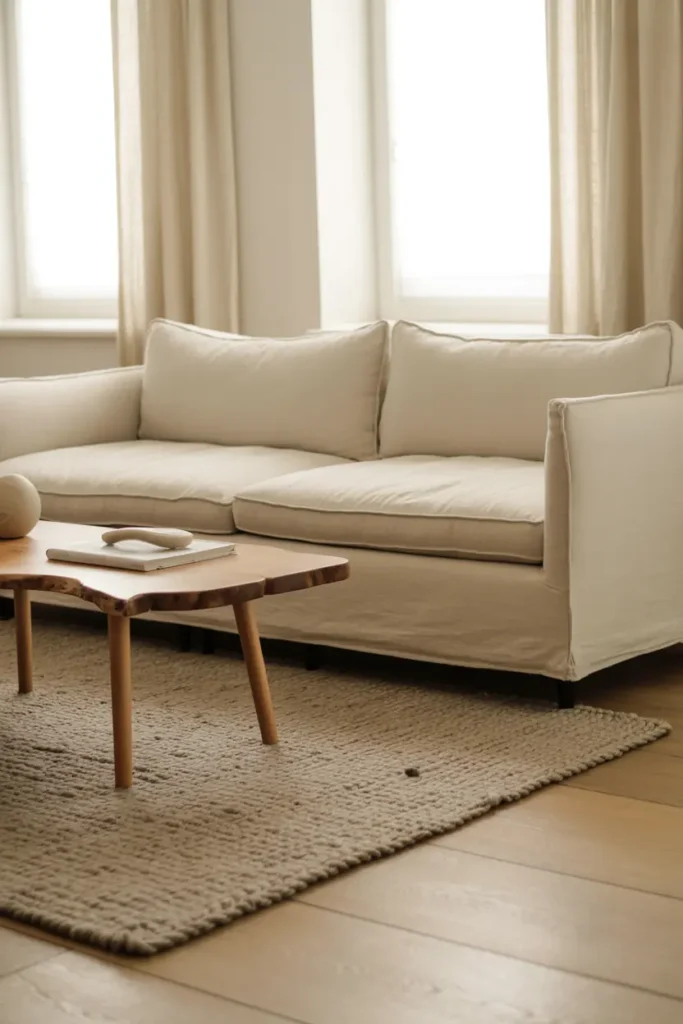
When color is restrained, texture carries the entire sensory load of the room. The formula that works: three contrasting textures at three different scales. A nubby wool or wool-blend rug with a pile height around half an inch, linen or linen-blend upholstery on the sofa, and one hard natural surface — white oak, travertine, or rattan. Each texture should be touchable from where you sit; texture you can only see from across the room does half the job.
What ruins this is the all-smooth room: leather sofa, glass coffee table, lacquered console. Every surface reflects the same way, so the eye finds nothing to rest on and the room feels cold despite being “warm” in color. If you already own smooth pieces, a chunky knit throw and a jute rug are the two fastest texture injections, usually under $150 combined.
5. Soft, Layered Lighting
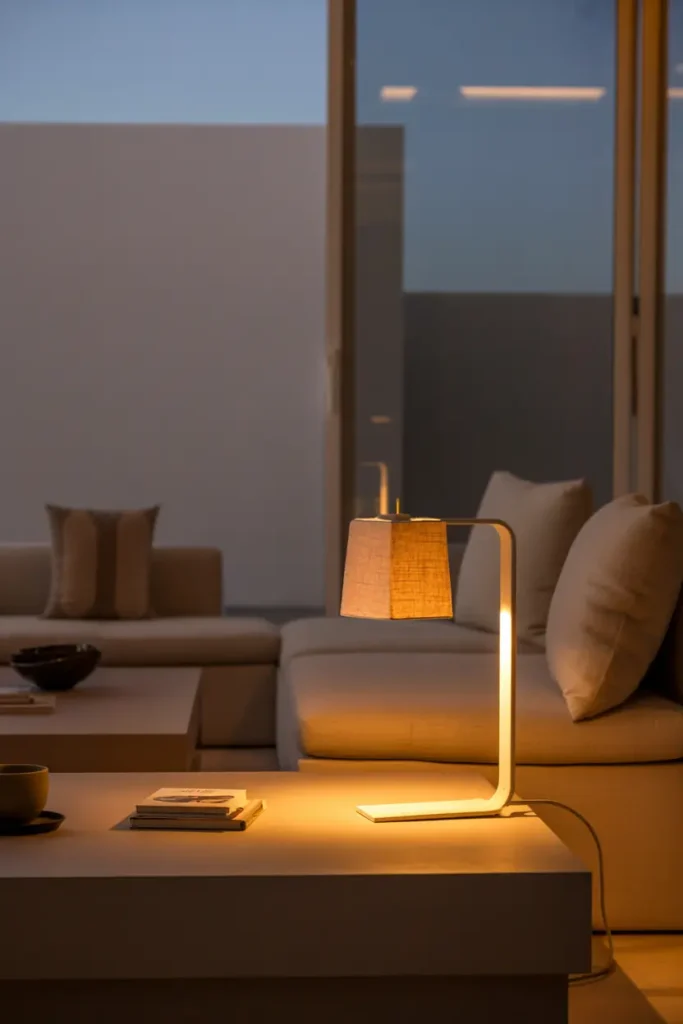
One overhead light is the fastest way to make a minimalist room feel like an office. The working alternative is three layers, all at 2700K warm white: ambient light from a floor lamp with a fabric shade (58 to 64 inches tall so the shade sits at standing eye level), task light from a small table lamp near the reading seat, and one accent — a picture light, a candle cluster, or LED strip behind a console. Put the two main lamps on dimmers; a $15 plug-in dimmer achieves what a $300 electrician visit does for table lamps.
Aim the light at surfaces, not at people. A floor lamp washing a warm wall feels twice as bright as the same bulb aimed at the floor, because your eye reads reflected light as room brightness. The classic error is buying a beautiful sculptural lamp with an exposed bulb and no shade — it becomes a glare source you never turn on.
6. One Strong Focal Point on the Walls
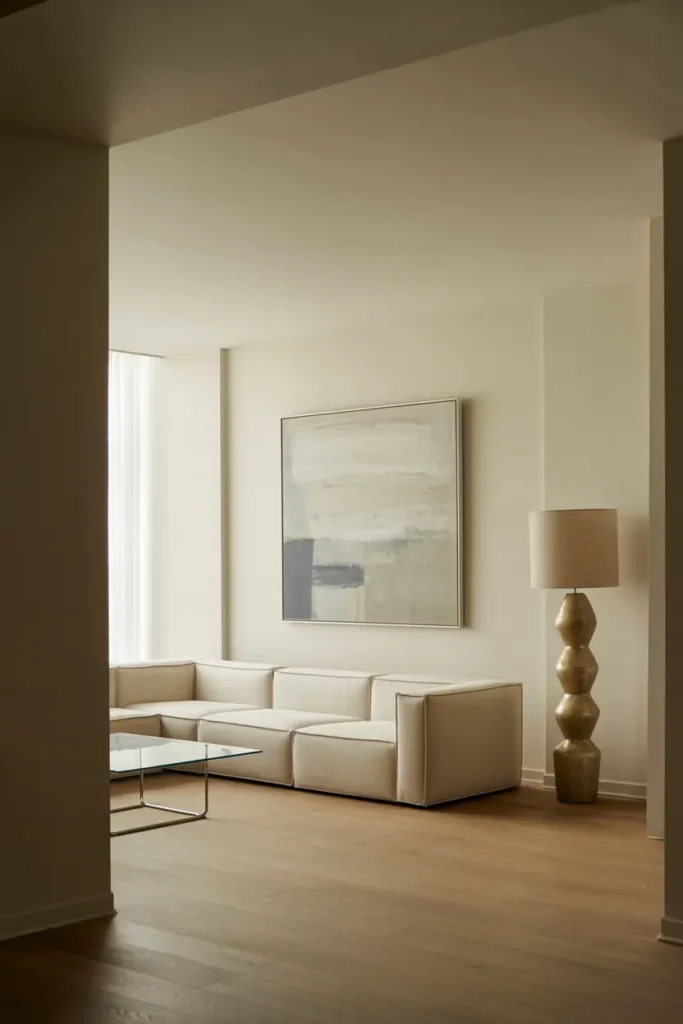
Minimalist walls work on a one-statement rule: a single piece sized 60 to 75 percent of the sofa’s width, hung so its center sits 57 to 60 inches off the floor. One oversized abstract canvas, one large-scale photograph, or one sculptural object does more than a dozen small frames, because a single large shape reads as intentional while many small ones read as undecided. A big round mirror works the same way and doubles the light in a dim room.
The gallery wall is the usual casualty here. Twelve small frames in a grid look curated in a maximalist home; in a minimal room they become visual noise that fights the calm you are building. If you already own small art you love, group it tightly in one hallway or bedroom instead, and give the living room its single quiet statement.
7. Hidden Storage, Clear Surfaces
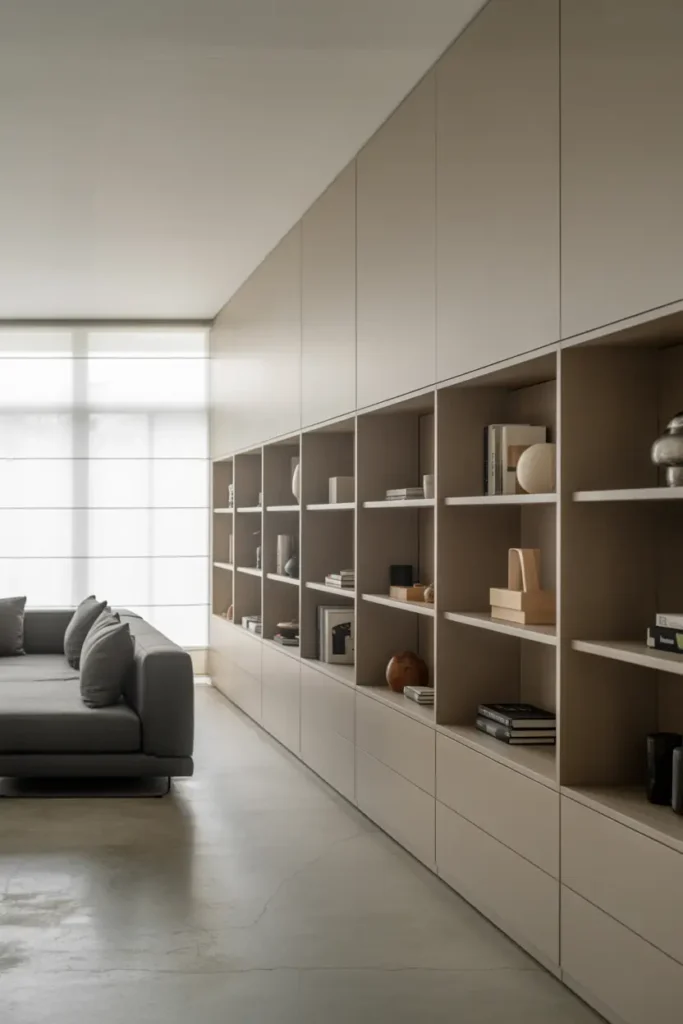
Clear surfaces are not a personality trait; they are a storage problem with a storage solution. Every category of living-room clutter needs a closed home: remotes and chargers in a lidded box on the coffee table, throws in an ottoman with storage, media gear behind the doors of a low console at least 16 inches deep. Open shelving looks great in photos and collects dust and visual noise in real life — one open shelf is a display, three open shelves are a storage unit you have to style forever.
Run the one-in-one-out rule for anything that lives on a surface. A new candle arrives, an old object leaves. It sounds strict, but surfaces creep back to cluttered within a month without it, and re-cluttered minimalism is just a regular room that cost more. A ten-minute Sunday reset — everything back in its closed home — keeps the system working.
8. Space Left Open on Purpose
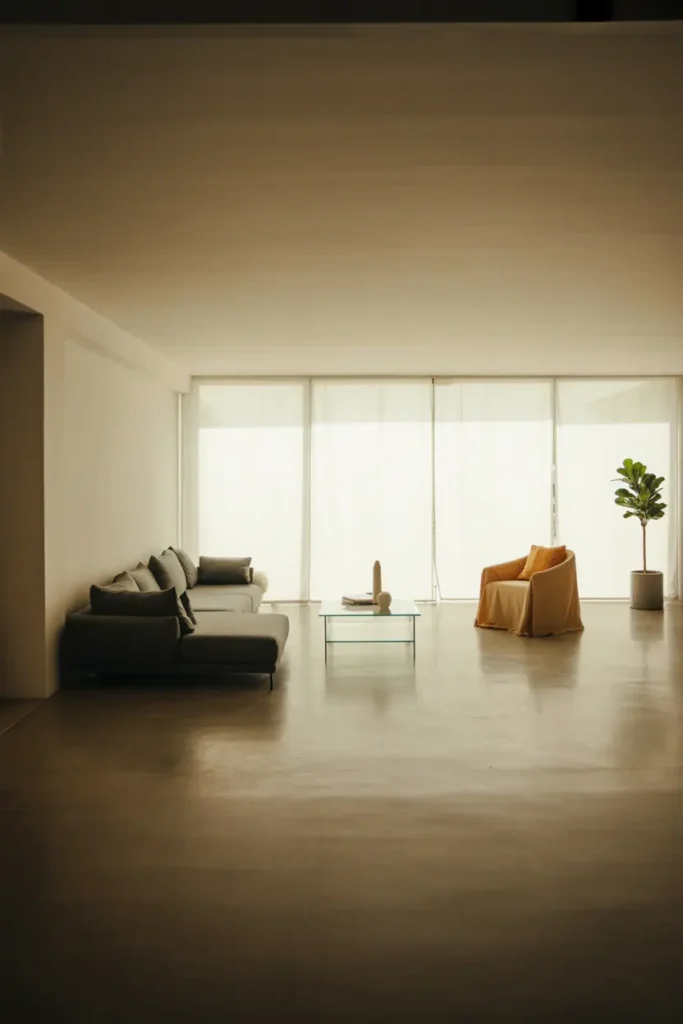
Empty floor space is the most misunderstood luxury in interior design. Keep 30 to 36 inches of clear walkway on the main paths through the room, and pull the sofa 3 to 4 inches off the wall instead of shoving it flat against it — that shadow gap actually makes the room feel larger, not smaller. When you can cross the room without sidestepping furniture, the whole space reads as calm and expensive.
The instinct to push everything to the walls “to open up the middle” usually backfires. It leaves a dead empty center surrounded by a cramped perimeter, and the room feels like a waiting area. Float the seating slightly inward, anchor it on the rug, and let the breathing room sit around the arrangement instead of in the middle of it.
Pro Tips
- Photograph the room to edit it. Clutter your eyes have learned to ignore jumps out in a photo. Take a picture from the doorway once a month and remove whatever catches your eye first.
- Repeat one wood and one metal. Pick a single wood tone and a single metal finish and use them on at least three pieces each. Repetition is what makes different furniture look like it belongs together.
- Buy the rug to fit the seating, not the room. The front legs of the sofa and chairs should sit on the rug — for most living rooms that means 8 by 10 feet minimum, not the 5 by 7 that looks lost.
- Live with paint swatches for 48 hours. Colors shift dramatically between daylight and lamplight. Never commit to a wall color from a single viewing.
FAQs
Won’t a minimalist living room feel cold and empty?
Only if you remove warmth along with the clutter. Warm paint undertones, layered textures, and 2700K lighting are what keep a minimal room feeling like a home. Cold minimalism is almost always a lighting problem, not a furniture problem.
How much does a minimalist living room refresh cost?
A cosmetic refresh — paint, a rug, lighting, and editing what you own — typically runs $800 to $2,000. Replacing the sofa as well pushes it to $2,000 to $4,000. Start with paint and lighting; they deliver the biggest change per dollar.
Can minimalism work with kids or pets?
Yes, with washable materials. Performance fabrics, indoor-outdoor rugs, and closed storage turn minimalism from fragile to practical. The real enemy is not kids — it is open shelving and white bouclé, which no household survives.
Where does the TV go in a minimalist living room?
Mount it on the focal wall and treat it as the single statement piece, framed by nothing, or hide it inside a media console with doors. What looks un-minimal is not the TV but the tangle of cables and devices around it — a $20 cable management kit solves most of it.

HowDecor is a home decor blog sharing simple, practical decorating ideas for everyday spaces. We believe a beautiful home should feel comfortable, personal, and full of warmth — and that great style does not require a huge budget. Our goal is to inspire readers to create spaces that feel peaceful, welcoming, and truly their own — one room at a time.