Here’s the part nobody tells you about decorating a kid’s room: whatever theme they beg for today will embarrass them in about eighteen months. The dinosaur phase gives way to the space phase, which gives way to “I want it ALL BLACK” at age eleven. So the smartest colorful kids’ rooms aren’t built around a theme at all — they’re built around a system where the expensive, hard-to-change parts stay flexible and the color lives in things you can swap on a Saturday afternoon.
That’s the approach behind every idea below. Roughly seventy percent of the room — walls, floor, big furniture — stays calm and forgiving. The remaining thirty percent is where the color goes wild: bedding, art, bins, rugs, lights. When tastes change (and they will), you redecorate with a shopping trip instead of a paint crew.
1. Bright Color Base That Feels Happy
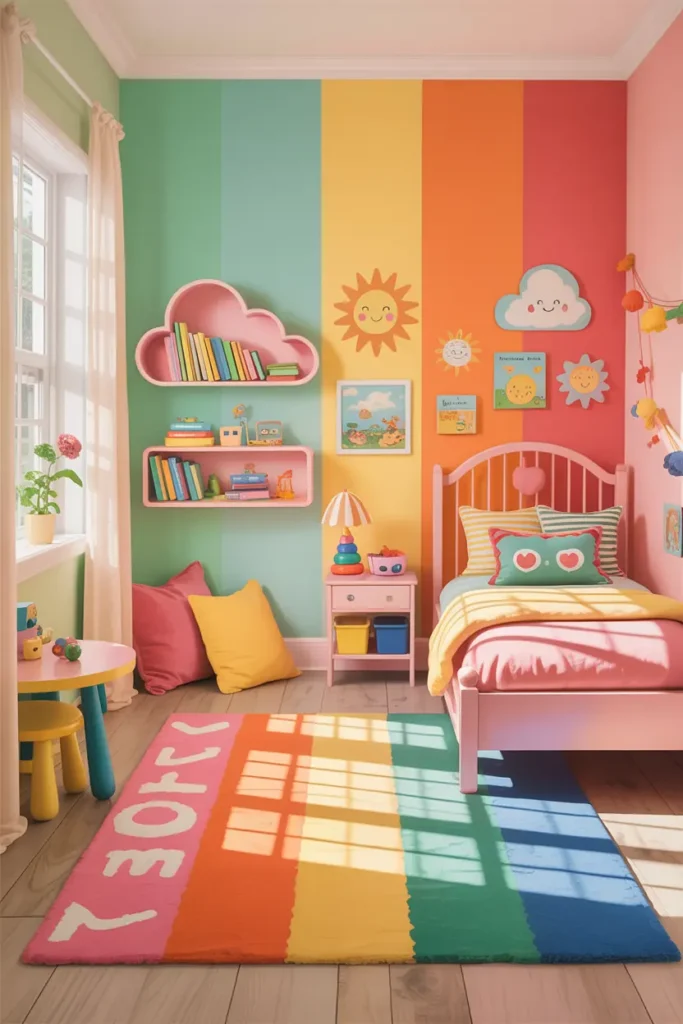
Start with one confident color on a single accent wall, not all four. A full room of saturated yellow can feel like living inside a highlighter, but one wall of warm marigold or soft sky blue gives the room its personality while the other three walls stay a warm white. Paint just the wall behind the bed — it’s the one your child sees most, and it’s the cheapest wall to repaint later. A gallon of quality washable paint covers about 350 square feet; one accent wall in a typical 10×12 kids’ room needs barely a quart, so you’re spending $20 to $35, not hundreds.
The finish matters more than the shade. Kids touch walls — constantly. Choose eggshell or satin, never flat, because flat paint shows every handprint and can’t be scrubbed. Before committing, buy two or three sample pots and paint big 2×2 foot swatches on poster board, then tape them up for 48 hours. Colors shift dramatically between morning and lamplight, and a coral that looks cheerful at noon can turn aggressive under a warm bulb at bedtime.
2. Fun Patterned Bedding
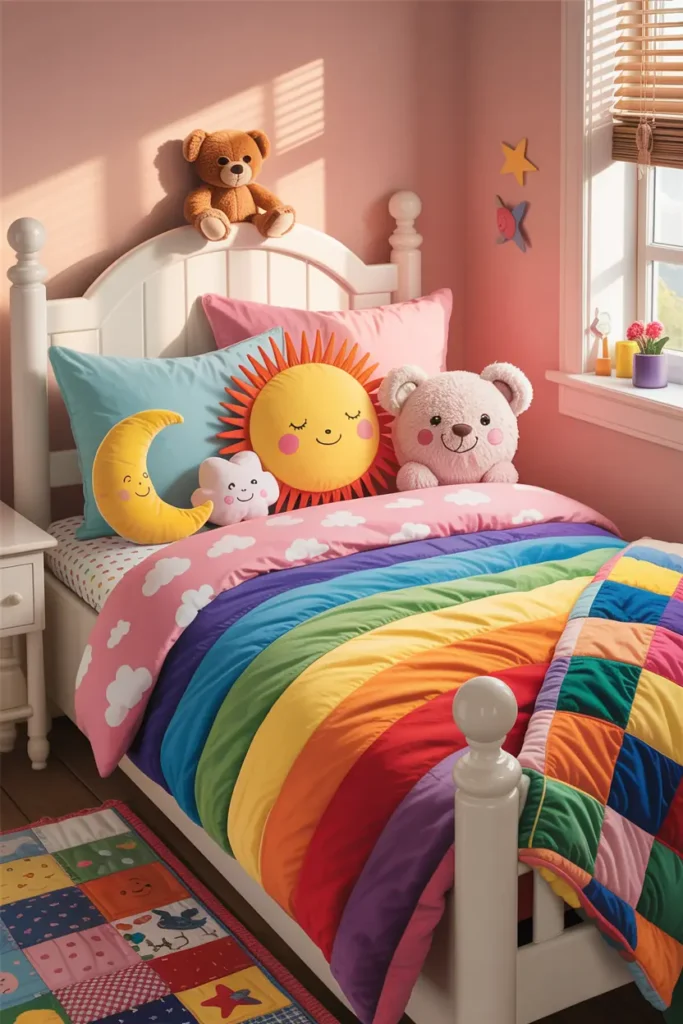
The bed eats up roughly a third of a small kid’s room visually, which makes bedding the highest-impact color swap in the whole space. Instead of character bedding tied to one show or movie — which has a shelf life of about a year — look for patterns with staying power: stars, stripes, dots, rainbows, simple animals. A duvet cover set in 100% cotton runs $25 to $50 and washes well, which matters because kids’ bedding gets washed constantly. Skip the matching 6-piece sets; buy the duvet cover and sheets separately so you can mix a patterned top with solid sheets that still work when the pattern retires.
Here’s a trick that saves arguments: pick two patterns you can live with, then let your child choose between them. They get real ownership, you get a room that doesn’t clash with everything else. And layer in a solid-color throw blanket in one of your accent colors — it breaks up a busy pattern, adds warmth for reading time, and hides the inevitable juice-box incident.
3. Colorful Wall Art and Prints
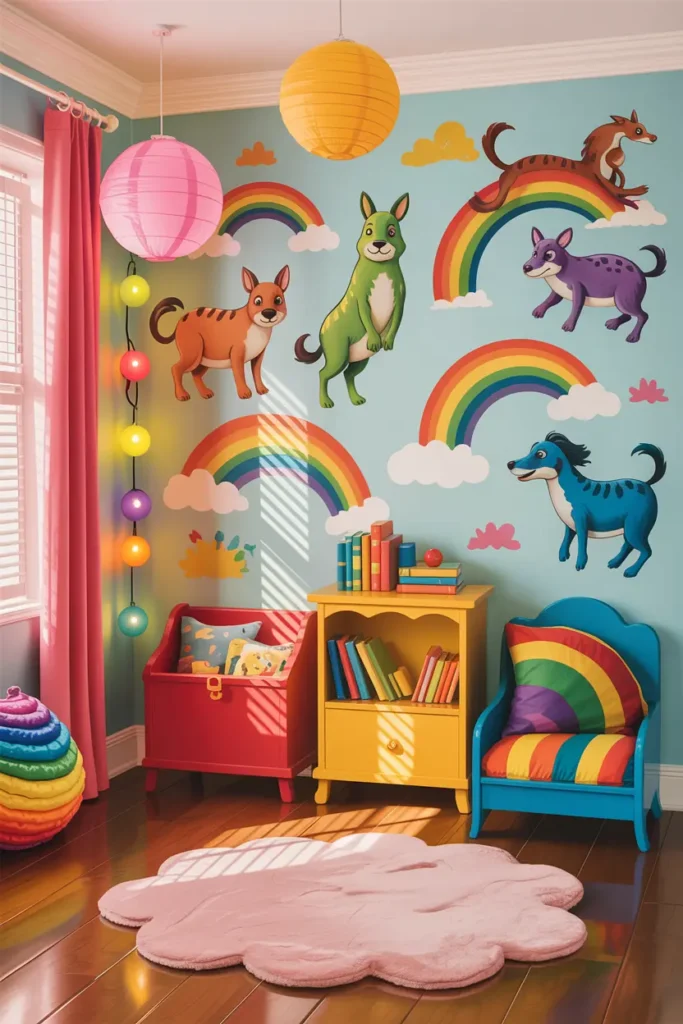
Adults hang art at 57 inches to center. In a kid’s room, that puts everything over their head — literally. Hang the pieces your child actually looks at with centers around 40 to 48 inches, roughly their eye level, and save the higher wall space for your sightlines. A narrow picture ledge shelf (about $15 to $25) is better than a dozen nail holes: kids can swap their own art in and out, which means the “gallery” refreshes itself every time they bring something home from school.
For maximum color with minimum commitment, removable wall decals beat framed prints. A $20 set of dots, stars, or alphabet decals covers a surprising amount of wall, peels off cleanly when tastes change, and survives renters’ deposit inspections. If you do frame things, buy one size — say 8×10 — in bulk and use the same simple frame everywhere. Uniform frames make even a chaotic mix of kid art look intentional instead of cluttered.
4. Playful Storage That Looks Fun
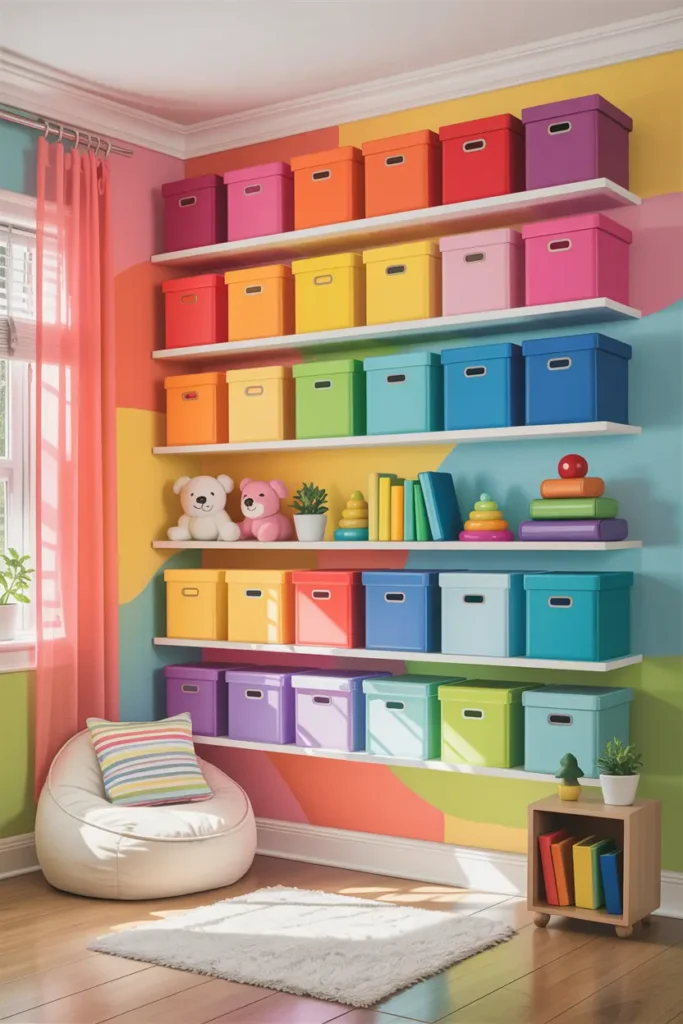
Storage only works in a kid’s room if a five-year-old can use it without help. That means bins at their height, not yours: the top of a toy shelf should sit no higher than about 36 inches for a preschooler. Cube organizers with 11-inch fabric bins are the workhorse here — each bin holds one category of toy, the bins pull out like drawers, and when one rips you replace a $7 bin instead of a whole unit. Systems like IKEA’s Trofast with its colored plastic bins have survived millions of kids for a reason.
The real secret is labeling with pictures, not words. Print or draw a simple image for each bin — blocks, cars, dolls — and tape it on front. Pre-readers can clean up independently, which is the whole point. And keep the total number of bins honest: if toys don’t fit in the designated bins, something needs to leave the room, not get crammed in. Colorful bins double as decor, so let them be bright — but keep the shelf itself neutral so the next reorganization doesn’t require new furniture.
5. Soft Play Rugs with Color
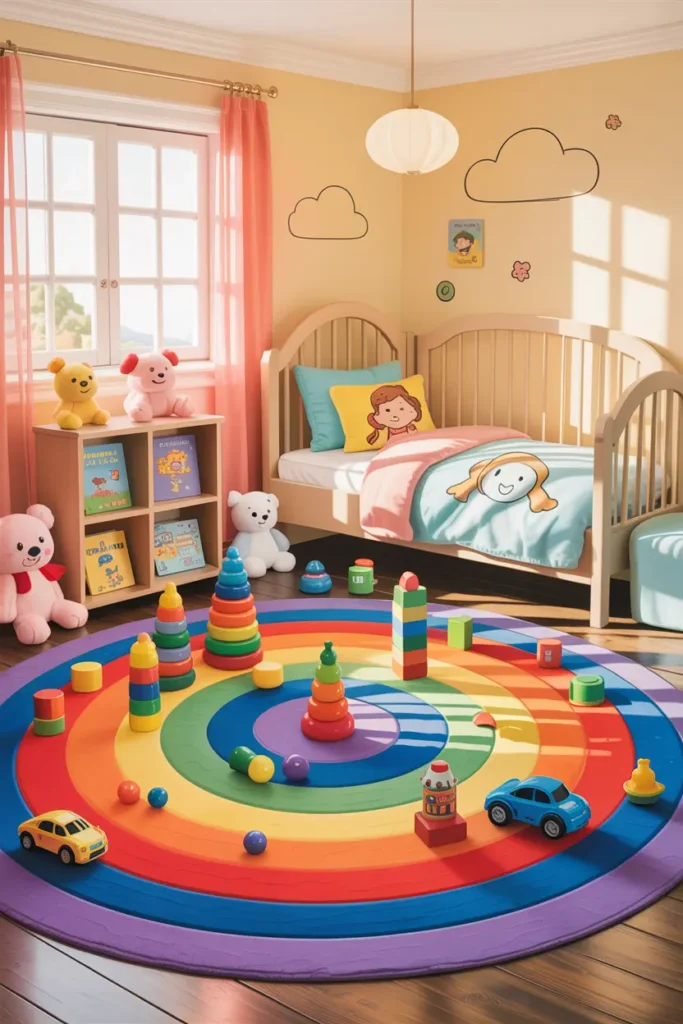
A rug defines the play zone and saves your floors, but the wrong rug in a kid’s room is a maintenance nightmare. Go low-pile — under half an inch — because toy cars roll on it, blocks stack on it, and crumbs vacuum out of it. High-pile shag looks cozy in photos and collects everything in real life. For a typical play area, a 5×7 rug gives enough floor for two kids and a sprawling LEGO build; in a smaller room, a 4×6 still anchors the zone without swallowing the floor.
Washable rugs have changed the game for kids’ rooms. Brands making machine-washable flatweave rugs mean a juice spill is a laundry problem, not a replacement problem — expect to pay $80 to $150 for a 5×7, roughly double a basic rug, and it’s worth it. Always use a rug pad underneath: a thin felt or rubber pad (about $30 for 5×7) stops the rug migrating across the floor during enthusiastic play and adds just enough cushion for knees and elbows.
6. Creative Reading or Play Corner
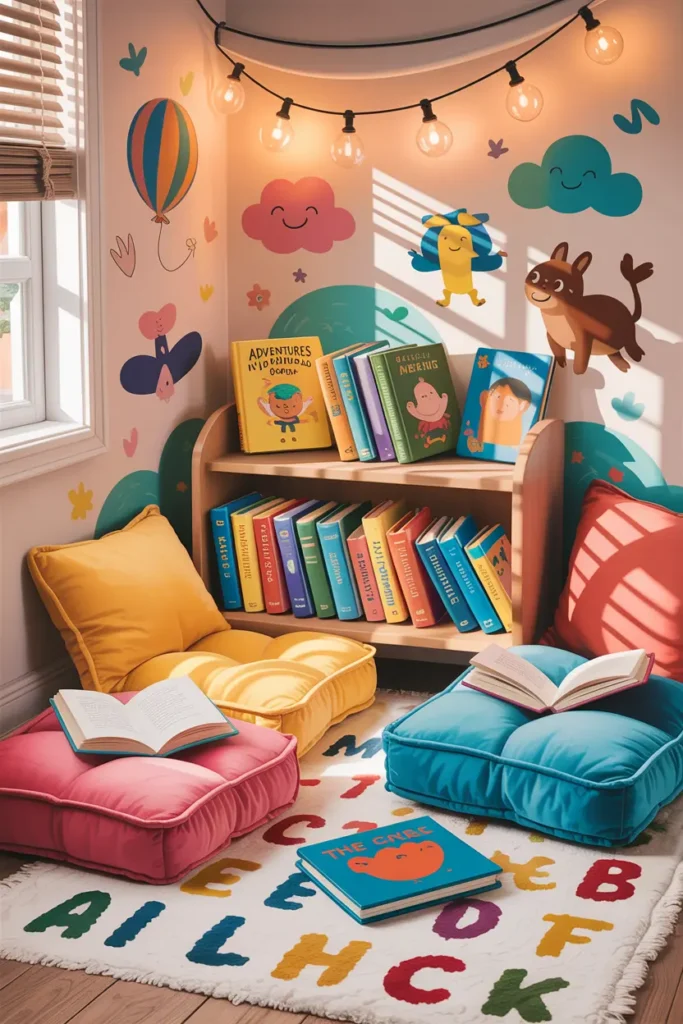
You don’t need much space for a corner that kids actually use — a 3×3 foot footprint is enough. The formula is simple: something to sit in, something to read, and light. A small bookshelf with books facing forward (covers out, like a bookstore) gets read ten times more than books spine-out on a tall shelf; a $25 forward-facing display shelf at kid height does more for reading habits than any expensive bookcase. Add a floor cushion or a small beanbag and a $30 to $60 fabric teepee or canopy, and you have a destination.
Place the corner near a window if you can — natural light makes it the default hangout spot during the day. The common mistake is making it too precious: if the cushions can’t be jumped on and the books can’t be pulled out freely, kids will read on your bed instead. Build it to be used hard. Washable cushion covers and a wipeable mat underneath handle the reality of snack-time reading.
7. Cheerful Lighting Touches
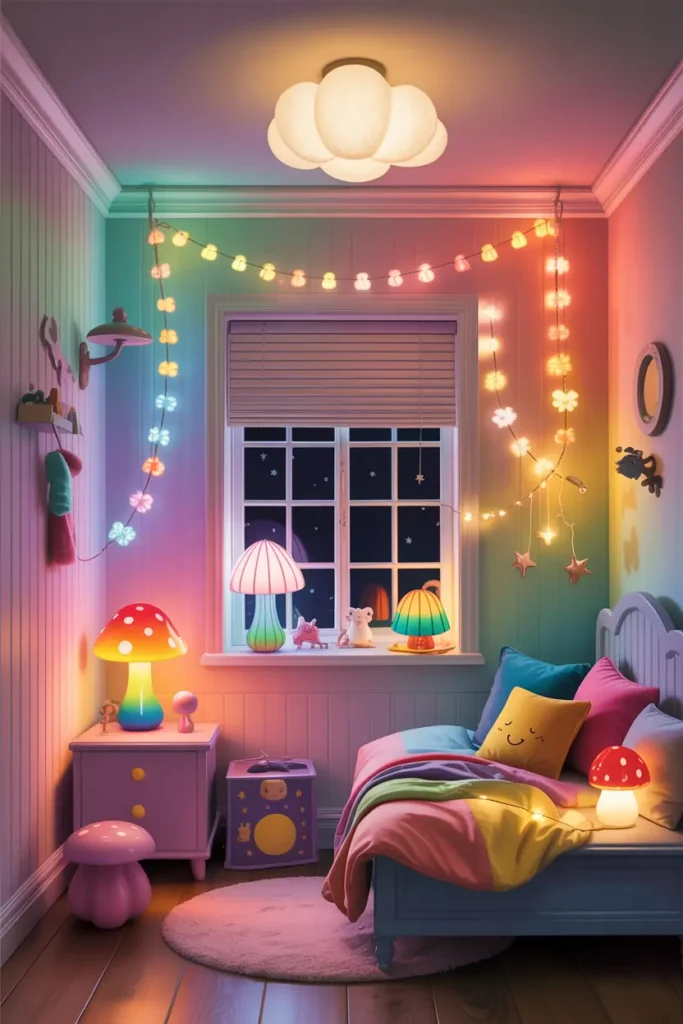
Overhead lighting is the enemy of a cozy kids’ room — a single bright ceiling fixture makes everything feel like a classroom. Layer instead: a dimmable main light for cleanup, a warm table lamp for reading, and a nightlight for the overnight hours. Keep every bulb at 2700K (warm white); cool blue-white LEDs suppress melatonin and make bedtime measurably harder. A $12 plug-in dimmer on the main lamp lets you drop the room to “almost asleep” brightness without a rewiring project.
For the fun factor, battery-operated fairy lights are the safest bet — no cords, no heat, and they tuck into jars, canopies, or along a shelf for about $8 a strand. Star-shaped nightlights or a simple color-changing bulb in the bedside lamp ($10 to $15) give kids a sense of control over their space, which genuinely reduces bedtime stalling. Avoid anything with a harsh glare at pillow height; if you can see the bare bulb from the bed, it needs a shade.
8. Personal Touches That Feel Special
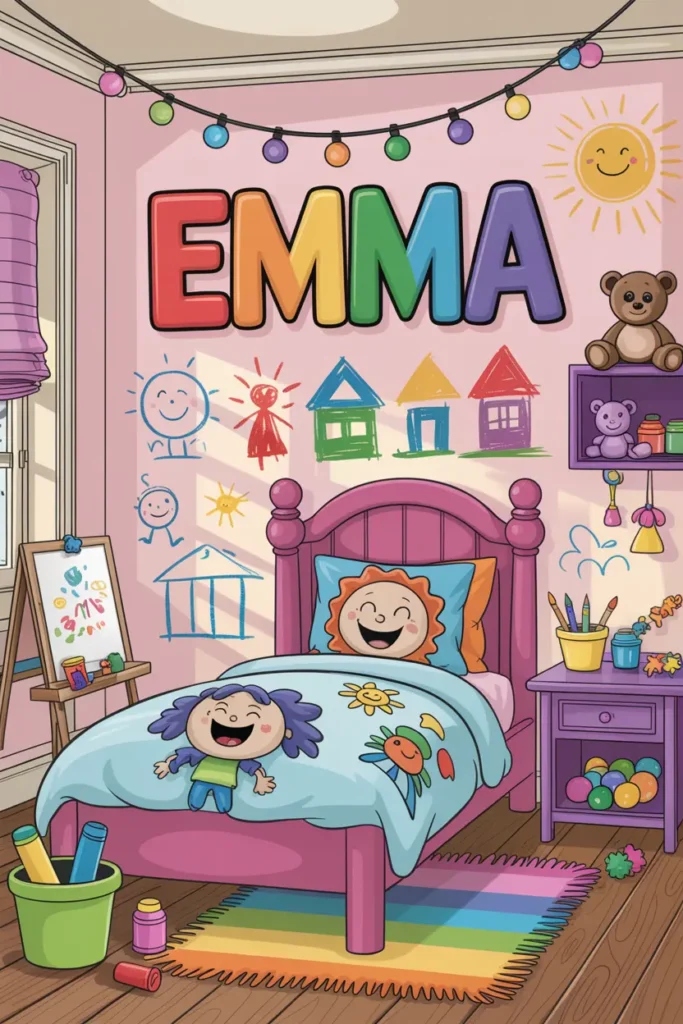
The difference between a decorated room and a loved room is evidence of the kid who lives there. A simple wire with clips ($10) strung at their height becomes a rotating gallery for their own drawings — swap pieces monthly and the room always feels current. A wooden name sign on the door, hung at their eye level rather than yours, marks territory in the way kids understand. These cost almost nothing and matter more than any single furniture piece.
Display, don’t store, the meaningful stuff. A shallow shadow box ($15) for the first lost tooth, the race medal, the rock collection beats a drawer every time. And frame one piece of their art properly — real frame, real mat — and hang it where guests see it. Kids notice which of their creations get the “grown-up” treatment, and it tells them their work has value. Rotate which piece gets the honor every few months.
The Takeaway
A great colorful kids’ room isn’t the one with the most color — it’s the one where the color is in the right places. Keep walls and big furniture flexible, pour personality into the swappable layers, and build everything at kid height for kid hands. Do that, and the room grows up alongside them instead of fighting them at every phase.
Pro Tips
- Test paint on poster board, not the wall. Tape 2-foot swatches up for two full days so you see the color in morning, afternoon, and lamplight before you buy a gallon.
- Cap the palette at three colors plus white. One main, one secondary, one accent. Every extra color you add makes the room feel busier without making it feel more fun.
- Buy storage before toys. Every new toy should have a labeled home waiting for it, or clutter wins within a month — no matter how pretty the room started.
- Photograph the room twice a year. You’ll spot what’s worn out, what’s been outgrown, and what your kid has quietly stopped using — then refresh only those pieces.
FAQs
How do I add lots of color without the room feeling chaotic?
Use the 70-20-10 approach: about 70 percent calm neutrals (walls, floor, big furniture), 20 percent one main color, 10 percent accents. Repeating the same two or three colors across bedding, bins, and art ties everything together so “colorful” reads as intentional rather than random.
What’s the best paint finish for a kids’ room?
Eggshell or satin. Both can be scrubbed clean of handprints and crayon marks, while flat paint stains permanently and semi-gloss looks too shiny on large walls. Always choose a washable formula marketed for high-traffic areas.
How often should I expect to redecorate a kids’ room?
Plan a light refresh every 18 to 24 months — new bedding, new art, reorganized storage — and a bigger update around ages 5, 8, and 11 as needs change. Designing with swappable layers from the start makes each refresh a weekend project instead of a full renovation.
Are wall decals safe for the paint underneath?
Quality removable decals are designed to peel off cleanly, but test one in a hidden spot first and never apply them to paint less than 30 days old. Cheap decals can pull fresh or flat paint, so stick with reputable brands and eggshell or satin finishes.

HowDecor is a home decor blog sharing simple, practical decorating ideas for everyday spaces. We believe a beautiful home should feel comfortable, personal, and full of warmth — and that great style does not require a huge budget. Our goal is to inspire readers to create spaces that feel peaceful, welcoming, and truly their own — one room at a time.