Here’s the uncomfortable truth about most “Japandi” bathrooms: they’re just beige bathrooms with a Japanese word attached. Real Japandi is a discipline, not a shopping list — it fuses Japan’s wabi-sabi (beauty in imperfection, in things that age) with Scandinavia’s devotion to function and light. If your bathroom just looks empty, you’ve done minimalism. If it feels calm because every material is honest and everything has a place, you’ve done Japandi.
The eight ideas below are organized as decisions, not purchases. Each one asks you to choose the quieter, more honest option — and explains why that choice is what actually creates the calm you’re after.
1. Calm Neutral Base That Feels Spa-Like
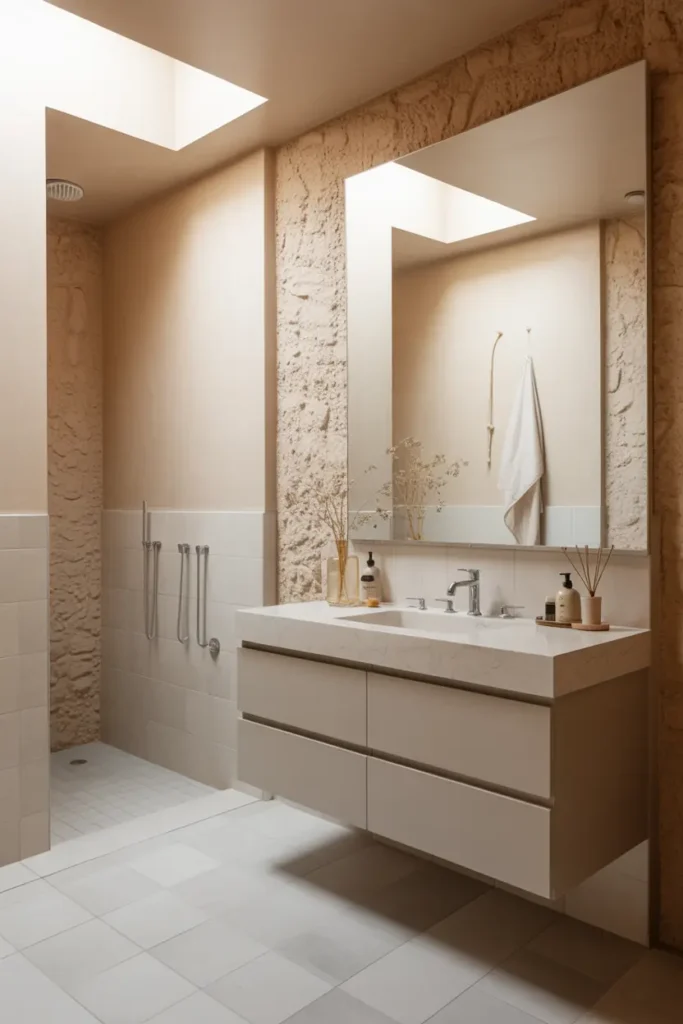
Start with the walls, and think texture before color. A limewash or plaster-look finish in warm white gives you subtle movement that flat paint can’t — the wall has depth without pattern, which is the entire Japandi trick. If you’re tiling, go large-format (12×24 inches or bigger): fewer grout lines means fewer visual interruptions, and the wall reads as one continuous calm surface instead of a grid.
Keep the palette to two neutrals maximum — a warm white and one deeper tone like light taupe or greige for the floor or a single accent wall. The moment a third neutral enters, undertones start arguing and the “quiet” falls apart. And resist the urge to add a feature wall in a bold material; in Japandi, the feature is the absence of features. The calm is the point, not a backdrop for something else.
2. Natural Wood That Adds Warmth
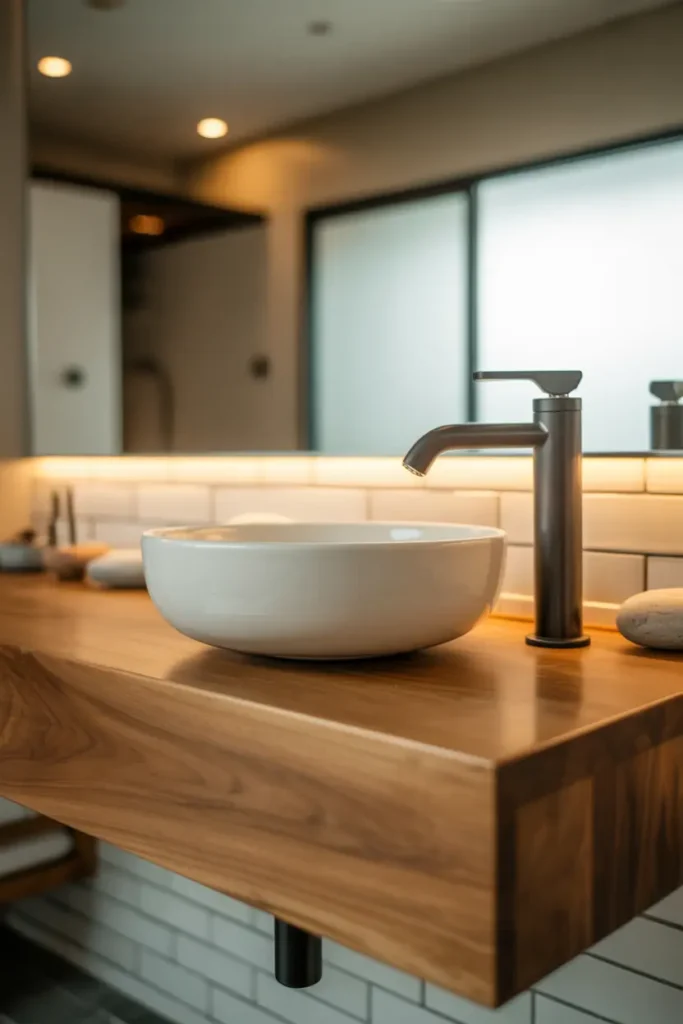
Wood is the soul of a Japandi bathroom — it’s the one warm, living material among all that stone and ceramic. Teak is the traditional choice for good reason: its natural oils resist moisture far better than oak or pine, which is why it’s been used on boats for centuries. A teak vanity or bath bridge will outlast cheaper woods by years in a steamy bathroom. Whatever species you choose, stick to exactly one throughout the room.
Finish it honestly. A matte oil or hardwax finish lets the grain show and can be spot-repaired; thick glossy varnish looks plastic next to natural stone and peels at the edges within a couple of years of steam exposure. Let the wood age — small color shifts and a softening of the surface are wabi-sabi working as intended, not damage. The Japanese half of Japandi explicitly values materials that show their life.
3. Minimal Floating Vanity Design
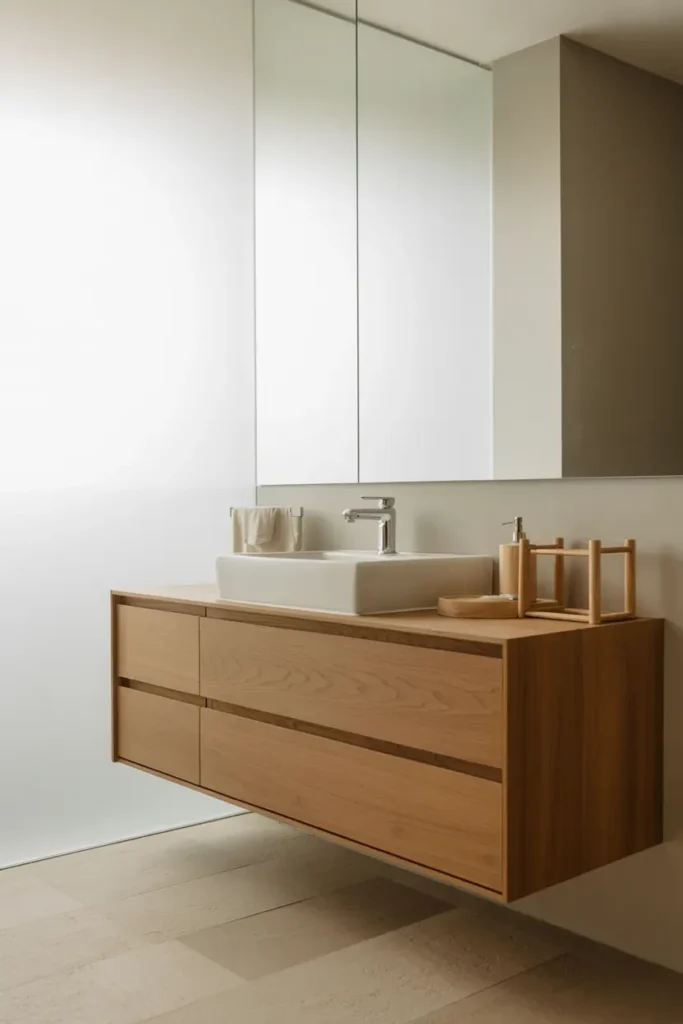
A wall-hung vanity does two things at once: it reveals the floor underneath, which makes the room read larger, and it removes the toe-kick grime trap that freestanding vanities develop. For the plumbing, have your installer run supplies and waste through the wall rather than the floor — it costs a bit more in labor but it’s what makes the float look intentional instead of improvised. Standard comfort height is 32 to 34 inches to the counter top.
Keep the front dead simple: push-to-open drawers with no visible handles, or a single recessed channel pull. Inside, the vanity earns its keep with dividers — a floating vanity with chaotic drawers is just hidden clutter, which defeats the purpose. One deep drawer with organizers beats two shallow junk drawers. And leave at least 8 inches of clear wall beneath it; the shadow gap underneath is part of the design, not wasted space.
4. Soft Matte Finishes Instead of Gloss
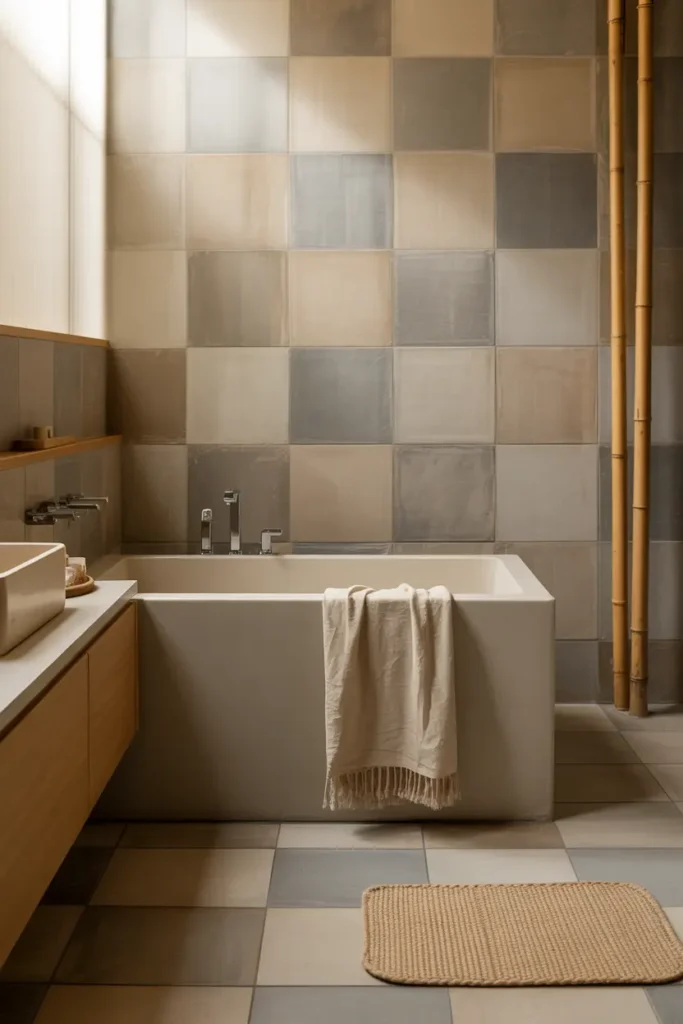
Gloss reflects; matte absorbs — and in a small bathroom, absorption is what keeps the light soft instead of bouncy and harsh. Matte tiles, matte stone-look countertops, and matte fixtures (brushed nickel or matte black) all work together to kill glare. There’s a practical bonus too: matte surfaces don’t show water spots and fingerprints the way polished ones do, so the room stays looking calm between cleanings.
One caution: matte black fixtures in hard-water areas will show mineral deposits as pale marks. If your water is hard, brushed nickel or stainless is the lower-maintenance matte choice — you get the soft look without the constant wiping. Whatever finish you choose, match it across all fixtures. Mixed metals are a maximalist move; Japandi wants one quiet metal, repeated.
5. Simple Japandi Wall Tiles
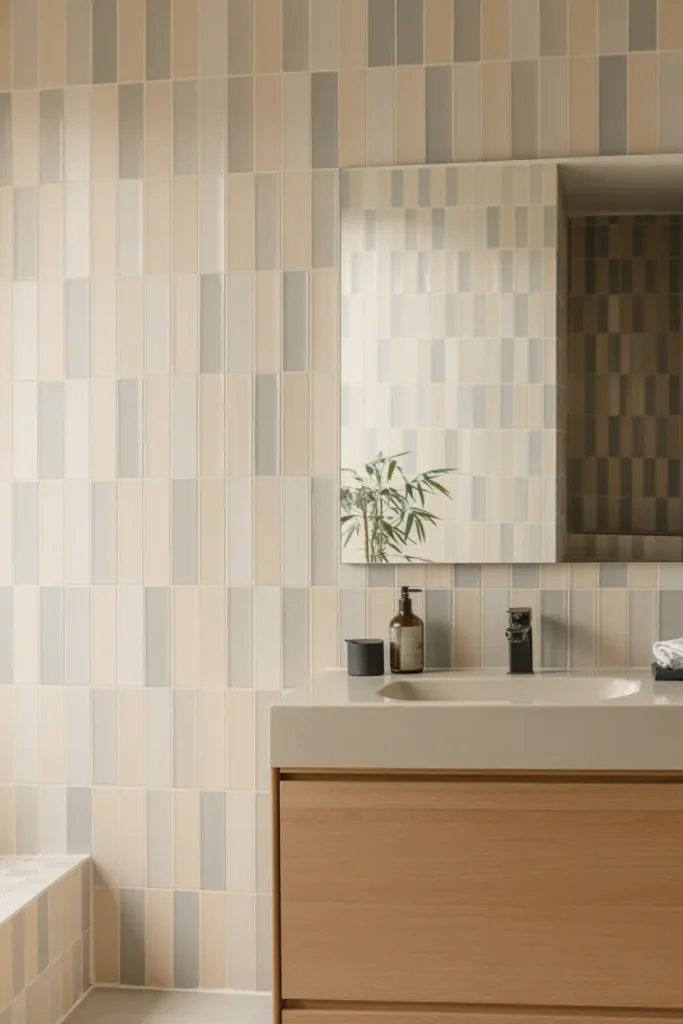
The tile pattern does more work than the tile color in a Japandi bathroom. A vertical stack — tiles set directly atop each other in straight columns — draws the eye upward and makes standard 8-foot ceilings feel taller, with zero extra cost over a basic grid. Handmade-look tiles in bone or warm white add the subtle surface variation that flat ceramic lacks; the slight unevenness catches light the way plaster does.
Run the same tile from floor to ceiling in the shower and at least one full wall outside it. Stopping tile at an arbitrary height creates a visual “event” that breaks the calm — full-height tiling makes the wall disappear into the architecture. Use a grout color close to the tile (not contrasting white), and keep grout lines tight at 1/16 inch if the tile allows it. The wall should read as a single material, not a mosaic.
6. Warm, Gentle Bathroom Lighting
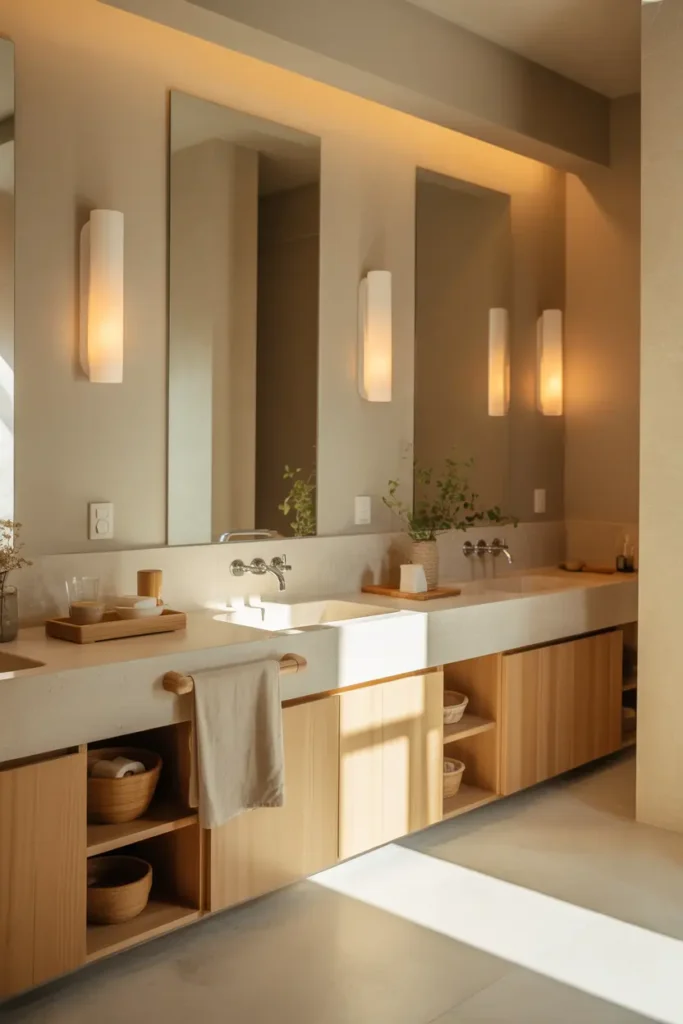
Japandi lighting borrows from the Japanese love of diffused, indirect light — think shoji screens, not spotlights. The single most effective move is an LED strip tucked under the floating vanity: it washes the floor with a soft glow that works as a nightlight and makes the vanity appear to hover. Use 2700K strips on a dimmer; cool-white LED strips will destroy the warmth you’ve built everywhere else.
For the mirror, choose a backlit round mirror or a pair of frosted-glass sconces rather than exposed bulbs or Hollywood strips. Frosted diffusers scatter light the way paper lanterns do — even, shadowless, gentle. Put the vanity lighting on a separate dimmer from the general light so mornings can be bright and functional while evenings drop to a low, warm wind-down. Two circuits, one room, completely different moods.
7. Clean Open Space with Hidden Storage
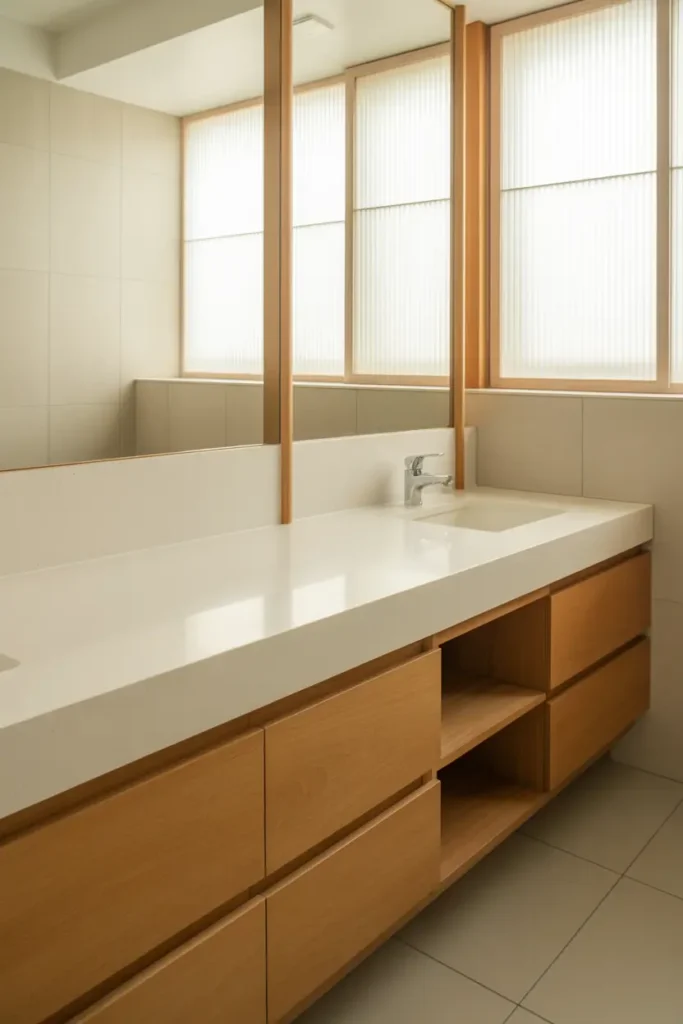
Clear counters aren’t a styling choice in Japandi — they’re the design. Everything you use daily needs a home behind a closed door: a recessed medicine cabinet (which steals zero floor space and sits flush with the tile), deep vanity drawers with dividers, and one tall narrow cabinet if the room allows it. Count your daily-use items honestly; if they don’t fit the hidden storage, you have too many, not too little storage.
Adopt the one-in-one-out rule for bathroom products — a new serum means an old bottle leaves. It sounds strict, but it’s the only system that maintains clear surfaces without weekly purging marathons. Decant the two or three products you do display into matching ceramic or amber glass dispensers; a row of mismatched branded bottles is visual noise, and in a quiet room, noise is all you see.
8. Subtle Organic Accessories Only
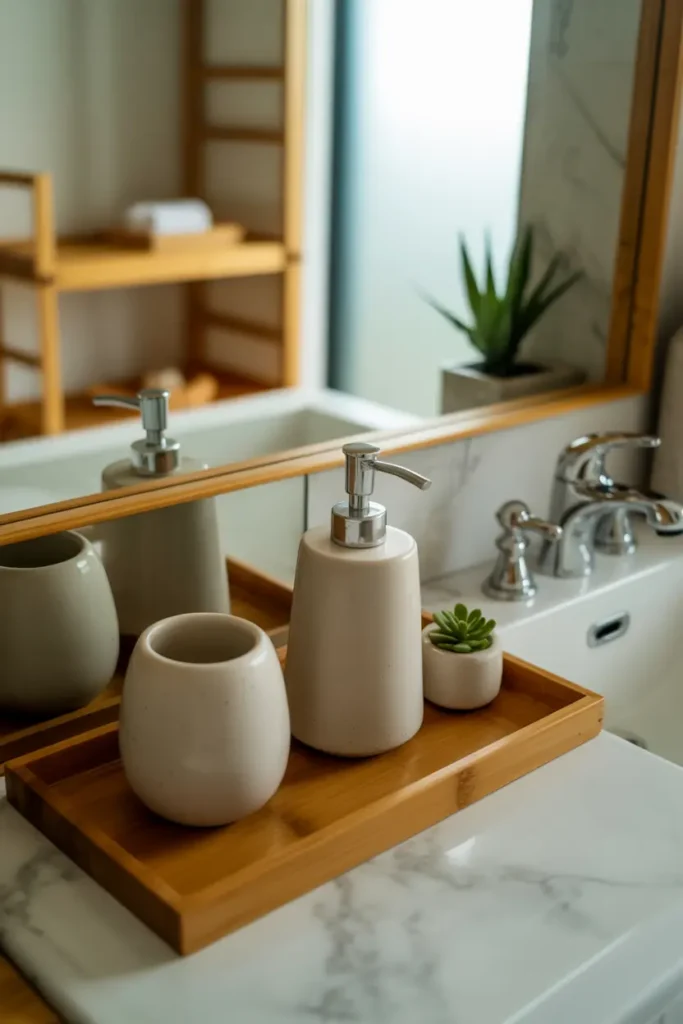
Here’s where wabi-sabi earns its place: choose one imperfect, handmade object and let it be the room’s soul. A slightly uneven ceramic soap dispenser, a hand-thrown vase with a single stem of eucalyptus, a stone tray with visible veining — one piece with evidence of the human hand does more for the room than ten perfect accessories. Machine-perfect decor in a Japandi bathroom reads as a hotel; one handmade piece reads as a home.
Then stop. A wooden bath bridge, a folded neutral towel, the ceramic dispenser — that’s a complete accessory scheme. Every additional object has to justify itself against the calm, and most won’t survive the test. If you love greenery, one small plant in a handmade pot is enough; a collection of plants turns a serene bathroom into a greenhouse, which is a different design entirely.
Final Thought
A Japandi bathroom isn’t decorated into calm — it’s edited into it. Choose honest materials, hide everything that doesn’t need to be seen, and let one imperfect handmade object carry the room’s warmth. The serenity you’re after is what remains when everything unnecessary is gone.
Pro Tips
- Light it at 2700K, everywhere. One cool-white bulb in a Japandi bathroom undoes thousands of dollars of warm material choices. Check every bulb, including the LED strip.
- Tile to the ceiling. Stopping tile halfway up the wall creates a visual breakpoint that fights the calm. Full-height reads as architecture, not decoration.
- Buy the handmade-look tile, skip the handmade price. Good zellige-look porcelain gives you the surface variation Japandi needs at a fraction of real zellige’s cost — and it’s easier to keep clean.
- Do the counter test monthly. If anything has lived on your counter for a month without a dedicated hidden home, either find it one or let it go. Clear surfaces are a practice, not a purchase.
FAQs
What’s the difference between Japandi and regular minimalism?
Minimalism is about having less; Japandi is about having the right things. Japandi specifically requires natural materials, visible craftsmanship, and warmth — a stark white minimalist bathroom with chrome fixtures isn’t Japandi, it’s just minimal. The wood tones and handmade textures are non-negotiable.
Can I do Japandi in a tiny bathroom?
Small bathrooms are actually ideal — the discipline of hidden storage and limited materials matters more when space is tight. Use the floating vanity, large-format tile, and vertical stack pattern; all three make small rooms feel significantly larger.
Is real wood okay in a steamy bathroom?
Teak and other naturally oily woods handle steam well, especially with a matte oil finish and decent ventilation. Avoid placing unsealed wood where it gets directly splashed, and always run the exhaust fan for 20 minutes after showers — that matters more than the wood species.
How do I keep it from looking cold and empty?
Coldness comes from too many hard, cool surfaces with nothing organic to balance them. If your Japandi bathroom feels sterile, you almost certainly need more wood, warmer lighting (check for 2700K), and that one handmade imperfect object — those three fixes solve it in nearly every case.

HowDecor is a home decor blog sharing simple, practical decorating ideas for everyday spaces. We believe a beautiful home should feel comfortable, personal, and full of warmth — and that great style does not require a huge budget. Our goal is to inspire readers to create spaces that feel peaceful, welcoming, and truly their own — one room at a time.