Let’s be honest about the starting point: your apartment bedroom is probably a 10×10 box with landlord-white walls, a beige carpet you didn’t choose, and a lease that forbids paint. That’s not a design obstacle — it’s actually the perfect blank canvas for Japandi, because this style was never about renovation. It’s about subtraction, honest materials, and a few deliberate choices that make a small rented room feel intentional instead of temporary.
Everything below assumes you can’t change the walls, the floor, or the ceiling. No demolition, no paint, nothing that risks your deposit. Just the moves that actually register in a small space — and the measurements that keep a compact room from tipping into cluttered.
1. Warm Neutral Japandi Color Scheme
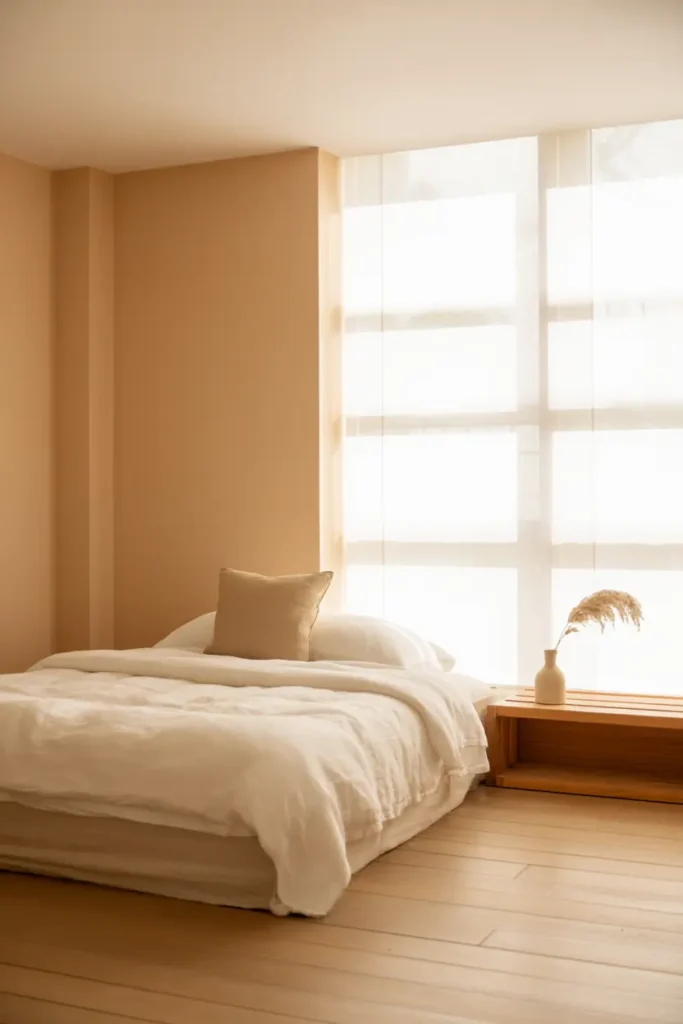
You can’t repaint, so you warm up the room with everything that’s not the wall. Landlord white is usually a cool, flat white — fight it with warm textiles, not more white. Oatmeal linen bedding, a jute or wool rug in natural tan, and light wood tones will pull the whole room toward warm-neutral even though the walls haven’t changed. The eye reads the big soft surfaces, not the paint.
Keep the palette ruthlessly tight: warm white, one beige/taupe, one wood tone, and that’s the entire room. In a 100-square-foot bedroom, every additional color is magnified — what looks like “a little variety” in a store looks like chaos in a small space. If you crave one deeper tone, put it in exactly one place (a throw pillow, a single art print) and let the neutrals do the rest of the work.
2. Low Platform Bed for Spacious Feel
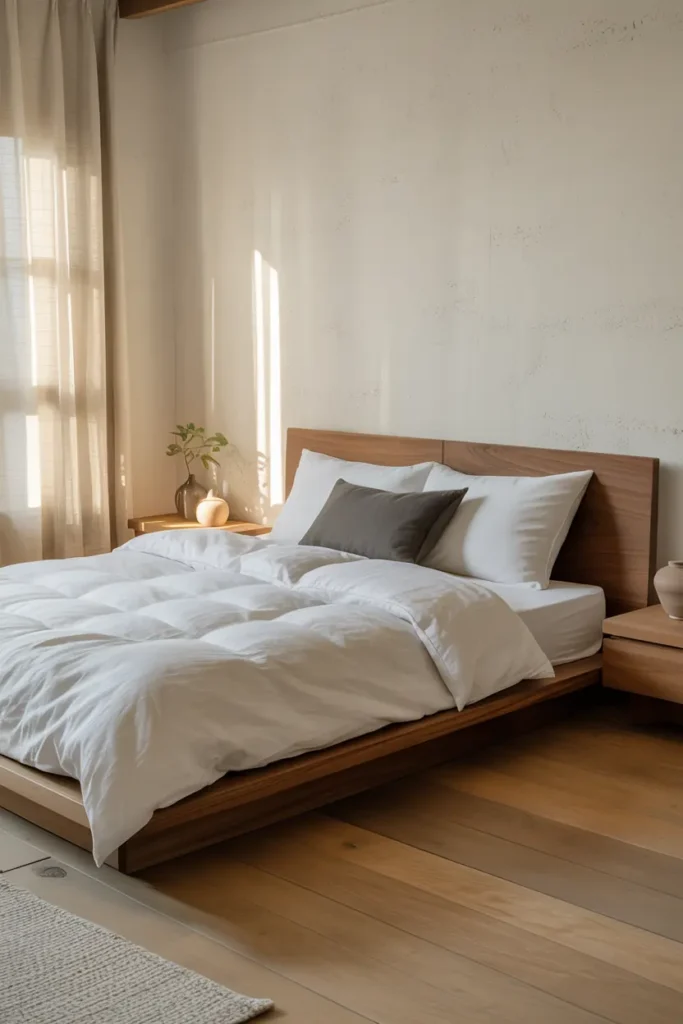
A low platform bed — platform top sitting 10 to 14 inches off the floor — is the single most effective trick for a small bedroom with standard 8-foot ceilings. The lower the bed’s visual mass, the more wall shows above it, and your brain reads that extra visible wall as extra room height. A tall headboard and high box spring do the opposite, chopping the wall in half. If buying new isn’t in the budget, removing the box spring and putting the mattress directly on a low slatted frame gets you most of the effect for free.
The platform earns its floor space with storage: drawers built into the base, or at minimum 6 to 8 inches of clearance underneath for flat bins. In a small apartment, the bed is the largest piece of furniture you own — if it isn’t storing things, you’re wasting roughly 30 square feet of potential storage. Measure your room before shopping: you want at least 24 inches of walkway on the sides you use, and the bed should never block more than one window.
3. Natural Wood Furniture Accents
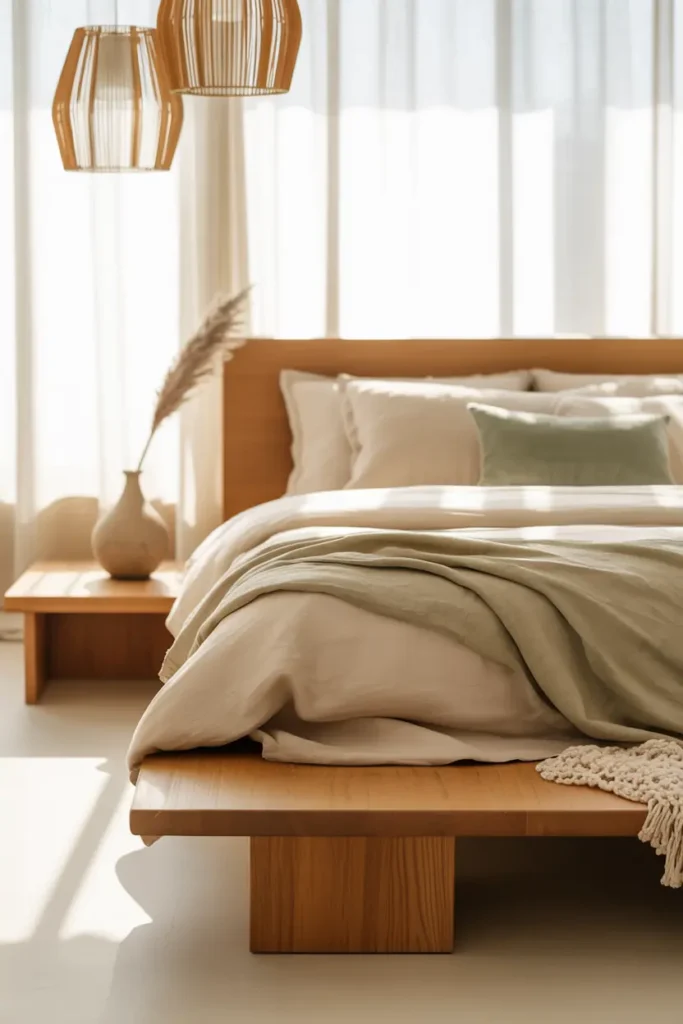
In a white-box rental, wood is what makes the room feel like someone lives there on purpose. One wood tone, repeated two or three times — the bed frame, a small nightstand, one floating shelf — is enough to warm the entire space. Light oak or ash keeps a small room feeling open; anything darker starts to visually weigh down a compact bedroom. And it doesn’t need to match perfectly: close tones in the same family look collected, which suits Japandi better than a matched set anyway.
For renters, the floating shelf is the hero piece. A 24-inch solid wood shelf mounted with proper anchors (not the tiny screws that come in the box) holds books and one object, replaces a bookcase that would eat two square feet of floor, and the holes are small enough to patch with $5 of spackle at move-out. That’s the Japandi-renter equation: maximum warmth, minimum footprint, fully reversible.
4. Minimal Furniture Layout
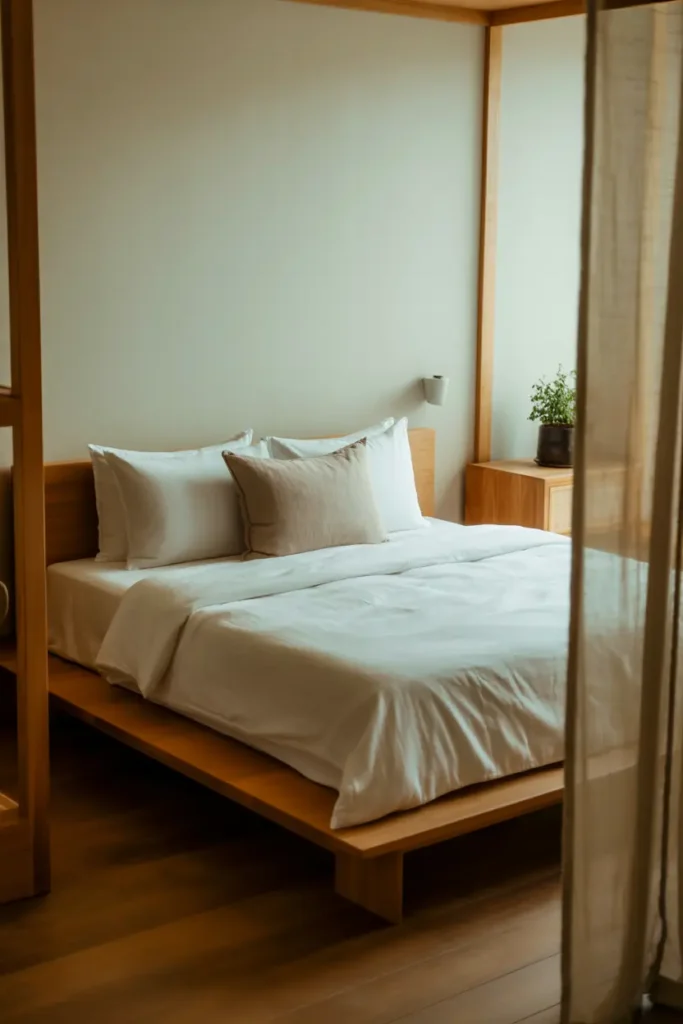
A small bedroom gets three pieces of furniture. That’s the rule: the bed, one nightstand, and one storage piece (a low dresser or the floating shelf plus under-bed drawers). Every fourth piece — the accent chair nobody sits in, the extra side table, the decorative ladder — makes a 10×12 room measurably harder to move through and clean. Draw your room to scale on graph paper before buying anything; most people overestimate their space by 20%.
Protect your walkways: 24 inches minimum on each used side of the bed, 30 inches in front of the closet or dresser drawers so they actually open. If the layout can’t deliver those clearances, the answer is fewer or smaller pieces, not creative squeezing. A small bedroom with clear paths and three good pieces feels calm; the same room with five cramped pieces feels like storage. The empty floor is doing design work — let it.
5. Soft Textured Bedding Layers
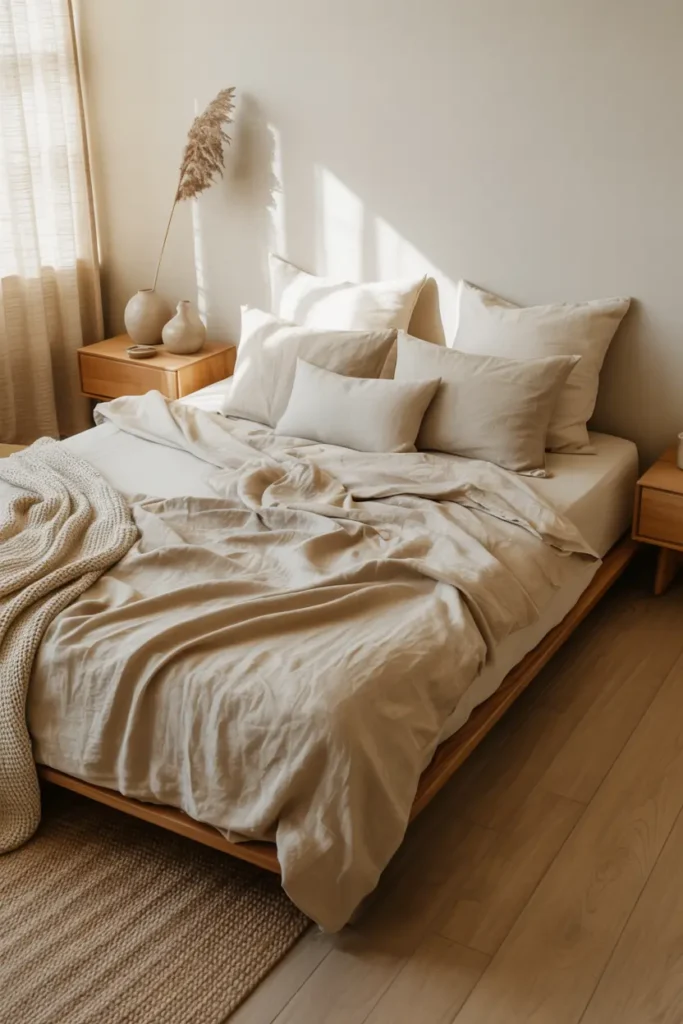
When the walls and floor are landlord-grade, the bed carries the entire style — it’s the biggest textile surface in the room. This is where your texture budget goes: washed linen or a linen-cotton blend for the duvet, a waffle or quilted coverlet folded at the foot, and pillowcases with a subtle texture rather than a print. Three layers maximum, all in your neutral palette. The variation between the weaves is what the eye reads as richness.
Wash everything before you judge it — linen in particular looks flat out of the package and comes alive after two or three washes. And skip the decorative euro shams and the twelve-pillow arrangement; in a small room, a mountain of pillows just eats the visual space the low bed worked to create. Two sleeping pillows and one lumbar or small square is the complete pillow program. Anything more is laundry.
6. Warm and Gentle Lighting
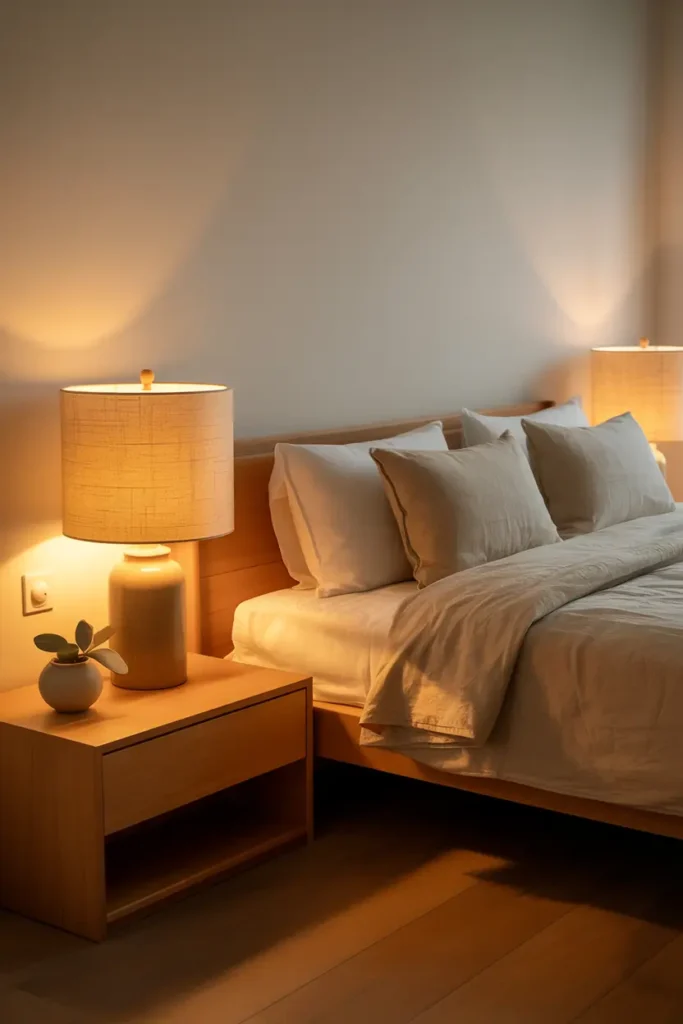
Overhead lighting in rentals is universally terrible — a single cool fixture in the ceiling center that flattens everything. Leave it off permanently and build your own lighting at human height: a paper lantern pendant on a plug-in cord with a hook (no electrician, no holes bigger than a pin), one bedside lamp with a fabric shade, and that’s a complete scheme. Rice-paper style lanterns are the Japandi move — they diffuse light the way shoji screens do, soft and shadowless, for about $20.
Everything at 2700K, and put the bedside lamp on the side you actually read on. If you only have one nightstand, a plug-in wall sconce with a cord cover frees the entire surface — renter-friendly, no wiring, and it gets the light up to a better height for reading. Total lighting budget for the room: under $80. The overhead fixture can stay as a very expensive ceiling decoration you never turn on.
7. Simple and Intentional Wall Decor
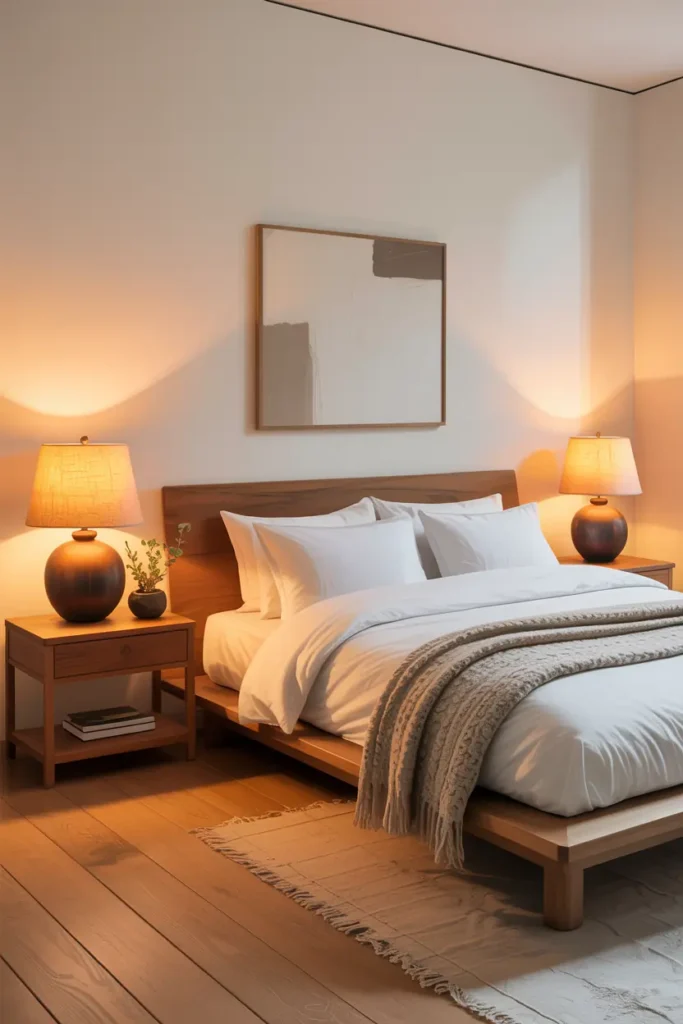
One piece. In a small bedroom, one considered piece of art beats a gallery wall every time — a gallery needs wall space you don’t have, and in a 10-foot room it reads as busy. Choose something in your neutral palette with an organic subject (a soft landscape, a botanical study, an abstract in clay tones), sized around 16×20 to 20×24 inches. Hang it where you see it from the bed, centered at about 57 inches.
No-nail hanging is a solved problem: adhesive strips rated for the frame’s weight hold a 20×24 frame securely and remove cleanly with heat from a hair dryer. For a softer Japandi touch, skip the frame entirely — clip the print to a thin wooden dowel top and bottom with small magnets or clips, and hang it from a single nail or hook. It reads as intentional and handmade, costs almost nothing, and leaves one tiny hole.
8. Open Space and Visual Balance
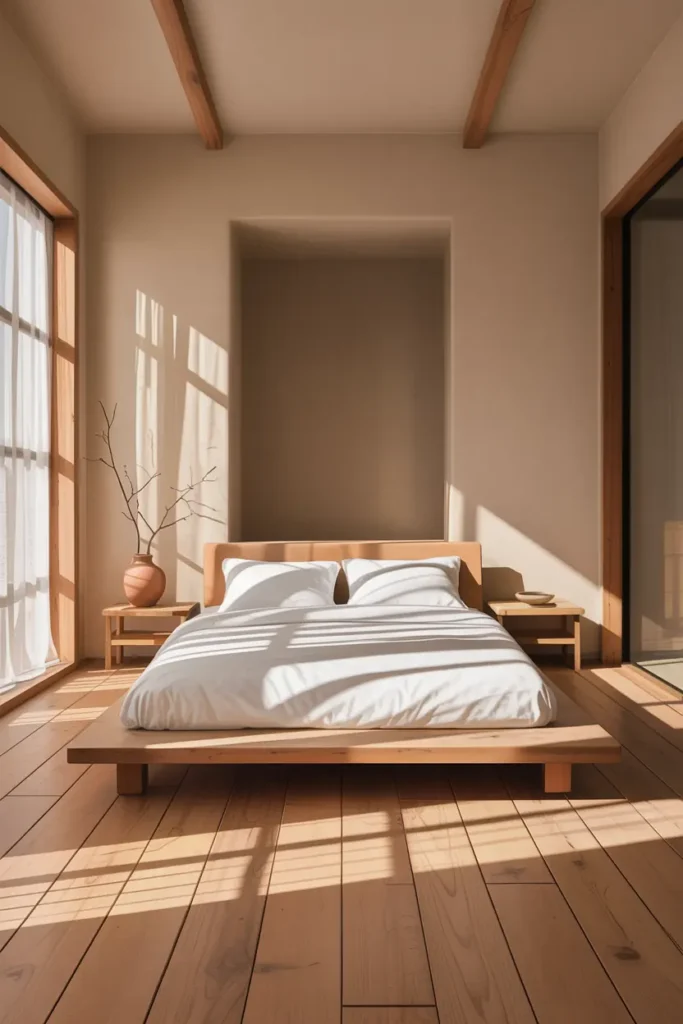
The goal is to keep at least 40% of your floor visible — that’s the threshold where a small room reads as “calm” instead of “full.” Audit ruthlessly: if you can’t see floor between pieces, something needs to go under the bed, onto the shelf, or out of the room. Visual balance matters as much as floor space: don’t stack all the visual weight on one side. If the dresser is on the left, the art or the plant goes right. A lopsided small room feels tense; a balanced one feels settled.
End with the door test: stand in the doorway and look in. The first thing you see should be the bed, made, in your neutral palette — not a pile of laundry, not the closet interior, not a tangle of chargers. Whatever the doorway reveals is what the room “says,” so arrange the sightline deliberately. In a small apartment, the bedroom door view is the room’s first impression, including to you, every single day.
Final Note
Japandi in a small rental isn’t about achieving a look — it’s about refusing clutter, choosing honest materials, and letting empty space do its quiet work. Three pieces of furniture, one wood tone, warm light at human height, and a bed worth looking at. That’s the whole formula, and it fits in a 10×10 box.
Pro Tips
- Measure twice, buy once. Tape the footprint of any new furniture on your floor with painter’s tape and live with it for 48 hours. In a small room, two inches is the difference between calm and cramped.
- Kill the overhead light. A $20 plug-in paper lantern plus one bedside lamp outperforms every rental ceiling fixture ever installed. Leave the overhead off for a week and you’ll never go back.
- One wood tone, three appearances. Bed frame, nightstand or shelf, plus one small object (a tray, a frame). Same family, repeated — that’s what makes it feel designed instead of accumulated.
- Photograph the doorway view. Your phone camera is ruthlessly honest about clutter your eyes have edited out. Fix whatever the photo shows first.
FAQs
How do I make a rental bedroom feel permanent without paint?
Invest in the big soft surfaces: quality bedding, a real rug, and one good wood piece. Those three carry the room’s style regardless of wall color, they move with you, and together they make landlord white disappear behind warmth.
What’s the best bed height for a small room?
Platform top 10 to 14 inches off the floor, mattress top around 22 to 24 inches total. Lower reads as more spacious and more Japandi; higher starts to dominate a small room visually. Skip the box spring entirely on a slatted platform.
Can I hang things without losing my deposit?
Yes — adhesive strips for frames under 5 pounds, and a single small nail hole for heavier pieces (patch with spackle, dab of touch-up paint, invisible at inspection). Floating shelves need proper wall anchors, but the holes are small and patchable.
My room is only 9×10. Is Japandi even possible?
More than possible — it’s ideal. The three-piece rule, the low bed, and the 40%-visible-floor target were made for exactly this size. Small rooms fail from too much stuff, not from style choice; Japandi’s discipline is the fix.

HowDecor is a home decor blog sharing simple, practical decorating ideas for everyday spaces. We believe a beautiful home should feel comfortable, personal, and full of warmth — and that great style does not require a huge budget. Our goal is to inspire readers to create spaces that feel peaceful, welcoming, and truly their own — one room at a time.