Try this experiment tomorrow morning. When you wake up, notice the first thing your eyes land on — before you’ve fully decided to be awake. In most small bedrooms, it’s clutter: the chair with yesterday’s clothes, the tangle of chargers, the closet door hanging open. Your nervous system registers all of it before coffee. Japandi design starts from this exact moment. It’s built on a simple premise: the first ten minutes of your morning should feel like exhaling, and your bedroom is either giving you that or stealing it.
The Japanese half of this style has a word for the goal — ma, the beauty of empty space, the pause between notes that makes music. What follows isn’t a shopping list. It’s eight decisions about what your bedroom shows you, what it hides, and what it asks of you, all in service of calmer mornings.
1. Calm Neutral Japandi Palette
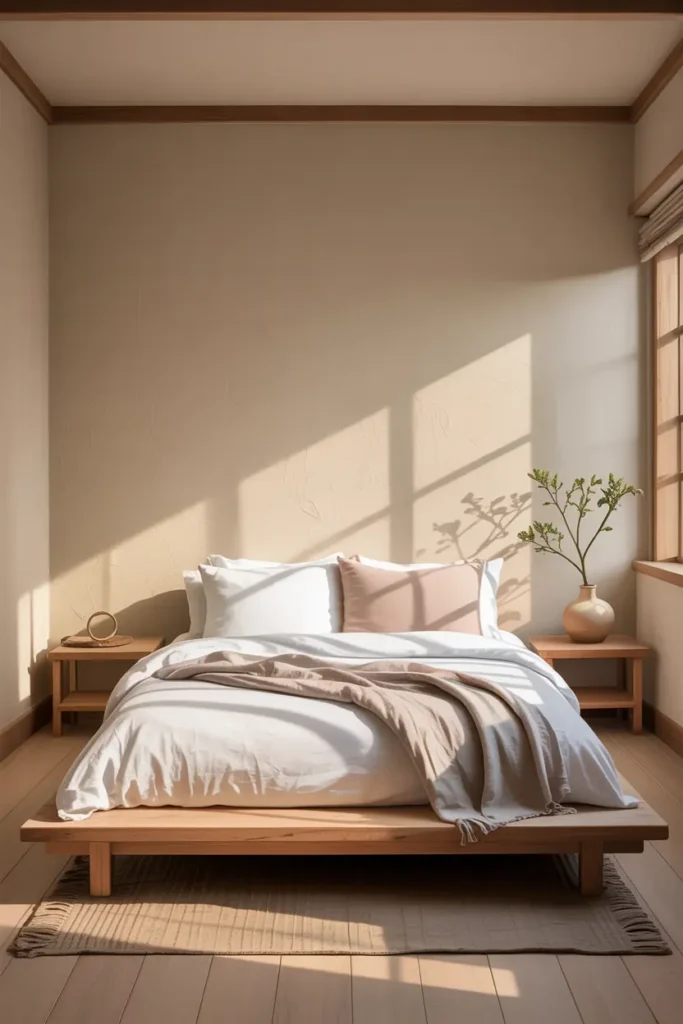
Limit the room to two neutrals: a warm white and one deeper tone — soft taupe, warm greige, or pale clay. Two is a discipline, not a suggestion. With two neutrals, the room has a quiet rhythm: light walls, slightly deeper floor or bedding, and the eye moves between them without effort. Add a third and the rhythm becomes noise, especially in a small room where every color is unavoidable.
Choose your deeper tone for how it behaves at 7am, not at noon. Bedrooms are morning rooms. Hold the swatch up in the first light of day — that’s the light you’ll actually live with. Warm taupes glow gently in morning sun; cool grays can turn flat and lifeless before 9am. And keep the ceiling the warm white, always: a tinted ceiling in a small room lowers it visually, while white lifts.
2. Low Profile Bed Design
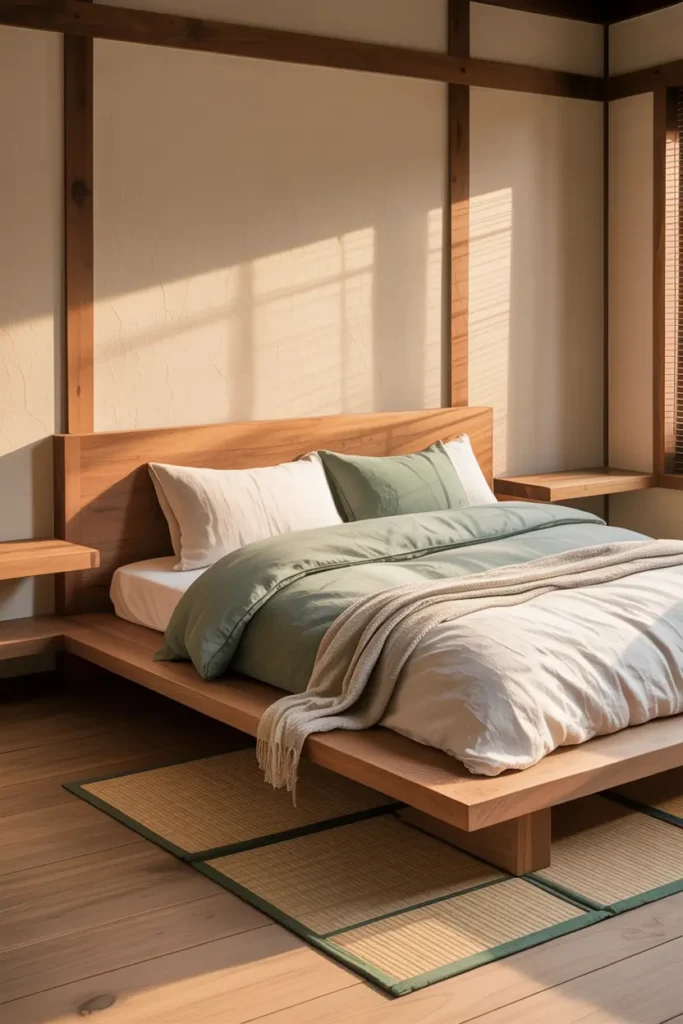
The low bed comes straight from the Japanese futon tradition, where sleeping close to the floor is about groundedness — physical and otherwise. A platform 10 to 14 inches high changes the room’s proportions: more wall shows above the bed, the ceiling feels higher, and the whole space settles downward into calm. It’s the opposite of a tall sleigh bed, which dominates a small room like a monument.
If you want to go further toward the tradition, a shikibuton on a low slatted base is the real thing — a cotton futon mattress ($200 to $400) that can be aired and folded, freeing the entire floor during the day. It’s firmer than Western mattresses, which some backs love and others don’t; try one in a store before committing. Either way, skip the box spring. The low, honest platform is the point — nothing hidden, nothing towering, just the bed at the height of rest.
3. Natural Wood Accents
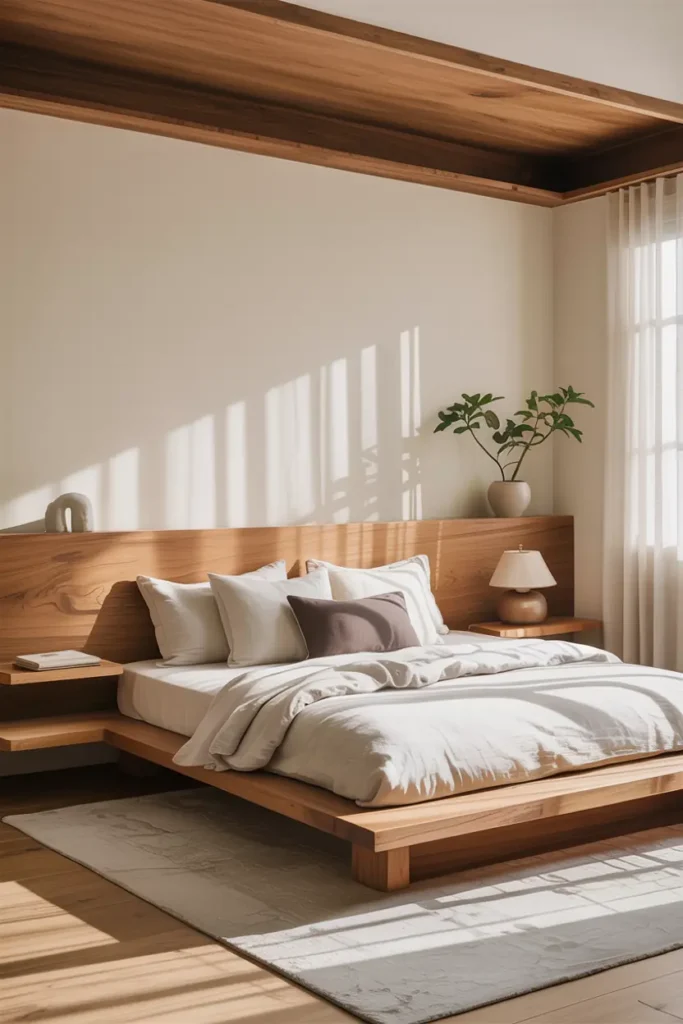
Wood in a Japandi bedroom should look like it grew, not like it was manufactured. Choose one species and let its character show: oak with visible grain, or walnut if you want deeper warmth. The finish should be matte oil or wax — something you could theoretically repair with sandpaper and an afternoon, not a plastic-feeling lacquer that chips and can’t be fixed. Honest materials age gracefully; dishonest ones just look tired.
Place wood where your hands go: the bed frame you touch getting in, the nightstand you reach for at night, the small stool or tray that holds your book. These contact points are where the material’s warmth actually registers — a wooden object across the room is decoration, but wood under your hand is experience. Two or three wooden pieces in one species is the complete program. The restraint is what makes each piece feel chosen.
4. Minimal Furniture Approach

Every piece of furniture in a small Japandi bedroom must pass a single test: does it serve sleep, dressing, or genuine rest? The bed serves sleep. One nightstand serves the lamp and the book. A low dresser or a simple wardrobe serves dressing. That’s the complete inventory for most rooms. The accent chair fails the test in nine bedrooms out of ten — it becomes a clothing rack within a week, and a clothing rack is clutter with good PR.
When you’re deciding what stays, use the morning test from the opening: stand in the doorway, look in, and ask what each piece is saying at 7am. If a piece’s message is “deal with me later” — the unfolded laundry chair, the overflowing hamper, the desk covered in yesterday — it’s working against the room. Either give it a closed home (inside the wardrobe, behind a door) or let it go. In Japandi, what you remove matters more than what you keep.
5. Soft Textured Bedding
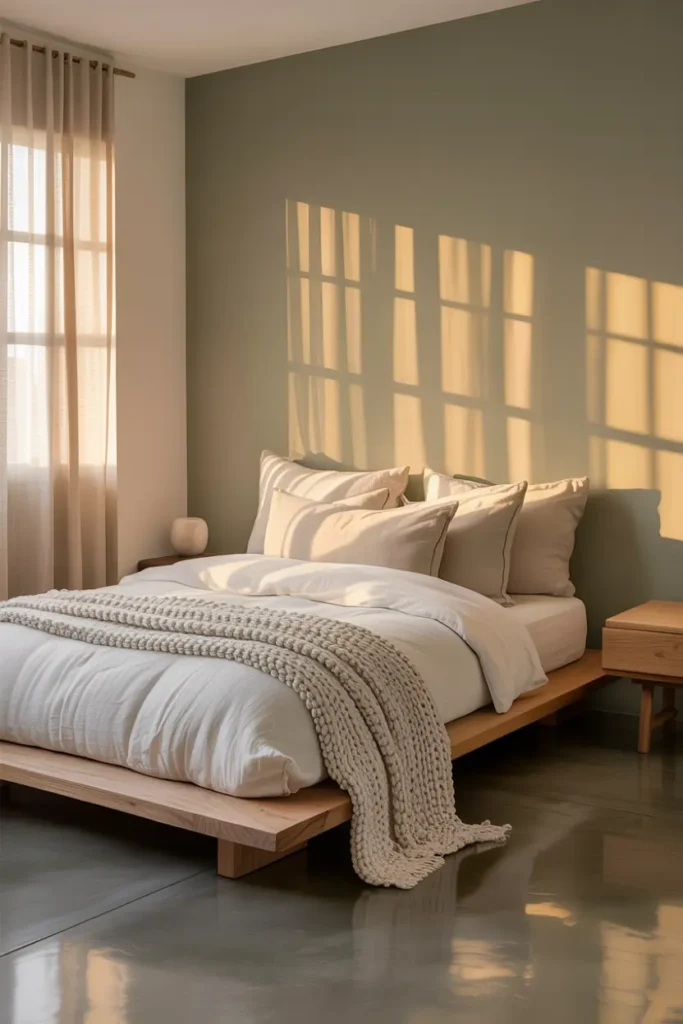
Forget thread count — it’s a marketing number that tells you almost nothing about comfort. What matters is fiber and weave: washed linen or a linen-cotton blend for the duvet cover, percale or washed cotton for sheets. Linen’s slightly irregular texture is the whole point here; it catches morning light beautifully and feels alive under your hands in a way that sateen’s uniform smoothness doesn’t. It also gets better for years instead of wearing out.
Weight matters as much as fabric. An all-season duvet around 10.5 tog (or 200-250 GSM) handles most climates without the summer-winter swap, and a single folded quilt at the foot adds the layered look without overheating anyone. Keep it to three layers total and two pillows per sleeper plus one accent at most. A bed buried in pillows isn’t luxurious in a small room — it’s a nightly chore of stacking and unstacking, and chores are the opposite of calm.
6. Warm Ambient Lighting
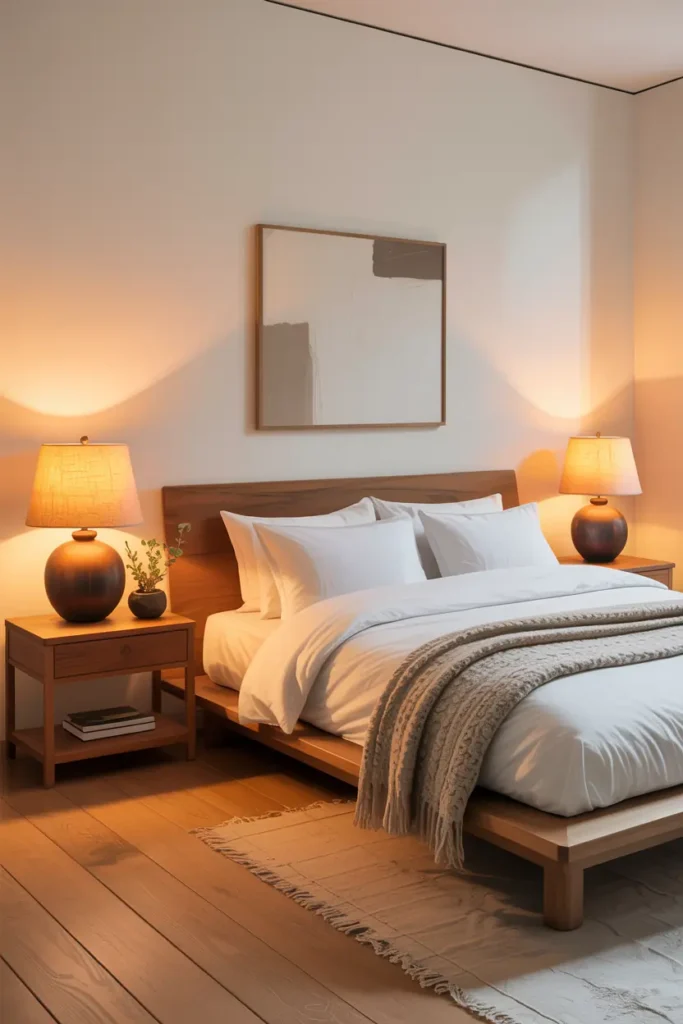
Light is the most powerful calm-maker in the room, and it should follow your circadian rhythm, not fight it. Mornings want bright, warm light — open the curtains fully, let the daylight in. Evenings want the opposite: low, warm pools of light that signal your body to wind down. Smart bulbs ($12 to $15 each) can automate this — bright 2700K at 7am, dimming to a deep warm glow by 10pm — so the room literally guides your day.
The fixtures themselves should disappear into the calm: a rice-paper pendant that glows like a lantern, a small ceramic table lamp with a fabric shade, nothing with visible harsh bulbs. And the overhead — if your room has a central ceiling fixture, consider it emergency lighting only. A bedroom lit from the ceiling feels interrogated; a bedroom lit from two low, warm sources feels held. Same room, same furniture, completely different nervous system response.
7. Simple Wall Decor

Borrow the tokonoma principle: in a traditional Japanese home, one alcove holds one beautiful object, changed with the seasons. Your bedroom wall gets the same treatment — one piece, chosen slowly, hung with intention. A single ink landscape, a textile hanging in natural fibers, one photograph that actually means something. The emptiness around it isn’t wasted space; it’s the frame that makes the piece matter. This is ma in action.
Resist the gallery wall. In a large living room it can work; in a small bedroom it’s visual chatter competing with rest. If one piece feels too bare to you, the answer usually isn’t more art — it’s a larger single piece, or better lighting on the one you have. A picture light or a well-placed sconce turns a simple print into a focal point and adds to the evening glow at the same time. One thing, lit well, beats five things competing.
8. Open Space and Balance
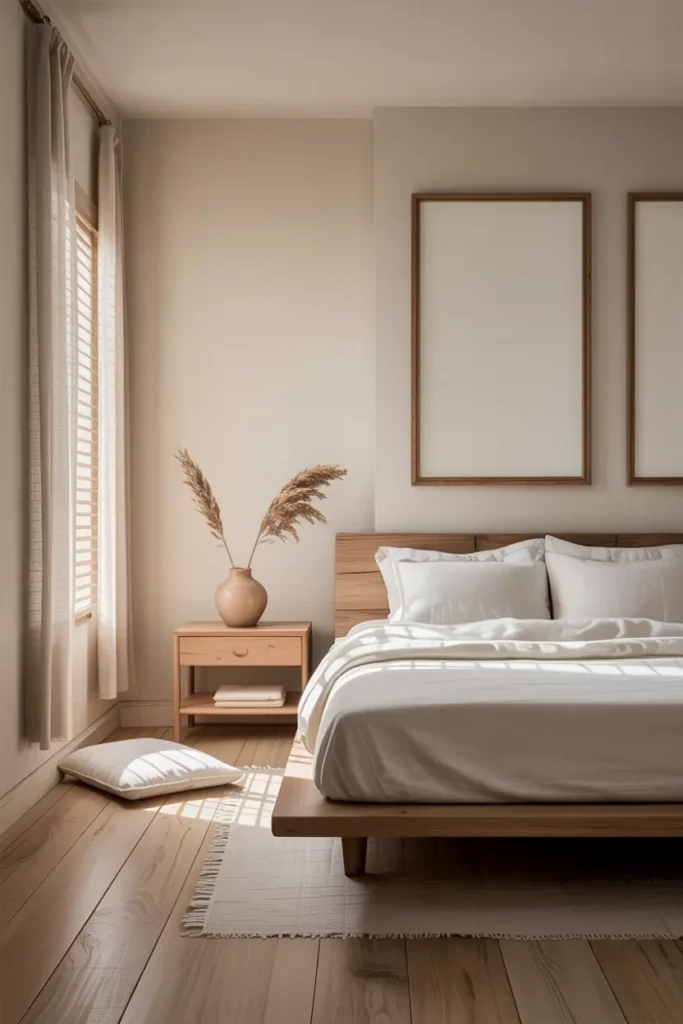
Here’s the rule that ties it all together: in a small Japandi bedroom, empty floor space is the luxury item. Aim to keep roughly half the floor visible and clear. That empty space isn’t “unused” — it’s the visual equivalent of silence, and it’s doing more for your sense of calm than any object could. Every time you’re tempted to fill a corner, remember that the corner is already full — full of the quiet you’re designing for.
Balance the weight you do have. If the bed sits left, the dresser or the art goes right; if the window is the bright anchor on one wall, the wood tones anchor the opposite. Walk the room’s perimeter in your mind and feel for lopsidedness — a small room that’s visually balanced feels settled and twice as calm as the same room with everything crowded to one side. Then stop. The discipline to stop is the final Japandi skill, and it’s the hardest one.
Final Note
A Japandi small bedroom isn’t a style you install — it’s a series of refusals: refusing the extra chair, the third color, the gallery wall, the harsh light. What’s left after the refusals is a room that shows you calm at 7am and asks nothing of you at 11pm. That’s not minimalism for its own sake. That’s design in service of rest.
Pro Tips
- Design for the doorway view. The sightline from your bedroom door is the room’s first impression, twice a day, every day. Arrange so the made bed — not the laundry — is what that view holds.
- Automate your light’s mood. A $15 smart bulb on a schedule (bright warm mornings, dim amber evenings) does more for your sleep quality than any single decor purchase.
- Touch-test your materials. Before buying, put your hand on it. Japandi lives in the tactile — if a fabric or finish doesn’t feel good under your fingers, it doesn’t belong, no matter how it photographs.
- Practice the seasonal swap. Twice a year, remove three things from the room and change one (the art, the throw, the object on the nightstand). The room stays fresh without accumulating.
FAQs
Isn’t this just minimalism with a Japanese name?
Minimalism says “less.” Japandi says “less, but warmer, more tactile, and more intentional.” A stark white minimalist box isn’t Japandi — without natural wood, honest textures, and that sense of wabi-sabi warmth, it’s just empty. The materials and the philosophy are what distinguish it.
How low should the bed actually be?
Platform top 10 to 14 inches off the floor is the sweet spot — low enough to change the room’s proportions, high enough for under-bed storage and easy cleaning. Below 10 inches, vacuuming underneath becomes miserable; above 14, you lose the grounded effect.
What if my partner doesn’t want “empty” walls?
Compromise on scale, not on principle: one larger shared piece instead of several small ones, or a single meaningful photograph in a beautiful frame. Most people who resist empty walls are actually resisting bare walls — one well-chosen, well-lit piece usually wins them over.
Can this work with kids or pets in the bedroom?
The washable neutrals and low furniture actually suit real life well — linen and low-pile wool handle wear gracefully. The main adjustment is storage: with kids or pets, hidden closed storage becomes even more essential, because the calm depends on surfaces staying clear.

HowDecor is a home decor blog sharing simple, practical decorating ideas for everyday spaces. We believe a beautiful home should feel comfortable, personal, and full of warmth — and that great style does not require a huge budget. Our goal is to inspire readers to create spaces that feel peaceful, welcoming, and truly their own — one room at a time.