Here’s a challenge: give me one Saturday, $300, and a bedroom you’re tired of looking at. By Sunday morning, it will feel like a different room — not because we renovated anything, but because bedroom upgrades follow a brutal 80/20 rule. A handful of changes deliver almost all the transformation; everything else is diminishing returns. Most people do the low-impact stuff first (new throw pillows) and never get to the moves that actually change how the room feels.
So this list is ordered by impact-per-dollar, highest first. Start at the top and work down as far as your Saturday takes you. Even the first three will change the room more than a full year of small tweaks.
1. Neutral Color Bedroom Base
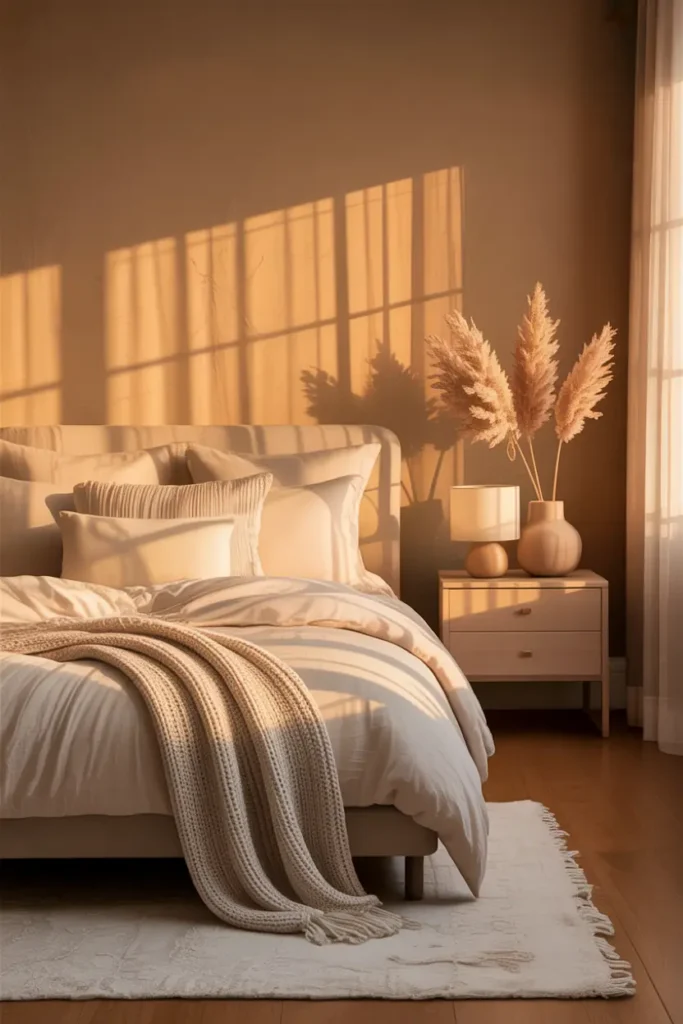
The highest-impact $40 you’ll ever spend on a bedroom is a gallon of paint on the wall behind your bed. Not the whole room — one wall, one Saturday morning, two coats. A warm greige or soft warm white on that single wall changes the room’s entire color temperature, and because it’s behind the bed, it’s the backdrop of everything. If even that’s too much commitment, the zero-dollar version works too: remove one colorful or clashing thing from the room and watch the neutrals you already own suddenly harmonize.
The reason neutrals upgrade instantly is that they hide a multitude of sins — mismatched furniture, different wood tones, hand-me-down pieces all calm down against a quiet backdrop. If your walls are already neutral but the room still feels off, the problem is usually undertone clash (a cool gray wall with warm beige bedding). Fix it with textiles in the wall’s undertone family rather than repainting: $60 in new pillowcases beats $200 in paint and primer.
2. Layered Bedding Style
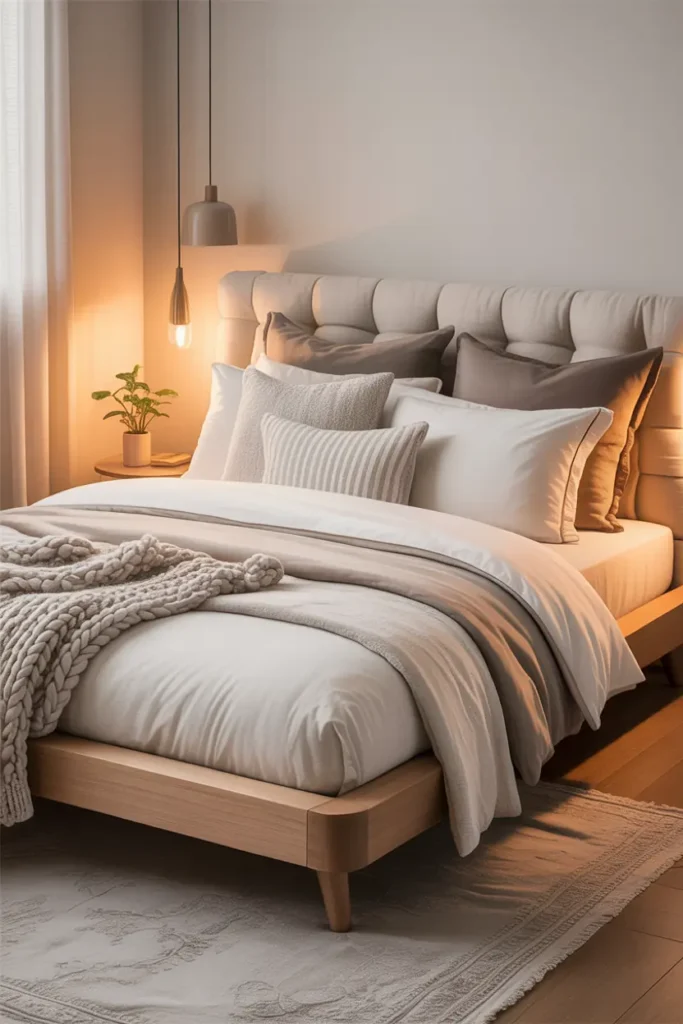
The bed is the largest thing in the room, so it’s upgrade number two — and you don’t need new bedding, just a new method. Strip the bed completely and rebuild it: fitted sheet, flat sheet, duvet, then fold the top 18 inches of the duvet back over itself to reveal the sheet beneath. Add sleeping pillows upright against the headboard, two shams in front, and one throw folded in thirds across the foot. That fold-back and that throw are the two moves that separate “made bed” from “designed bed,” and they cost nothing.
If you are buying one thing, make it a textured throw in a tone slightly deeper than your duvet — a waffle weave, a chunky knit, a washed linen, around $40 to $60. Texture is what the eye reads as luxury, not thread count. And here’s the maintenance trick that keeps it looking upgraded: remake just the top third of the bed every morning (smooth the duvet, refluff the shams, straighten the throw). Ninety seconds, and the room looks intentional all day.
3. Statement Headboard Look
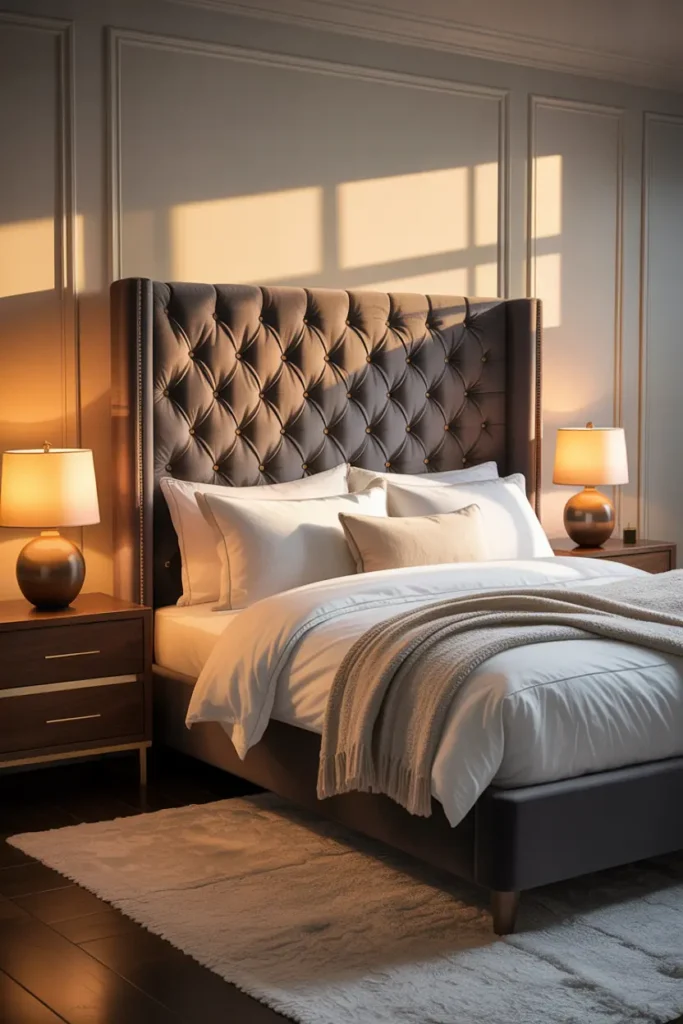
No headboard is the single most “unfinished” look in a bedroom — the bed just floats against the wall like it’s waiting for the rest of the furniture to arrive. The fastest fix is an upholstered headboard panel: wall-mounted, 48 to 54 inches tall, in a neutral performance fabric. Online retailers sell them for $120 to $200, installation is four screws into studs, and the transformation is disproportionate to the effort. It gives the bed a backbone and the wall a focal point in one move.
The $20 alternative is a painted arch: painter’s tape, a quart of paint in a tone deeper than your wall, and a half-circle behind the bed. It takes an afternoon including drying time, and it creates the visual effect of a headboard — a defined zone, a color anchor — for the price of lunch. Either option beats the most common mistake, which is a headboard that’s too short: anything under 48 inches tall disappears behind pillows and might as well not exist.
4. Soft Lighting Upgrade
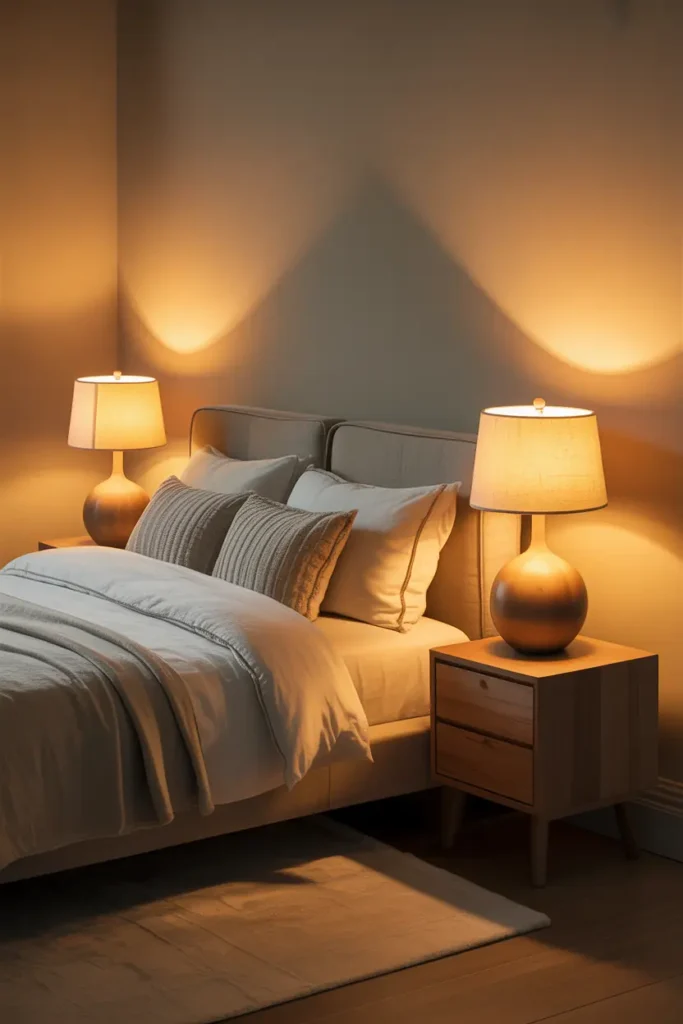
Before you buy a single lamp, do the $20 bulb swap: replace every bulb in the bedroom with 2700K warm white, and make the bedside bulbs dimmable. Most bedrooms are lit like offices — cool, bright, overhead — and no amount of decor overcomes bad light. Warm bulbs alone will make your existing furniture look better; it’s the closest thing to a filter for real life.
Then kill the overhead habit. A bedroom needs light at human height: matching bedside lamps with fabric shades (thrift stores are full of great lamp bases for $10 to $15 — just add new shades), or plug-in wall sconces if nightstands are small. Put them on plug-in dimmers ($12 each). The formula is simple: overhead off, lamps on, dimmed low. Do this on Saturday evening and stand in the doorway — the room will feel like it doubled in expensiveness.
5. Minimal Wall Art
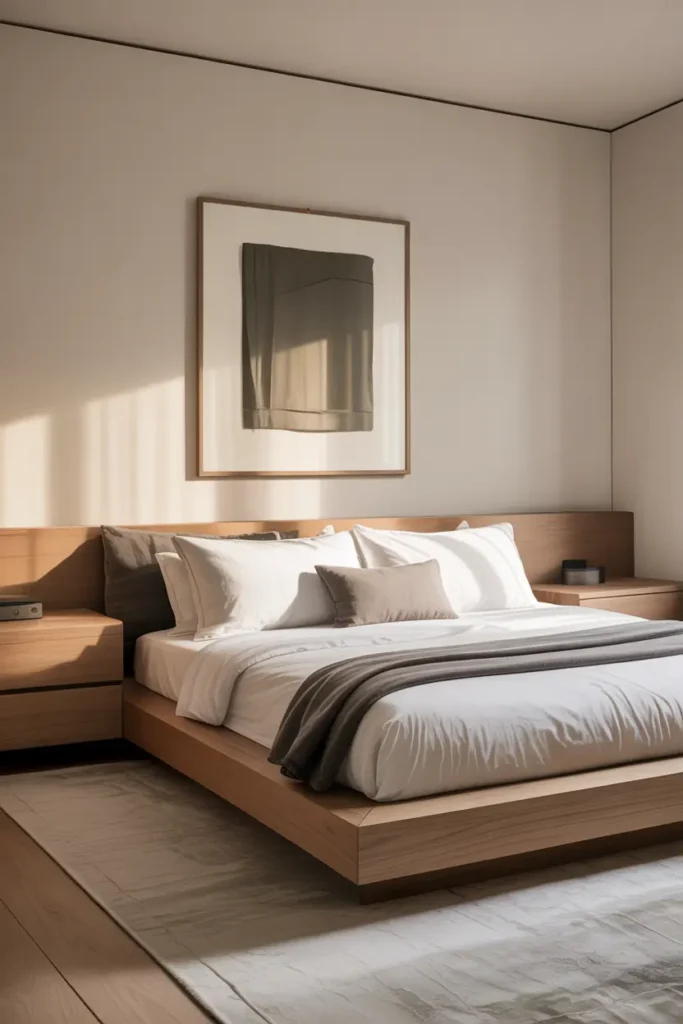
Bare walls are the difference between “bedroom” and “finished bedroom,” and the fix is cheaper than you think. One large piece over the bed — roughly two-thirds the width of the headboard — or a matching pair, and you’re done. The budget move: print one of your own photos large. A 20×30 print at a local print shop costs around $25 to $35, and a personal photograph in a simple frame beats generic art every time because it actually means something.
Frame it properly, because framing is where cheap art looks expensive: a thin black or natural wood frame with a real mat (2 to 3 inches of white space around the image). Thrift stores sell solid wood frames for a few dollars — pop out someone else’s print, cut a mat to fit yours. Hang the center at 57 to 60 inches. One well-framed, well-placed piece finishes a wall; five small random frames just decorate the anxiety.
6. Bedside Table Styling
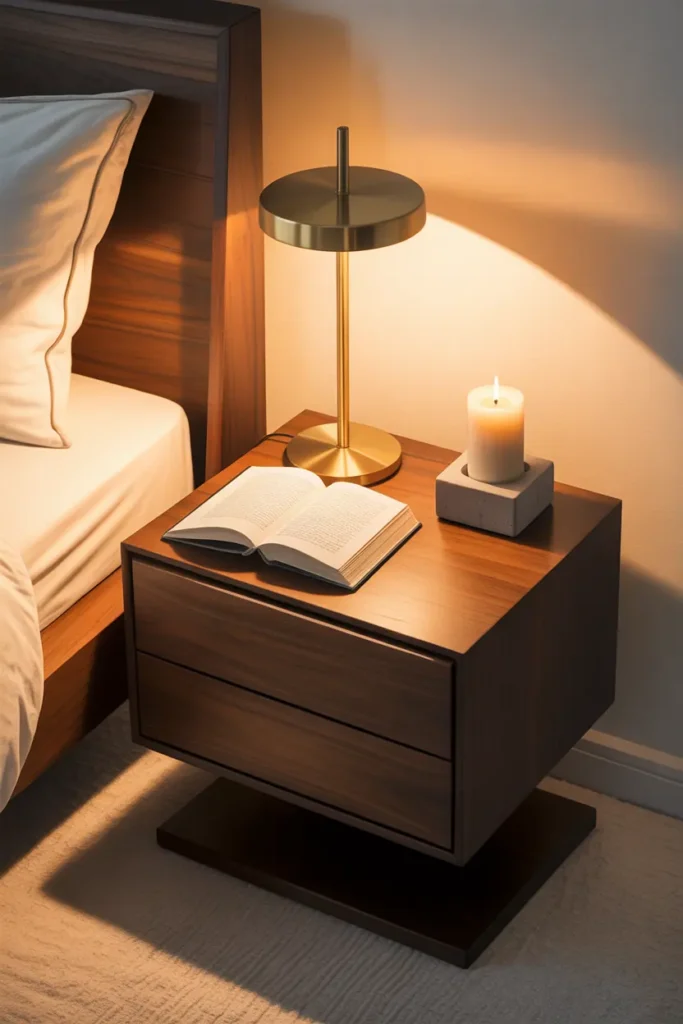
Clear it completely first — every single thing off. Then add back exactly three: the lamp, the book you’re actually reading, and one small personal thing (a candle, a small plant, a framed photo). That’s the formula, and the reason it works is that a clear nightstand is what your eyes land on first thing in the morning and last thing at night. Clutter there sets the tone for the whole day; calm there does the opposite.
Corral the functional mess with one tray or small box: charger, lip balm, glasses, medication — everything that needs to be within reach but doesn’t need to be seen. A $15 tray turns a scattered surface into an arrangement. And if your nightstand has no drawer, a small lidded box does the same job. The goal isn’t minimalism as a lifestyle; it’s a surface that looks calm at 11pm when you’re tired, which is when it matters.
7. Area Rug Comfort
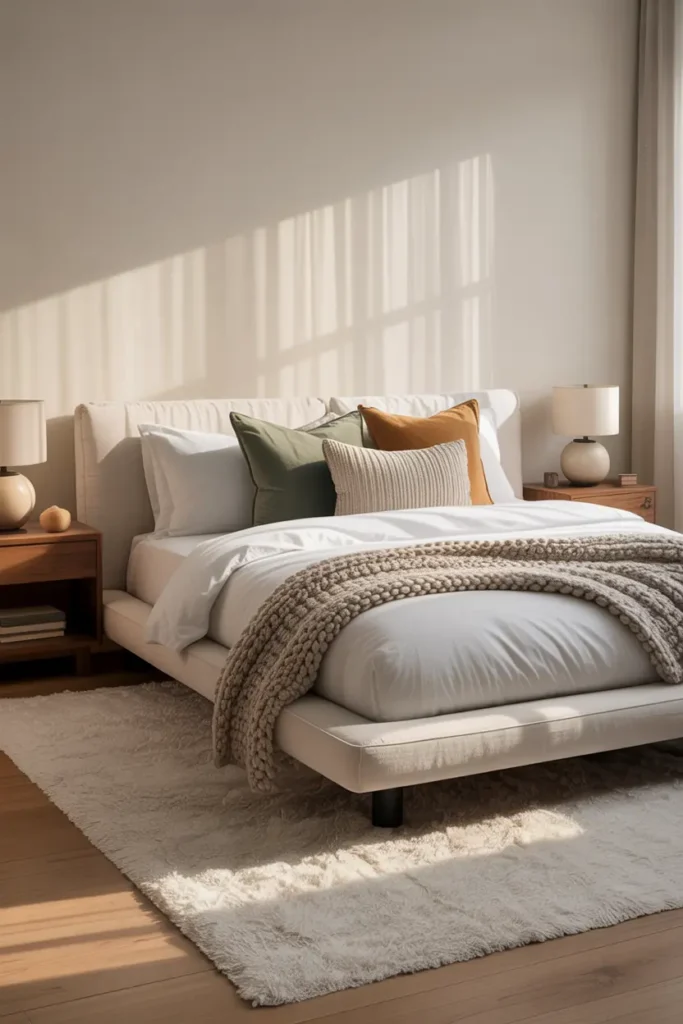
A rug under the bed is the difference between furniture sitting in a room and furniture belonging to a room. For a queen, that’s 8×10 feet — big enough that the nightstands sit on it and it extends 18 to 24 inches beyond the bed’s sides. Yes, it’s the most expensive item on this list ($150 to $300 for a decent one), and yes, it’s worth it: it warms the room acoustically and visually, protects the floor, and makes the bed look anchored instead of floating.
Can’t swing 8×10? Two runners (2.5×8 feet each), one on each side of the bed, deliver 80% of the comfort where your feet actually land for under $100 total. Choose a low-pile, washable option in a tone close to your bedding — the rug should support the palette, not introduce a new one. And always add a rug pad: it stops slipping, adds cushion, and makes a $150 rug feel like a $400 one.
8. Curtains That Elevate

Bad curtains — too short, too narrow, hung at the frame — make even nice rooms look unfinished. The fix follows three numbers: rod 4 to 6 inches above the window frame, 8 to 12 inches wider on each side, and panels twice as wide as the rod for fullness. This makes windows look larger, ceilings look higher, and light filter beautifully. It’s a $60 to $100 transformation (rod plus two panels) that changes the room’s architecture without touching a wall.
Fabric choice: a linen blend in warm white or natural. It filters light into a soft glow, never looks heavy, and works with every neutral palette. Hem them to just kiss the floor — puddling looks romantic but collects dust, and floating an inch above looks like a measuring error. Steam out the packaging wrinkles after hanging; ten minutes with a handheld steamer, and they hang like they cost three times more.
9. Decluttered Clean Look
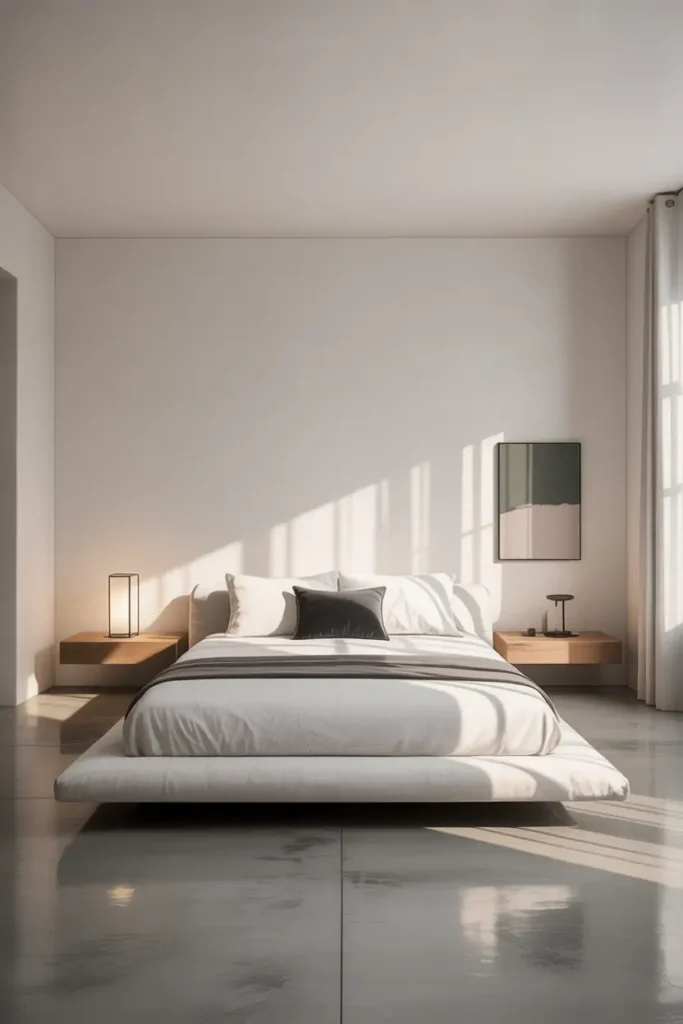
Do the box method: grab a box, set a timer for 20 minutes, and remove everything from the bedroom that doesn’t belong there — the chair with clean-ish clothes, the stack of unread mail, the exercise equipment, the “I’ll deal with it later” pile. Don’t organize it; just get it out. You’ll be shocked how much of what you thought was “the room” was actually just stuff in the room.
Then apply the one-in-one-out rule going forward: anything new that enters the bedroom means something leaves. Bedrooms accumulate clutter because they’re private — nobody sees it but you, so standards slip. But you’re the one who sleeps there, which means you’re the one who deserves the calm. A decluttered bedroom doesn’t just look bigger; sleep researchers consistently find people rest better in tidy rooms. This upgrade is free and it pays off every single night.
10. Personal Touch Accent
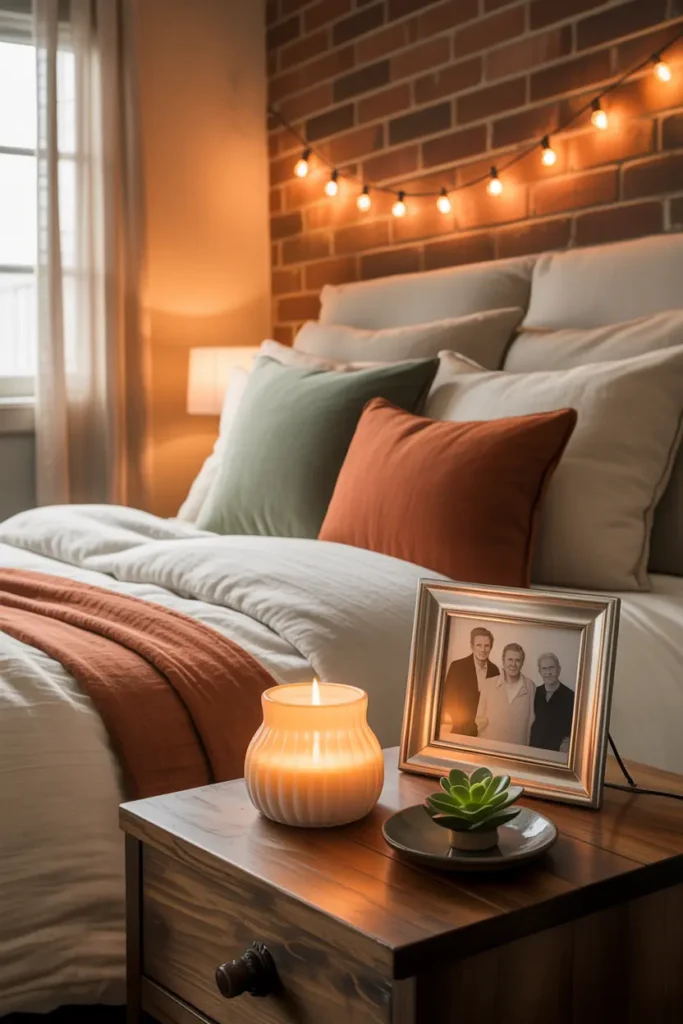
The final 5%: one thing that’s unmistakably yours. A framed photo from a trip that mattered, the book you’re reading with a beautiful cover, a candle in a scent that means “evening” to you. One thing, placed deliberately, where you’ll see it. This is what separates a styled room from a showroom — evidence that a specific person lives here.
Keep it to one or two objects, because the personal touch only works against a calm background. Ten personal objects is a memory shelf; one is a statement. And make it sensory if you can: the right scent (a candle or diffuser in cedar, linen, or fig) does more for the “upgraded” feeling than any object, because smell bypasses the visual brain entirely and goes straight to emotion. Light it at 9pm. That’s the room telling you the day is done.
Final Note
Start at the top of this list and work down. Paint or bulbs on Saturday morning, bedding and lighting by afternoon, art and styling by evening — and by Sunday you’re waking up in a room that feels new. None of it required a renovation. All of it required deciding the room was worth the Saturday.
Pro Tips
- Work in impact order. Paint, bulbs, bedding, headboard, lighting, art — in that sequence. Don’t buy throw pillows before you’ve fixed the light; it’s like accessorizing before getting dressed.
- The $20 bulb swap comes before everything decorative. Every bulb in the room to 2700K warm white. Nothing you buy will look right under bad light.
- Photograph before you start. Take a doorway photo Saturday morning. When you’re tired at 4pm and can’t tell if anything changed, the before-and-after will keep you going.
- One wall of paint beats a room of accessories. If you only do one thing from this list, paint the wall behind the bed. A $40 gallon outperforms $400 of decor.
FAQs
What’s the fastest bedroom upgrade if I only have one hour?
Remake the bed properly (the fold-back method), clear both nightstands down to three items each, and swap every bulb to 2700K warm white. One hour, nearly zero cost, and the room will feel dramatically calmer tonight.
How much should a weekend bedroom refresh cost?
A meaningful refresh runs $150 to $300: paint ($40), bulbs ($20), a throw ($50), curtain rod and panels ($80), and frames or a print ($40). The rug is the one big-ticket item — add $150 to $300 if you include it, or use runners for under $100.
Should I paint all four walls or just one?
Just the one behind the bed, in most cases. One accent wall gives you the color impact with a quarter of the work and paint, and it’s the easiest to redo if you change your mind. Four walls is a bigger commitment for a marginally bigger payoff.
How do I keep the room looking upgraded after the weekend?
The 90-second morning reset: smooth the duvet, refluff the pillows, straighten the throw, clear the nightstand. And the one-in-one-out rule for anything new entering the room. Upgrades fade through accumulation, not time — stay ahead of the clutter and the room stays new.

HowDecor is a home decor blog sharing simple, practical decorating ideas for everyday spaces. We believe a beautiful home should feel comfortable, personal, and full of warmth — and that great style does not require a huge budget. Our goal is to inspire readers to create spaces that feel peaceful, welcoming, and truly their own — one room at a time.