Let’s talk real numbers, because “budget decor” advice is useless without them. The living room refresh below costs between $0 and about $150 total — I’ve priced every idea the way you’d actually buy it: thrift stores, discount retailers, and the stuff already in your house. No $400 “budget” rugs, no sponsored links disguised as tips. And the order matters: we start with free, because the best budget decorator I know always spends the $0 ideas first and is often surprised how far they go.
One principle runs through all eight: spend money only on what the camera — and your guests — actually notice. That’s textiles, light, and surfaces. Nobody has ever walked into a living room and complimented the expensive side table. Everybody notices the lighting.
1. Neutral Cushion Refresh
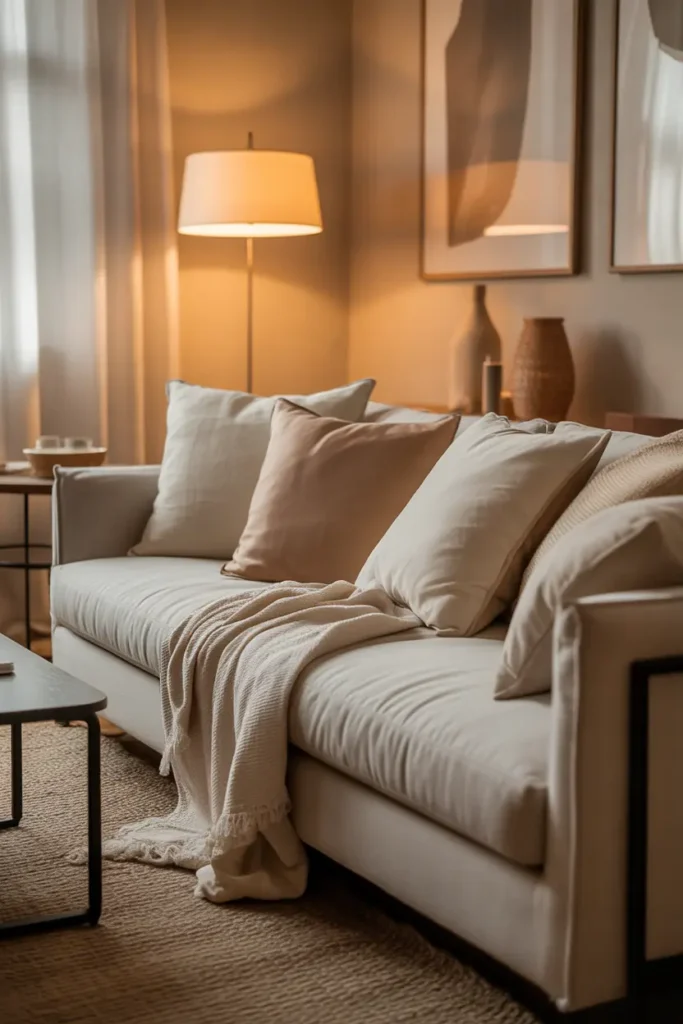
New cushion covers are the highest-impact $30 in home decor. A set of four 18×18 covers in a neutral linen-look fabric runs $25 to $35 online — compare that to $200+ for a new set of cushions, when your existing inserts are perfectly fine. (Check first: unzip a cushion; if the insert springs back when squeezed, it’s reusable. Only replace inserts that stay flat.) Stick to two or three tones in the same family — say, oatmeal, warm gray, and cream — and the sofa looks intentional instead of tired.
The formula that always works: two solid covers, one with subtle texture (a waffle weave or slub), in descending sizes from back to front — 20-inch behind, 18-inch in front. Skip the tiny 12-inch accent pillows; they look fussy and cost nearly as much as the big ones. And wash the covers before you judge the color — cotton and linen covers often arrive looking flat and bloom after one wash. This is a 20-minute, $30 transformation. Do it first.
2. Rearranged Furniture Layout
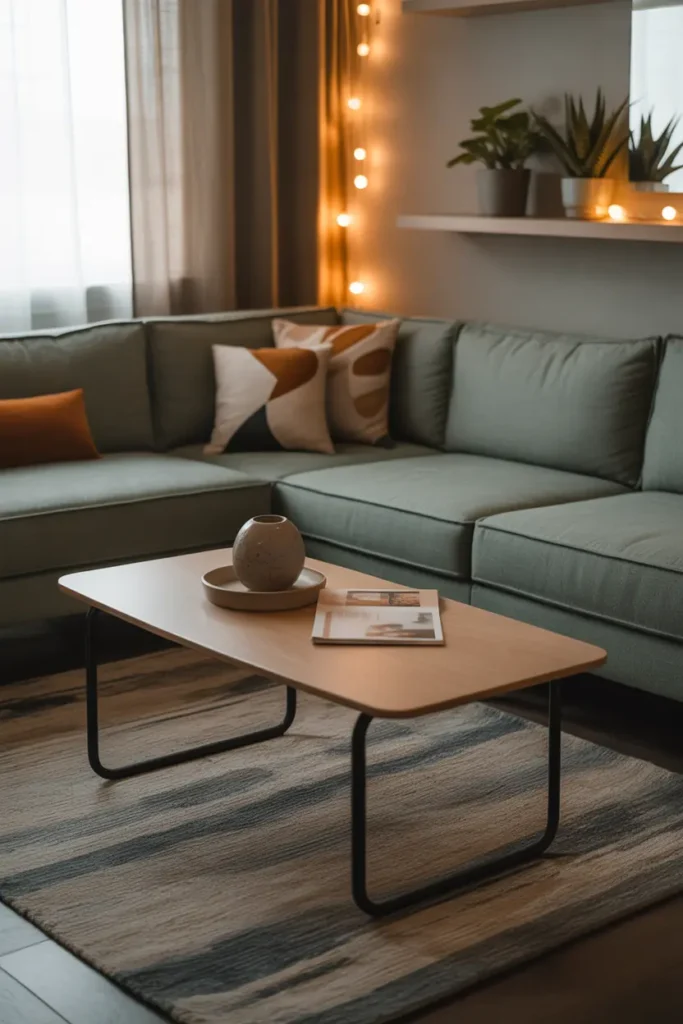
Free, and often more transformative than anything you can buy. The method: pick your focal point first (usually the largest window, the fireplace, or the TV wall — be honest about which one your household actually faces), then arrange seating to face it. Most living rooms are arranged around the walls out of habit, not design; pulling the sofa even 12 inches off the wall and angling one chair creates a conversation zone that feels deliberate.
Protect 36 inches of walkway on the main traffic path — measure it, don’t eyeball it, because “feels fine” while you’re moving furniture always turns out to be 28 inches by evening. Try the float: move the sofa off the wall entirely, with a narrow console behind it if you have one. It sounds counterintuitive in a small room, but floating the main piece creates walkways on both sides and the room breathes. Take a photo from the doorway after each arrangement. The camera doesn’t lie about flow the way tired eyes do.
3. Simple Wall Frame Decor
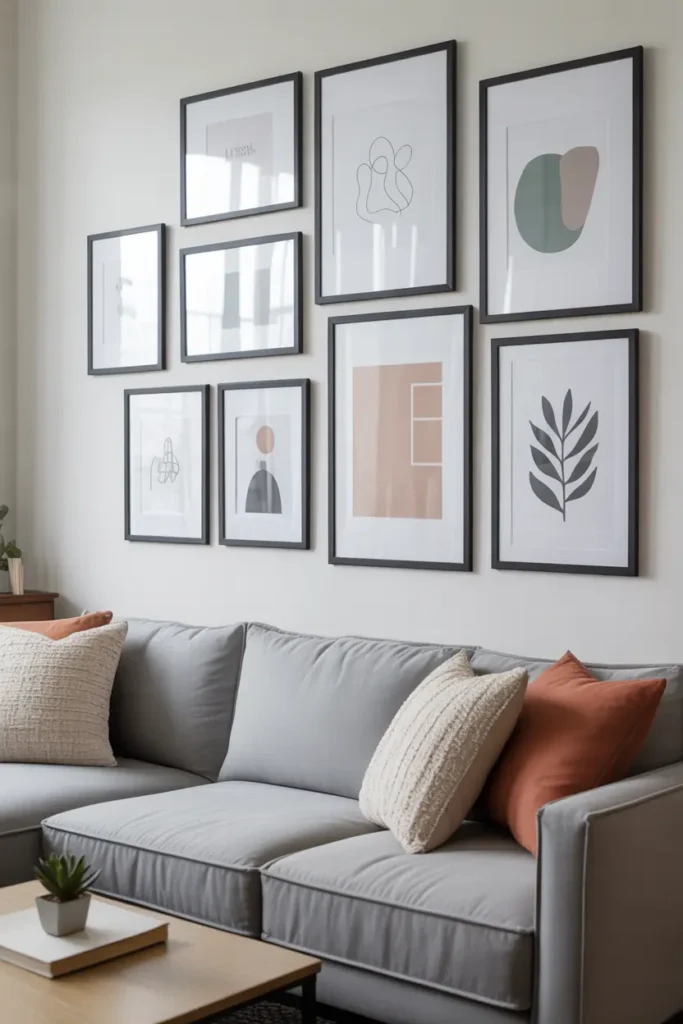
The $20 gallery wall is real, and it starts at the thrift store. Solid wood frames go for $2 to $5 each secondhand — look for real wood (heavy, with visible grain on the back) and ignore the art inside, which you’re replacing. A $6 can of matte black or warm white spray paint unifies mismatched frames completely; two light coats, dried between, and nobody can tell they came from four different decades.
For the art itself: print your own photos large (an 11×14 print costs a few dollars at any print shop), or print free public-domain art — museum collections have thousands of high-resolution downloads that cost nothing. The trick to a gallery that looks designed rather than random is the mat: cut simple white mats (pre-cut mats run $3 to $5) so every piece gets a breathing border. Uniform mats plus uniform frames equals a wall that looks like it cost hundreds. Total: under $25.
4. Mirror for Space Effect
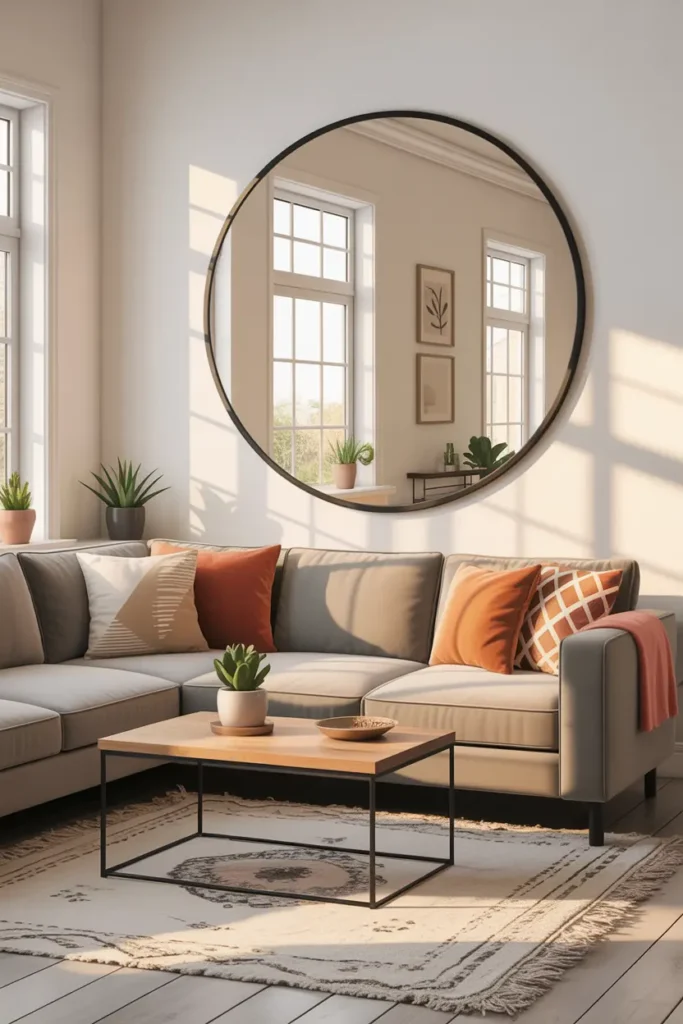
Thrift stores are mirror goldmines — large mirrors go for $15 to $30 because nobody wants to ship them, which is exactly why you should buy them in person. Look for a leaning floor mirror, 60 inches or taller; it needs no hanging hardware, moves room to room, and genuinely doubles the sense of space. Check the silvering by looking at it straight on — a few age spots are character, but large black patches mean the mirror is dying.
Placement is everything: across from the window, always, so it doubles your daylight instead of your blank wall. Behind the sofa works too if the sofa faces the window — the mirror catches the light over your shoulder. And here’s the free version most people miss: if you already own a mirror that’s doing nothing in a hallway, relocate it to the living room’s window wall. The best budget decor is the decor you already own, moved to where it works hardest.
5. Coffee Table Styling
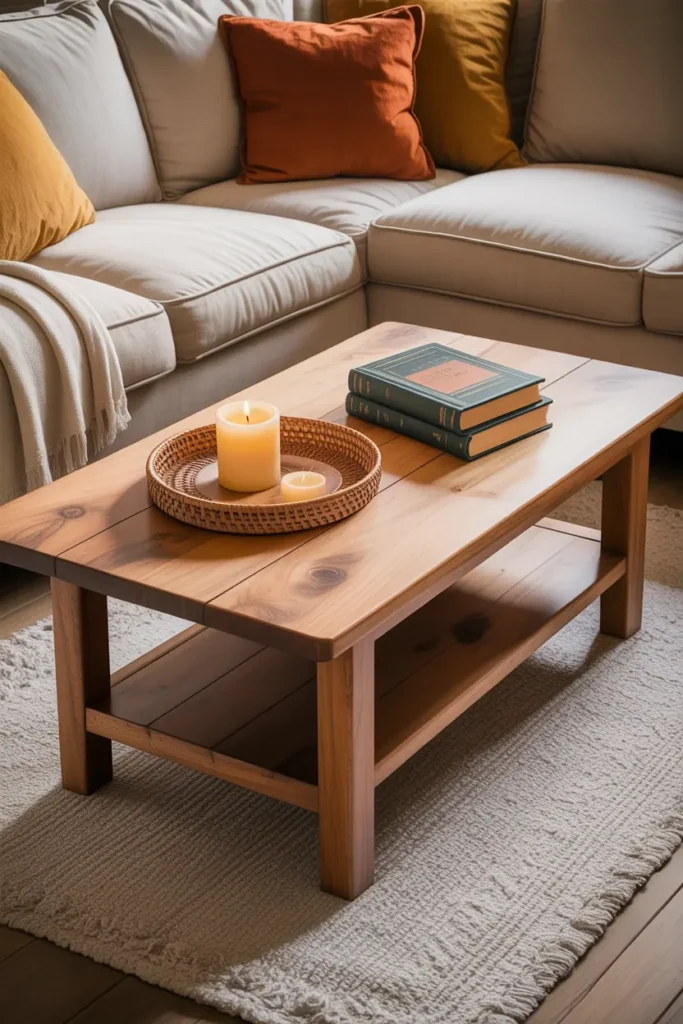
Before spending anything, clear the coffee table completely. Most coffee tables aren’t ugly — they’re just buried. Once clear, rebuild with the 3-2-1 formula: three books stacked (largest on bottom, spines aligned), two small objects of different heights, one living thing (a small plant or a candle). A $10 tray underneath corrals it all and makes the arrangement look deliberate while keeping the surface wipeable.
Shop your house first: books you actually own, a candle from the bathroom, the small plant from the windowsill that would love the light here. If you’re buying, one beautiful coffee-table book from a used bookstore ($8 to $12) beats three small trinkets every time — scale reads as luxury, clutter reads as the opposite. And leave some empty surface. A coffee table needs room for actual coffee; styling that prevents function isn’t styling, it’s a museum exhibit.
6. Soft Lighting Touch
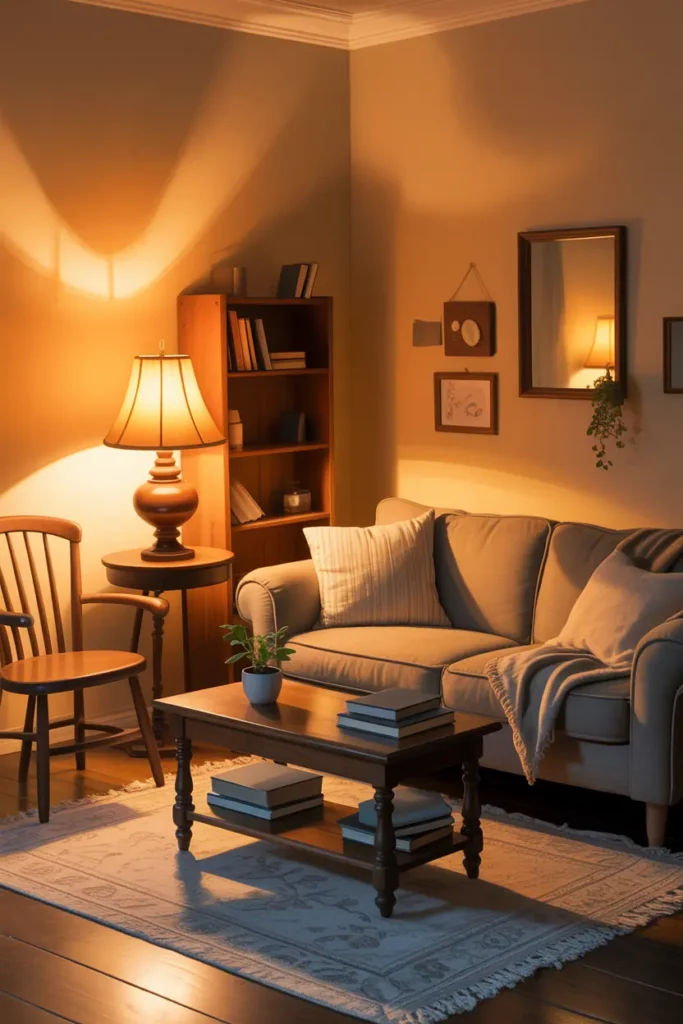
The $20 bulb swap, again, because it matters most here: every bulb in the living room to 2700K warm white. Living rooms suffer more than any other room from the standard rental setup — one cool ceiling fixture doing all the work. Warm bulbs alone will make your existing furniture and textiles look richer; it’s the single cheapest visual upgrade in this entire guide.
Then add one lamp, bought secondhand. Thrift stores sell solid lamp bases for $8 to $15 — look for heavy, stable bases and working sockets, and ignore ugly shades because you’re replacing the shade ($15 to $20 new, or $5 thrifted). A drum shade in white linen diffuses light beautifully. Place it where you sit in the evening, put it on a plug-in dimmer ($12), and you now have the three-source setup — overhead off, lamp on low, and maybe a $8 string of fairy lights in a jar — that makes every living room feel expensive after dark.
7. Floating Shelf Decor
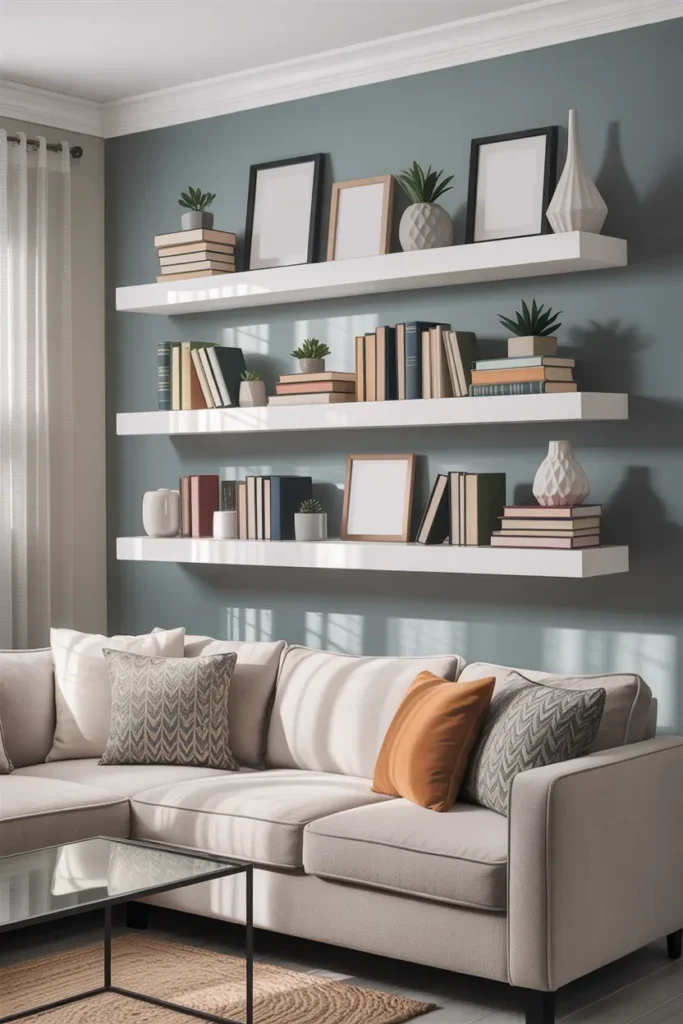
Two floating shelves ($15 to $25 each) on the emptiest wall do triple duty: storage, display, and the vertical interest that makes a room feel designed. Mount them with proper wall anchors into studs where possible — a shelf that sags or wobbles undoes the entire effect, and the right anchors cost $5. Stagger them rather than stacking directly: one at 60 inches, one at 72, offset by a foot. The asymmetry looks intentional; perfect symmetry looks installed.
Style with the 60-30-10 of shelving: 60% books (spines out, grouped by height), 30% one larger object per shelf (a vase, a framed photo, a basket), 10% empty space. The empty space is not optional — crammed shelves read as storage, while shelves with breathing room read as decor. A $4 thrifted vase with grocery-store eucalyptus ($5 a bunch, lasts two weeks) is the classic budget stylist’s move, and it works every time.
8. Rug for Cozy Feel
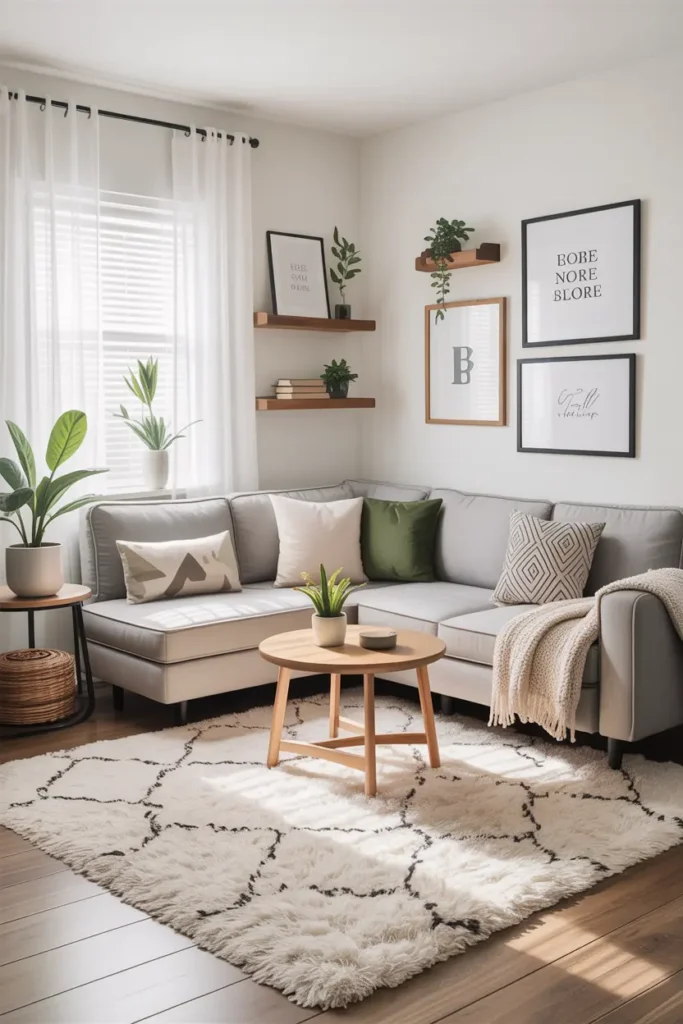
The rug is the one place where budget shoppers get burned: a too-small rug makes the whole room look off, and rugs are priced by size. The rule stands regardless of budget — big enough that front legs of all seating sit on it, which usually means 8×10 for a standard living room. The budget play is secondhand: estate sales and marketplace listings regularly have quality 8×10 wool rugs for $50 to $100, a tenth of retail. Check for stains in daylight, and budget $30 for a professional cleaning — still a fraction of new.
If secondhand isn’t available, a flatweave cotton or jute rug in 8×10 runs $80 to $150 new — less plush than wool, but honest and durable. Keep the color close to your sofa or your floor; the rug should unify, not announce. And always, always the rug pad ($40 to $60 for 8×10): it prevents the slipping that makes cheap rugs feel cheap, adds the cushion you’re missing, and doubles the rug’s life. A $100 rug on a good pad feels like a $300 rug. That’s not a metaphor — it’s physics.
Final Note
The whole refresh — covers, paint, frames, mirror, bulbs, lamp, shelves, rug with pad — lands between $150 and $300 if you thrift smart, and half of it was free. But here’s the real secret: the rooms that look expensive aren’t the ones where the most was spent. They’re the ones where every dollar went to something the eye actually sees — light, textiles, and clear surfaces — and nothing went to clutter. Spend where it shows. That’s the entire budget philosophy.
Pro Tips
- Spend in this order: free, light, textiles, surfaces. Rearrange first, then bulbs, then cushion covers and curtains, then frames and shelves. Never buy decor before you’ve done the free moves — you’ll buy the wrong things.
- Thrift the heavy stuff, buy the soft stuff new. Mirrors, frames, lamp bases, and shelves are better secondhand (cheaper, often better made). Cushion covers and rug pads are better new (hygiene and fit matter).
- One $6 can of spray paint unifies everything. Mismatched thrift frames, an ugly lamp base, a dated mirror frame — matte black or warm white spray paint makes them all look like a set. Two light coats, dry between.
- Photograph before you spend. A doorway photo shows you what guests see — usually it’s lighting and clutter, not furniture. Fix what the photo shows before opening your wallet.
FAQs
What’s the cheapest way to make my living room look better today?
Rearrange the furniture (free), remake the coffee table with the 3-2-1 formula using things you own (free), and swap every bulb to 2700K warm white ($20). Those three moves change the room more than $200 of new decor.
Where should I actually spend money vs. save?
Spend on: rug pad, decent bulbs, and one good textile (throw or covers). Save on: frames, mirrors, lamp bases, shelves, and books — all excellent secondhand. Never splurge on small decorative objects; scale beats trinkets every time.
How do I style shelves without them looking cluttered?
The 60-30-10 rule: 60% books, 30% one larger object per shelf, 10% deliberate empty space. If a shelf looks cluttered, the problem is almost always too many small objects — remove the three smallest things and reassess.
My living room is dark with one small window. What helps most?
A large mirror across from the window (thrifted, $15-30), the warmest bulbs you can find, and light-colored textiles. Don’t fight the darkness with more stuff — bounce what light you have and keep surfaces warm and reflective.

HowDecor is a home decor blog sharing simple, practical decorating ideas for everyday spaces. We believe a beautiful home should feel comfortable, personal, and full of warmth — and that great style does not require a huge budget. Our goal is to inspire readers to create spaces that feel peaceful, welcoming, and truly their own — one room at a time.