You spend roughly a third of your life in your bedroom, and your body keeps score of how that room treats you. Sleep researchers will tell you what decorators have always sensed: cool, dark, quiet, uncluttered rooms produce measurably better sleep. A cozy modern bedroom isn’t just a style preference — it’s a health decision you make with paint, fabric, and light.
These eight ideas build a bedroom around rest first and looks second — though the happy truth is that what helps you sleep also happens to look beautiful. Warmth, softness, darkness, and calm: that’s the whole recipe.
Idea 1: Colors That Lower Your Heart Rate

Color psychology isn’t mysticism — muted, desaturated tones genuinely reduce visual stimulation, which is what your brain needs to wind down. Choose bedroom colors with low saturation: warm greige, soft oatmeal, muted sage, dusty clay. These tones recede rather than demand attention, and in lamplight they glow instead of glaring.
Avoid high-contrast patterns and bright accent walls in the bedroom; save the energy for the living room. If you crave color, put it in the bedding or art — large wall areas should stay restful. The wall you face from bed matters most; make it the calmest surface in the room.
Idea 2: Bedding Layered Like You Mean It

The secret to a bed that looks inviting and sleeps perfectly is layers you can adjust: a fitted sheet, a light blanket or coverlet, a duvet, and a throw at the foot. Sleepers’ temperature needs change through the night, and layers let each person calibrate without fully waking. Choose natural fibers — cotton, linen — which breathe; synthetics trap heat and cause the 3 a.m. wake-up.
The cozy look comes from slight imperfection: a duvet turned down at the top, pillows slightly askew, the throw casually folded. A bed styled within an inch of its life looks unapproachable; a bed that looks slept-in-but-beautiful invites you in. Wash bedding weekly — clean sheets are the cheapest luxury that exists.
Idea 3: Light That Prepares You for Sleep

Your bedroom lighting should mimic sunset: warm, low, and dimming. Overhead lights blast 4000K+ daylight tones that tell your brain it’s noon; replace the habit with bedside lamps at 2700K or lower, ideally on dimmers. Dimming lights 30–60 minutes before bed measurably supports melatonin production — this is one of the few decor choices with real physiological impact.
Each sleeper needs their own bedside light with an individual switch — no more negotiating one lamp. Plug-in wall sconces save nightstand space and look intentional. And put the main overhead on a smart bulb or don’t use it at all after 8 p.m.; the evening bedroom should never be brightly lit.
Idea 4: Wood for Warmth You Can Feel

Natural wood does something in a bedroom that no other material manages: it reads as warm to both the eye and the touch. A wooden bed frame, nightstands, or even just a wooden bench at the foot of the bed grounds the room’s softness with something solid. Mid-tone woods — oak, walnut — work best; they’re warm without being heavy.
You don’t need much: two wooden nightstands and a wooden-framed mirror are enough to warm an entire bedroom. The grain’s irregularity is the point — in a room full of soft rectangles (bed, pillows, rug), wood grain is the natural pattern that keeps things from feeling sterile.
Idea 5: Art That Quiets the Mind
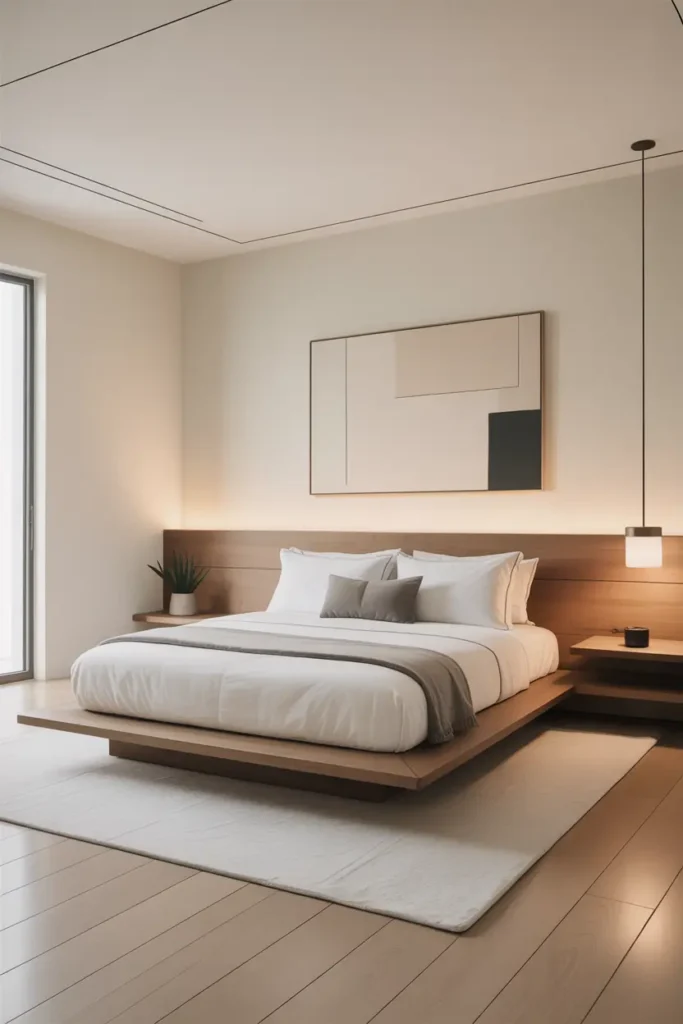
Bedroom art should be the visual equivalent of a deep breath: landscapes, abstracts in muted tones, soft photography. Avoid busy, high-contrast, or emotionally intense imagery where you sleep — your brain processes visual input even as you’re winding down. One calm piece above the bed or dresser is plenty.
Keep frames simple and the palette within the room’s tones. Oversized art works beautifully in bedrooms because it simplifies — one decision instead of many. And hang it where you’ll see it in the morning; the first thing your eyes land on sets the day’s tone.
Idea 6: A Corner for Slow Mornings
A bedroom earns the word “cozy” when there’s somewhere to be that’s not the bed: a small armchair by the window with a throw and a side table for tea. It doesn’t need to be large — even a 24-inch-wide chair creates the option of slow. Morning light, a book, ten unhurried minutes: this corner is where the bedroom stops being purely functional.
Face the chair toward the best view or light, not toward the bed or TV. Add a small lamp for evening reading so the corner works at both ends of the day. If space is truly tight, a wide window bench with cushions serves the same purpose.
Idea 7: Greenery for Cleaner-Feeling Air
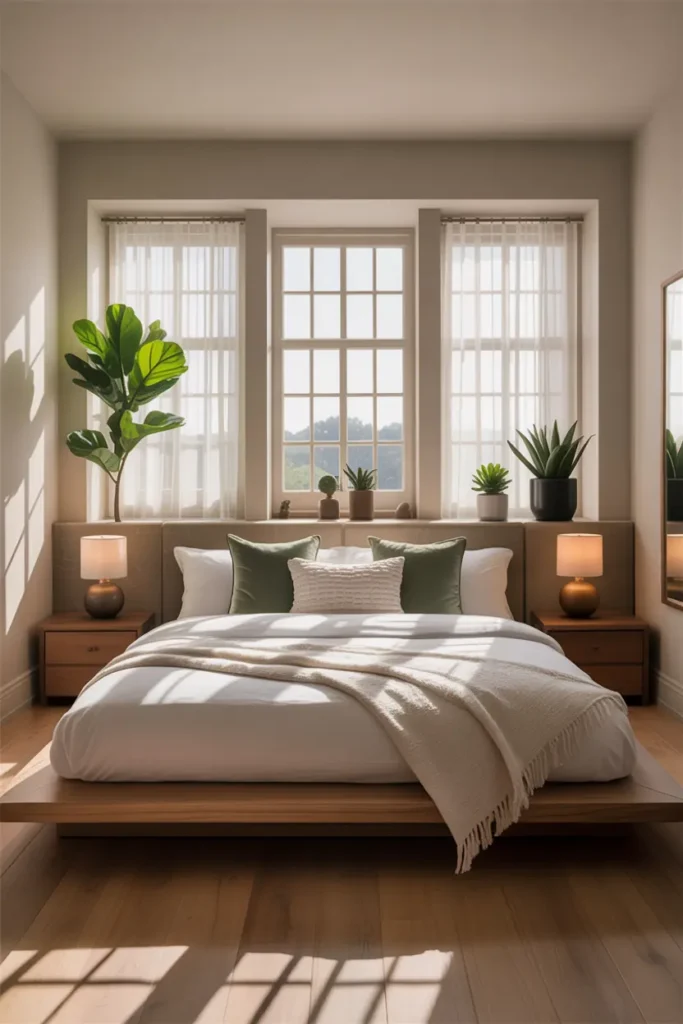
A plant in the bedroom does quiet psychological work: living things make rooms feel cared for, and cared-for rooms feel restful. Choose something undemanding — a snake plant, pothos, or ZZ plant — in a pot that matches the room’s palette. One medium plant on the dresser or a tall one in the corner is enough; this isn’t a greenhouse.
Keep plants away from the direct bedside if you’re scent-sensitive, and skip strongly fragrant flowers in the bedroom — scent is powerful at sleep time and not always welcome. Wipe leaves monthly; dusty plants look neglected and collect allergens.
Idea 8: Personal Touches, Sparingly
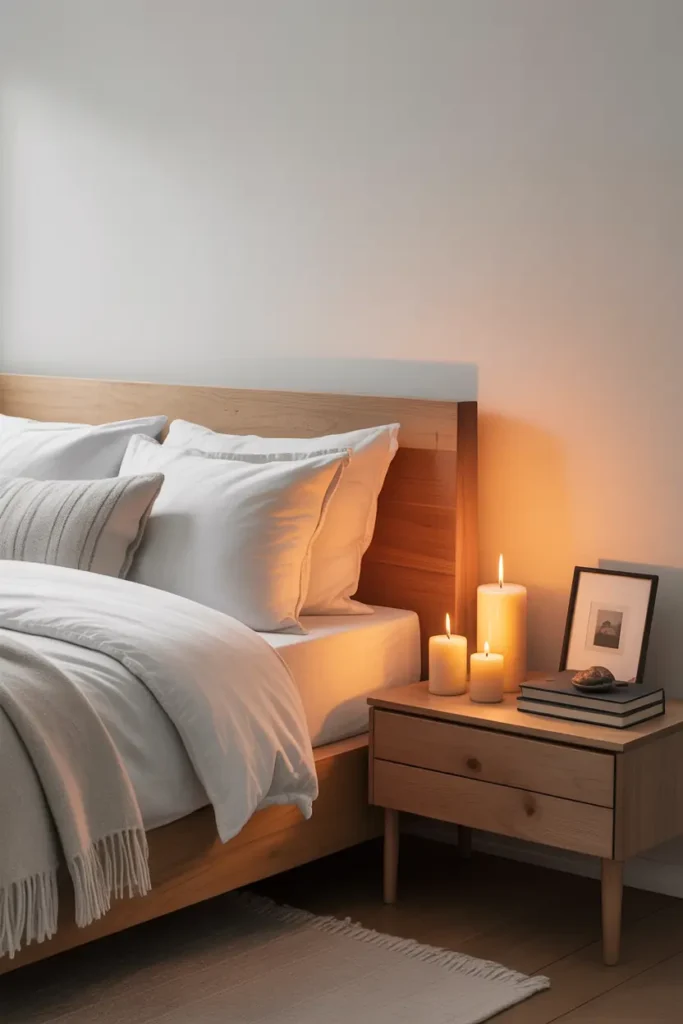
A cozy bedroom needs proof that a person lives there — but sleep needs calm, so keep it to a few. One framed photo that makes you happy, a candle you actually light, a book you’re actually reading, something from somewhere you’ve been. Four personal objects, tops, on visible surfaces. Everything else lives in drawers.
The test: stand in the doorway and count what catches your eye. If it’s more than five things, edit. Coziness comes from softness and warmth, not from density — a few meaningful objects in a calm room feel infinitely cozier than a room full of stuff.
Final Thought
A cozy modern bedroom is built from the senses outward: colors that recede, bedding you can adjust, light that dims like sunset, wood you can touch, and just enough of yourself on display. Design for sleep first, and the beauty follows on its own.
Pro Tips
- Keep the bedroom 2–3 degrees cooler than the rest of the house if you can — 65–68°F (18–20°C) is the sleep sweet spot, and bedding layers handle the rest.
- Charge your phone outside the bedroom or in a closed drawer. The single biggest upgrade to bedroom calm costs nothing.
- Wash your duvet cover and sheets weekly, pillows monthly. Clean bedding genuinely improves sleep quality — and it smells like care.
- Do a 5-minute nightly reset: throw in the hamper, surfaces cleared, tomorrow’s clothes laid out. Waking up to order is a gift to your morning self.
FAQs
What makes a bedroom feel cozy?
Layered soft textures (bedding, rug, throw, curtains), warm dimmable lighting, warm muted colors, and uncluttered surfaces. Coziness is softness plus warmth plus calm — remove any one and the feeling fades.
What is the best lighting for a bedroom?
Warm white (2700K or lower), layered and dimmable: bedside lamps or sconces per sleeper, plus low ambient light. Avoid overhead lighting in the evening — it suppresses melatonin and kills coziness.
How can I make a small bedroom cozy?
Small bedrooms cozy up naturally — lean in. Use the full wall for the bed, add layered bedding, one warm lamp, and a soft rug. Avoid pushing furniture against every wall; even 3 inches of breathing room helps.
Should bedrooms be minimalist?
Somewhat — visual calm supports sleep. But sterile isn’t restful either. Aim for “warm minimal”: clear surfaces, calm palette, plus a few personal objects and soft textures. Edit for calm, not for emptiness.

HowDecor is a home decor blog sharing simple, practical decorating ideas for everyday spaces. We believe a beautiful home should feel comfortable, personal, and full of warmth — and that great style does not require a huge budget. Our goal is to inspire readers to create spaces that feel peaceful, welcoming, and truly their own — one room at a time.