After fifteen years of designing kitchens, I can tell you the question I hear most: “Will I regret white?” Almost never, is my honest answer — but only if you get three decisions right. The shade of white, the countertop, and the lighting. Get those wrong and white looks cold and clinical. Get them right and you have a kitchen that still looks fresh when the kids leave for college.
These twenty ideas come from real kitchens I’ve planned and lived with — not showroom mock-ups. They cover every budget, from a £500 paint refresh to a full refit, and every one accounts for the part nobody talks about: white kitchens have to survive actual cooking, sticky hands, and the daily mess we all have to contend with.
1. All-White Shaker Cabinets with Warm Wood Accents
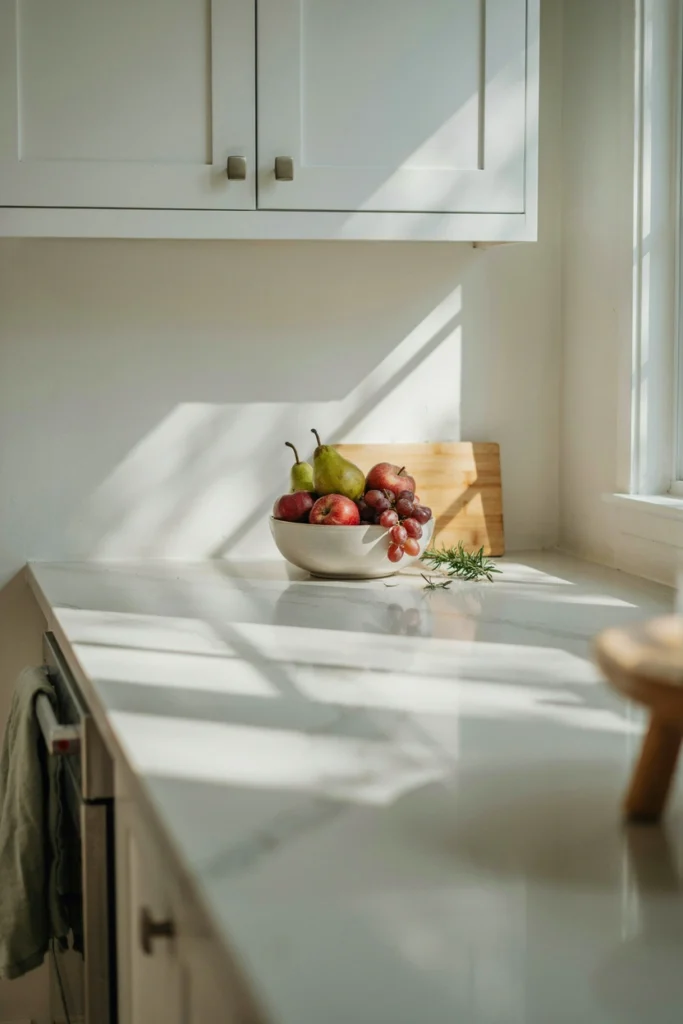
Shaker is the safest cabinet style ever made, and there’s a structural reason: the five-piece frame-and-panel door has real shadow lines, so it hides the tiny waves and ripples that make flat-front white doors look cheap after two years. Paint them in a warm white (think Farrow & Ball Wimborne White, not a blue-white) and they’ll stay calm for decades.
The trick is adding wood in exactly three places — never more. A chunk of butcher block beside the hob for chopping, two open oak shelves, and bar stools with wooden seats. Three warm notes against all that white, and the kitchen feels like someone actually cooks here. More than three and it starts looking like a farmhouse theme park.
2. White Kitchen with Black Hardware
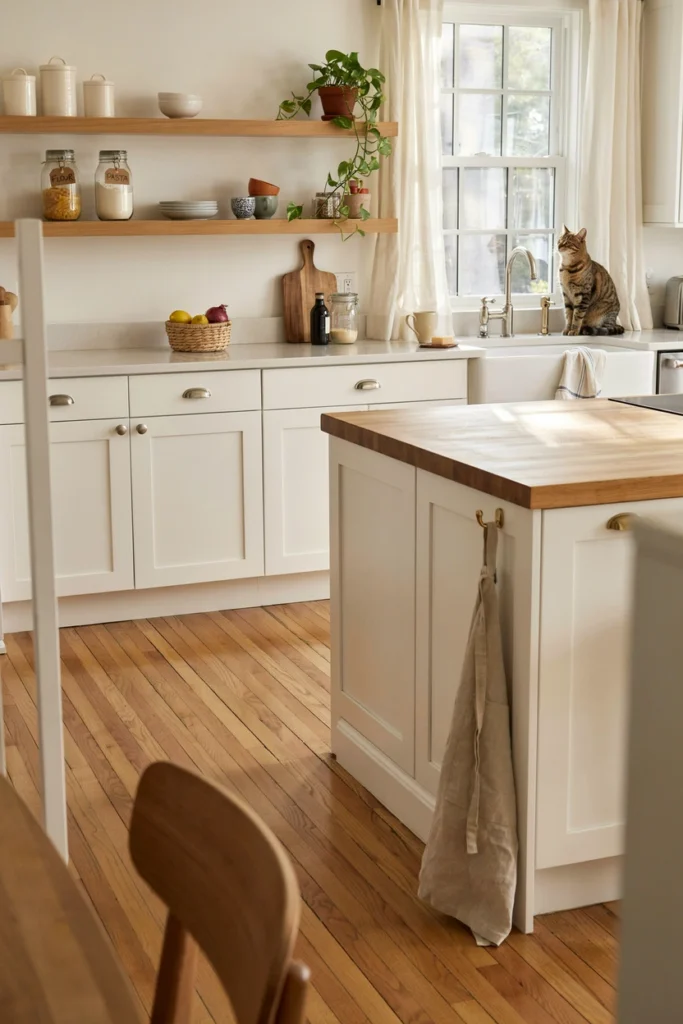
Swapping chrome handles for matte black is the highest-impact £80 you’ll ever spend on a kitchen. The contrast gives the eye something to lock onto — without it, an all-white kitchen can feel like a fog. I recommend 128mm bar pulls on drawers and 35mm knobs on doors; anything smaller looks fussy against big white fronts.
One warning: cheap black hardware chips. I’ve seen £2 pulls go grey at the edges within a year. Spend the extra on powder-coated solid brass or zinc, and match the tap to the handles — a brushed black mixer tap ties it all together. If you can’t replace the tap yet, black handles plus a black kettle on the worktop gets you 80% of the look.
3. Soft White Rather Than Bright White
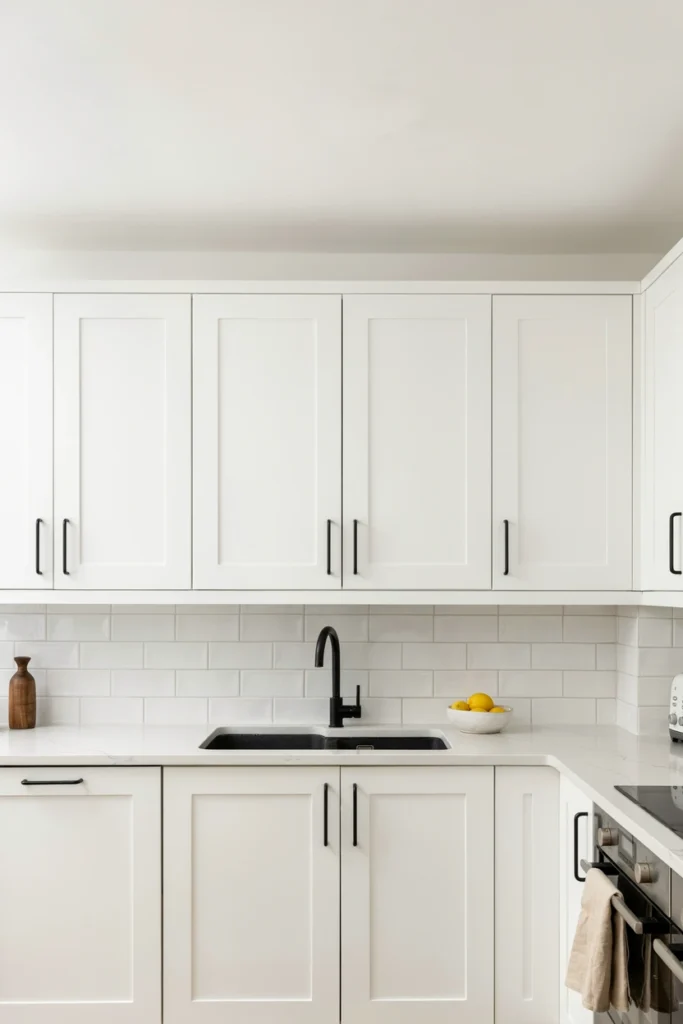
Here’s something paint companies won’t tell you: pure brilliant white (the stuff on your ceiling) is a blue-based colour. In a north-facing kitchen with cool daylight it turns faintly grey-blue and every shadow looks dirty. Soft whites — Pointing, Slipper Satin, or even a basic warm off-white — have a whisper of yellow that keeps them reading as “white” under any light.
The practical payoff is maintenance. On bright white, a turmeric splash glows like a warning sign; on warm off-white it reads as a faint mark you wipe away on Saturday. If you’re repainting existing cabinets, order three A5 samples, tape them to the doors, and look at them at 8am, 1pm, and 9pm under the kitchen lights before you commit.
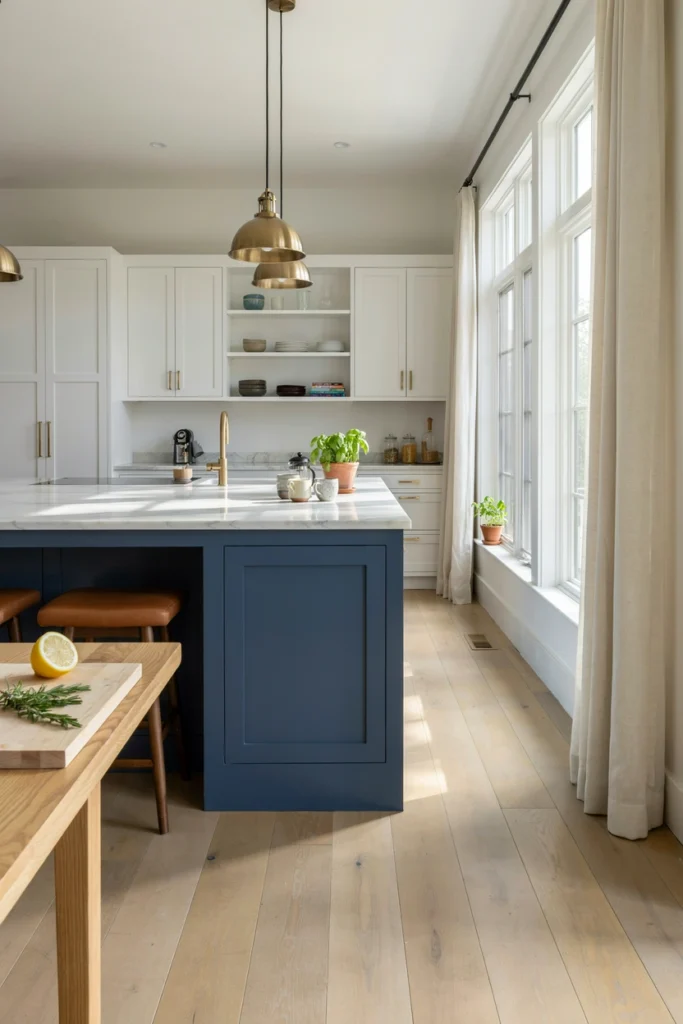
4. White Kitchen with a Coloured Island
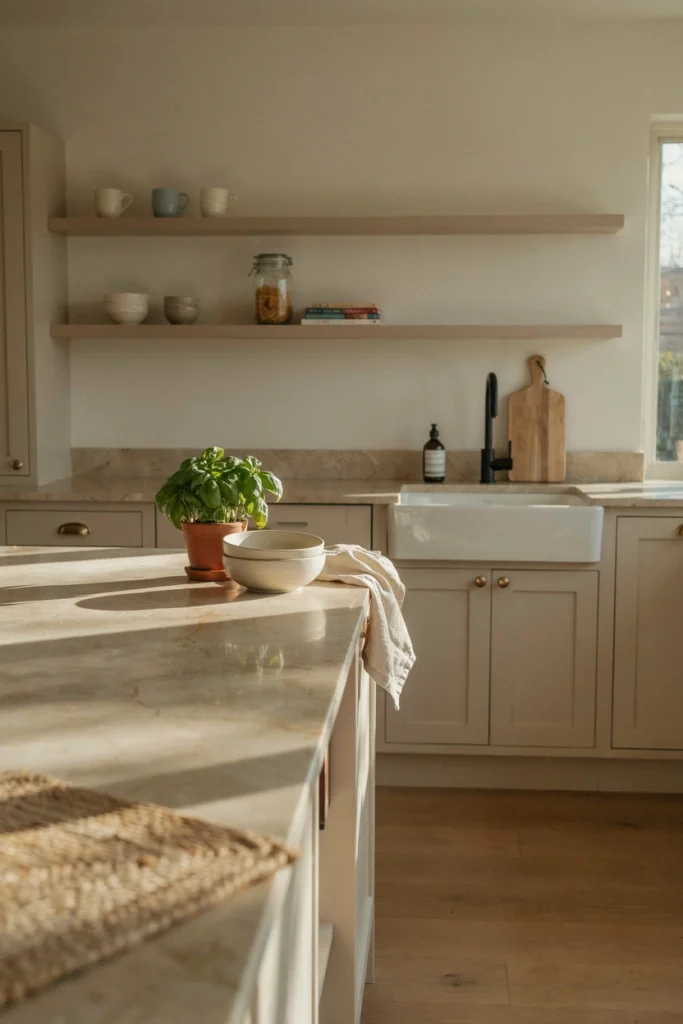
A white kitchen with a navy or sage island is the design equivalent of a white shirt with good shoes — timeless because the risky bit is small and easy to change. Islands are typically 2.4–3m of cabinetry, so repainting one is a £300 weekend job, versus £4,000+ to redo a whole kitchen.
For resale, this is the smartest move on the list. Surveyors and agents consistently flag all-white kitchens as “broad appeal,” and the coloured island gives buyers the personality they photograph for their own listings. Navy (Hague Blue types), deep forest green, and dusty blue sit best against white because they’re dark enough to ground the room without shrinking it.
5. White Cabinets with Marble or Marble-Effect Countertops
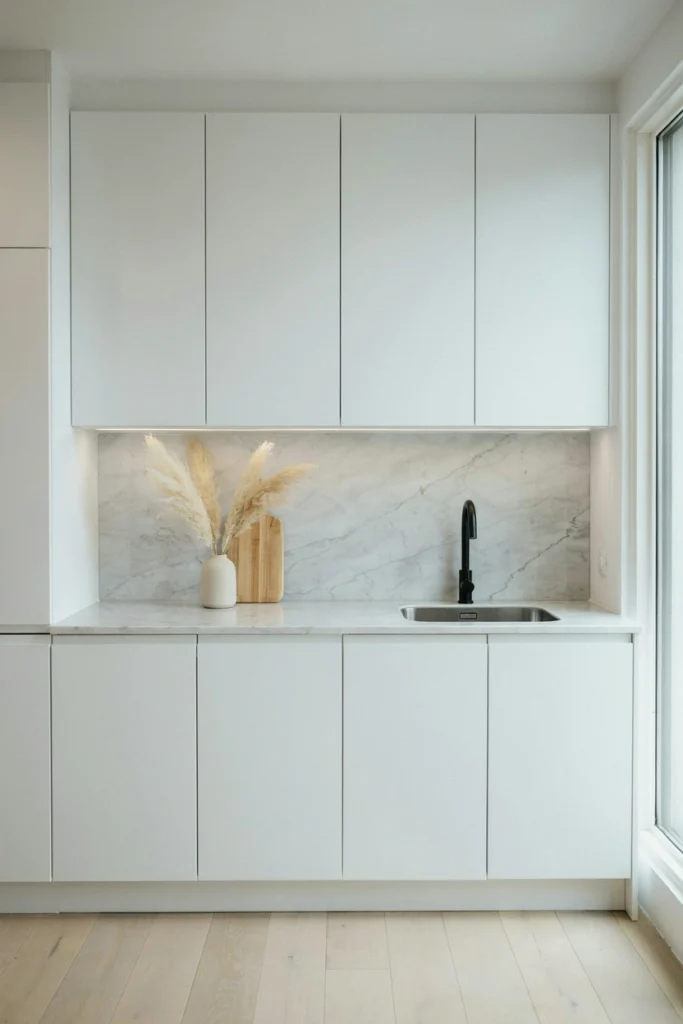
Real Carrara marble is beautiful and completely unforgiving — lemon juice etches it in minutes, and red wine leaves a memory you’ll explain to every guest. That’s why I now steer most families toward marble-effect quartz: brands like Silestone or Caesarstone replicate the veining at 20mm or 30mm thickness, and you can put a hot pan down without flinching.
The detail that separates the real thing from the lookalike isn’t the pattern — it’s the edge. A thick 40mm mitred edge on quartz reads as expensive marble; a thin square edge reads as laminate. Spend your countertop budget on the edge profile and a proper waterfall end on the island if you can. That’s what people touch and photograph.
6. Open Shelving in a White Kitchen
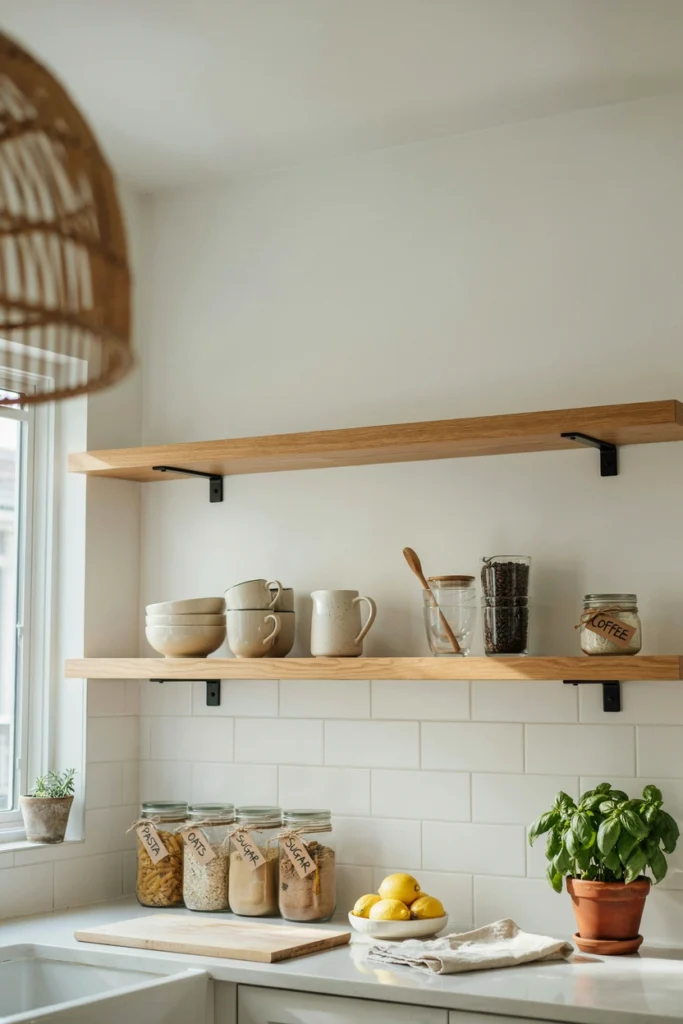
Two open shelves instead of one wall cabinet costs almost nothing and changes the whole feel of the room. But there’s a discipline to it: display only what you use weekly. The plates you eat from, the glasses you drink from, the olive oil you cook with. Everything else belongs behind doors collecting less dust.
Brackets matter more than the shelves. Floating white oak shelves need concealed steel brackets rated to at least 25kg per shelf — cheap floating brackets sag within a year under a stack of dinner plates. Mount into studs or use proper plasterboard anchors, and keep shelf depth at 25cm: deep enough for plates, shallow enough that nothing hides at the back going stale.
7. White Kitchen with Patterned Floor Tiles
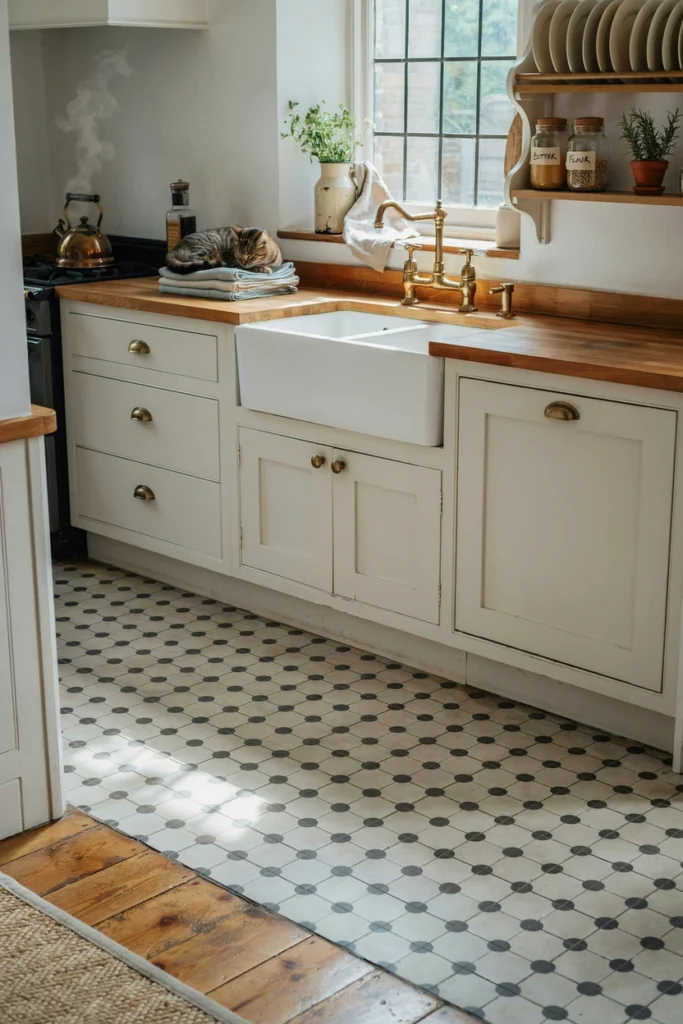
When the cabinets are quiet, the floor can be loud. Victorian-style black-and-white geometric tiles or a soft encaustic pattern give the room its entire personality from the ground up — and because the eye drops to the floor first when you enter, this is often the first thing guests notice.
Two practical notes from experience. First, use grout one shade darker than you think; mid-grey grout on a patterned floor hides crumbs for a week, white grout shows them in an hour. Second, porcelain replicas of encaustic tiles cost a third of the handmade ones and need no sealing — worth it in a working kitchen where you’ll mop weekly.
8. Handleless White Kitchen for a Sleek Look
Handleless kitchens look incredible in photos and demand one honest decision: are you okay with push-to-open? Every door and drawer becomes a touch surface, which means fingerprints — especially on high-gloss fronts. If that sentence made you wince, choose a 45-degree J-pull rail instead: your fingers grip a recessed channel, the front stays clean, and the silhouette stays seamless.
Go satin, not gloss. A matte or soft-sheen lacquer hides marks three times better than high gloss and doesn’t show every ripple in the door. And budget for soft-close everything — in a handleless kitchen there’s no handle to slow a closing door, so cheap hinges slam. It’s the difference between a kitchen that feels engineered and one that feels flimsy.
9. White Kitchen with Exposed Brick or Stone
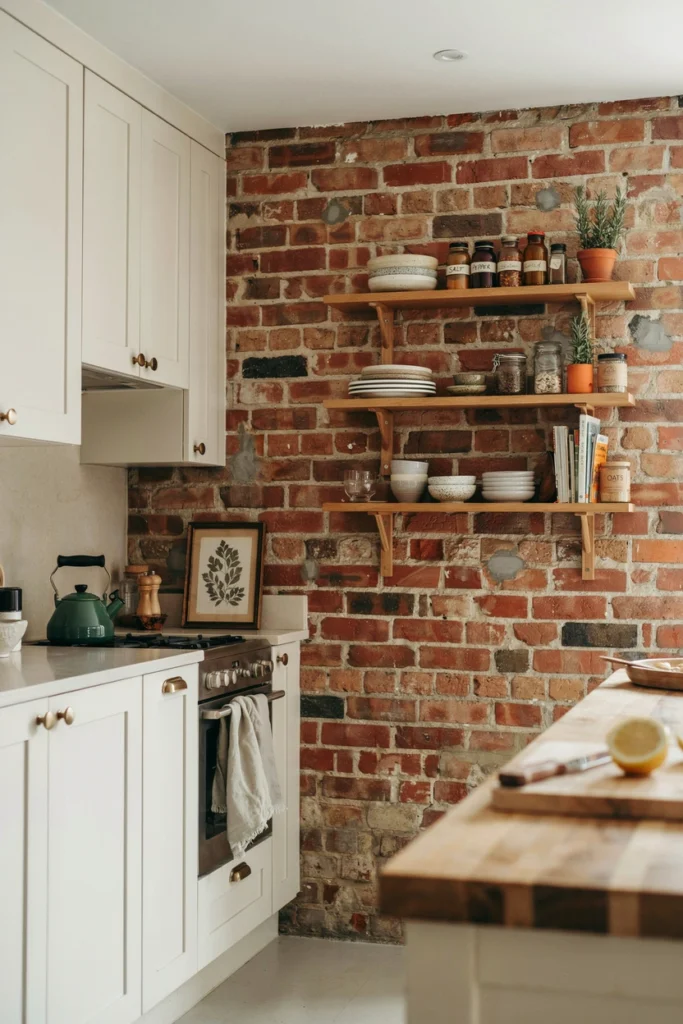
One raw wall is all it takes. A single exposed brick chimney breast or a stone splashback behind the range cooker gives a white kitchen the one thing it usually lacks: something with texture that isn’t trying to be perfect. The roughness makes the smooth white cabinetry look intentional rather than sterile.
Before you commit, check two things. Real brick in a kitchen needs sealing with a matte masonry sealer, or grease will stain it permanently within months — this is the mistake I see most. And if it’s an internal wall, check it’s actually brick underneath and not crumbling plaster; exposing a wall that needs rebuilding turns a £400 job into a £4,000 one.
10. Small White Kitchen That Feels Bigger
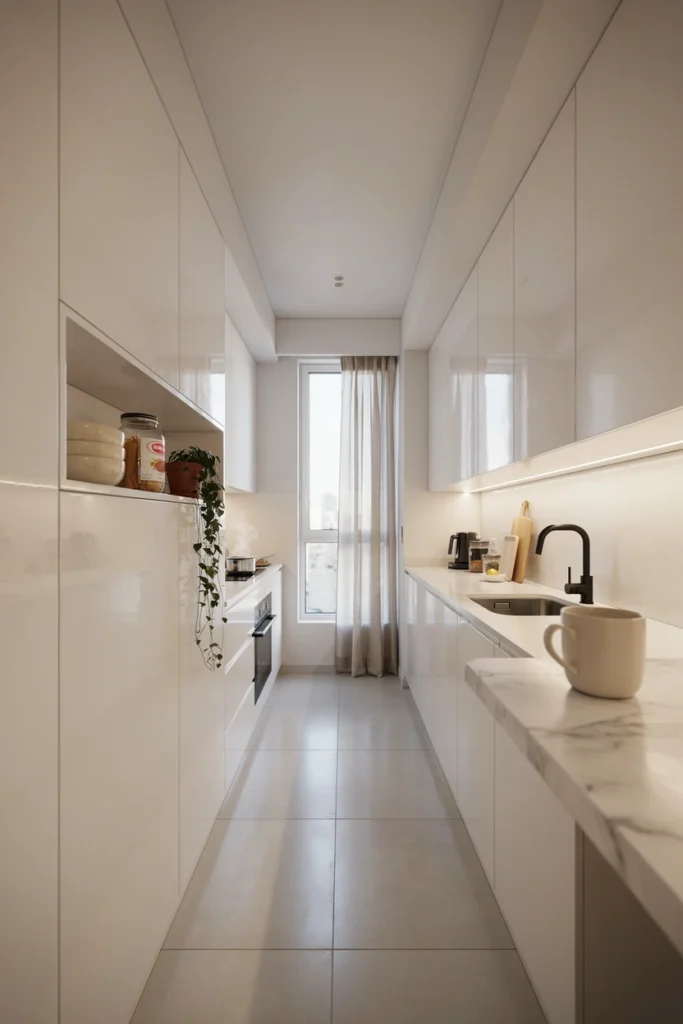
In a kitchen under 8 square metres, white does genuine heavy lifting — but the magic isn’t the colour, it’s the continuity. Run the exact same white on walls, ceiling, and cabinets, and the eye stops registering where one surface ends and another begins. That blur is what reads as “bigger.”
The other half of the equation is light you can see. Under-cabinet LED strips (2700K, not daylight) wash the worktop in warm light and erase the shadow line under wall units that makes small kitchens feel cramped. Take wall cabinets to the ceiling — the 30cm gap above standard units collects grease and visually chops the room in half. Full-height costs a little more; it pays back every day.
11. White Kitchen with Natural Linen or Fabric Textures
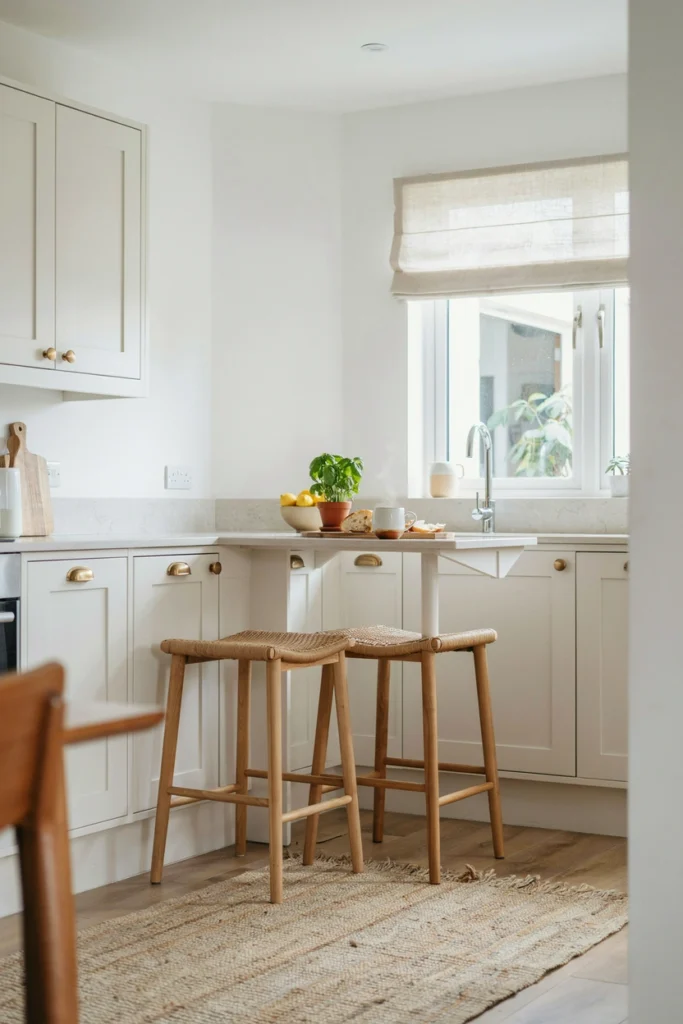
White kitchens fail acoustically before they fail visually. Hard floors, stone tops, and flat cabinet fronts bounce every clatter around the room, and the brain reads that echo as “cold.” Fabric fixes it: a linen roman blind, upholstered bar stools, or a flat-weave runner under the island absorbs sound and instantly softens the space.
Keep fabrics washable and in warm neutrals — oatmeal, flax, soft stone — one tone warmer than the cabinets so they don’t go grey against the white. A 60×230cm washable runner is the single best £40 upgrade for a white kitchen: it warms your feet, quiets the room, and protects the floor where you stand to cook.
12. White Kitchen with Green Plants
Plants are the cheapest colour a white kitchen can buy. A trailing pothos on top of the wall units or a big olive tree in the corner does what no accessory can: it introduces an organic shape into a room full of rectangles. The human eye is wired to find that restful.
Be strategic about placement, not sentimental. Herbs live on the windowsill where you’ll actually snip them — basil, thyme, and rosemary survive a sunny sill with a weekly water. For the decorative spots, choose plants that tolerate kitchen humidity swings: pothos, ZZ plants, and snake plants. Anything fussy will sulk above the radiator and you’ll feel guilty every time you boil pasta.
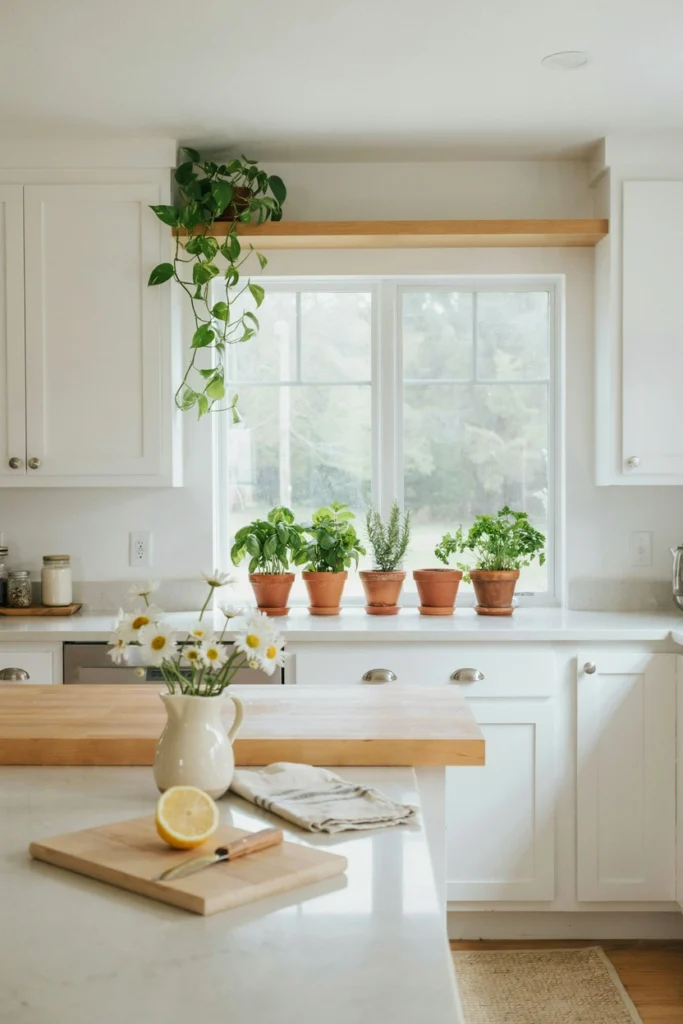
13. White Kitchen with Warm Lighting
This is the decision that makes or breaks a white kitchen, and it costs less than the handles. White cabinets under 4000K+ “daylight” bulbs look like a dental surgery; under 2700K warm white they look like a home. If your kitchen feels cold, check your bulbs before you blame the paint.
Layer three sources minimum: downlights or a flush ceiling fitting for task light, under-cabinet strips for the worktop, and pendants over the island at 75–90cm above the counter. Put the pendants on a separate dimmer switch. Being able to drop the island to a glow while the worktop stays bright is what makes a kitchen work at 7am and at 9pm.
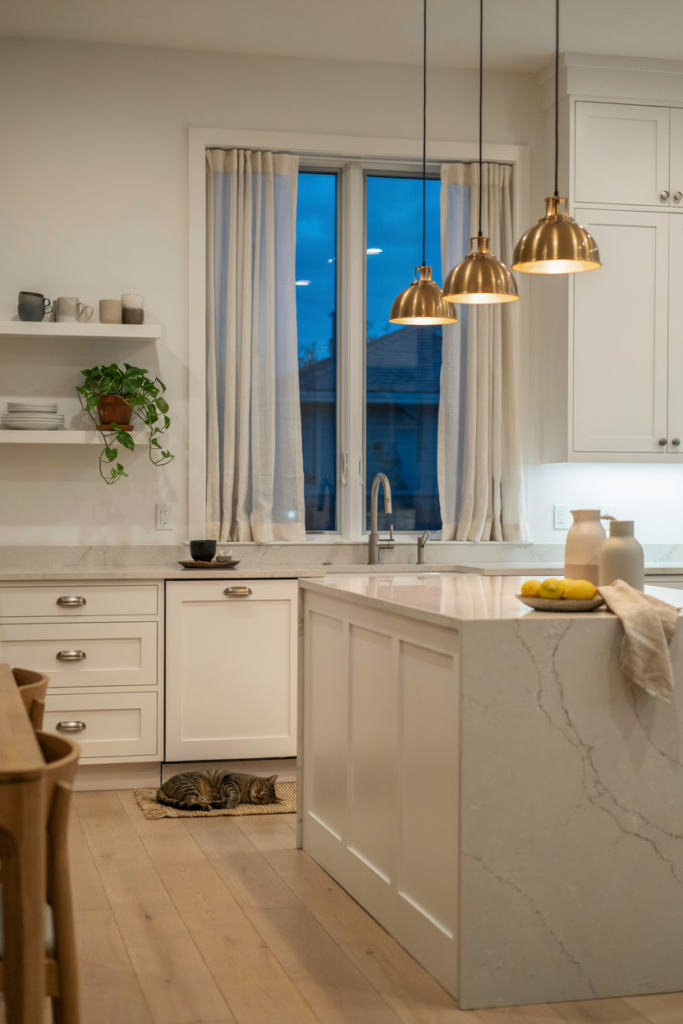
14. White Kitchen with a Butler Sink
A Belfast or butler sink is the one “traditional” detail that earns its keep in a modern kitchen. The 25–30cm deep basin swallows roasting trays and stockpots that won’t fit a standard 18cm inset sink, and the exposed ceramic front breaks up a long run of white doors with genuine craftsmanship.
Check your cabinet first: a butler sink needs a 60cm or 90cm Belfast sink base unit with a reinforced frame, because the sink alone weighs 20–30kg before water. Pair it with a bridge mixer tap in brushed brass or chrome — the tap’s twin pillars echo the sink’s traditional lines — and leave 10cm of worktop each side for the washing-up reality.
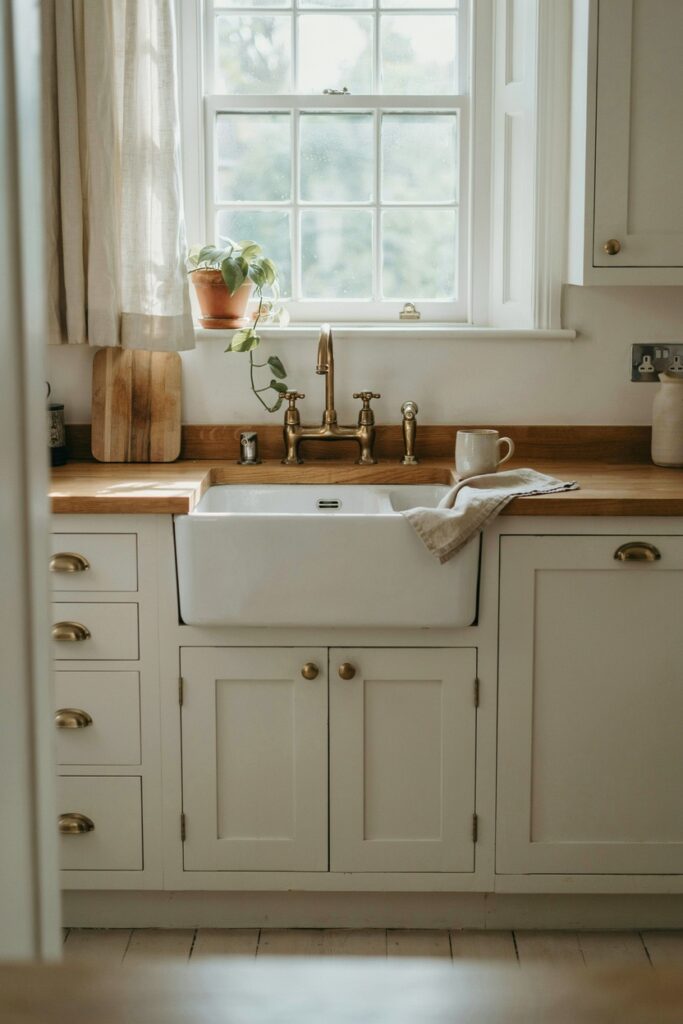
15. White Kitchen with Two-Tone Lowers
White uppers, darker lowers is the compromise that satisfies everyone in the household: the room stays light at eye level where you feel the space, and the base units — the ones that take the kicks, splashes, and scuffs — wear a forgiving colour. Soft grey, warm putty, or pale sage all work; the lowers should be 3–4 shades deeper than the uppers, not a different colour entirely.
If you’re repainting, do the lowers first and live with them for a week before deciding whether the uppers need touching at all. Often the contrast alone refreshes the whole kitchen, and you’ve spent one tin of paint instead of six. Use a proper furniture paint with a hard-wearing topcoat — standard wall emulsion on base cabinets chips at the corners within months.
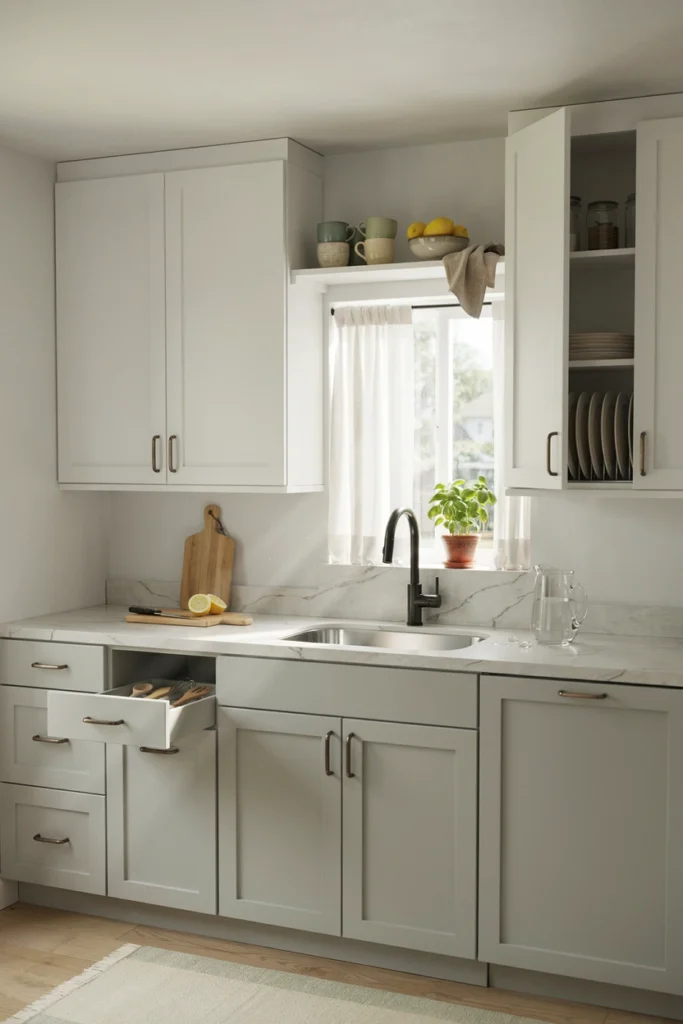
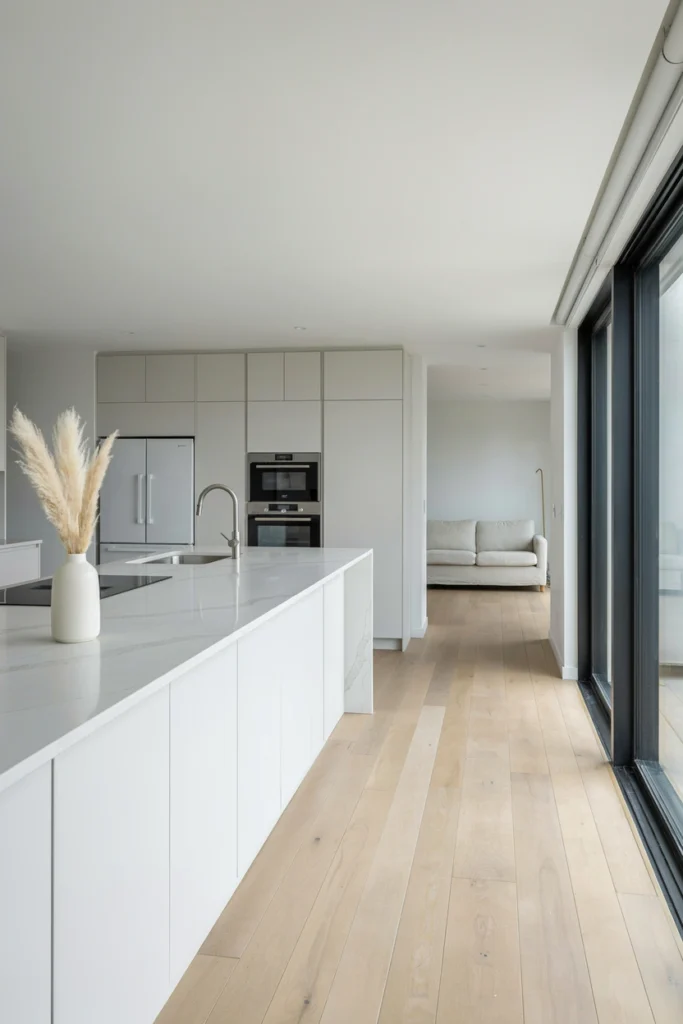
16. White Kitchen in an Open-Plan Space
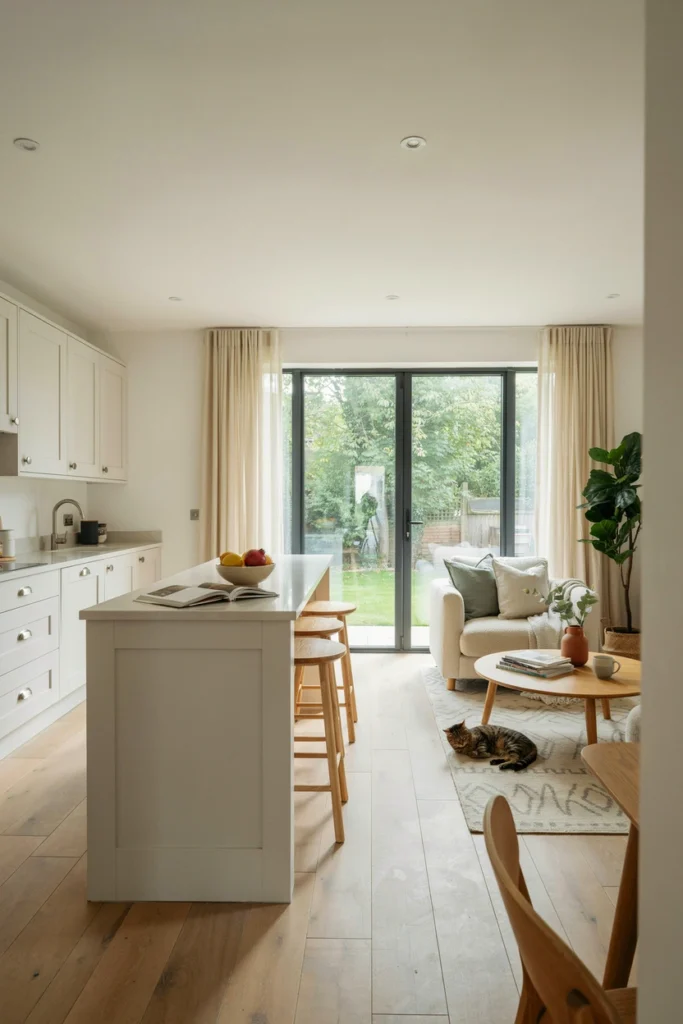
In open-plan living, the kitchen is always on stage — and white is the colour that lets it step back. Dark cabinetry in an open-plan room reads as a second room competing with the lounge; white cabinetry reads as a calm backdrop that lets the sofa, the art, and the view do the talking.
The make-or-break detail is the floor: run one continuous flooring from kitchen to living area with no threshold strip. The moment you change material, the brain draws a boundary and the kitchen becomes a zone again. Porcelain or engineered wood both work — just pick one and commit across the whole space. Match the island’s back panels to the living room wall colour and the kitchen practically disappears into the architecture.
17. White Kitchen with Vintage or Antique Details
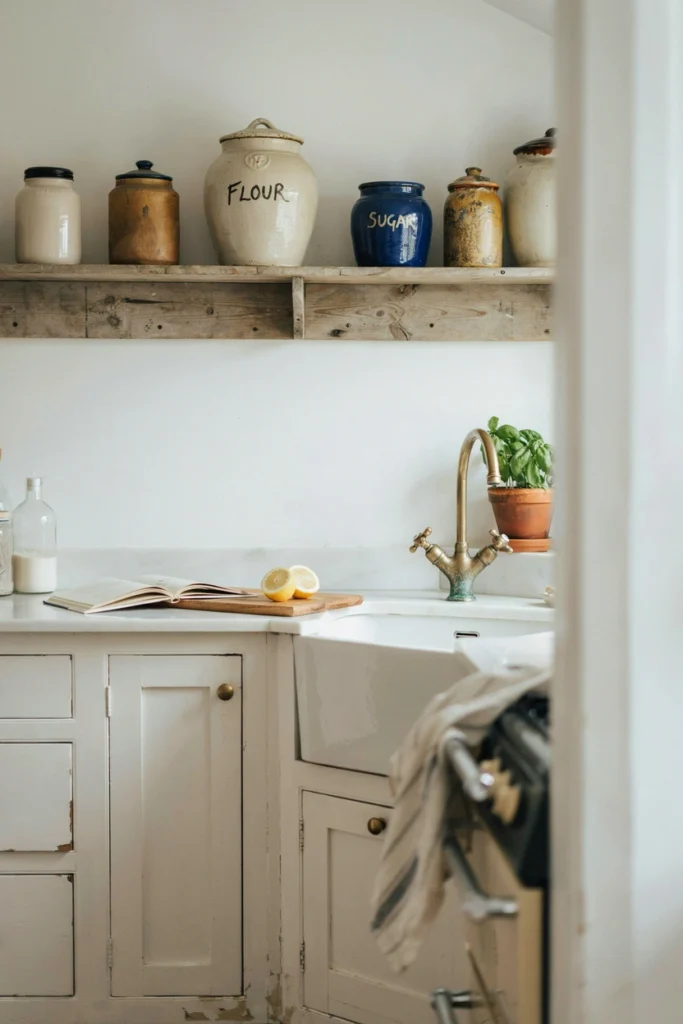
Two old things. That’s the recipe — a vintage mirror, a reclaimed shelf, an antique brass tap, a flea-market pendant. Two genuine old pieces give a white kitchen a past; ten make it a theme. The contrast between crisp new cabinetry and something with a hundred years of patina is what designers mean when they say a room has “soul.”
Buy the best condition you can afford rather than the prettiest photo. Old taps need re-washering and sometimes new cartridges — check parts are available before you fall in love. Reclaimed wood shelves must be kiln-dried and sealed with food-safe oil if they’re near the hob, or they’ll absorb every cooking smell for a decade.
18. White Gloss Kitchen on a Tight Budget
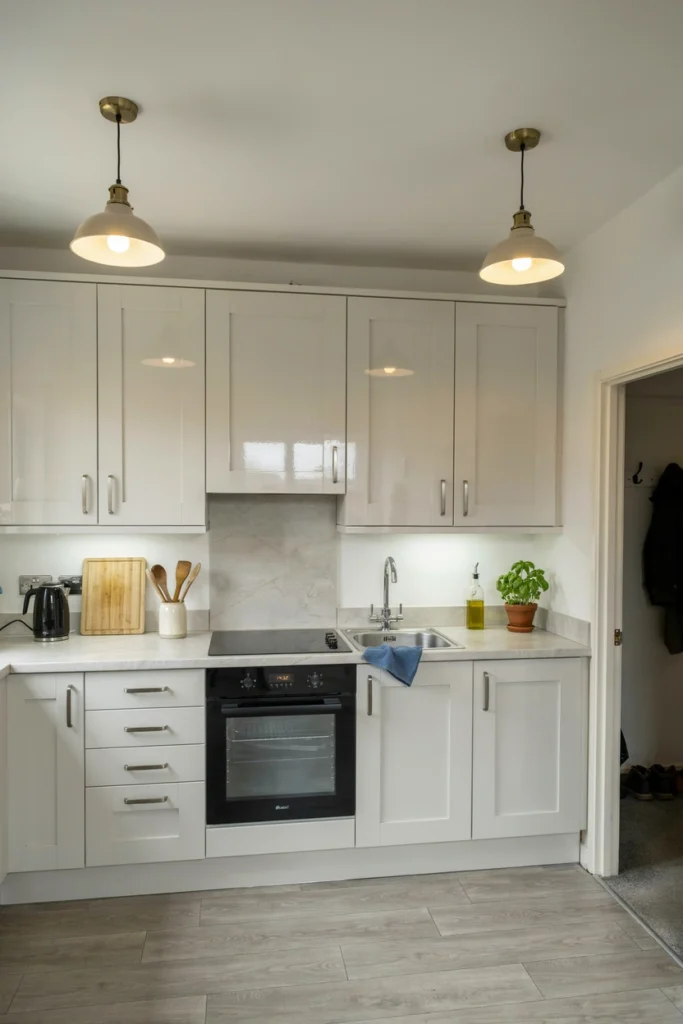
Budget gloss kitchens have quietly become very good — the carcasses are the same 18mm MFC the mid-range brands use, and the doors are a decent acrylic. Where the money shows is the fitting: get the units level to within 2mm, align every door gap, and a £2,000 kitchen reads as £8,000. Get it wrong and no amount of styling saves it.
Allocate your limited budget in this order: worktop first, lighting second, splashback third, cabinets last. A £300 laminate worktop in a convincing oak or stone effect, £60 of under-cabinet LEDs, and a £150 herringbone tile splashback will elevate budget white gloss beyond recognition. The doors just need to be white, flat, and clean.
19. White Kitchen with Statement Backsplash
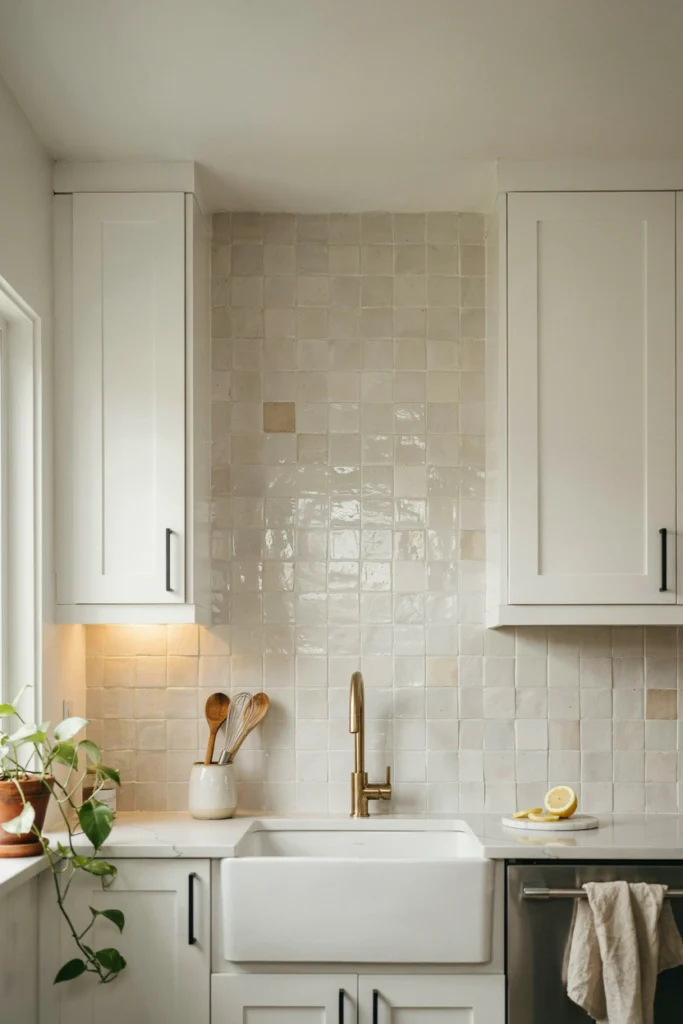
The splashback is the smallest canvas in the kitchen and the one with the most freedom — typically 3–5 square metres, so even handmade zellige at £80/m² stays under £400. That’s why it’s the right place for the pattern or colour you were afraid to put anywhere else.
Three options that never fail against white: handmade-look zellige in a pale tone (the uneven glaze catches light beautifully), a full-height slab of dramatic quartz behind the hob (no grout lines to clean, maximum impact), or classic subway tiles laid herringbone instead of stacked (same tile, twice the interest, about 15% more labour). Whichever you choose, take it all the way to the ceiling behind open shelves — stopping at the standard 60cm line is what makes splashbacks look like an afterthought.
20. Timeless White Kitchen That Grows with Your Home
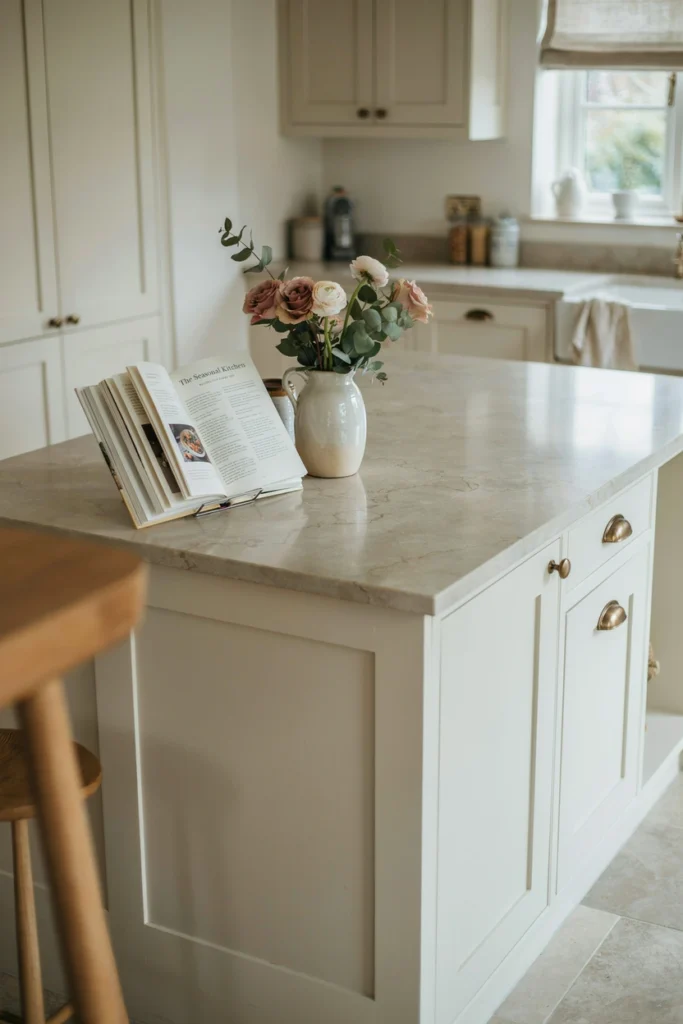
The white kitchens that still look right in twenty years share one trait: nothing in them was fashionable when it was installed. Shaker doors, a simple stone or quartz top, brushed nickel or brass that isn’t trying to make a statement, and flooring in a natural material. Every “of its moment” detail you avoid is five years of relevance you gain.
Spend on what you can’t change later — cabinet carcasses, the worktop, the floor — and keep everything else replaceable. Handles, taps, pendants, and bar stools are the jewellery; they should be the things you swap in a decade, not the things you live with forever. A white kitchen designed this way doesn’t just age well — it actively gets better as your taste sharpens around it.
Conclusion
A white kitchen isn’t a safe choice or a boring choice — it’s a disciplined one. It asks you to get the shade right, light it warmly, and let texture and one or two honest materials do the talking. Do that, and white stops being the absence of colour and becomes the thing that makes everything else in the room look better.
Start with the three decisions that matter most — your white, your worktop, your lighting — and build outward from there. Ten years from now, when the sage-green and navy kitchens are being ripped out, yours will just need new handles.
Pro Tips
- Sample paint on the actual doors, not on paper. Tape A5 swatches to two different cabinet doors — one near the window, one in the darkest corner — and check them morning, noon, and night before choosing your white.
- Keep one “sacrificial” cleaning cloth. White kitchens show every smear, so wipe handles and the bin cupboard daily with a microfibre cloth kept just for the kitchen. Two minutes a day beats a two-hour deep clean monthly.
- Match your white across batches. If you’re buying doors, panels, and plinths separately, order them together. “White” varies between manufacturers, and a plinth half a shade off will bother you forever.
- Photograph the kitchen in daylight before buying accessories. A quick phone photo reveals undertones your eyes adjust away — if the cabinets look blue or yellow in the photo, your white is fighting your light.
FAQs
Do white kitchens get dirty easily?
They show marks faster than mid-tone kitchens, but they don’t get dirty faster — you just notice it sooner, which most owners say makes them clean more regularly. Warm off-whites and satin finishes hide day-to-day marks far better than bright white gloss. A quick daily wipe of handles and high-touch areas keeps a white kitchen looking fresh with minimal effort.
Does a white kitchen make a room feel bigger?
Yes, measurably so. White reflects 80–90% of light versus under 10% for near-black, which is why the same room feels larger painted white. The effect is strongest when you keep one continuous white across walls, ceiling, and cabinets, and add under-cabinet lighting to erase shadows.
What colours pair well with a white kitchen?
Almost anything, which is the point — but the pairings that age best are navy, sage green, warm wood tones, matte black, and brushed brass. Limit yourself to one strong accent colour plus one metal finish; more than that and the calm that makes white work starts to fracture.
Will white kitchen cabinets go out of style?
White has been the best-selling kitchen colour for over three decades and shows no sign of leaving — estate agents still list it as the safest choice for resale. Styles around it change (handleless one decade, shaker the next), but the white itself endures. Choose a simple door style and you sidestep trends entirely.

HowDecor is a home decor blog sharing simple, practical decorating ideas for everyday spaces. We believe a beautiful home should feel comfortable, personal, and full of warmth — and that great style does not require a huge budget. Our goal is to inspire readers to create spaces that feel peaceful, welcoming, and truly their own — one room at a time.