Black kitchens are not for the faint-hearted — they’re for the sure-hearted. I’ve designed them for clients who knew exactly what they wanted, and I’ve talked just as many clients out of them when the room, the light, or the lifestyle said no. This guide is the honest version: when black works, why it works, and how to get it right.
Because here’s the truth about black cabinetry: it’s the most dramatic thing you can do to a kitchen, and drama needs directing. These twenty ideas cover every configuration — matte, gloss, two-tone, textured — plus the lighting, materials, and proportions that separate a stunning black kitchen from an expensive mistake.
Read the “how to choose” section at the end before you commit to anything. It will save you from the three mistakes I see most — and they’re all made before a single cabinet is ordered.
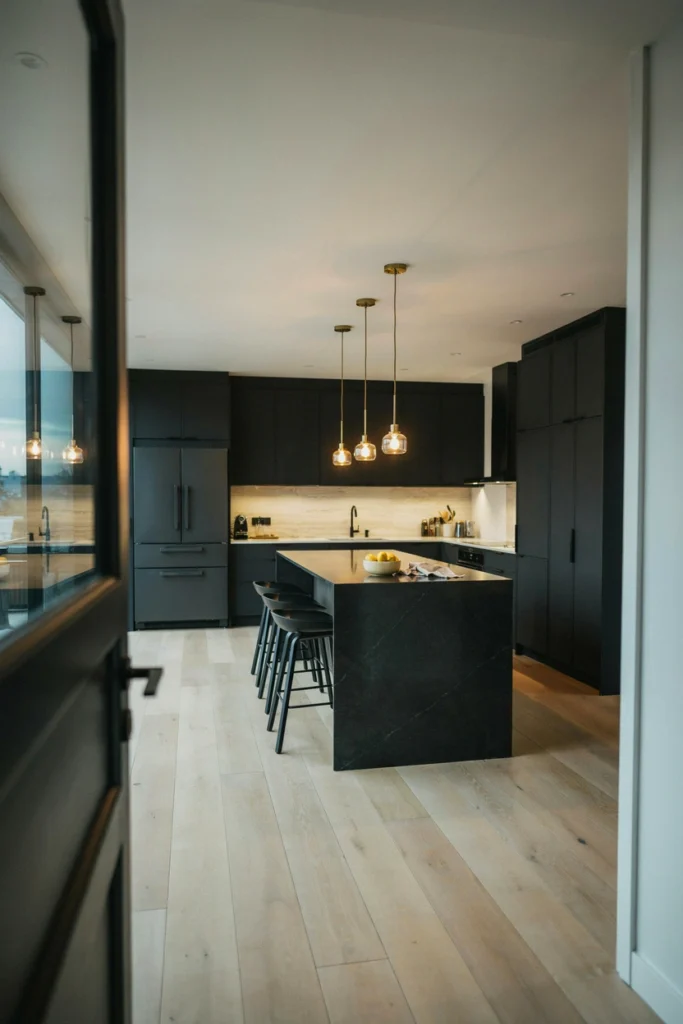
1. Matte Black Cabinets With Warm Wood Accents
Matte black with warm oak is the black kitchen at its most livable — the wood softens the severity, the black gives the wood gravitas. This is the combination I’d specify for a family kitchen in black: it has all the drama with none of the coldness.
Keep the wood mid-tone or pale. Dark walnut against black disappears; pale oak sings. And choose matte over gloss for the cabinets — matte black hides fingerprints and dust; gloss black is a full-time cleaning job disguised as a kitchen.
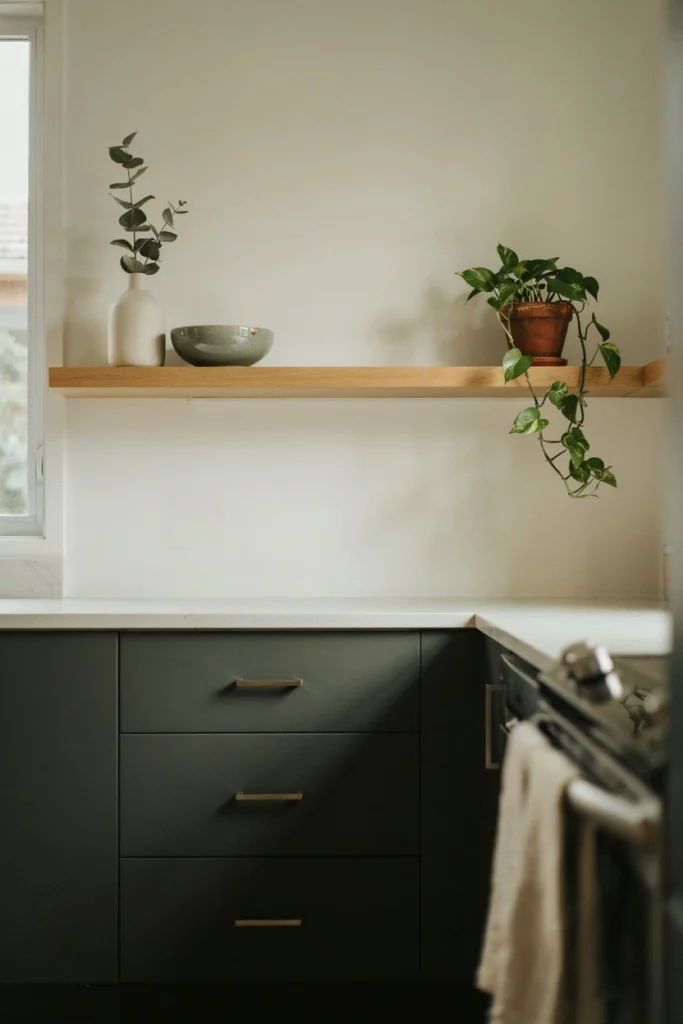
2. Black Shaker Cabinets for a Classic Modern Blend
Shaker doors in black shouldn’t work — traditional style, radical colour — but they’re one of the great kitchen combinations. The classic panel gives the dark colour depth and shadow; the black gives the traditional style edge. It’s the mullet of kitchens: business in the joinery, party in the colour.
This style works particularly well in kitchens of any size. In smaller kitchens, black shaker cabinets paired with a light countertop and open upper shelving create a space that feels intentional without being overwhelming. The light worktop is doing essential work here — it’s the horizon that keeps the dark cabinetry from closing in.
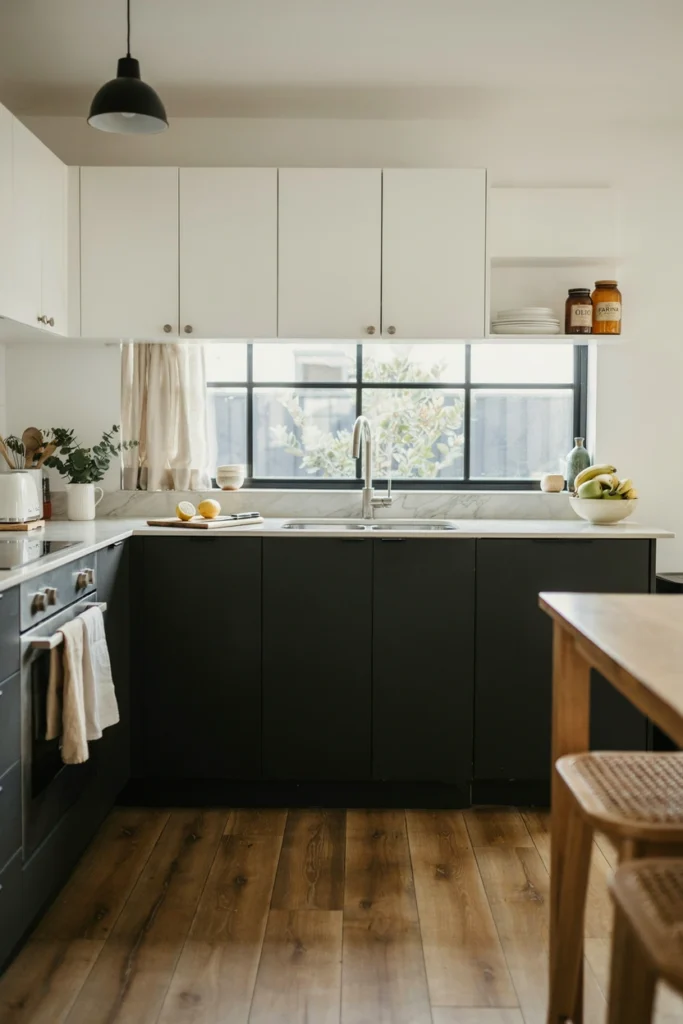
3. Two-Tone Kitchens With Black Lowers and White Uppers
Black below, white above is the training-wheels black kitchen — and I mean that as high praise. You get the drama at worktop level where the eye falls, the practicality of dark base units that hide scuffs, and the lightness above that keeps the room breathing.
This combination works particularly well in smaller or medium-sized kitchens where a fully black kitchen might feel too heavy. The white upper cabinets reflect light back into the room and prevent the black from dominating in a way that could make the space feel enclosed. The division between the two colors at countertop height also creates a natural visual horizon that makes the room feel organized and intentional.
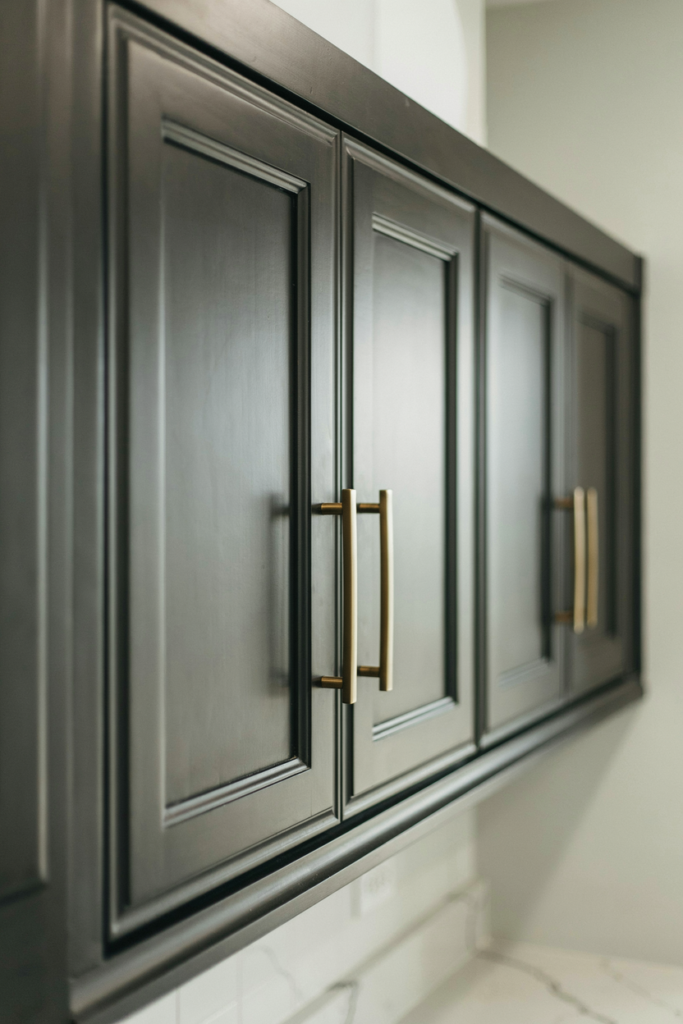
4. Black Cabinets With Brass Hardware for a Luxe Finish
Black and brass is the power pairing — the metallic warmth does for black what it does for charcoal, but more dramatically. Unlacquered brass that patinas over time is the connoisseur’s choice; the evolving finish means the kitchen literally gets better with age. This is the combination for dining kitchens and evening spaces, where the brass catches candlelight and glows.
Commit to the metal: brass handles, brass tap, brass pendant details. Mixed metals against black look indecisive; one warm metal looks intentional. And keep the brass brushed or aged — polished brass against black can read as 1980s revival in the wrong way.
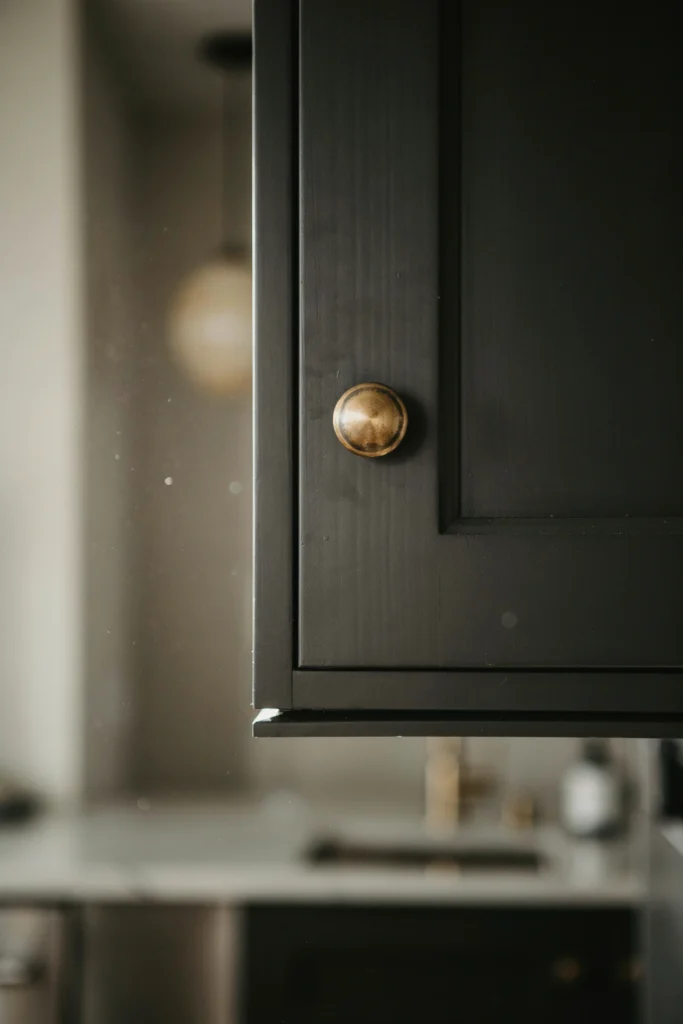
5. Open Shelving Mixed With Black Closed Cabinets
Open oak or pale wood shelves against black cabinetry break the darkness exactly where the eye needs relief — at eye level. They also give you display space that isn’t another black surface, which matters more than you’d think: a kitchen of unrelieved black starts to feel like a beautiful cave.
Style the shelves with light objects — white ceramics, glass, pale wood — to maximize the contrast. Dark objects on the shelves disappear into the background; the shelves should be the bright notes in the composition.
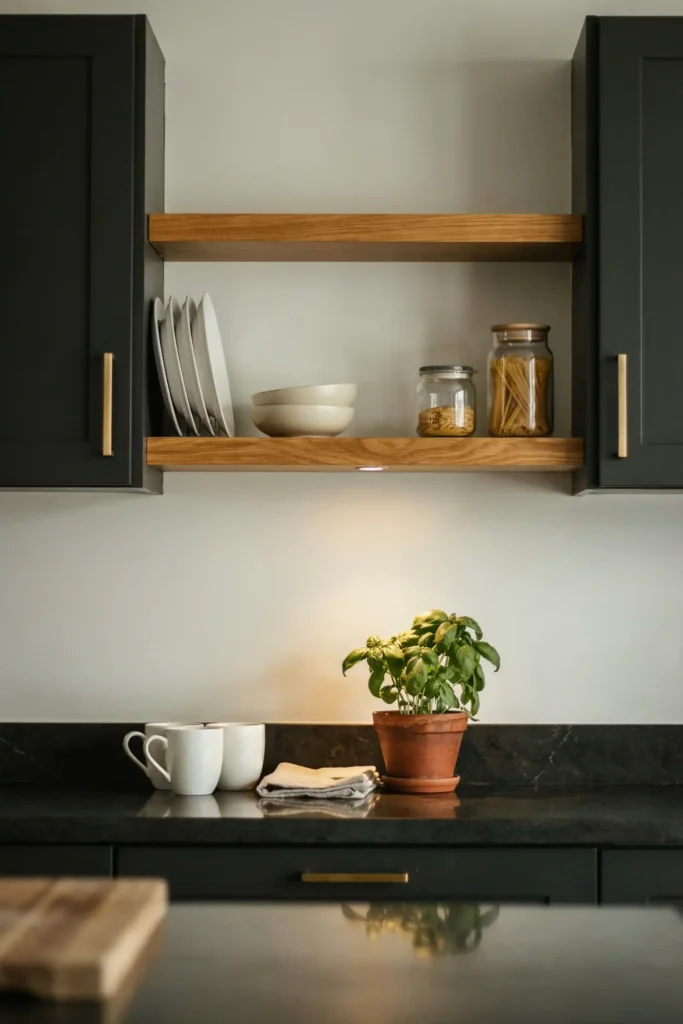
6. Black Kitchen Island as a Statement Piece
A black island in a pale kitchen is the lowest-risk way into this look: one piece of drama, repaintable in a weekend, removable if you hate it. It anchors the room the way a dark rug anchors a pale floor — the eye needs somewhere to land, and the island provides it.
Give the island a pale worktop to maintain the contrast that makes it work, and light it properly — pendants above, and ideally a different pendant style from the main kitchen to mark it as furniture rather than fitted cabinetry.
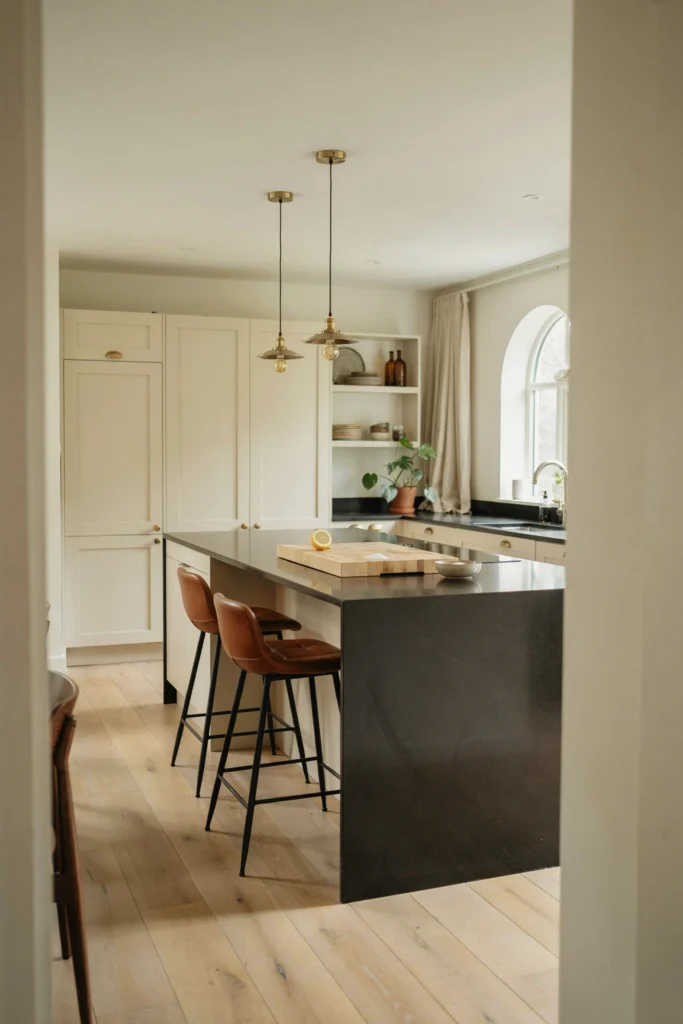
7. Black Cabinets With Concrete Countertops
Black cabinets with a concrete worktop is the industrial pairing at its most refined — two honest, matte materials with nothing to hide. The concrete’s subtle tonal variation keeps the black from feeling flat, and the combination has a gallery-like seriousness that suits minimalist homes.
This pairing needs warmth from somewhere: oak flooring, warm lighting (never cool), and ideally something living. Concrete plus black plus cool light is the combination that makes guests whisper “it’s a bit cold” — warm it up and it’s magnificent.
8. Glossy Black Cabinets for a High-Impact Dramatic Look
Gloss black is the supermodel of kitchen finishes — stunning in the right light, high-maintenance always. It reflects the room like a dark mirror, which can make a kitchen feel twice its size, but it shows every fingerprint, every dust particle, every micro-scratch.
Only choose gloss if you’ll enjoy the maintenance — daily wipe-downs with a microfibre cloth are the reality. And only in a room with something worth reflecting: gloss black facing a beautiful garden doubles the view; gloss black facing a brick wall doubles the brick wall.
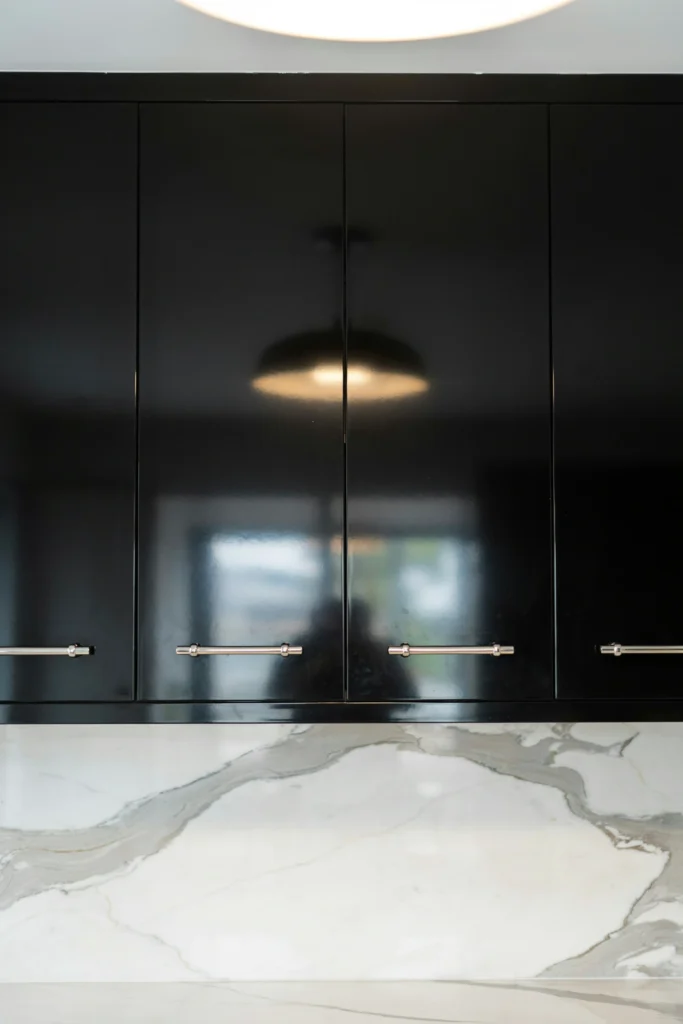
9. Black Cabinets With Green Accents for a Natural Contrast
Green is black’s most flattering companion — the living colour against the architectural dark. A green island with black perimeter, black cabinets with a wall of green tiles, or simply abundant plants: green gives black the organic contrast it needs to feel alive rather than designed.
Go deep with the green — forest, emerald, racing — not mint or sage, which wash out against the black’s intensity. The green needs to hold its own; pale greens disappear next to black like whispers next to shouting.
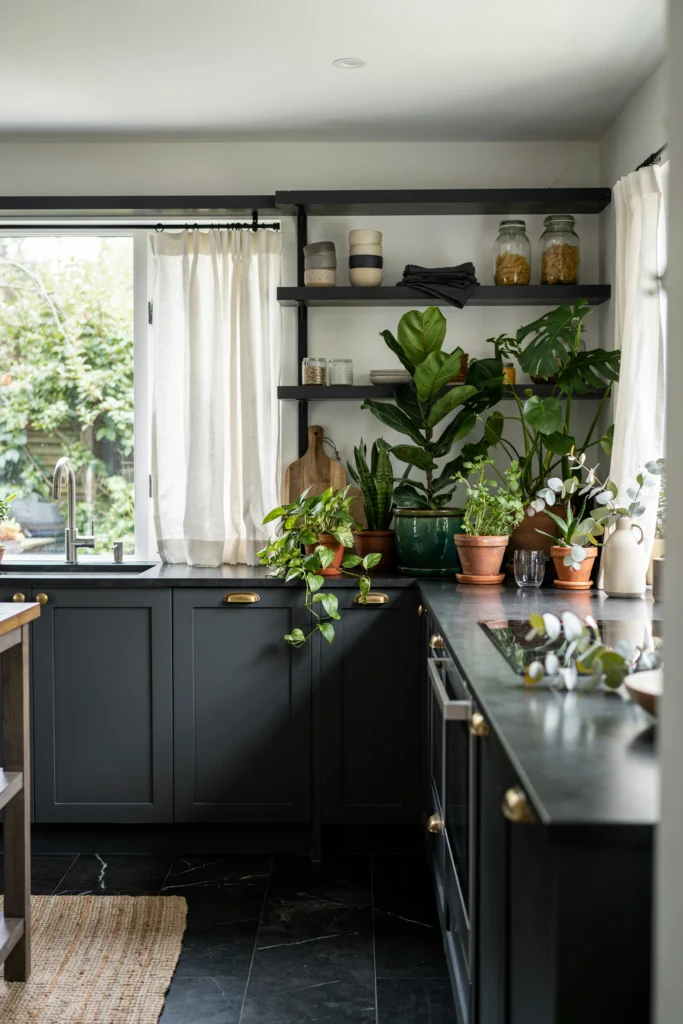
10. Black Cabinets in a Small Kitchen Done Right
Small black kitchens work when the black is treated as an accent, not a field: black lowers, white uppers, pale worktop, mirror-bright lighting. The formula is contrast, contrast, contrast — every dark surface needs a pale partner within sight.
What kills small black kitchens is timidity in the lighting. Under-cabinet strips, a pale splashback that bounces light, and a ceiling that stays white: light is the ingredient that makes the small dark room feel intentional rather than cramped.
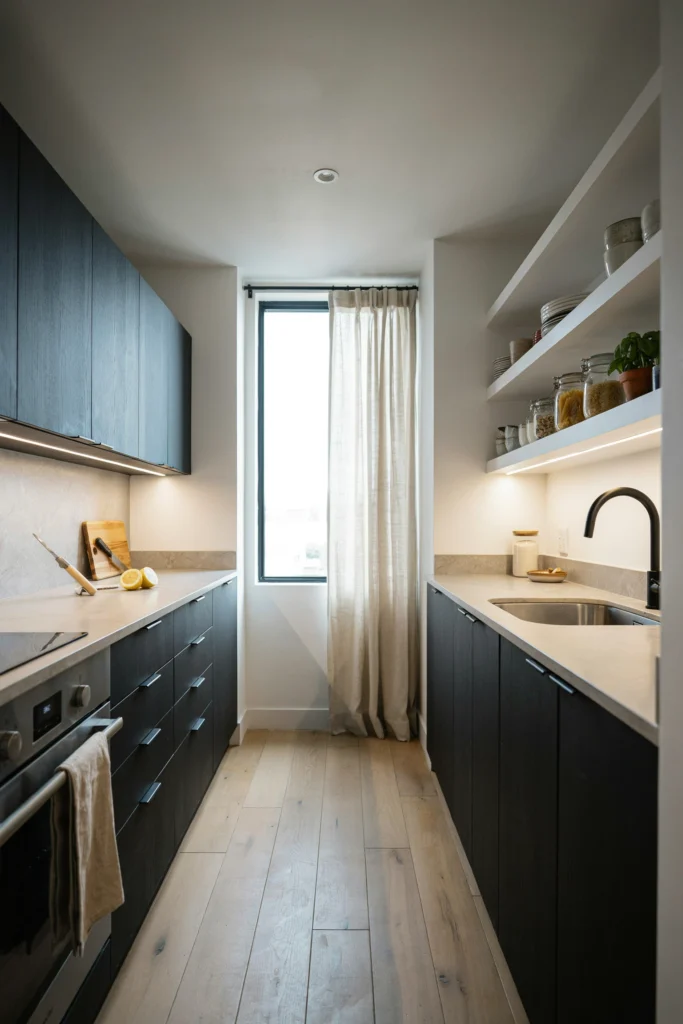
11. Black Cabinets With White Marble for Timeless Contrast
Black and white marble is the tuxedo of kitchens — formal, timeless, and impossible to get wrong if the proportions are right. The veining in the marble softens the black’s severity; the black gives the marble’s elegance an edge. It’s the pairing for people who want drama with a guarantee.
Let the marble be the star: a full-height slab behind the hob, or a waterfall island end. And choose the marble’s veining deliberately — bold dramatic veining for a bold kitchen, quiet soft veining if you want the black to dominate.
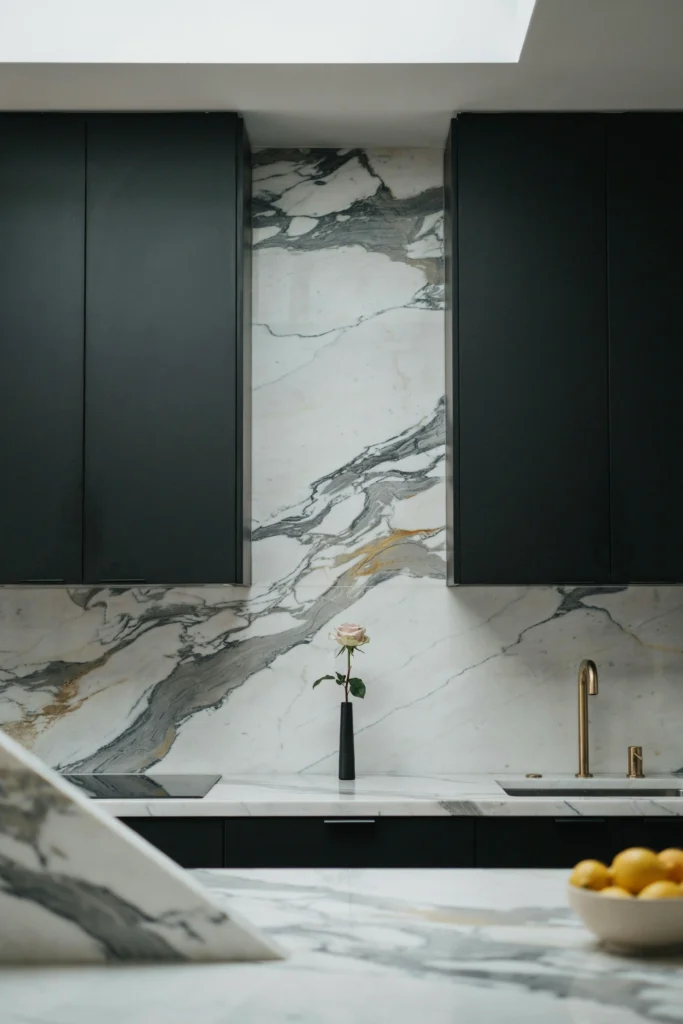
12. Black Cabinets With Terrazzo Flooring
Terrazzo’s confetti chips against black cabinetry is playful-meets-serious — the floor brings the joy, the cabinets bring the gravitas. It’s a combination with real personality, and it works because the terrazzo’s pale background keeps the room light underfoot.
Keep the terrazzo’s background pale and the chips warm-toned; dark terrazzo with black cabinets is too much darkness in one room. The floor should be the light note — let it do that job.
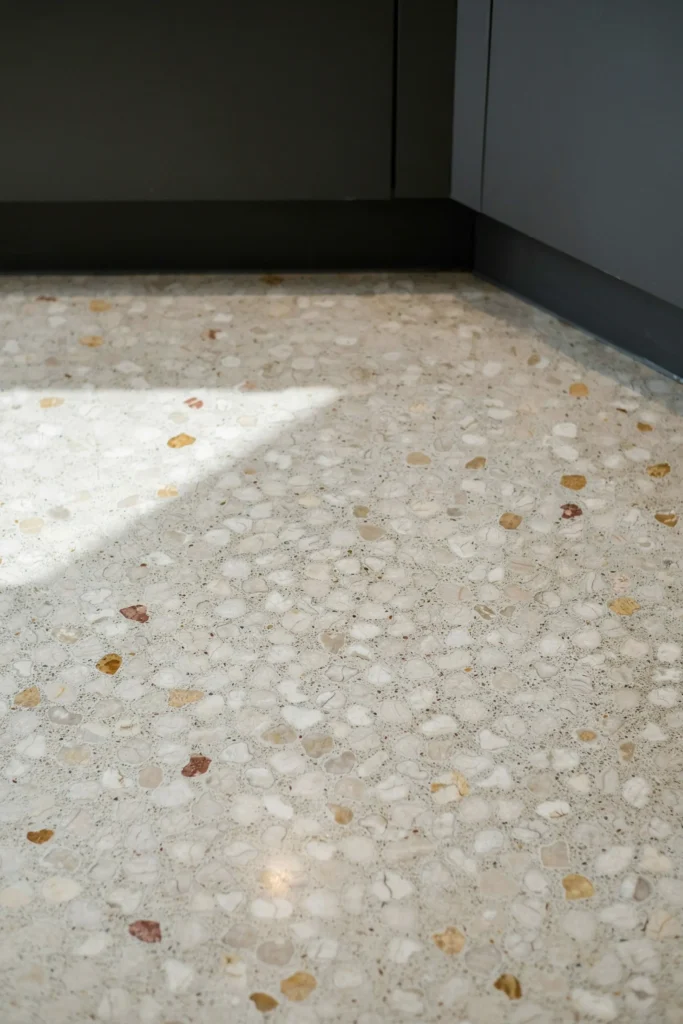
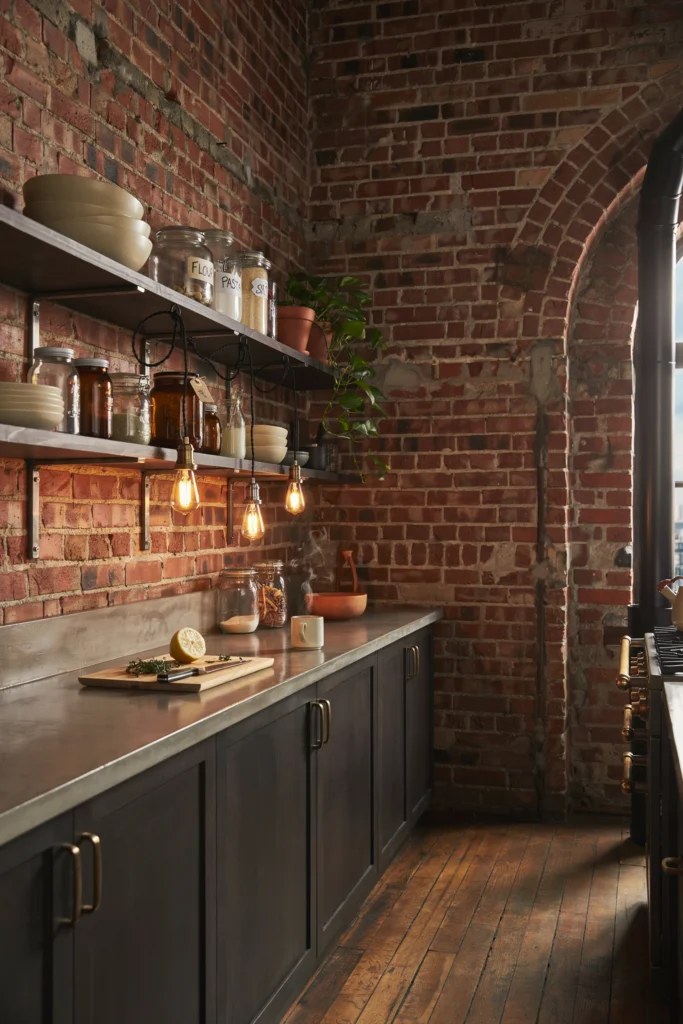
13. Industrial Style Black Kitchen With Exposed Brick
Black cabinets with exposed brick is the converted-warehouse look, and it’s magnificent when the architecture supports it — high ceilings, big windows, original features. The brick’s warmth and texture do essential work against the black’s flatness.
Seal the brick before you cook — matte masonry sealer, non-negotiable, or grease stains it permanently. And warm the lighting: industrial black plus cool LEDs is a workshop; industrial black plus warm filaments is a home.
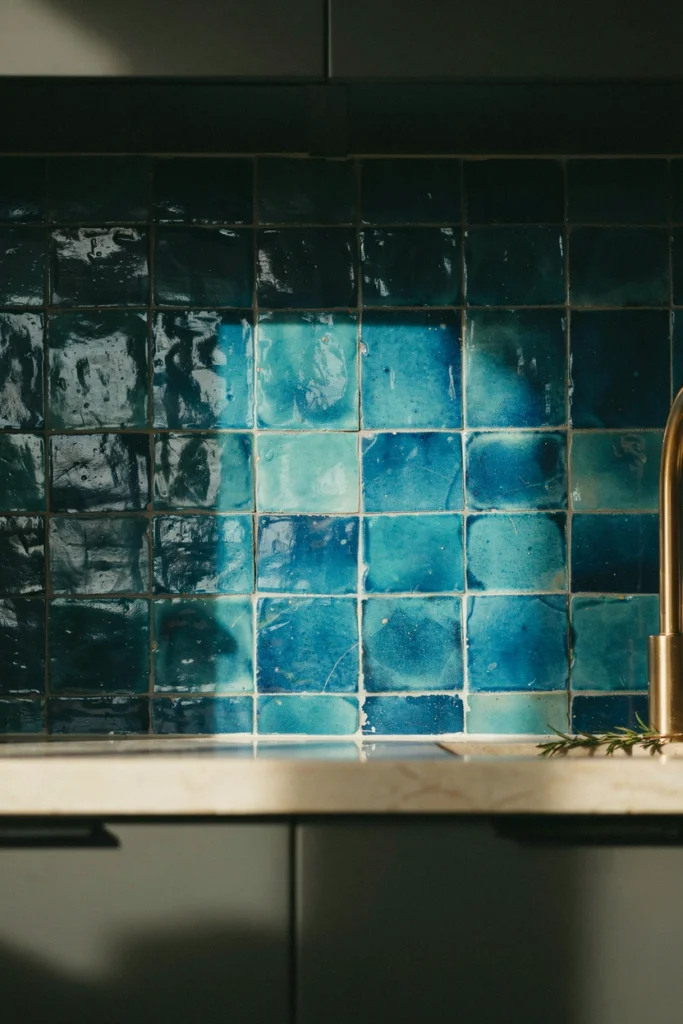
14. Black Cabinets With Statement Backsplash
Against black cabinets, the splashback is your one shot at pattern, colour, or shine — the cabinets are quiet (darkly quiet), so the splashback can speak. Handmade-look tiles in deep green or blue, a dramatic stone slab, metallic mosaics: this is where the kitchen’s personality lives.
Keep it contained: the splashback zone only, not wrapping the whole room. A statement that covers every wall stops being a statement and becomes a theme.
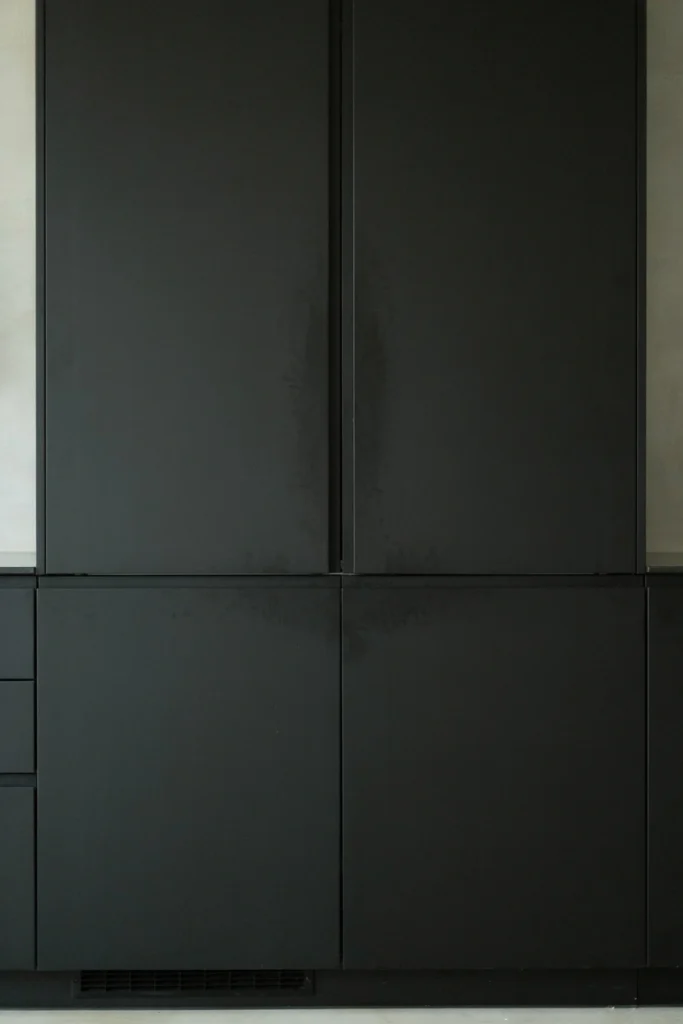
15. Minimalist Black Kitchen With Hidden Handles
Handleless black is black at its most architectural — pure planes of darkness, nothing to interrupt the geometry. It demands perfect fitting: black shows every misalignment that paler colours forgive, so the installation quality has to be flawless.
Choose push-to-open or J-pull mechanisms honestly — push-to-open means fingerprints on every door, J-pull keeps fronts clean. And specify soft-close everything; in a handleless kitchen there’s no handle to slow a slamming door.
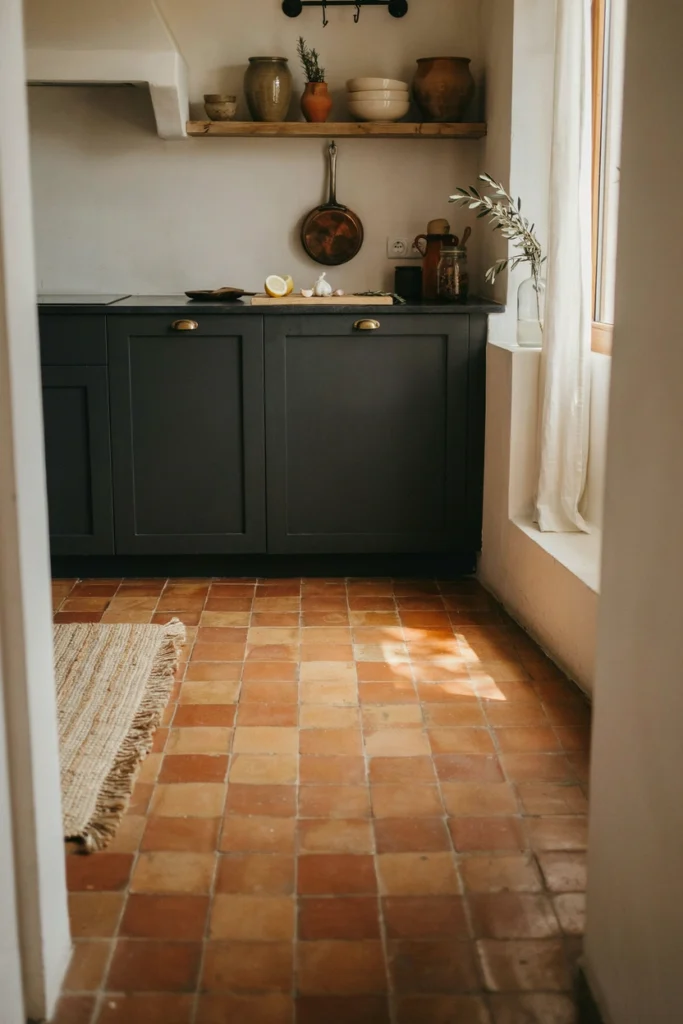
16. Black Cabinets With Warm Terracotta Tones
Terracotta is black’s warmest friend — the clay colour brings an earthy, human warmth that stops black feeling severe. Terracotta floor tiles with black cabinets is the Mediterranean-industrial crossover that shouldn’t work and absolutely does.
One terracotta element is enough: floor, splashback, or accessories. The warmth should feel like an accent, not a second theme competing with the black.
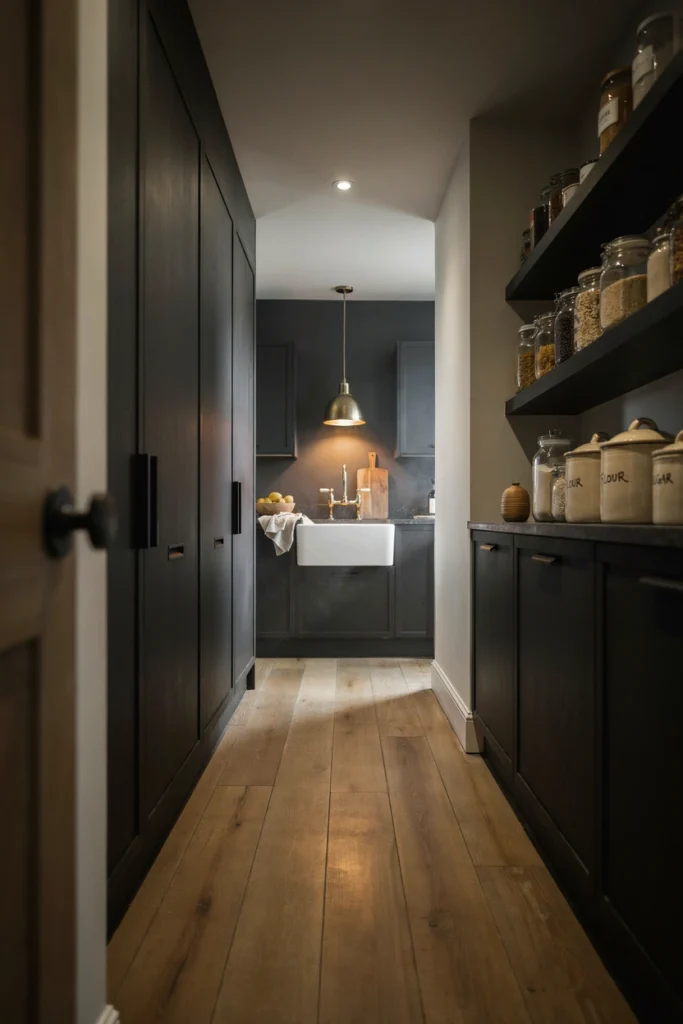
17. Black Cabinets in a Scullery or Butler’s Pantry
The scullery is black’s natural habitat — a working room where dark colours hide the reality of work and look magnificent doing it. A black scullery behind a paler main kitchen is the sophisticated solution: beauty for guests, practicality for the cook.
It’s also the zero-risk trial: if you’ve always wanted black but fear the commitment, do the scullery first. You’ll know within a month whether black is your colour, and the main kitchen stays untouched.
18. Black Cabinets With Integrated Appliances
Appliances disappearing behind black doors create the calmest possible kitchen — no steel rectangles interrupting the dark planes. The room reads as architecture rather than equipment, which is exactly the effect black cabinetry is reaching for.
The fitting has to be precise: integrated appliances behind dark doors show gaps mercilessly. Use the manufacturers’ own fixing kits and allow proper ventilation — overheated integrated appliances behind unvented black doors are a service call waiting to happen.
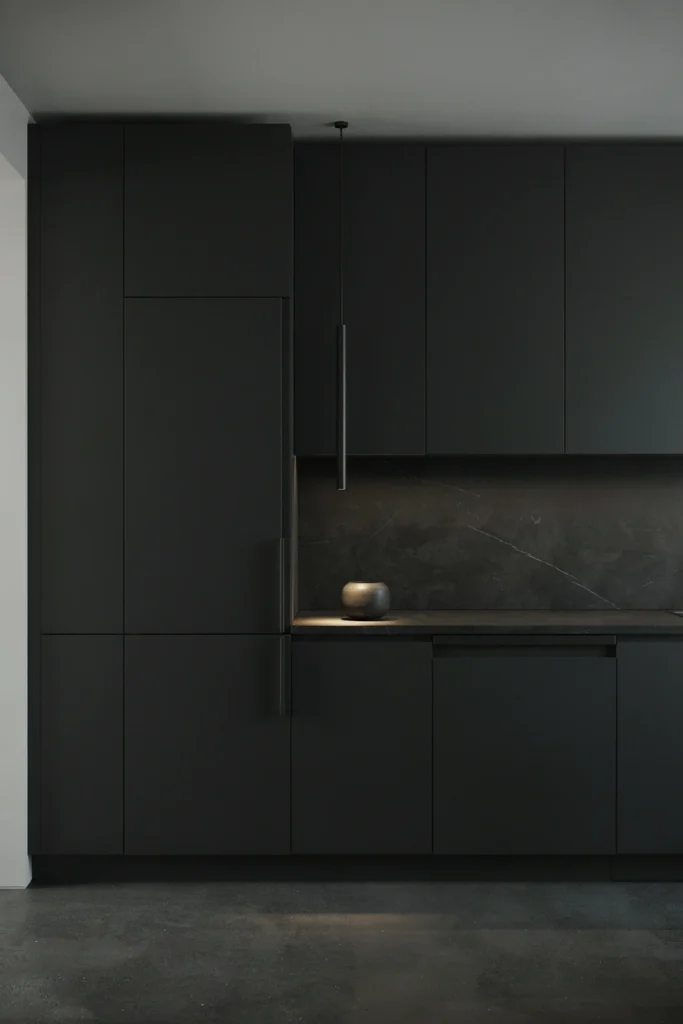
19. Black Cabinets Paired With Dark Flooring for a Moody Interior
Black cabinets with dark flooring is the full commitment — the moody, cocooning, candlelit kitchen. It works in rooms with generous natural light and high ceilings, where the darkness has space to breathe. Done right, it’s the most atmospheric kitchen possible.
The non-negotiables: warm lighting everywhere (2700K maximum), a pale worktop as the room’s light source, and something reflective — brass, glass, mirror — to keep the darkness from going flat. Miss any of the three and the mood curdles into gloom.
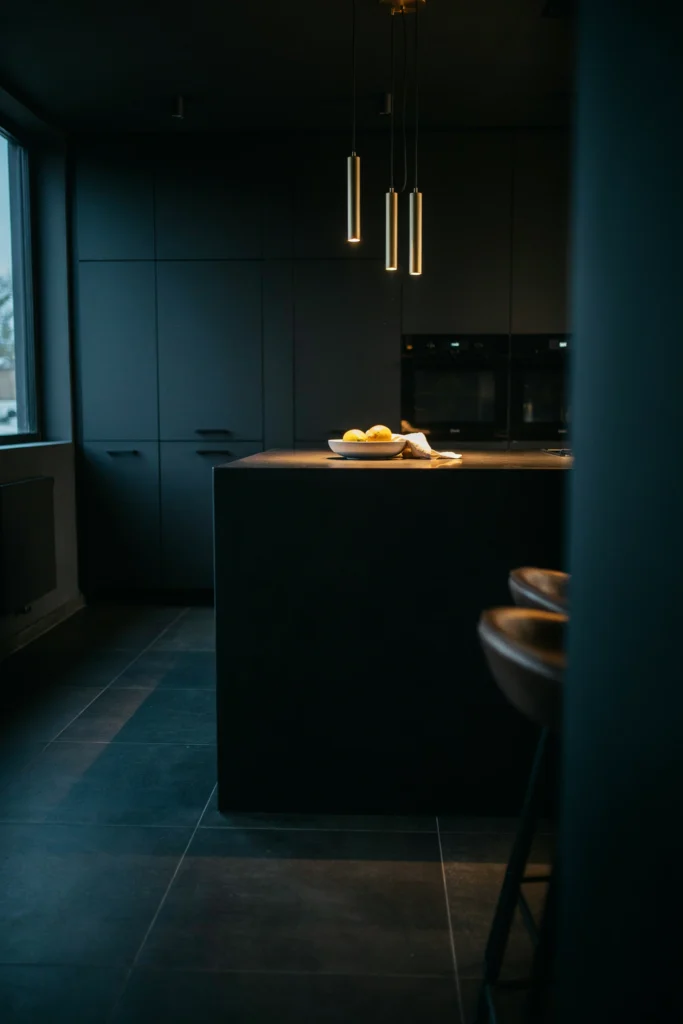
20. Black Cabinets With Natural Stone and Earthy Tones
Natural stone — slate, honed granite, travertine — with black cabinets is the elemental kitchen: rock and shadow, ancient materials doing what they’ve always done. The stone’s variation is essential; flat manufactured surfaces next to black look dead, while natural stone looks alive.
Let the stone be honed, not polished — polished stone plus black cabinets is a lot of shine competing for attention. Honed stone’s soft matte surface is the calm partner black needs.
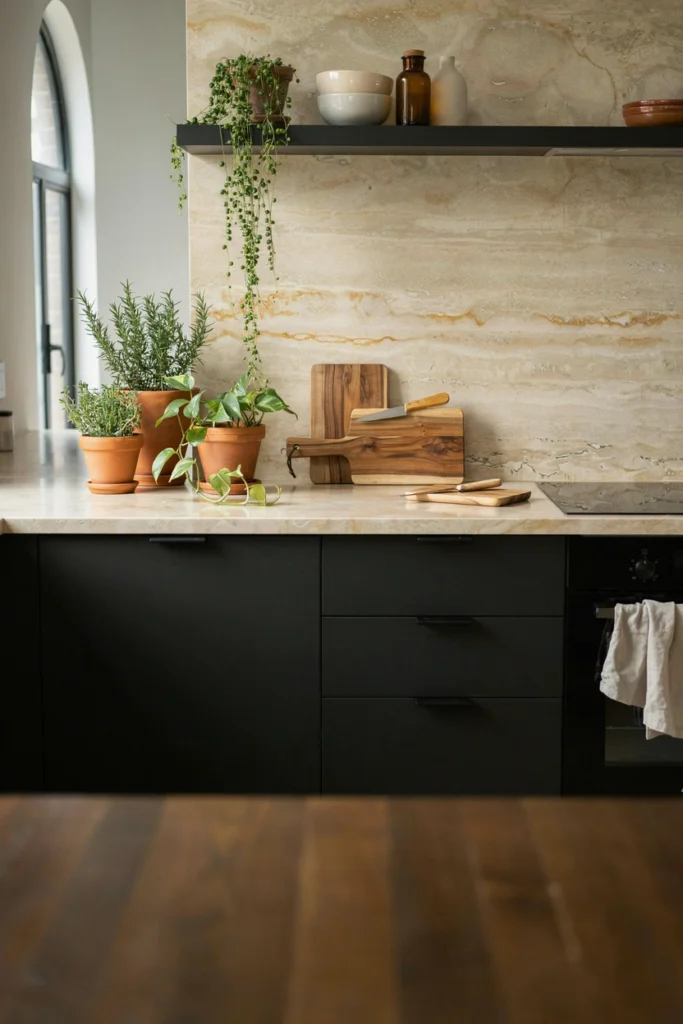
How to Choose the Right Black Kitchen Cabinet Style for Your Home
Start with light, not colour. Stand in your kitchen at 9am, 1pm, and 8pm. If it’s bright at all three times, you can do full black. If it’s bright only at midday, do black lowers. If it’s never bright, do a black island and stop there. Light is the gatekeeper — respect it and black will reward you.
Then consider lifestyle honestly. Young children plus gloss black equals a cleaning job you didn’t apply for. Heavy daily cooking plus black near the hob equals visible grease. Matte black, black lowers, and black away from the splash zone are the practical answers — drama where it works, sense where it matters.
Finally, sample the actual black. “Black” ranges from blue-black to brown-black to true neutral, and the undertone changes everything under your lighting. Paint a full door, live with it for a week, and watch it at night — that’s the black you’ll actually live with.
Conclusion
Black kitchens aren’t a trend — they’re a temperament. They suit the decisive, reward the bold, and punish the half-hearted. Done with conviction, good light, and honest materials, a black kitchen is the most memorable room in the house.
Be sure, be brave, and light it like you mean it.
Pro Tips
- Audit your light before your colour. Full black needs a bright room; black lowers need decent light; a black island works almost anywhere. Match the amount of black to the amount of light — this one decision prevents 90% of black-kitchen regret.
- Matte for living, gloss for showing off. Matte black hides daily life; gloss black displays it. Unless you enjoy wiping, choose matte or satin for the cabinets you touch and save gloss for the island or the units nobody opens.
- Always give black a pale partner. Every dark surface needs a light one in sight — worktop, floor, splashback, or ceiling. Black without contrast isn’t dramatic, it’s just dark.
- Warm the metals, warm the light. Brass or bronze hardware and 2700K lighting keep black kitchens feeling like homes. Cool chrome and daylight bulbs keep them feeling like showrooms.
FAQs
Do black kitchen cabinets show dirt and fingerprints?
Matte black hides dust and marks reasonably well; gloss black shows everything. Fingerprints show most around handles — which is why handleless or J-pull designs need honest consideration. A quick daily wipe of high-touch areas keeps matte black looking sharp with minimal effort.
Will a black kitchen make my small kitchen look smaller?
It can, but the configuration matters more than the colour: black lowers with white uppers and a pale worktop work fine in small kitchens. Full black needs good light to avoid feeling cramped. When in doubt, confine the black to the island — all the drama, none of the risk.
What countertop looks best with black cabinets?
White or pale quartz with subtle veining is the classic contrast that lifts the room. Marble adds timeless luxury; pale wood adds warmth; concrete adds industrial edge. Avoid very dark worktops unless the floor is pale — the room needs one broad light surface.
Are black kitchens still in style?
Black has moved from trend to established option — it’s been specified steadily for over a decade and shows no sign of leaving. Like white, it now reads as a deliberate design choice rather than a fashion statement, especially in matte finishes with classic materials.

HowDecor is a home decor blog sharing simple, practical decorating ideas for everyday spaces. We believe a beautiful home should feel comfortable, personal, and full of warmth — and that great style does not require a huge budget. Our goal is to inspire readers to create spaces that feel peaceful, welcoming, and truly their own — one room at a time.